Category Archives: History

Art History: “Félix Fénéon: The Anarchist And The Avant-Garde” (MoMA)

“It would not be a commonplace portrait at all, but a carefully composed picture, with very carefully arranged colors and lines. A rhythmic and angular pose. A decorative Félix, entering with his hat or a flower in his hand.”

With these words, in 1890, Paul Signac described to Félix Fénéon the extraordinary portrait he was dedicating to him. In it, Signac paid homage to Fénéon’s distinctive appearance, his generous but enigmatic personality, and his innovative approach to modernism.

This painting, a masterpiece in the Museum’s collection, will be the centerpiece of Félix Fénéon, the first exhibition dedicated to Fénéon (1861–1944). An art critic, editor, publisher, dealer, collector, and anarchist, Fénéon had a wide-ranging influence on the development of modernism in the late 19th and early 20th centuries.

In the late 1880s, he played a key role in defining the new movement known as Neo-Impressionism, a term he coined himself, whose artists, including Signac, used tiny dabs of color that would mix in the eye of the viewer. Over the next five decades, he championed the careers of artists from Georges-Pierre Seurat and Signac to Pierre Bonnard, Henri Matisse, and Amedeo Modigliani.

He amassed a renowned collection of paintings by these artists and many others, and he was also a pioneering collector of art from Africa and Oceania. The exhibition will feature some 130 objects, including major works that Fénéon admired, championed, and collected, as well as contemporary photographs, letters, and publications that trace key chapters in his biography. Together these works reveal the profound and lasting legacy of Fénéon’s keen eye and bold, forward-looking vision.

Art History: “Emotional Expression” In Artwork Of Venetian Painter “Titian” (National Gallery Video)

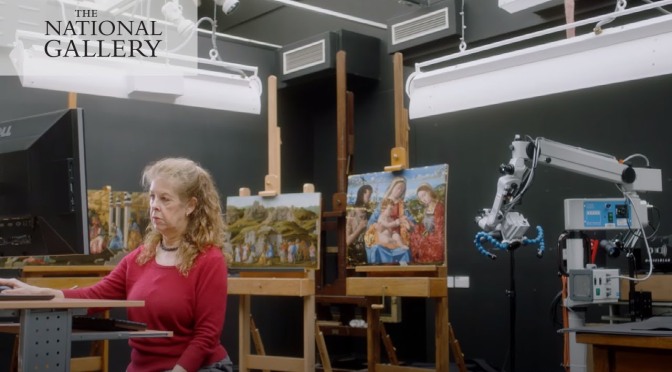
The way Titian painted was unlike other artists of his day. With little in the way of preliminary drawings, Titian worked very freely straight onto the canvas. Watch artist Andy Pankhurst show us how Titian would have worked.

Website

Tiziano Vecelli or Vecellio, known in English as Titian, was an Italian painter during the Renaissance, considered the most important member of the 16th-century Venetian school. He was born in Pieve di Cadore, near Belluno. During his lifetime he was often called da Cadore, ‘from Cadore’, taken from his native region.

Top Travel Videos: “Aerial America – Maryland / Delaware” (Smithsonian)


https://www.youtube.com/watch?v=0hQ8NjjXinY

Maryland and Delaware are two small states of great historical significance. Highlighted by the great bays of the eastern seaboard: Chesapeake and Delaware, both states are defined by the legacies of their colonial pasts. This aerial journey reveals their giant stature in the history of America.

Website

International Magazines: “The Florentine” – Italy April 2020 Issue Released


pjimage

The Florentine Healing Not Broken Issue April 2020-page-11

In this special Covid-19 edition of The Florentine, rejoice in a renewed humanism from Florence, of learning, words, thoughts and creativity, with articles, poems and short stories penned by the city’s international community, plus ideas and considerations for the future from Tuscany’s leaders and institutional figures, all interspersed with iconic photography of Florence at its most restful.

Read full issue

Art History: “Rembrandt’s Self Portraits” – Oxford Ashmolean Museum (2020)

Curator An Van Camp tells us about Rembrandt’s obsession with self portraits and how he improved his skill throughout his life.

Website

Rembrandt Harmenszoon van Rijn; 15 July 1606 – 4 October 1669) was a Dutch draughtsman, painter, and printmaker. An innovative and prolific master in three media, he is generally considered one of the greatest visual artists in the history of art and the most important in Dutch art history. Unlike most Dutch masters of the 17th century, Rembrandt’s works depict a wide range of style and subject matter, from portraits and self-portraits to landscapes, genre scenes, allegorical and historical scenes, and biblical and mythological themes as well as animal studies. His contributions to art came in a period of great wealth and cultural achievement that historians call the Dutch Golden Age, when Dutch art (especially Dutch painting), although in many ways antithetical to the Baroque style that dominated Europe, was extremely prolific and innovative and gave rise to important new genres. Like many artists of the Dutch Golden Age, such as Jan Vermeer of Delft, Rembrandt was also an avid art collector and dealer.

From Wikipedia

Lectures: “Beyond Gatsby: The Fabled Gardens of Long Island’s Gold Coast”

Originally comprising vast areas of the North Shores of Long Island, the Gold Coast was a favorite retreat of the rich and famous. Beginning around the turn of the century and through the 1920’s, the North Shore was the place to be for some of the most notable Americans. Along with grand houses, they built elaborate gardens, hiring such notable architects and landscape architects as Delano and Aldrich, Carrere and Hastings, the Olmsted Brothers, and Beatrix Farrand. Discover the gardens, as they were originally built, and learn about their history, landscape design, and present condition. This event was presented through the generous support of the Boston Design Center as part of the ICAA-NE Design Series.

CeCe Haydock graduated from Princeton University (BA English) and received a master’s degree in landscape architecture from the SUNY School of Environmental Science and Forestry. After working for the New York City Parks Department, she joined the firm, Innocenti and Webel in Locust Valley, NY, before starting her private practice. In 2007, she did research as a Visiting Scholar at the American Academy in Rome on Edith Wharton and Italian villas. She has lectured and written on historic Italian, French, and American gardens for Old Westbury Gardens, Maryland’s Ladew Topiary Gardens, Princeton University, and numerous garden and horticultural clubs. A trustee of Planting Fields Arboretum and a member of the International Council of The Preservation Society of Newport County, she is a visiting lecturer at the New York Botanic Garden and an adjunct professor at Long Island University. CeCe is currently expanding her private practice to include landscape sustainability.

Website

Top Travel Videos: “Aerial America – Colorado” (Smithsonian Channel)

https://www.youtube.com/watch?v=dMLte7OEQaE

Get ready for a Rocky Mountain adventure over the state that boasts some of the highest peaks, tallest sand dunes and largest single-site brewery in America. Every year Colorado attracts music lovers, ski buffs, and sports fans drawn to its Red Rocks, Aspen slopes and the Broncos’ Mile High Stadium. But it is also a state with a history, marked by war, a gold rush and legendary bank robberies. Through it all, Colorado remains a feast for the eyes.

Website

Today: 250th Anniversary Of William Wordsworth’s Birth – “That Inward Eye”

From an Apollo Magazine article (April 7. 2020):

‘They flash upon that inward eye
 Which is the bliss of solitude’
.
William Wordsworth Daffodils - I Wandered Lonely As A Cloud - Amazon photo‘We are fond of tracing the resemblance between Poetry and Painting,’ wrote William Wordsworth  (1770–1850) in the famous ‘Preface’ to Lyrical Ballads (1800), ‘and, accordingly, we call them Sisters.’ To speak of the ‘sister arts’ was indeed a critical platitude of the age, though as it happens Wordsworth’s attitude towards painting wasn’t normally very sisterly. 


Apollo Magazine logoWhen, in 1840 or so, a well-meaning houseguest called Margaret Gillies made a drawing of the 70-year old Mrs Wordsworth, everyone agreed that it was an excellent likeness; but her kind act was rewarded with a testy and somewhat ungracious sonnet from the sitter’s husband. He preferred to visualise Mary in her salad days: ‘’tis a fruitless task to paint for me, / Who, yielding not to changes Time has made, / By the habitual light of memory see / Eyes unbedimmed, see bloom that cannot fade, / And smiles that from their birth-place ne’er shall flee / Into the land where ghosts and phantoms be’.
.
All she possesses, as a painter, is the outward eye: ‘that inward eye’ is the poet’s hallmark, as of course Miss Gillies would have known from Wordsworth’s most famous poem, the one about the daffodils – ‘They flash upon that inward eye / Which is the bliss of solitude’. By chance we know (because Wordsworth left it on record, saying they were the best thing in the poem) that those two lines were actually contributed by Mary, so the uxoriousness of the thing is double: not only does she evade the merely visual but she also possesses the innate genius to be able to name the imaginative power that so transcends it.
.

Travel & History Books: “Great Camps Of The Adirondacks” – Gorgeous Updated 2nd Edition (2020)

The foremost guide to the historic camps of the Adirondacks―a unique vernacular style of rustic architecture designed to complement the land. Now available in a Great Camps of the Adirondacks Harvey H Kaiser 2020second and enlarged edition, here is the foremost guide to the historic camps within America’s spectacular forest preserve, the six million acre Adirondack Park.

When first published in 1982, Great Camps of the Adirondacks launched a campaign for the preservation of these architectural treasures while also sparking a trend in great camp-inspired home design, a cohesive approach to building that author Harvey H. Kaiser named Adirondack Rustic Style.

Great Camps of the Adirondacks - Harvey Kaiser 2020

In this second edition, preservationists will find a success story. Designers and builders will discover page after page of inspiration. All readers will see the history of a region unfold as Americans from the mid-1870s to the late-1930s, including the very wealthiest New Yorkers, sought out the wilderness. The camps they built as private seasonal retreats are distinguished both as architectural responses to the Adirondack environment in the use of logs and stone, and as successful examples of buildings blended into the forest and the natural contours of the mountains and lakes―homes built to serve as beautiful complements to the land itself.

Harvey H. Kaiser served as the Senior Vice President for Facilities Administration and University Architect at Syracuse University between 1972 and 1995. His 1982 book Great Camps of the Adirondacks popularized the term “Great Camps” to refer to the grand summer residences that wealthy families built in the Adirondack Mountains in the nineteenth century, and revitalized interest in these sites. Several studies on western national park architecture culminated in his 2008 book The National Park Architecture Sourcebook.


Steven Engelhart is the executive director of Adirondack Architectural Heritage (AARCH) located in Keeseville, New York. AARCH is a private, nonprofit. historic preservation organization for New York State’s Adirondack Park, whose mission is to promote better public understanding, appreciation, and stewardship of the region’s architecture, communities, and historic sites.

Read more or purchase