DISCOVER BRITAIN MAGAZINE (OCTOBER / NOVEMBER 2023 – The latest issue features Eastern delights – From punting in Cambridge to crabbing in Norfolk; Bloody Mary – Where England’s first Queen was proclaimed; London pubs – Perfectly pulled pints; Holkham Hall – Behind the scenes on the vast estate, and more…
BBC Select (November 4, 2023) – How much is the personality of England intertwined with the visions of Shakespeare? Acclaimed historian Simon Schama tries to get beneath the skin of the playwright and understand why his stories are so relevant today.
In this insightful documentary we are shown how Shakespeare knew the importance of not just reflecting the lives of the kings and queens who peppered his plays, but ordinary people too – including thieves, clowns and prostitutes.
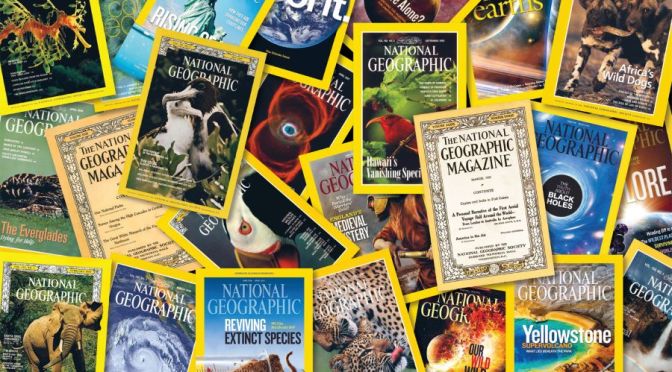
National Geographic (NOVEMBER 2023) – The latest issue features The race to capture carbon – Any climate solutions strategy requires the removal of carbon from the atmosphere. Here are 12 of the most promising strategies; What flashy feathers reveal about the secret lives of birds, and more…
Getting to zero carbon emissions won’t save the world. We’ll have to also remove carbon from the air—a massive undertaking unlike anything we’ve ever done.
BY SAM HOWE VERHOVEK
Over the past few centuries, we have dug, chopped, burned, drilled, pumped, stripped, forged, flared, lit, launched, driven, and flown our way to adding 2.4 trillion metric tons of carbon dioxide to Earth’s atmosphere.
That’s as much CO2 as would be emitted annually by 522 billion cars, or 65 cars per person living today.
On a lonely, lunar-like valley 20 miles outside of Reykjavík, Iceland, Edda Aradóttir is on a mission to put it back where it came from.
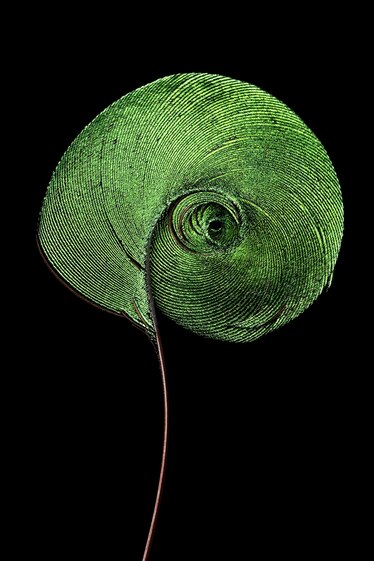
Shimmery. Spiky. Shaggy. Soft. Feathers are what make birds so alluring—but these photographs remind us that they also tell a story about the science of evolution.
BY ANNIE ROTH
PHOTOGRAPHS BY HEIDI AND HANS-JÜRGEN KOCH
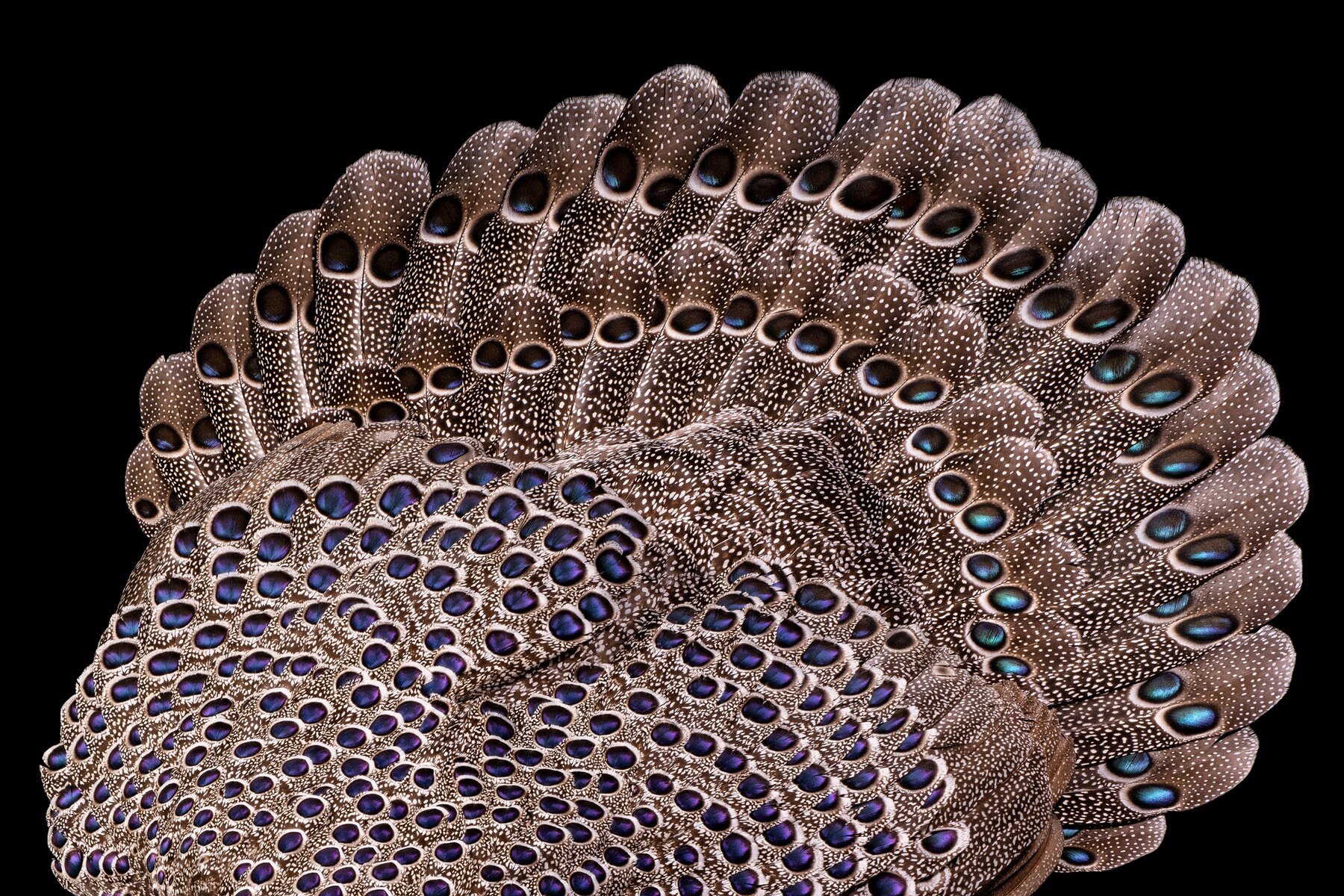
In 1860 Charles Darwin wrote, “The sight of a feather in a peacock’s tail, whenever I gaze at it, makes me sick!” The plumes were so extravagant, he surmised, they could be a hindrance to survival. Darwin’s frustration with their seemingly inexplicable elegance eventually led him to the idea of sexual selection. Although this form of natural selection—driven by the preference of one sex for certain characteristics in individuals of the other sex—is well understood today, a peacock’s feather can still hold mystery for its viewers, says Heidi Koch. She and her husband, Hans-Jürgen, have spent the past few years photographing feathers in all their glorious detail.
Although both sexes of the gray peacock pheasant have back and tail feathers adorned with brilliant eyespots, the males make the best use of them. During elaborate wooing rituals, they raise and fluff up their feathers—which can reach nearly 16 inches in length—putting..
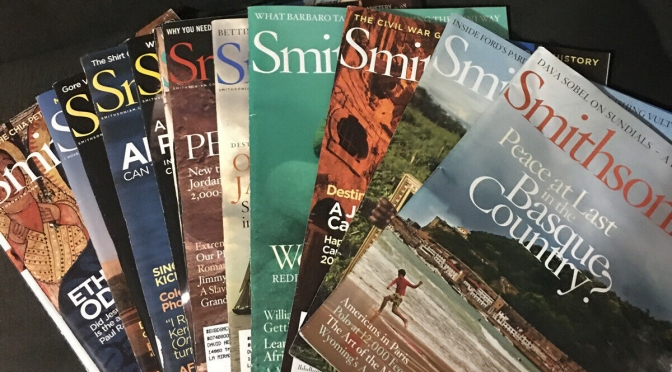
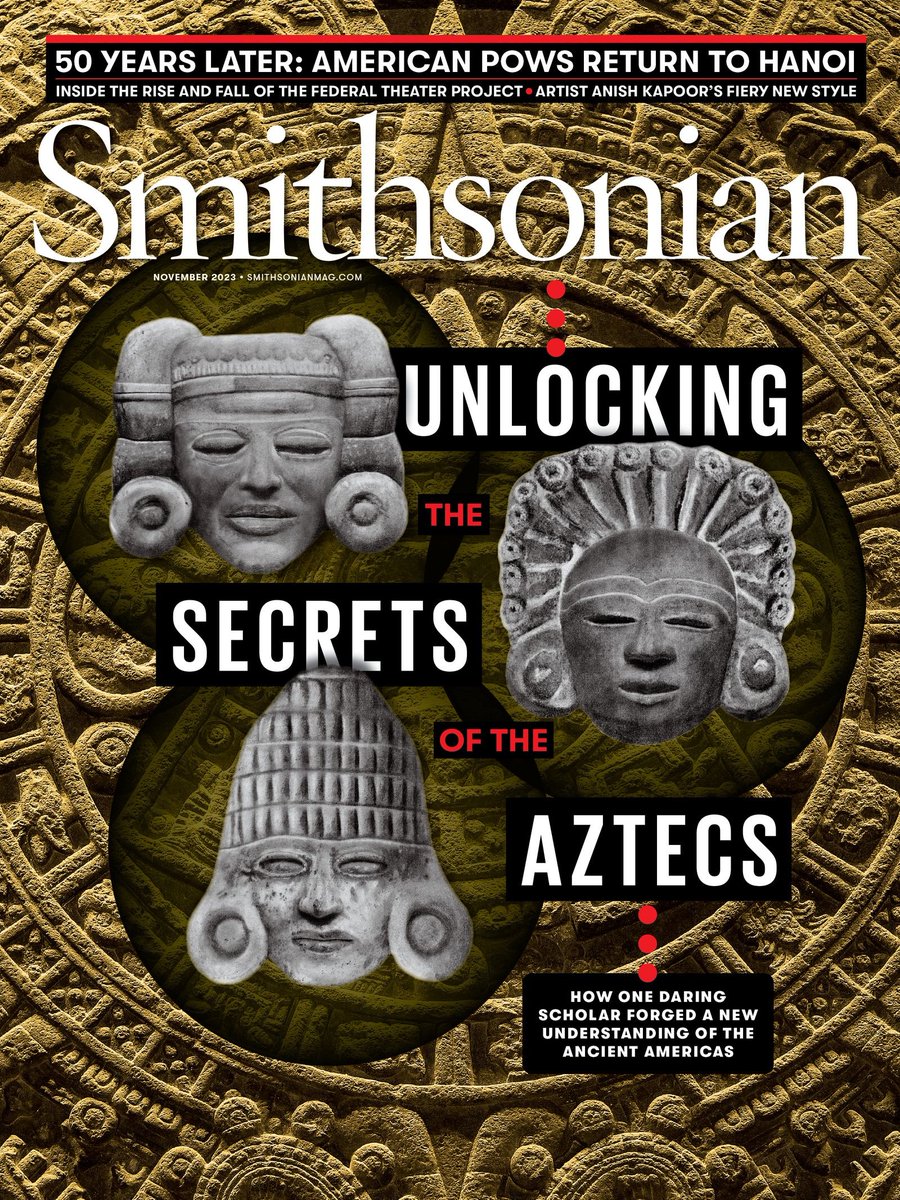
Smithsonian Magazine (November Issue) –The latest issue features Unlocking the Secrets of the Aztecs – How one daring scholar forged a new understanding of the ancient Americas; Healing in Hanoi – After 50 years, U.S. veterans commemorate their release from a notorious Vietnamese prison
On a bright day early in 1885, Zelia Nuttall was strolling around the ancient ruins of Teotihuacán, the enormous ceremonial site north of Mexico City. Not yet 30, Zelia had a deep interest in the history of Mexico, and now, with her marriage in ruins and her future uncertain, she was on a trip with her mother, Magdalena; her brother George; and her 3-year-old daughter, Nadine, to distract her from her worries.
In March of this year, I followed retired U.S. Air Force Colonel Robert Certain through the entryway of the former Hoa Lo Prison in Hanoi. French colonists built the prison in the 19th century, calling it the Maison Centrale and using it to imprison and behead Vietnamese dissidents. During the Vietnam War, American prisoners facetiously called it the Hanoi Hilton. For the first time in 50 years, Certain was about to step inside the notorious compound where he’d been held, interrogated and beaten.
Architectural Digest (October 24, 2023) – Today Architectural Digest travels to Lower Manhattan to tour the newly completed Perelman Performing Arts Center. An integral part of the new World Trade Center site, architects Joshua Ramus and David Rockwell were eager to give the arts a new home in the area.
Ramus calls the building a “mystery box” as the theater’s 3 auditoria ingeniously extend and combine to create over 62 stage-audience configurations, resulting in a different space each time you visit. But what makes this building so special is revealed at dusk when the chandeliers shine through its 5,000 marble tile exterior, causing it to glow.
As this unique space finally opens its doors, the ultimate hope for Perelman is to inspire artists to create profound work–in turn inspiring the public.
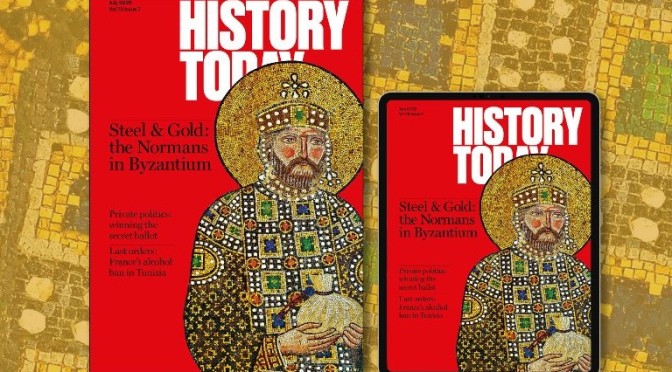
HISTORY TODAY MAGAZINE (NOVEMBER 2023) – This issue features The murder John F. Kennedy 60 years on, the dirty secrets of medieval monks, what the Nazis learnt from the Beer Hall Putsch, Christianity’s bloody history in Japan, and deaf expression in Renaissance art.
Was it the mob? A coup? Cuban dissidents? War hawks? 60 years after the assassination of John F. Kennedy, the theories are still debated. Do any of them hold up?
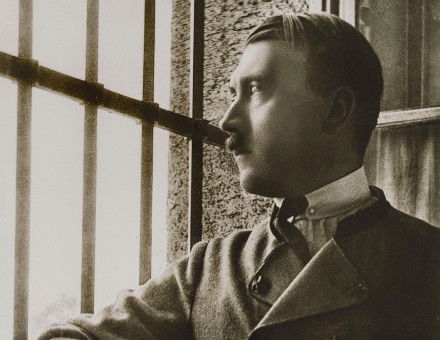
In the aftermath of the Munich Beer Hall Putsch of November 1923, Hitler was in prison and the Nazi Party banned. But its failure taught him valuable lessons.
Repulsive revelations of bodily infestations were viewed by some in medieval Europe as proof of sanctity. But for most, parasites were just plain disgusting.
Confinement: The Hidden History of Maternal Bodies in Nineteenth-Century Britain by Jessica Cox looks at the engine of the Victorian population boom: motherhood.
“I have searched everywhere for the city of dreams,” he wrote after wandering far from Paris to overcome writers’ block, “and found it here, in Ronda.”
German poet Rainer Maria Rilke (1913)
The Times and The Sunday Times (October 15, 2023) – Walking in the footsteps of poets on a new cultural trip, James Stewart takes a wander from Ronda and gets spectacular scenery and ancient traditions all to himself.
Rupit
Teetering at the edge of the Tajo river gorge, Ronda, 90 minutes’ drive west from Malaga, remains the most spectacular urban setting in Europe. Its cat’s cradle of white streets is haunted by the ghosts of Moorish princes, soundtracked by the strum of guitars and the tinkle of fountains.
The Sierra de Grazalema Natural Park
If you’re in the mood for romance, nowhere in Spain comes close, Ernest Hemingway reckoned. He’s still right, so long as you’re happy to share your precious moment with massed day-trippers from the Costa del Sol. Expect visitor numbers to grow again when a £1.1 million suspended gorge walk, the Camino del Desfiladero del Tajo designed by the architect behind Malaga’s Caminito del Rey, opens later this year.
Even so, what everyone is really coming to Ronda for – to inland Andalusia – is Old Spain. You won’t find it written on signposts but, like the crackle of duende during a flamenco concert, you’ll know it when you experience it. It’s the country of pueblos blancos and half-remembered battles and scenery of savage beauty; the one that attracted Grand Tour visitors such as Disraeli and Irving long before anyone had thought of the Costa del Sol.
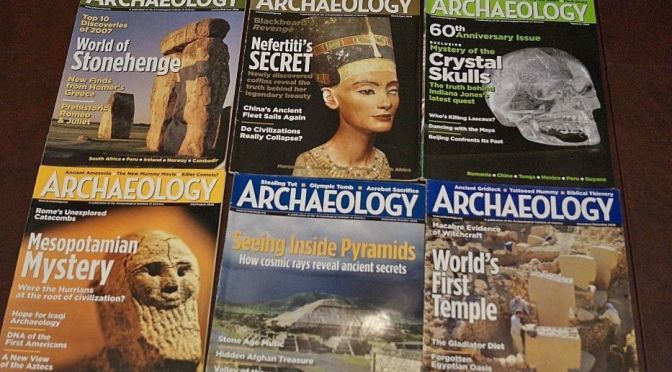
4,000-year-old cuneiform tablets illuminate the personal lives of Mesopotamian businesswomen
By DURRIE BOUSCAREN
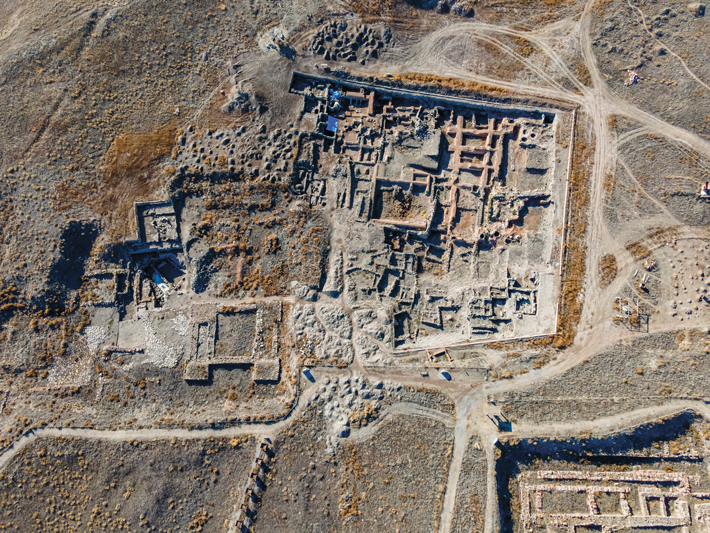
Excavations at the ancient Anatolian city of Kanesh in Turkey have revealed a district where merchants from the distant Mesopotamian city of Assur in Iraq lived and worked. Some 23,000 cuneiform tablets, mostly dating from about 1900 to 1840 B.C., have been found in the merchants’ personal archives in Kanesh.
The parents of an Assyrian woman named Zizizi were furious. Like many of their neighbors’ children, their daughter had dutifully wed an Assyrian merchant. Sometime around the year 1860 B.C., she had traveled with him to the faraway Anatolian city of Kanesh in modern-day Turkey, where he traded textiles. But her husband passed away and, instead of returning to her family, Zizizi chose to marry a local.
ICELAND REVIEW MAGAZINE (OCT/NOV 2023): The latest issue features ‘Island In The Making’ – A Scientific Expedition of Surtsey Island; Mycological Magic – Foraging with Iceland’s Mushroom Queen, and more…
HISTORY TODAY MAGAZINE (OCTOBER 2023) – This issue features Turkey and the end of the Ottomans; When Inca mummies came to Europe; How Henry II survived the Great Rebellion, and more…
In 1173 the Angevin empire looked set to fall, facing rebellion on all sides. Against incredible odds Henry II won a decisive victory, silencing kings, lords – and his own children.
News, Views and Reviews For The Intellectually Curious







 National Geographic (NOVEMBER 2023) – The latest issue features The race to capture carbon – Any climate solutions strategy requires the removal of carbon from the atmosphere. Here are 12 of the most promising strategies; What flashy feathers reveal about the secret lives of birds, and more…

:focal(699x796:700x797)/https://tf-cmsv2-smithsonianmag-media.s3.amazonaws.com/filer_public/23/b6/23b6fe53-d635-4e65-a8c7-07a841b3ba6d/opener2.jpg)
:focal(1545x1030:1546x1031)/https://tf-cmsv2-smithsonianmag-media.s3.amazonaws.com/filer_public/a3/19/a319ccce-cbbb-4594-b331-c1213d02d1de/nov2023_d02_hanoi.jpg)




















 Boomers Daily