Category Archives: Health

Health Infographics: “Women’s Heart Attack Symptoms” (Scripps)

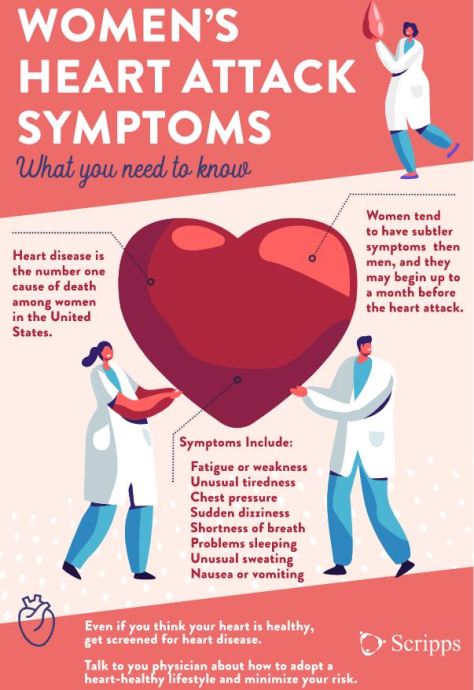
Heart disease is the number one cause of death among women in the United States. It takes the lives of nearly twice as many women as all forms of cancer combined, yet many women know very little about their heart health.Women's Heart Attack Symptoms Scripps InfographicHeart attack symptoms in women

Women tend to have subtler symptoms, and they may begin up to a month before the heart attack. Symptoms include:

  • Fatigue or weakness
  • Unusual tiredness
  • Pressure, or tightness in the center of the chest
  • Pain that spreads to the upper body, neck or jaw
  • Unusual sweating, nausea or vomiting
  • Sudden dizziness
  • Shortness of breath
  • Problems sleeping

Because many of these symptoms can be associated with common illnesses such as the flu, women are more likely to brush them off or assume something less serious is going on — and that can be a serious or even fatal mistake. If you experience these symptoms, don’t ignore them. Play it safe and call 911. The sooner you get treatment, the greater the chances of recovery.

Read more

Healthcare: “2018 Health Care Cost Report” Shows Spending Grew 18% Per-Person From 2014 – 2018

HCCI Releases 2018 Health Care Cost and Utilization Report 

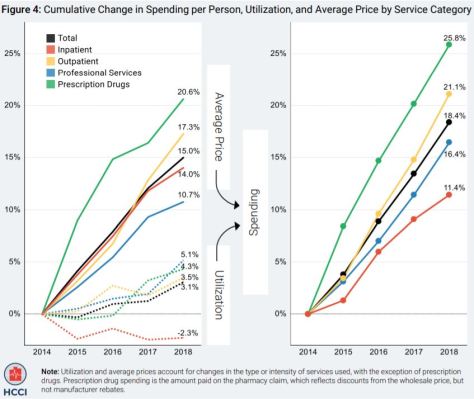
Per-Person Health Care Spending Grew 18% from 2014 to 2018, Driven Mostly by Prices

Health Care Cost Institute 2018 Health Care Cost and Utilization Report Cumulative Change in Spending per Person by Service Category


The report examines four groups of health care services and dozens of sub-categories. Of the four major categories, outpatient visits and procedures saw the highest 2018 spending increase (5.5%). Other notable trends include:

  • Inpatient services. 
    • Per-person spending on inpatient admissions rose 11.4% between 2014 and 2018
    • Within each sub-category of inpatient admissions, average prices grew steadily between 2014 and 2018 while utilization trends varied. However, the 2.0% price increase in 2018 was lower than the near 4% annual increases from 2014 to 2017.
  • Outpatient services.
    • ​Increases in prices and use led to a 16% increase in spending from 2014 to 2018.
    • ver that period, ER visit spending increased 32% and spending on observation stays went up 29%.
  • Professional services.
    • ​Spending increased 16% and growth accelerated over the 5-year period, driven by office visits and administered drugs.
    • Psychiatry also saw strikingly high spending growth of 43% from 2014 to 2018, which was driven mostly by increased use.
  • Prescription Drugs.
    • Generic drugs accounted for 88% of all prescriptions. .
    • Out-of-pocket payments for prescriptions for generic drugs was less than one-fifth of out-of-pocket payments on brand drugs.

Read full report

Health Studies: High Milk & Dairy Consumption Not Related To Lower Heart Disease, Diabetes (NEJM)

From the New England Journal of Medicine (February 13, 2020):

Milk and Dairy Product Health NEJMIn our opinion, the current recommendation to greatly increase consumption of dairy foods to 3 or more servings per day does not appear to be justified…When consumption of milk is low, the two nutrients of primary concern, calcium and vitamin D (which is of particular concern at higher latitudes), be obtained from other foods or supplements without the potential negative consequences of dairy foods.

For calcium, alternative dietary sources include kale, broccoli, tofu, nuts, beans, and fortified orange juice for vitamin D, supplements can provide adequate intake at far lower cost than fortified milk. Pending additional research, guidelines for milk and equivalent dairy foods ideally should designate an acceptable intake (such as 0 to 2 servings per day for adults), deemphasize reduced-fat milk as preferable to whole milk, and discourage consumption of sugar-sweetened dairy foods in populations with high rates of overweight and obesity.

For adults, the overall evidence does not support high dairy consumption for reduction of fractures, which has been a primary justification for current U.S. recommendations. Moreover, total dairy consumption has not been clearly related to weight control or to risks of diabetes and cardiovascular disease. High consumption of dairy foods is likely to increase the risks of prostate cancer and possibly endometrial cancer but reduce the risk of colorectal cancer.

Read full article

Study: 20% Of Surgery Patients Get “Surprise” Out-Of-Network Bills Averaging Over $2000

From a JAMA Network online study (February 11, 2020):

JAMA Network NewsIn this analysis of commercially insured patients who had undergone elective surgery with an in-network surgeon at an in-network facility, approximately 1 in 5 received an out-of-network bill, with a mean potential balance bill of $2011.


In this retrospective analysis of 347 356 surgical episodes among commercially insured patients who had undergone elective surgery with in-network primary surgeons and facilities, 20% of episodes involved out-of-network charges.

The patterns of out-of-network bills varied with the clinical scenario. Simpler ambulatory procedures that tend to involve 1 surgeon (arthroscopic meniscal repair, breast lumpectomy) had fewer out-of-network bills (13%-15% of cases), whereas inpatient procedures (hysterectomy, knee replacement, colectomy, CABG surgery) had more frequent out-of-network bills (24%-33% of cases). These more complex procedures were also associated with larger potential balance bills, in the range of $2000 to $4000.

Read full study

Healthcare: “Open Heart Surgery – Inside The OR” (Northwestern Medicine)

Tough to beat! Head #InsideTheOR with S. Christopher Malaisrie, MD, and witness open heart surgery by one of the best cardiology and heart surgery programs in the nation as ranked by US News and World Report.

Health Talk: Stanford Dermatology Professor Eleni Linos On “Tanning Bed” Cancer Research

Eleni Linos MD PhD Stanford Medicine Dermatology“Studies with financial links to the indoor tanning industry were much more likely to discuss perceived benefits of indoor tanning and to downplay the harms,” said Eleni Linos, MD, DrPH, professor of dermatology, who sees patients at Stanford Health Care’s dermatology clinic at the Hoover Pavilion. “The association is quite striking. We need scientific data to be independent of industry influence. I am concerned that funding sources may influence the conclusions of these papers.”

The BMJ podcastIn 2012, Eleni Linos, professor of dermatology at Stanford university, published a systematic review and meta-analysis of the link between non-melanoma cancer and sun-beds. That bit of pretty standard research, and a particular rapid response to it, has kicked of years of work – and in this podcast I talk to Eleni and her colleagues Stanton…

Read article


Mayo Clinic Health: “Obesity Epidemic And Popular Diet Trends”

On the Mayo Clinic Radio program, Dr. Donald Hensrud, director of the Mayo Clinic Healthy Living Program, discusses the obesity epidemic and talks about popular diet trends, including intermittent fasting.

This interview originally aired Feb. 8, 2020.

Learn more about intermittent fasting: https://www.mayoclinic.org/healthy-li…