Category Archives: Arts & Literature

Art: “The Rediscovery Of Gaston Lévy’s Collection” Of Paul Signac & Camille Pissarro (Sotheby’s Video)

Known best as the author of Paul Signac’s first catalog raisonné, Gaston Lévy was perhaps the most remarkable art collector in pre-war Paris. After the Nazi regime seized his properties and dispersed his paintings, masterpieces were thought to have been lost to the Lévy family forever.

Camille Pissarro Gelée blanche Jeune Paysanne Faisant Du Feu 1888

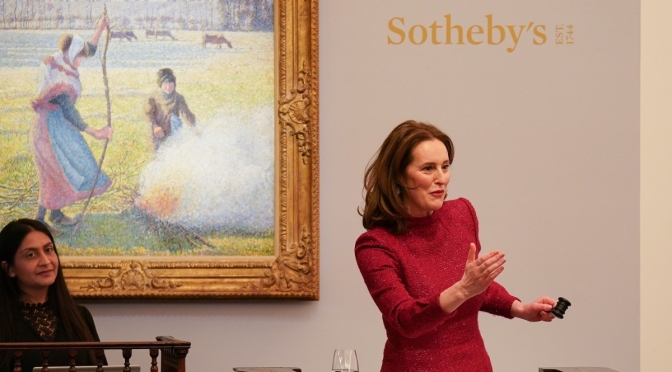
However, This February Sotheby’s is proud to offer three recently restituted masterworks from the Lévy collection in our Impressionist & Modern Art Evening Sale. In this episode of Expert Voices, Sotheby’s Head of Restitution Lucian Simmons chronicles the story of Gaston Lévy’s collection and explores the extraordinary talent of Paul Signac and Camille Pissarro through their works Gelee Blache, Quai de Clichy and La Corne D’or.

Paul Signac Quai De Clichy Temps Gris 1887

(4 February | London)

Top Documentaries: “Honeyland” Is An “Oscar Game-Changer” (NY Times)

The film… “is nothing less than a found epic, a real-life environmental allegory and, not least, a stinging comedy about the age-old problem of inconsiderate neighbors.”

“Honeyland” is the first film to be nominated for best documentary and best international feature (the category formerly known as best foreign-language film). It follows Hatidze Muratova, a middle-aged beekeeper whose peaceful life in the North Macedonian countryside is disrupted when a chaotic family moves in next door.

The movie premiered at the Sundance Film Festival last year and came out on top with three awards, including the grand jury prize for documentary in the world cinema showcase.

From a New York Times online review

New Exhibitions: Painter Andrew Wyeth (1917-2009) – The Forum Gallery NYC

Photo of Andrew Wyeth by Peter Ralston In the Studio Courtesy of Ralston Gallery

Forum Gallery, New York, presents an exhibition of works by Andrew Wyeth (1917-2009), who set the standard for American figurative art in the second half of the Twentieth Century. Working in pencil, watercolor, egg tempera and his much-beloved personal medium of drybrush, Wyeth, throughout his life, was a resolute champion of the universal life force of each person he chose to paint, and of the unique, difficult, ever-changing rural American world in which he chose to live. His art was controversial as it was popular, and he remains one of very few living artists to be celebrated by important single-person exhibitions at The Metropolitan Museum of Art in New York (1976) and the National Gallery of Art, Washington, DC (1987).

Firewood Study for Groundhog Day 1959 Andrew Wyeth
Firewood Study for Groundhog Day 1959 Andrew Wyeth (The Forum Gallery NYC)

“Andrew Wyeth: Five Decades” at Forum Gallery features paintings dated from 1940 through 1994, including landscapes that imply personal struggle and portray great beauty; and provocative figurative works, including examples from The Helga Pictures.

Forum Gallery NYC LogoWebsite


Artists: Belgian Surrealist Painter René Magritte Linked “Consciousness And The External World”

From a Christies.com online article:

René Magritte, The Son of Man, 1964

‘The creation of new objects, the transformation of known objects; a change of substance in the case of certain objects: a wooden sky, for instance; the use of words in association with images; the misnaming of an object… the use of certain visions glimpsed between sleeping and waking, such in general were the means devised to force objects out of the ordinary, to become sensational, and so establish a profound link between consciousness and the external world.’

René François Ghislain Magritte (1898-1967) was born in Lessines, Belgium. His father was a tailor and textile merchant; his mother committed suicide in 1912, drowning herself in the River Sambre.

René Magritte 1898 - 1967 Le Somnambule 1946

From the 1930s, Magritte sought to find ‘solutions’ to particular ‘problems’ posed by different types of objects, a method that enabled him to challenge and reconfigure the most ubiquitous and commonplace elements of everyday life. These problems obsessed him until he was able to conceive of an image to solve them.

This philosophical method had come to him after waking from a dream in 1932. In his semi-conscious state, he looked over at a birdcage that was in his room but saw not the bird that inhabited the cage, but instead an egg. This ‘splendid misapprehension’ allowed him to grasp, in his own words, ‘a new and astonishing poetic secret.’

Read full article

Literary Debates: “This House Prefers Reading Oscar Wilde To George Orwell” (Cambridge)

The Cambridge Union logoABOUT THE MOTION: This House Prefers Reading Oscar Wilde to George Orwell Do we prefer satire or comedy? Do we take refuge in the serious or the frivolous? Do we understand the importance of being earnest or would we rather be in room 101? These two authors demonstrate well two powerful traditions in British literature, the comic and the satirical. They both of course share in each other’s art. Some would argue that during our present global crises we should look to Orwell more than ever, others would reach for the escapism of Oscar Wilde. In a new enterprise for the Cambridge Union, we are beginning our cultural debates – and this is our first. At least for a while.

ABOUT OUR SPEAKER (Closing for the Proposition) Will Self is the author of 25 books, some of which have been translated into 25 languages. His Dorian: An Imitation is an adaptation of Oscar Wilde’s The Picture of Dorian Gray set during the AIDS crisis. He holds the Chair in Contemporary Thought at Brunel University, and lives in South London.

ABOUT OUR SPEAKER (Closing for the Abstention) Professor Angie Hobbs graduated in Classics and then a Ph.D. in Ancient Philosophy at the University of Cambridge. After a Research Fellowship at Christ’s College, she moved to the Philosophy Department at the University of Warwick. She was a judge of the Man Booker International Prize 2019 and is on the World Economic Forum Global Future Council 2018-9 for Values, Ethics and Innovation

Video Interviews: 65-Year Old Director Ron Howard At Sundance Film Festival

Director Ron Howard stops by Cinema Cafe for a thought-provoking conversation with Variety’s Matt Donnelly about REBUILDING PARADISE, his documentary premiering at the 2020 Sundance Film Festival in Park City. Presented by Variety.

Top New Museum Exhibits: “Young Rembrandt” At The Ashmolean (Feb 27 – Jun 7)

Witness the meteoric rise of Rembrandt, from his first tentative works as a teenager in his home town of Leiden, to the sublime masterpieces he produced in Amsterdam ten years later.

This landmark show explores the early years of the career of the most famous of all Dutch artists, Rembrandt van Rijn (1606–1669). Beginning with his earliest known paintings, prints and drawings made in the mid-1620s, and ending at the moment he rockets to stardom in Amsterdam in the mid-1630s, this exhibition charts an astonishing transformation.

ashmolean-logo-with-text-12x3.25

This is the largest collection of works devoted to the young Rembrandt and includes over 30 of his paintings, and 90 drawings and prints from international and private collections. On display for the first time is the newly discovered painting Let the Little Children Come to Me.

Don’t miss this unprecedented opportunity to examine young Rembrandt’s work and observe his remarkable metamorphosis from insecure teenager to the greatest Dutch painter of all time.

Website

Exhibitions: “Envisioning 2001: Stanley Kubrick’s Space Odyssey” (MOMI NYC)

From a New York Times online review:

“Envisioning 2001” shows Kubrick as a director in command of all aspects of filmmaking, and it suggests that he and Clarke were no small obsessives when it came to understanding their subject matter. One of the first items in the exhibit is a request form from 1964, with Clarke’s name and address, sent to the United States Air Force. He sought information on a sighting — which turned out to be a satellite — that he and Kubrick, then developing the story for the movie, had seen in the sky over New York.

Some of the first visitors to see the exhibition Envisioning 2001 Stanley Kubrick's Space Odyssey. Photo by Thanassi Karageorgiou Nas Karas Studios Jan 16, 2020 at Museum of the Moving Image
Some of the first visitors to see the exhibition Envisioning 2001: Stanley Kubrick’s Space Odyssey. Photo by Thanassi Karageorgiou Nas Karas Studios Jan 16, 2020 at Museum of the Moving Image

As it approaches its 52nd birthday, “2001: A Space Odyssey” remains one of the most inventive and enduring of all movies. But from the vantage point of 2020, it can be difficult to appreciate the sheer breadth of imagination involved in its making.

Enter “Envisioning 2001: Stanley Kubrick’s Space Odyssey,” a new exhibit at the Museum of the Moving Image in Astoria, Queens, that runs through July 19. The show brings together original correspondence, sketches, storyboards, props, video clips and much more to illustrate how Kubrick, the film’s director, and Arthur C. Clarke, the science fiction author who collaborated with him on the screenplay, set about bringing the future to the screen.

Read full article

New Branded Short Films: “Duality”, Written And Directed By Joe Sill (2020)

Written & Directed by: Joe Sill

Starring: Matteo Aluisi, Dante Spencer, Shahanna Jaffer, Naiya Singh Padilla, Mona Sishodia, Iyad Hajjaj, Zoya Yaseka, Meghan Alexander, Jon Komp Shim, Darren Kendrick
Client: HITACHI

Original music was done by electronic music duo Gramatik & Luxas.

Duality Cinematic Poem Short Film For Hitachi Directed by Joe Sill 2020

“We are wanderers
Exploring our world
As travelers without a map.

And our artificial intelligences
Have long gazed deep into our world.”

Two A.I.’s — one older generation and one newer — wander through a looking-glass of a limbo world, gazing at humanity’s past and present in search of humans who might carry the torch into humanity’s future — and give what knowledge they can, in hopes that we may one day solve the problems we’ll face in the future.

This is a branded short film for the Japanese technologies company, HITACHI, where the company was seeking to find a way to tell an emotional story about the many crises we face as a human race, and our relationship to artificial intelligence. It was a unique situation where a technologies company sought to craft an abstract, art-driven and hypothetical film as a vessel to spread an important message to anybody developing artificial intelligence: that we must do so quickly and with a moral compass, in hopes that one day AI will be advanced enough and driven by empathy to help human beings solve potential crises together… as AI, being one of our greatest creations, may be the essential factor in ensuring the survival of the human race.

Duality Cinematic Poem Short Film For Hitachi Directed by Joe Sill 2020

Production Company: SIOUXX
Executive Producers: Andreas Neumann, Khadija Donatelli
Creative Directors: Ken Hanada, Andreas Neumann
Producer: Michael Rodriguez Dueñas
Copywriter: Benjamin McAllister
Futurist: Julian Scaff
Production Supervisor: Jake Brown
Production Coordinator: Pure Brisbon
First Assistant Director: Adam Zimmer
Second Assistant Director: Luther Sartor

Director of Photography: Nico Aguilar
First Assistant Camera: Connor Lambert
Second Assistant Camera: Nick Vannatta
DIT: John Goodner

Duality Cinematic Poem Short Film For Hitachi Directed by Joe Sill 2020

Website

Movie Scenes: Atticus Finch (Gregory Peck) Closing Argument In “To Kill A Mockingbird” (1962)

To Kill A Mockingbird 1962 Movie starring Gregory Peck“Now, gentlemen, in this country our courts are the great levelers. In our courts, all men are created equal. I’m no idealist to believe firmly in the integrity of our courts and of our jury system. That’s no ideal to me. That is a living, working reality!”

Gregory Peck won an Oscar® for his brilliant performance as the Southern lawyer who defends a black man accused of rape in this film version of the Pulitzer Prize-winning novel. The way in which it captures a time, a place, and above all, a mood, makes this film a masterpiece. The setting is a dusty Southern town during the Depression. A white woman accuses a black man of rape. Though he is obviously innocent, the outcome of his trial is such a foregone conclusion that no lawyer will step forward to defend him – except Peck, the town’s most distinguished citizen. His compassionate defense costs him many friendships but earns him the respect and admiration of his two motherless children.

© 1963 Pakula-Mulligan Productions, Inc. & Brentwood Productions, Inc. All Rights Reserved.

Cast: Gregory Peck, John Megna, Ruth White, Paul Fix, Brock Peters, Frank Overton Produced By: Alan J. Pakula

Directed By: Robert Mulligan