

The twists and turns of the online brokerage’s path to a public offering The brokerage app Robinhood has transformed retail trading. WSJ explains its rise amidst a series of legal investigations and regulatory challenges as it looks forward to its IPO. Photo illustration: Jacob Reynolds/WSJ
Category Archives: Analysis

Automobiles: Decline Of The American Convertible
Rising in popularity in the 1950s and 1960s, the convertible car is an automotive American icon. It was a vehicle meant for leisure and fun. Some of the most iconic models throughout history were convertibles, such as the Chevrolet Corvette and the Ford Mustang. However, in the last few years, convertibles have been slowly declining in popularity. Along with rising prices, American car buyers, especially those with children, value practicality and functionality over looks and leisure, leading their interest towards SUV’s and midsize sedans. In 2021, convertibles make up only 0.46% of new car sales. Can the iconic design stand the test of time?

Aviation: Boeing & Airbus Counter China’s Comac
Boeing and Airbus dominate global aviation, but China’s Comac wants to challenge the duopoly with new planes. WSJ’s Jon Sindreu explains how supply chains, technology and geopolitics could help the Western aircraft makers to protect key markets. Photo Composite: George Downs

Container Shipping: How Maersk Managed Crisis
The global container business is in chaos. Surging consumer demand, covid outbreaks and a shortage of containers has led to higher volume for ocean carriers and congestion at ports.
Maersk, the world’s largest container shipper, has seen record profits. The Danish shipping firm whose customers include Walmart and Nike announced May 2021 first-quarter revenue of $12.4 billion, a 30% increase from a year earlier. Maersk has a fleet of over 700 ships and handles one in every five containers shipped by sea. The company also owns terminals around the world and has a growing land-based logistics business. On average a Maersk container ship calls on a port somewhere around the globe every six minutes.
Like its competitors the company has faced a series of obstacles in the first half of 2021 ranging from the worldwide shortage of shipping containers to the blockage of the Suez Canal. So, with vaccine rollouts in place in the U.S. and consumer discretionary spending shifting towards services will Maersk and its rivals be able to maintain their momentum? And what do bottlenecks at ports and higher freight rates mean for U.S. consumers? Watch the video to find out what’s next for Maersk.

Analysis: The Western U.S. Drought’s Major Impacts
Watering the Country’s Food Basket Is Becoming a Challenge
Droughts are part of a natural cycle of water. But the drought currently gripping the Western U.S. has climate scientists concerned that the cycle may be shifting. This has major implications for those who rely on the water the most: farmers and the communities they surround. Photo Illustration: Carter McCall/WSJ
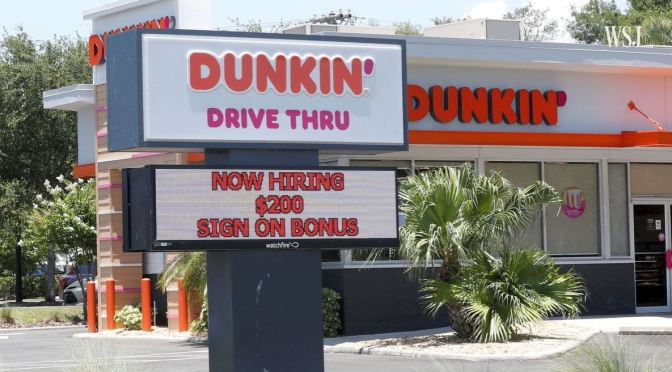
Employment: Do Hiring Incentives Work? (WSJ)
Low-wage work is in high demand, and employers are now competing for applicants, offering incentives ranging from sign-on bonuses to free food. But with many still unemployed, are these offers working? Photo: Bloomberg

Analysis: The Cognitive Effects Of Covid-19
Covid-19 is complex. It can affect the nervous system, leading to language disorders, strokes and seizures. Scientists are still trying to understand why. 75% of people hospitalised with the virus continue to suffer from secondary symptoms at least six months after they recover. Many find it hard to function in their daily lives. Researchers hope understanding Covid’s impact on the brain could pave a way for treatment.
Podcast: World Economy Fault Lines, Afghanistan Abandoned, Publishing
A selection of three essential articles read aloud from the latest issue of The Economist. This week, the new fault lines in the world economy, the catastrophic consequences of America abandoning Afghanistan (10:28) and how Mills & Boon, a famed publisher of romantic novels, wants to diversify its hero base (17:30)
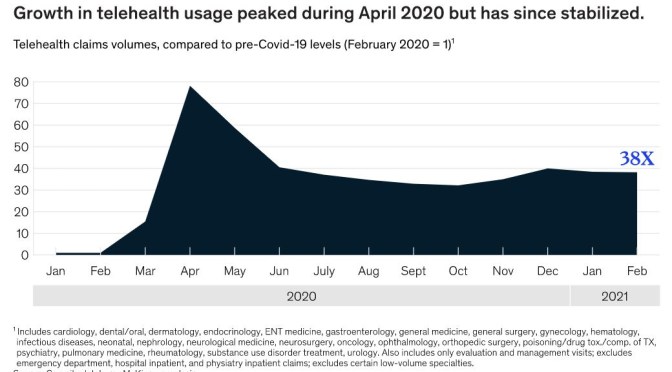
Telemedicine: Growth Rate Peaked In April 2020, Stabilized During 2021
A year ago, we estimated that up to $250 billion of US healthcare spend could potentially be shifted to virtual or virtually enabled care. Approaching this potential level of virtual health is not a foregone conclusion. It would likely require sustained consumer and clinician adoption and accelerated redesign of care pathways to incorporate virtual modalities.
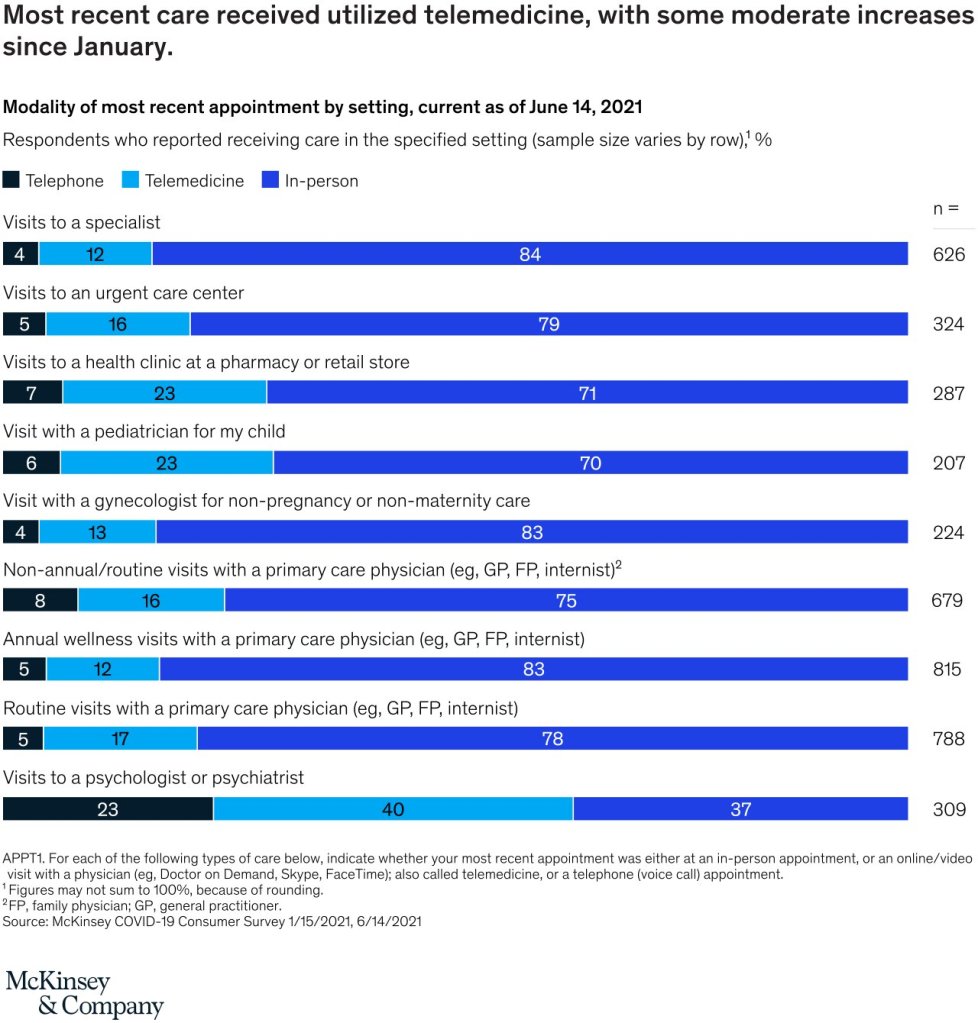
- Telehealth utilization has stabilized at levels 38X higher than before the pandemic. After an initial spike to more than 32 percent of office and outpatient visits occurring via telehealth in April 2020, utilization levels have largely stabilized, ranging from 13 to 17 percent across all specialties.2 This utilization reflects more than two-thirds of what we anticipated as visits that could be virtualized.3
- Similarly, consumer and provider attitudes toward telehealth have improved since the pre-COVID-19 era. Perceptions and usage have dropped slightly since the peak in spring 2020. Some barriers—such as perceptions of technology security—remain to be addressed to sustain consumer and provider virtual health adoption, and models are likely to evolve to optimize hybrid virtual and in-person care delivery.
- Some regulatory changes that facilitated expanded use of telehealth have been made permanent, for example, the Centers for Medicare & Medicaid Services’ expansion of reimbursable telehealth codes for the 2021 physician fee schedule. But uncertainty still exists as to the fate of other services that may lose their waiver status when the public health emergency ends.
- Investment in virtual care and digital health more broadly has skyrocketed, fueling further innovation, with 3X the level of venture capitalist digital health investment in 2020 than it had in 2017.4
- Virtual healthcare models and business models are evolving and proliferating, moving from purely “virtual urgent care” to a range of services enabling longitudinal virtual care, integration of telehealth with other virtual health solutions, and hybrid virtual/in-person care models, with the potential to improve consumer experience/convenience, access, outcomes, and affordability.

Political Analysis: Brooks & Tumulty On Congress’ Earmarks, Afghanistan
New York Times columnist David Brooks and deputy opinion editor for The Washington Post, Karen Tumulty, join Judy Woodruff to discuss the week in politics, including the return of congressional earmarks, withdrawal of U.S. troops from Afghanistan, the latest on the New York City mayor’s race and what it means about the Democratic Party.
 Boomers Daily