In this series from The Paris Review, poets read and discuss the poems getting them through these strange times…from their couches.

In this series from The Paris Review, poets read and discuss the poems getting them through these strange times…from their couches.
As we’re spending more time at home, it’s important to find new ways to remain active and exercise is important. Mayo Clinic physical therapist Sunni Alessandria and her colleagues offer some insight and tips for exercises you can do at home.
Downtown Frankfurt as most of Germany is turned into a ghost town. Eerie athmosphere in this normally busy city. Scary times.
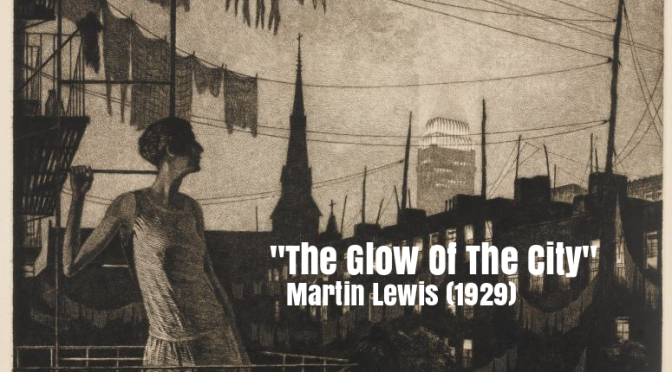
Born in Victoria, Australia, Martin Lewis was a printmaker who is known for his scenes of urban life in New York during the 1920s and 1930s. As a youth Lewis held a variety of jobs that ranged from working on cattle ranches in the Australian Outback, in logging and mining camps, to being a sailor. In 1898, he moved to Sydney for two years where he received his only formal art training. During this period he may have been introduced to printmaking; a local radical paper, The Bulletin, published two of his drawings.
Lewis left Australia in 1900 and first settled in San Francisco. He eventually worked his way eastward to New York. Little is known about his life during the following decade except that he made a living as a commercial artist and produced his first etching in 1915. Lewis’ skill as an etcher was noticed by Edward Hopper, who became a lifelong friend. In 1920, dissatisfied with his job, Lewis used his entire savings to study art and to sketch in Japan. He returned to New York after a two-year stay and resumed his commercial art career, but also pursued his own work as a painter and printmaker.
During the Depression, Lewis moved to Newtown, Connecticut, but later returned to Manhattan, where he helped establish a school for printmakers. From 1944-1952 Lewis taught a graphics course at the Art Students League in New York.
During his thirty-year career, Lewis made about 145 drypoints and etchings. His prints, like Shadow Dance and Stoops in Snow, were much admired during the 1930s for their realistic portrayal of daily life and sensitive rendering of texture. The artist’s skill in composition and his talent in the drypoint and etching media have received renewed attention in recent years. Lewis is one of the few printmakers of this era who specialized in nocturnal scenes. Some scholars consider his print Glow of the City his most significant work because of the subtlety of handling. A minute network of dots, lines, and flecks scratched onto the plate creates the illusion of transparent garments hanging in the foreground, while the Chanin Building, an art deco skyscraper, towers over the nearby tenements.
As coronavirus continues to spread around the world, face masks are in high demand as people look for ways to protect themselves. But do they really protect most people from contracting the virus? Dr Shunmay Yeung from London School of Hygiene and Tropical Medicine explains.
Dr. Paul Krugman is a Nobel Prize-Winning economist, and a regular commentator for the New York Times. Though academically recognised for his contributions to international trade theory, he writes about a wide range of economic issues, and is well known for making economic theory accessible to non-academics through his columns and numerous popular books. A liberal, Dr. Krugman is a fierce opponent of the modern Republican party, though he previously served as an economic advisor in Reagan’s White House.
ABOUT THE OXFORD UNION SOCIETY: The Oxford Union is the world’s most prestigious debating society, with an unparalleled reputation for bringing international guests and speakers to Oxford. Since 1823, the Union has been promoting debate and discussion not just in Oxford University, but across the globe.
Syndicated columnist Mark Shields and New York Times columnist David Brooks join Judy Woodruff to discuss the latest political news, including a surreal week in which much of American daily life shut down, bright spots of people helping each other in a time of need, President Trump’s handling of the crisis, the ongoing issue of political polarization and how government should respond.
To celebrate the launch of “The Woods”, the third album from acclaimed musician Hamish Napier Music, we’ve teamed up to bring you an audio-visual treat.
The Woods was commissioned by #CairngormsConnect to celebrate the ancient forests that make the project area so special.
Hamish has used the Scottish Gaelic alphabet, which is centred around Scotland’s native trees, to explore the folklore, natural and social heritage of Strathspey.
Gion Mikaku, founded 1929: – 2 different cuts of beef: Tajima beef filet mignon and Kobe beef rump steak with just the right amount of marbling (intra-muscular fat) and no extra-muscular fat – 400g in total. Steak cutting behind a window in their kitchen, friendly, dedicated service, pleasant view, extra hot griddle for proper searing, right timing and handling of the steaks: they certainly know what they are doing – This restaurant meal included garlic rice (between steak and dessert).








 Boomers Daily