

Artificial intelligence is helping humans make new kinds of art. It is more likely to emerge as a collaborator than a competitor for those working in creative industries.
Tag Archives: Technology
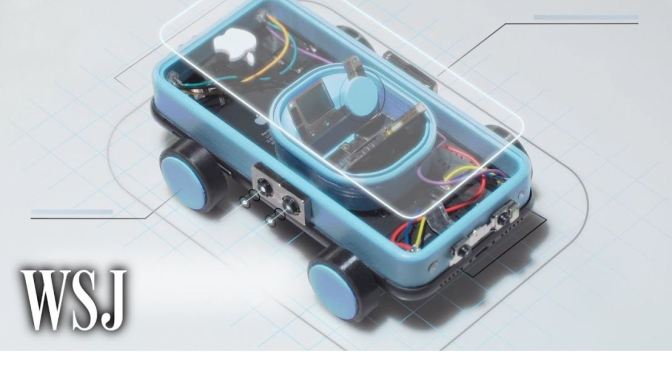
Analysis: ‘How Would Apple Make A Car’ (Video)
As tech companies become a key part of the auto industry, cars are looking more like giant computers on wheels. To understand why a tech giant like Apple might want to make a car, we built one out of iPhone parts. Photo illustration: Alex Kuzoian/WSJ

Analysis: Will Elon Musk’s ‘Starlink’ Improve Rural Internet Service? (Video)
SpaceX’s new Starlink satellite internet service is being touted as a rural internet game changer. WSJ spent time with a few beta testers in a very remote area of Washington state to see if it’s truly the solution to the global broadband gap. Photo Illustration: Laura Kammermann

Future Air Travel: ‘Lillium’ – 7-Seat Electric Vertical Take-Off & Land Jet (Video)
Lilium can revolutionize regional travel, saving people hours not minutes. Using its 7-Seater Lilium Jet, revealed March 30, 2021. Lilium’s regional shuttle service will enable sustainable, high-speed transportation. The 7-Seater Lilium Jet has market-leading capacity and is the first of Lilium’s serial aircraft.
It is capable of quiet vertical take-off, allowing Lilium access to more landing sites and the opportunity to build higher network density, avoiding the need for expensive ground infrastructure. The 7-Seater Lilium Jet and regional shuttle service business model are projected to deliver the best unit economics, with passenger and enterprise opportunities.
The Lilium 7-Seater Jet
The Lilium 7-Seater Jet has a projected cruise speed of 175 mph at 10,000 feet and a range of 155+ miles, including reserves. It is the culmination of five years of technology development across four generations of technology demonstrators, including Lilium’s full-scale 5-Seater.
Lilium applied for concurrent type certification for a high-capacity aircraft with EASA and the FAA in 2018. Development of the 7-Seater Lilium Jet began in stealth mode following this milestone. In 2020 the 7-Seater Lilium Jet received CRI-A01 certification basis from EASA.
Lilium has successfully developed, tested and refined the underlying technology for electric vertical take-off and landing jets – Lilium’s proprietary Ducted Electric Vectored Thrust (“DEVT”) technology, along with key control systems, aircraft and battery architecture. DEVT technology enables Lilium to scale to higher-capacity aircraft and keep noise emissions and ground footprint low.

Biotechnology: ‘mRNA Could Change The World’

The dream of mRNA persevered in part because its core principle was tantalizingly simple, even beautiful: The world’s most powerful drug factory might be inside all of us.

Like so many breakthroughs, this apparent overnight success was many decades in the making. More than 40 years had passed between the 1970s, when a Hungarian scientist pioneered early mRNA research, and the day the first authorized mRNA vaccine was administered in the United States, on December 14, 2020. In the interim, the idea’s long road to viability nearly destroyed several careers and almost bankrupted several companies.

Video Analysis: How Vaccine Passports Can Kick-Start The Economy
Vaccine passports are likely to become a feature of everyday life as lockdowns are lifted across the world. But as “green passes” kick-start economies, what are the potential drawbacks? Read more of our coverage on coronavirus : https://econ.st/397Mkxq

Analysis: ‘Tencent – China’s Most Valuable Company’
Mar.23 — In the space of two decades, Tencent Holdings Ltd. has become China’s most valuable company and Asia’s largest conglomerate. But with Chinese authorities stepping up scrutiny of the internet sector and cracking down on monopolies. it’s not clear if the WeChat owner will still have the same freedom to expand. Bloomberg Television’s David Ingles reports.

Interview: ‘GENIUS MAKERS’ Author Cade Metz On Artificial Intelligence From A Human Perspective
How Cade got access to the stories behind some of the biggest advancements in AI, and the dynamic playing out between leaders at companies like Google, Microsoft, and Facebook.
Cade Metz is a New York Times reporter covering artificial intelligence, driverless cars, robotics, virtual reality, and other emerging areas. Previously, he was a senior staff writer with Wired magazine and the U.S. editor of The Register, one of Britain’s leading science and technology news sites. His first book, “Genius Makers”, tells the stories of the pioneers behind AI.
Topics discussed: 0:00 Sneak peek, intro 3:25 Who is “Genius Makers” for and about? 7:18 *Spoiler alert!* Artificial General Intelligence (AGI) 11:01 How the story continues after the book ends 17:31 Overinflated claims in AGI 23:12 Deep Mind, OpenAI, and AGI 29:02 Outsider perspectives 34:35 Early adopters of ML 38:34 Who gets credit for what? 42:45 Dealing with bias 46:38 Aligning technology with nee

Analysis: ‘NFT’s And The Digital Art Boom’ (Video)
Non-fungible tokens, or NFTs, have exploded onto the digital art scene this past year. Proponents say they are a way to make digital assets scarce, and therefore more valuable. WSJ explains how they work, and why skeptics question whether they’re built to last. Photo Illustration: Jacob Reynolds/WSJ
A non-fungible token is a special type of cryptographic token which represents something unique. NFTs are called non-fungible because they are not mutually interchangeable, since they contain unique information, although it is possible to mint any number of NFTs representing the same object.

Health: ‘Overcoming Challenges In Medical Wearables’ (Video)
Medical wearables are quickly becoming a potential solution in a world where tele-health is gaining ground. Here are three examples of challenges in designing medical wearables, and how to overcome them.
 Boomers Daily