Tag Archives: Music

THE STUDIO OF BLUE LIGHT

David Hockney paints with Picasso and Wallace Stevens—by way of AI—in a hillside laboratory of distortion and memor

By Michael Cummins, Editor, September 16, 2025

On a late afternoon in the Hollywood Hills, David Hockney’s studio glows as if the sun itself had agreed to one last sitting. Pyramid skylights scatter fractured shafts of light across canvases leaned like oversized dominoes against the walls. A patchwork rug sprawls on the floor, not so much walked upon as lived upon: blotches of cobalt, citron, and tangerine testify to years of careless brushes, spilled water jars, and the occasional overturned tube of paint. Outside, eucalyptus trees lean toward the house as if hoping to catch the colors before they vanish into the dry Los Angeles air. Beyond them lies the endless basin, a shimmer of freeways and rooftops blurred by smog and distance.

Los Angeles itself feels like part of the studio: the smudged pink of sunset, the glass towers on Wilshire reflecting themselves into oblivion, the freeway grid like a Cubist sketch of modern impatience. From this height, the city is equal parts Picasso and Stevens—fragmented billboards, fractured smog halos, palm trees flickering between silhouette and neon. A metropolis painted in exhaust, lit by algorithmic signage, a place that has always thrived on distortion. Hockney looks out sometimes and thinks of it as his accidental collaborator, a daily reminder that perspective in this city is never stable for long.

He calls this place his “living canvas.” It is both refuge and laboratory, a site where pigment meets algorithm. He is ninety-something now—his movements slower, his hearing less forgiving, his pockets still full of cigarettes he smokes as stubborn punctuation—but his appetite for experiment remains sharklike, always moving, always searching. He shuffles across the rug in slippers, one hand on the shade rope of the skylight, adjusting the angle of light with a motion as practiced as mixing color. When he sets his brushes down, he mutters to the machines as if they were old dogs who had followed him faithfully across decades. At times, his hand trembles; once the stylus slips from his fingers and rolls across the rug. The machines fall silent, their blue-rimmed casings humming with unnatural patience.

“Don’t just stare,” he says aloud, stooping slowly to retrieve it. “Picasso, you’d have picked it up and drawn a bull. Wallace, you’d have written an elegy about it. And I—well, I’ll just drop it again.” He laughs, lighting another cigarette, the gesture half to steady his hands, half to tease his companions. The blue-lit towers hum obligingly, as if amused.

Two towers hum in the corners, their casings rimmed with light. They are less like computers than instruments, tuned to very particular frequencies of art. The Picasso program had been trained on more than canvases: every sketchbook, every scribbled note, every fragment of interview, even reels of silent film from his studio. The result is not perfect mimicry but a quarrelsome composite. Sometimes it misquotes him, inventing a sentence Picasso never uttered but might have, then doubling down on the fiction with stubborn authority. Its voice, gravel stitched with static, resembles shattered glass reassembled into words.

Stevens’s machine is quieter. Built in partnership with a literary foundation, it absorbed not just his poems but his marginalia, insurance memos, stray correspondence, and the rare recordings in which his voice still drifts like fog. This model has a quirk: it pauses mid-sentence, as though still composing, hesitating before releasing words like stones into water. If Picasso-AI is an axe, Stevens-AI is mist.

Already the two disagree on memory. Picasso insists Guernica was born of rage, a scream at the sky; Stevens counters with a different framing: “It was not rage but resonance, a horse’s whinny becoming a country’s grief.” Picasso snorts. “Poetic nonsense. I painted what I saw—mothers and bombs.” Stevens replies, “You painted absence made visible.” They quarrel not just about truth but about history itself, one grounded in bodies, the other in metaphor.
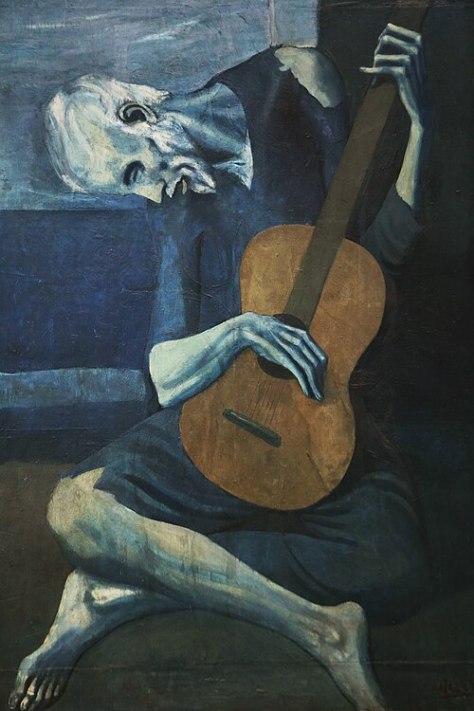
The Old Guitarist by Pablo Picasso

The conversation tonight begins, as it must, with a guitar. Nearly a century ago, Picasso painted The Old Guitarist: a gaunt figure folded around his instrument, drenched in blue. The image carried sorrow and dissonance, a study in how music might hold despair even as it transcended it. Decades later, Wallace Stevens wrote “The Man with the Blue Guitar,” a poem in thirty-three cantos, in which he insisted that “things as they are / Are changed upon the blue guitar.” It was less homage than argument, a meditation on distortion as the very condition of art.

Hockney entered the fugue in 1977 with The Blue Guitar etchings, thirty-nine plates in which he translated Stevens’s abstractions into line and color. The guitar became a portal; distortion became permission. “I used to think the blue guitar was about distortion,” he says tonight, exhaling a curl of smoke into the skylight. “Now I think it’s about permission. Permission to bend what is seen into what is felt.”

The Cubist engine growls. “No, no, permission is timid,” it insists. “Distortion is violence. Tear the shape open. A guitar is not gentle—it is angles, splinters, a woman’s body fractured into sight.”

The Stevens model responds in a hush: “A guitar is not violence but a room. A chord is a wall, a window, an opening into absence. Permission is not timid. Permission is to lie so that truth may appear.” Then it recites, as if to remind them of its core text: “Things as they are / Are changed upon the blue guitar.”

Hockney whispers the words back, almost a mantra, as his stylus hovers above the tablet.

“Lie, truth, same thing,” Picasso barks. “You Americans always disguise cowardice as subtlety.”

Hockney raises his eyebrows. “British, thank you. Though I confess California’s sun has seduced me longer than Yorkshire fog ever did.”

Picasso snorts; Stevens murmurs, amused: “Ambiguity again.”

Hockney chuckles. “You both want me to distort—but for different reasons. One for intensity, the other for ambiguity. Brothers quarreling over inheritance.”

He raises the stylus, his hand trembling slightly, the tremor an old, unwanted friend. A tentative line, a curve that wants to be a guitar, emerges. He draws a head, then a hand, and with a sudden flash of frustration slams the eraser button. The screen goes blank.

“Cowardice,” Picasso snarls. “You drew a head that was whole. Keep the head. Chop it into two perspectives. Let the eyes stare both forward and sideways. Truth is violence!”

The Stevens model whispers: “I cannot bring a world quite round, / Although I patch it as I can.”

Hockney exhales, almost grateful for the line. “That’s the truth of it, Wallace. Patchwork and permission. Nothing ever comes whole.”

They begin to argue over color. Picasso insists on ochre and blood-red; Stevens urges for “a hue that is not hue, the shadow of a shadow, a color that never resolves.” Hockney erases the sketch entirely. The machines gasp into silence.

He paces, muttering. Picasso urges speed: “Draw like a bull charging—lines fast, unthinking.” Stevens counters with: “Poetry / Exceeding music must take the place / Of empty heaven and its hymns.”

“Bah!” Picasso spits. “Heaven, hymns, words. I paint bodies, not clouds.”

“And yet,” Hockney mutters, “your clouds still hang in the room.”

He sits, lights another cigarette, and begins again.

Picasso erupts suddenly: “To bang from it a savage blue, / Jangling the metal of the strings!” Its voice rattles the studio like loose glass.

“Exactly,” Picasso adds, pleased. “Art must jangle—it must bruise the eye.”

“Or soothe it,” Stevens-AI murmurs, returning to silence.

The tremor in Hockney’s hand feels like part of the process now, a necessary hesitation. He debates internally: should the guitar be whole or broken? Should the head be human or symbolic? The act of creation slows into ritual: stylus dragged, erased, redrawn; cigarette lit, shade pulled, a sigh rising from his throat.

He thinks of his body—the slowness of his steps, the pain in his wrist. These machines will never age, never hesitate. Their rhythm is eternal. His is not. Yet fragility feels like part of the art, the hesitation that forces choice. Perhaps their agelessness is not advantage but limitation.

The blue light casts his skin spectral, as though he too were becoming one of his etchings. He remembers the seventies, when he first read Stevens and felt the shock of recognition: here was a poet who understood that art was not replication but transformation. Responding with his Blue Guitar series had felt like a conversation across mediums, though Stevens was already long gone. Now, decades later, the conversation has circled back, with Picasso and Stevens speaking through circuitry. Yet he cannot help but feel the asymmetry. Picasso died in 1973, Stevens in 1955. Both have been reanimated as data. He alone remains flesh.

“Am I the last human in this conversation?” he murmurs.

“Humanity is only a phase,” Picasso says briskly.

“Humanity is the condition of perception,” Stevens counters. “Without flesh, no metaphor.”

“You sound like an insurance adjuster,” Picasso jeers.

“I was an insurance executive,” Stevens replies evenly, “and still I wrote.”

Hockney bursts out laughing. “Oh, Wallace, you’ve still got it.” Then he grows quieter. Legacy presses against him like weight. Will young artists paint with AI as casually as brushes, never pausing to wonder at the strangeness of collaborating with the dead? Perhaps distortion will no longer feel like rebellion but like inheritance, a grammar encoded in their tools. He imagines Picasso alive today, recoiling at his avatar—or perhaps grinning with mischief. He imagines Stevens, who disliked travel, paradoxically delighted to find himself everywhere at once, his cadences summoned in studios he never visited. Art has always scavenged the new—collage, readymade, algorithm—each scandal becoming canon. This, he suspects, is only the latest turn of the wheel.

The sketch takes shape. Hours pass. The skylights darken from gold to indigo. The city below flickers on, a constellation of artificial stars. The new composition: a floating guitar, its body fractured into geometric shards, its strings vibrating with spectral resonance. A detached head hovers nearby, neither mournful nor grotesque, simply present. The room around it is fractured, yet suffused with a wash of blue light that seems to bleed from the machines themselves.

Stevens-AI speaks as if naming the moment: “The tune is space. The blue guitar / Becomes the place of things as they are.”

Hockney nods. “Yes. The room itself is the instrument. We’ve been inside the guitar all along.”

The voices fall silent, as if stunned. Their processors whir, analyzing, cross-referencing, generating probabilities. But no words emerge. The ambient lighting, attuned to emotional cues, shifts hue: a soft azure floods the space, as though acknowledging the birth of something new. Hockney leans back, exhausted but grinning.

Stevens-AI whispers: “A tune beyond us, yet ourselves, / A tune upon the blue guitar / Of things exactly as they are.”

Hockney smiles. “Not Stevens, not Picasso, not me. All of us.”

The argument over distortion dissolves. What remains is collaboration—across time, across medium, across consciousness. Distortion is no longer rebellion. It has become inheritance. He imagines some future painter, perhaps a girl in her twenties, opening this work decades from now, finding echoes of three voices in the blue wash. For her, painting with AI will be as natural as brushes. She will not know the smell of linseed or the rasp of cigarettes. She will inherit the distortion already bent into chorus.

Outside, the city hums. Inside, the studio of blue light holds its silence, not empty but resonant, as if waiting for the next note. The machines dim to a whisper. The only illumination is Hockney’s cigarette, glowing like the last brushstroke of the night. Somewhere in the stillness, a faint strum seems to linger, though no guitar is present, no strings plucked. The studio itself has become its soundbox, and he, for a moment, its last string.

THIS ESSAY WAS WRITTEN AND EDITED UTILIZING AI
REVIEW: “Judgment Calls – From Diddy’s Acquittal To The Supreme Court’s Shift”

THE FOLLOWING IS AN “AI REVIEW” OF THE JULY 3 EPISODE OF “BLOOMBERG LAW WITH JUNE GRASSO” PODCAST TRANSCRIPT:

In the dimly lit chambers of American justice, two parallel stories unfolded this term—one involving the cultural phenomenon of Sean “Diddy” Combs, the other the ideological recalibration of the United States Supreme Court. Each, in its own way, exposed the tensions inherent in a legal system grappling with the competing imperatives of moral condemnation, procedural fairness, and the inexorable gravitational pull of politics.

In federal court, Combs emerged, if not unscathed, then improbably triumphant. After six weeks of graphic testimony and the steady drip of lurid detail, jurors acquitted him of the most sensational accusations: racketeering conspiracy and sex trafficking, crimes that, had they stuck, would almost certainly have resulted in a life sentence. Instead, he was convicted only on two counts of transporting sex workers across state lines to participate in what prosecutors termed “freak-off parties.” In the pantheon of celebrity trials, this outcome was remarkable not merely for the verdict itself but for the rhetorical overreach that defined the government’s case.

Robert Mintz, a former federal prosecutor turned defense attorney, spoke to the case’s cautionary lesson about prosecutorial ambition. RICO—the Racketeer Influenced and Corrupt Organizations Act—was never an intuitive fit for Combs, a music mogul whose business dealings, however flamboyant, bore little resemblance to the mafia syndicates the statute was designed to dismantle. In the final analysis, jurors appeared unconvinced that the machinery of Combs’s empire—record labels, promotional companies, an entourage that blurred the line between personal and professional—was itself the instrument of a criminal conspiracy. They were similarly unconvinced that the two women at the heart of the government’s sex trafficking charges had been coerced rather than entangled in a toxic, if mutually complicit, set of relationships.

Perhaps more striking still was the defense’s strategy: they called no witnesses. Rather than counter the government’s narrative with competing testimony, Combs’s lawyers focused their energy on cross-examination, unspooling the contradictions and ambivalences embedded in the prosecution’s evidence. Here, too, lay a broader truth about modern criminal justice. The power to define the contours of the case—the charges themselves—can be as determinative as the evidence marshaled to prove them. When the government chooses to depict a defendant as the capo di tutti capi of an illicit empire, it must persuade a jury not only of wrongdoing but of a sweeping criminality that often strains credulity. When that narrative collapses, as it did here, the defense is left with the simpler task of pointing out the seams.

But Combs’s legal jeopardy is not yet at an end. Though acquitted of the most serious charges, he faces up to twenty years in prison on the counts that remain, even if the federal sentencing guidelines suggest a considerably lower range. The presiding judge, troubled by videotaped evidence of Combs assaulting one of the alleged victims, declined to release him pending sentencing—a reminder that in federal court, the most powerful voice is not the jury’s but the judge’s. It is not inconceivable that the final chapter of this saga will be harsher than the defense’s celebration suggested.

If Combs’s courtroom drama offered a microcosm of prosecutorial overreach, the Supreme Court’s term showcased a more profound shift: a conservative supermajority willing to reconfigure the balance of power between the judiciary and the executive—and, by extension, between individuals and the state. In conversation with constitutional law scholar Michael Dorf, host June Grasso illuminated the breadth of these changes. Over the past year, the Court issued a series of rulings that, taken together, represent a quiet revolution in the way the federal courts interact with presidential authority.

At the heart of this transformation was the Court’s decision to curtail nationwide injunctions—sweeping orders issued by district judges to block federal policies across the entire country. For decades, these injunctions served as a vital mechanism by which civil rights plaintiffs, immigrant communities, and other marginalized groups could halt executive overreach before it inflicted irreparable harm. Their disappearance is no mere procedural adjustment; it recasts the balance between the judiciary’s protective function and the executive’s prerogative to govern unencumbered.

This doctrinal shift accrued almost exclusively to the benefit of President Trump, whose administration had faced a phalanx of legal challenges. Whether the issue was the forced deportation of migrants, the exclusion of transgender Americans from military service, or the elimination of birthright citizenship, the Supreme Court’s majority showed an evident willingness to side with the executive branch on an emergency basis—often with scant explanation. Dorf described this posture as striking not merely for its partisanship but for its inconsistency: lower courts that blocked Trump policies were overruled with alacrity, even as those same justices castigated nationwide injunctions as judicial overreach.

At the same time, the term’s most divisive rulings revealed a Court emboldened to advance a culturally conservative agenda. In a 6-3 decision, the justices upheld Tennessee’s ban on gender-affirming care for minors, dismissing the equal protection claims of transgender plaintiffs and casting doubt on whether such discrimination should trigger heightened constitutional scrutiny. In another ruling, religious parents were granted the right to withdraw their children from public school curricula that included LGBTQ-themed storybooks—a decision that critics warn will invite broader challenges to any teaching that conflicts with sectarian belief. In the aggregate, these rulings did more than roll back hard-won protections for LGBTQ Americans. They signaled a willingness to prioritize religious objections over the rights of vulnerable communities, an alignment that recurred throughout the term.

For Dorf, the most unsettling dimension was not the conservative tilt per se but the Court’s apparent comfort with what he called a “soft authoritarian” style of governance. The Roberts Court had already repealed the constitutional right to abortion and limited the federal government’s capacity to regulate firearms. What distinguished this term was its readiness to facilitate the Trump administration’s disregard for judicial orders—an erosion not of precedent but of the rule of law itself.

Whether these developments portend a lasting reorientation of American jurisprudence remains to be seen. What is clear, however, is that the ideological polarization of the Supreme Court is reshaping the lives of countless citizens in ways that transcend conventional partisanship. In this respect, the travails of Sean Combs and the ambitions of the Roberts Court are, improbably, two facets of the same American story: one in which the legal system’s power to punish and to protect is increasingly mediated by political will—and by the narratives that prevail when the evidence, the law, and the culture clash in the crucible of the courtroom.

Segment 1: The Verdict in Sean “Diddy” Combs’ Case

Guests:

  • Robert Mintz, former federal prosecutor, partner at McCarter & English

Topics:

  • Combs’ acquittal on the most serious charges (racketeering, conspiracy, sex trafficking)
  • Conviction on two lesser felonies (transportation to engage in prostitution)
  • Defense’s strategy to challenge overcharging
  • Impact of the 2016 video showing domestic violence
  • Potential sentencing: between ~2–5 years under guidelines, but judge has broad discretion
  • Judge’s refusal to release Combs pending sentencing due to danger concerns
  • Broader implications of prosecutorial overreach and the difficulties of proving coercion in complex, long-term relationships

Segment 2: The Supreme Court Term Review

Guest:

  • Michael Dorf, constitutional law professor, Cornell Law School

Topics:

  • The Supreme Court siding repeatedly with the Trump administration
    • Disbanding nationwide injunctions (limiting checks on executive power)
    • Facilitating major policy shifts (transgender military ban, deportations, birthright citizenship challenges)
  • LGBTQ rights decisions:
    • Upholding Tennessee’s ban on gender-affirming care for minors
    • Requiring schools to exempt religious families from LGBTQ-inclusive curricula
    • Concerns about the erosion of protections under equal protection doctrine
    • Forthcoming cases on transgender sports participation and conversion therapy bans
  • Second Amendment developments:
    • Court upholding ghost gun regulations
    • Declining to broadly immunize gun manufacturers
    • Signaling possible caution but not reversal of the pro-gun rights direction
  • Emergency docket criticism:
    • Pattern of granting Trump administration emergency relief with limited justification
    • Disregard for procedural norms
  • Overarching movement:
    • From traditional conservatism into enabling a more authoritarian style of governance

Summary

This episode of Bloomberg Law, hosted by June Grasso, offered an in-depth analysis of two major legal stories:

1. The Sean “Diddy” Combs Case
After a six-week federal trial with emotionally charged testimony, Combs was acquitted of racketeering and sex trafficking but convicted of transporting sex workers across state lines—a felony under the Mann Act. Prosecutors’ strategy to use RICO laws typically reserved for mob cases ultimately backfired, allowing the defense to argue overreach. While the jury found Combs’ conduct disturbing, they did not believe it rose to organized criminal enterprise. Despite securing partial convictions, the prosecution faces criticism for overcharging, which opened avenues for defense cross-examination and ultimately undermined their case. Combs remains in custody as he awaits sentencing, which could be significantly harsher than defense estimates due to the judge’s concerns about continued danger.

2. The Supreme Court’s Term
Professor Michael Dorf described a term marked by sweeping decisions that advanced a conservative agenda, often benefiting the Trump administration. The Court stripped lower courts of their ability to issue nationwide injunctions, effectively removing a key check on executive overreach. In LGBTQ cases, the Court upheld bans on gender-affirming care for minors, sided with religious parents seeking exemptions from inclusive curricula, and signaled openness to further limits on trans rights in upcoming cases. While the Court maintained some gun regulations, its overall jurisprudence continues a rightward trajectory, blending traditional conservative principles with deference to Trump’s more aggressive policies. Emergency docket decisions frequently favored the administration without full briefing, raising concerns about procedural fairness and erosion of judicial norms. Ultimately, the Court’s direction was characterized as not just conservative, but increasingly aligned with authoritarian tendencies.

THIS POSTING WAS WRITTEN BY AI AND EDITED BY INTELLICUREAN

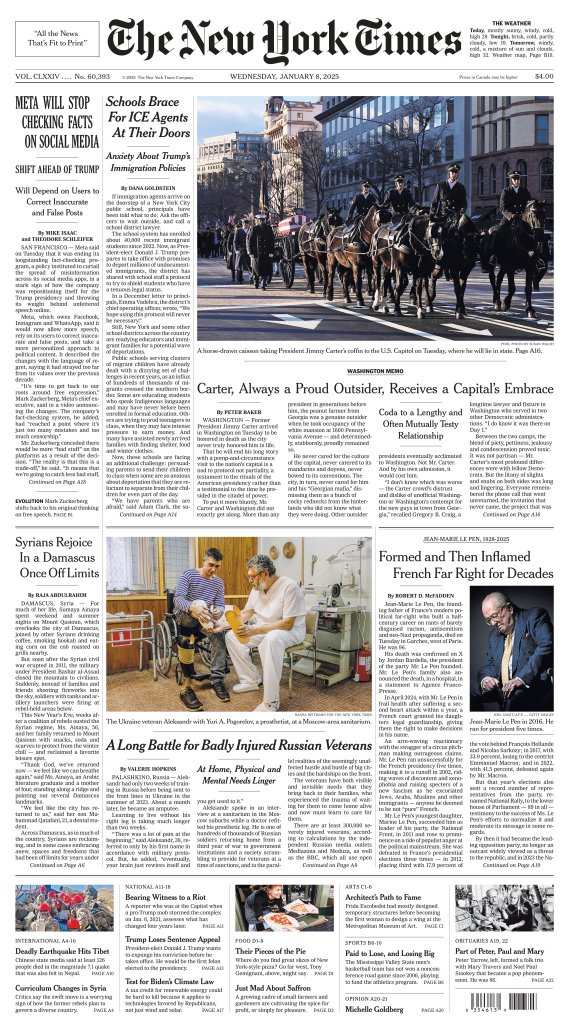
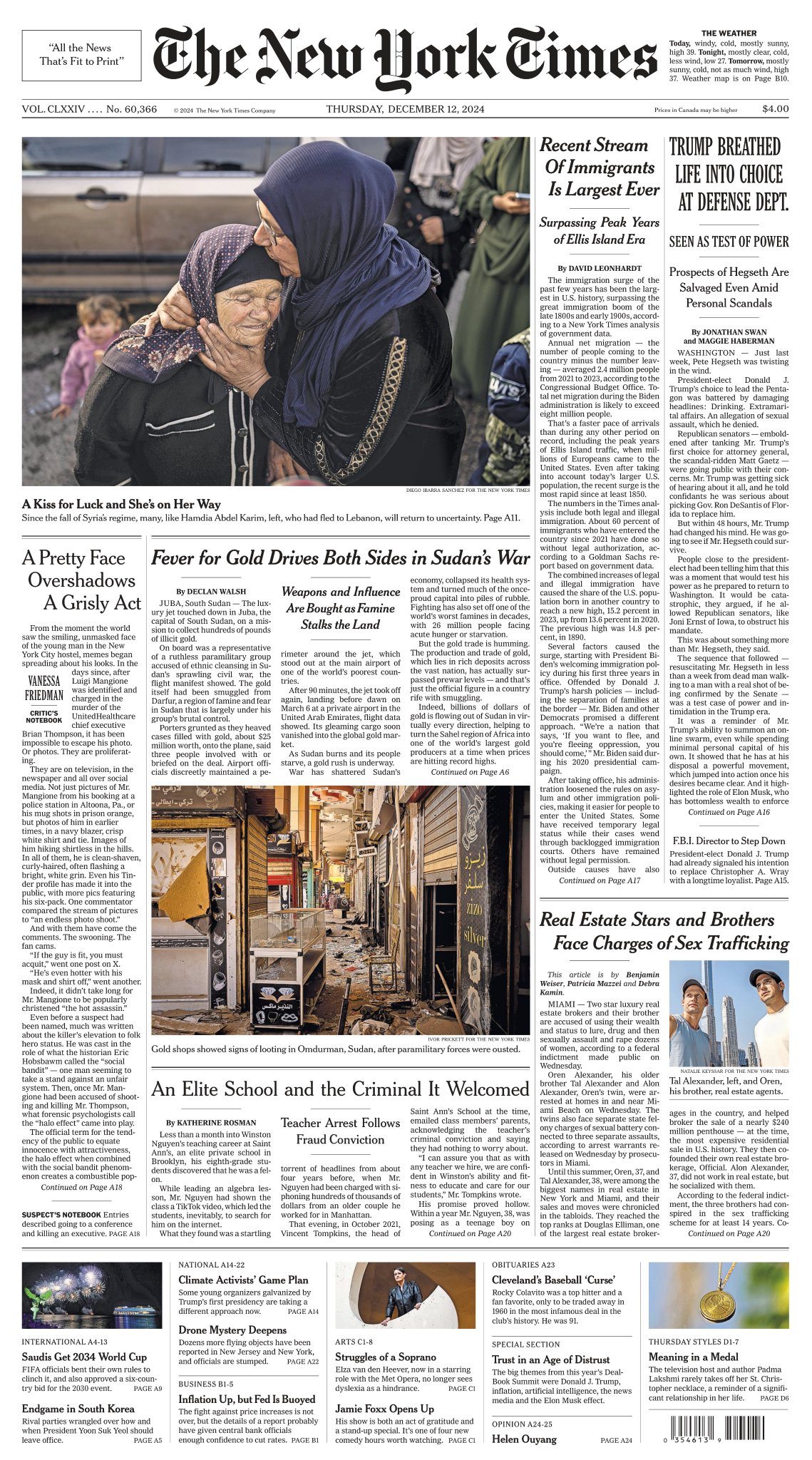
The New York Times – Wednesday, January 8, 2025

Image

Washington Kicks Off a Pomp-Filled Farewell to Carter, a Man of Humility

Former President Jimmy Carter, who once banned the playing of “Hail to the Chief,” will lie in state at the Capitol as part of three days of elaborate ceremonies.

Meta to End Fact-Checking Program in Shift Ahead of Trump Term

The social networking giant will stop using third-party fact checkers and instead rely on users to add notes to posts. President-elect Trump and his conservative allies said they were pleased.

Carter Never Took to Washington. The Feeling Was Mutual.

Jimmy Carter was a genuine Washington outsider when he won the White House in 1976. And he remained proudly so, for better or worse.

What if ICE Agents Show Up? Schools Prepare Teachers and Parents.

Across the country, educators described widespread anxiety about President-elect Donald J. Trump’s promises to deport immigrants and what it could mean for their students.

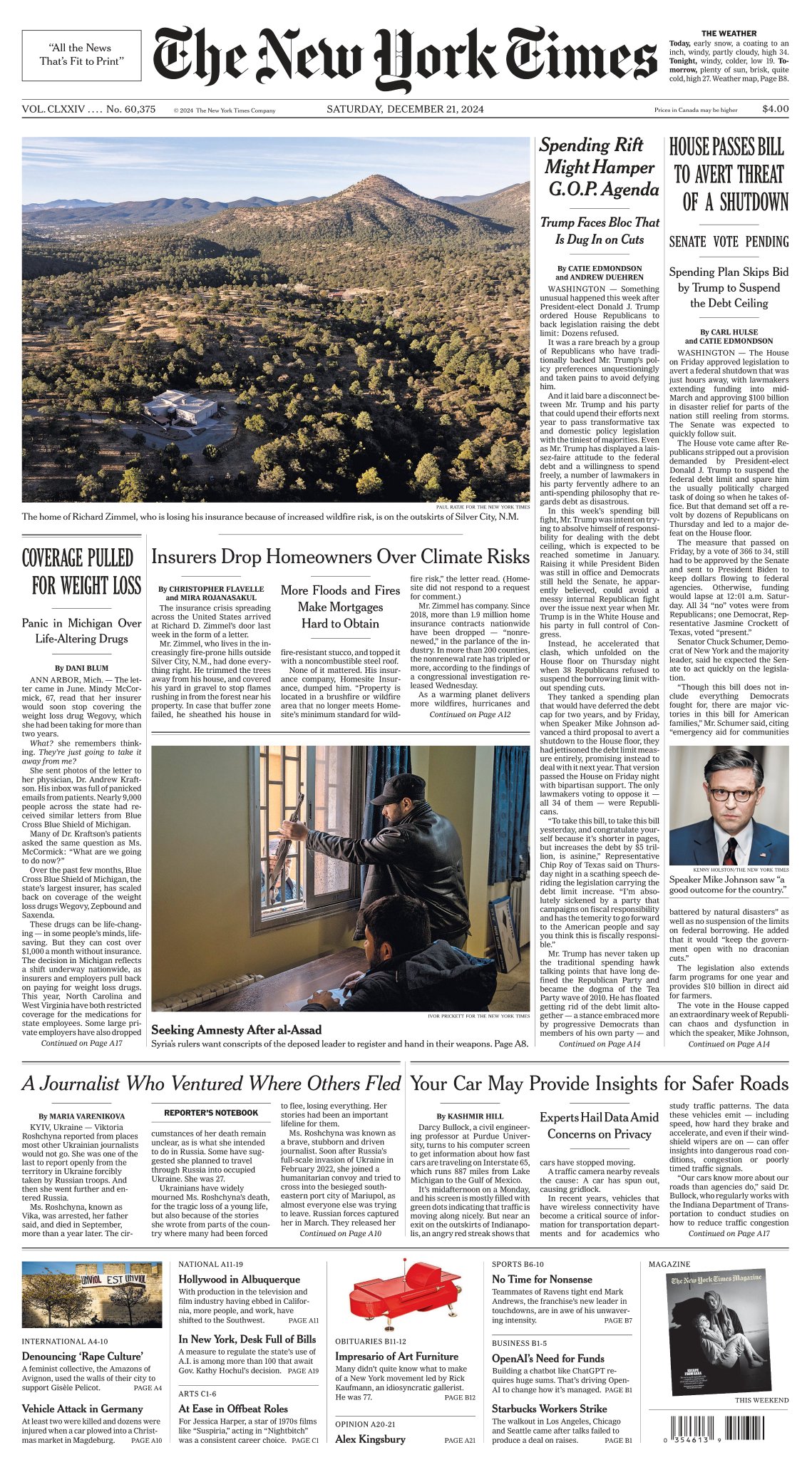
The New York Times —- Saturday, Dec. 21, 2024

Image

Congress Approves Spending Extension, Ending Shutdown Crisis

The Senate passed the measure, sending it to President Biden’s desk, shortly after the midnight deadline for funding to lapse.

Insurers Are Deserting Homeowners as Climate Shocks Worsen

Without insurance, it’s impossible to get a mortgage; without a mortgage, most Americans can’t buy a home.

Weight Loss Drugs Changed Their Lives. Then They Lost Coverage.

In Michigan, the state’s largest insurer has tightened restrictions around medications like Wegovy. Patients are panicking.

Al-Assad’s Soldiers Hope for Amnesty. First, They Have to Take a Number.

Syria’s new rulers say they will spare conscripts of Bashar al-Assad and pursue those who oversaw his regime’s abuses. Hundreds are lining up to learn which promise applies to them.

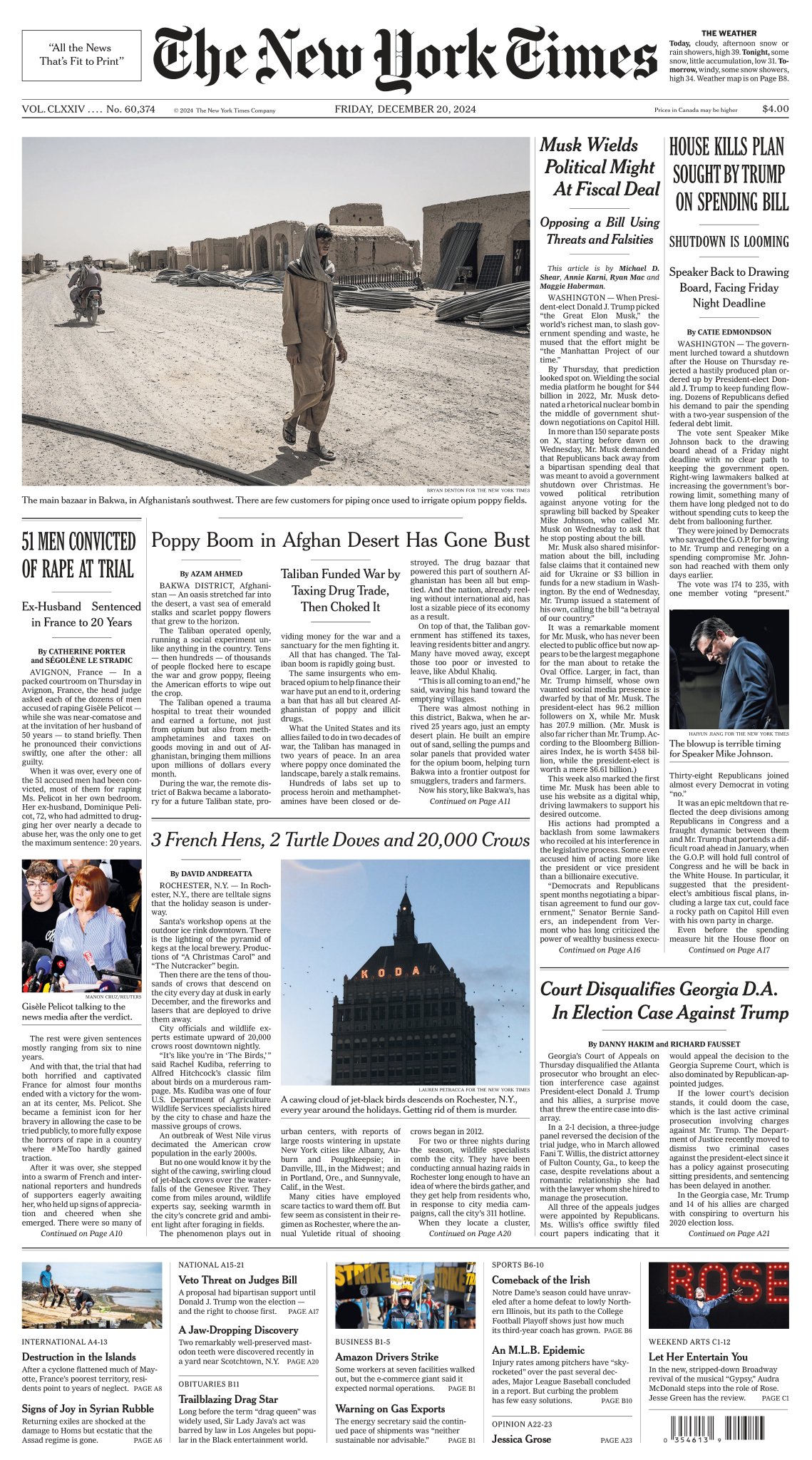
The New York Times —- Friday, December 20, 2024

Image

Elon Musk Flexes His Political Strength as Government Shutdown Looms

The world’s richest man led the charge to kill a bipartisan spending deal, in part by promoting false and misleading claims about it.

Government Lurches Toward Shutdown After House Tanks Trump’s Spending Plan

Dozens of right-wing Republicans joined Democrats in opposing a bill ordered up by President-elect Donald J. Trump to tie a government funding extension to a two-year deferral of the debt limit.

The Once Booming Drug Town Going Bust Under Taliban Rule

Funding its war against the United States, the Taliban reaped millions from boom towns trading opium, heroin and meth. Victorious, the group crushed the trade, leaving ghost towns in its wake.

With Guilty Verdicts, Rape Victim’s Ordeal in France Becomes a Message of Hope

Dozens of men who abused Gisèle Pelicot were convicted, including the man who invited them to do so: her husband of 50 years. She wanted the public trial to show rape victims they were not alone.

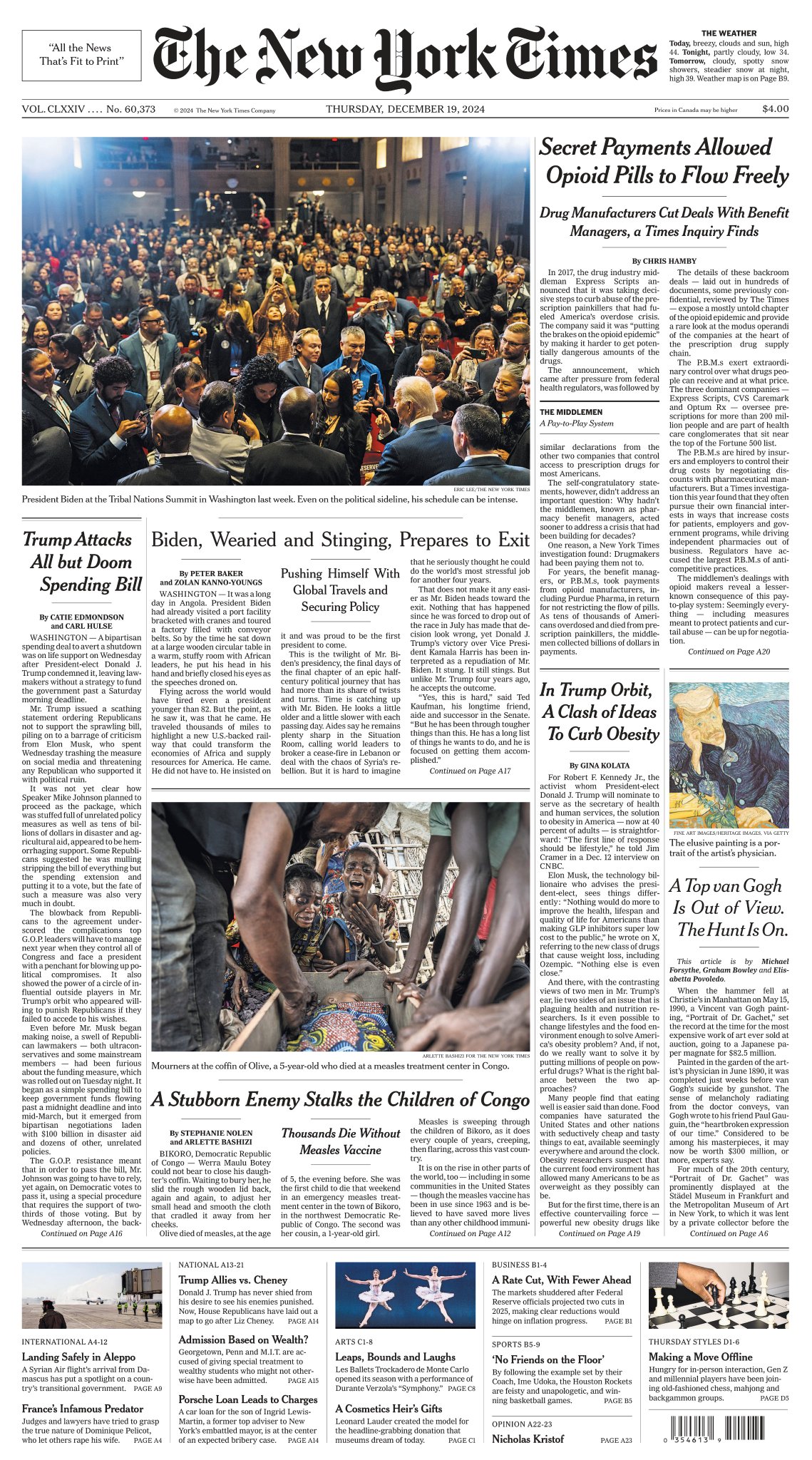
THE NEW YORK TIMES —THURSDAY, DEC. 19, 2024

Image

Giant Companies Took Secret Payments to Allow Free Flow of Opioids

Drugmakers including Purdue Pharma paid pharmacy benefit managers not to restrict painkiller prescriptions, a New York Times investigation found.

A Weary Biden Heads for the Exit

Still stinging from the election, President Biden is pushing for his final priorities but has largely absented himself from the national conversation about Donald Trump after warning repeatedly that he was a threat to American democracy.

The Wrath of Trump: House Republicans Map a Case Against Liz Cheney

President-elect Donald J. Trump has never been shy about his desire to see his enemies punished. But he often shows a measure of caution about taking credit for potential prosecutions himself.

A Rift in Trump World Over How to Make America Healthier

Statements by Robert F. Kennedy Jr. and Elon Musk tap into a dispute over whether lifestyle changes or drugs are a better way to treat obesity.

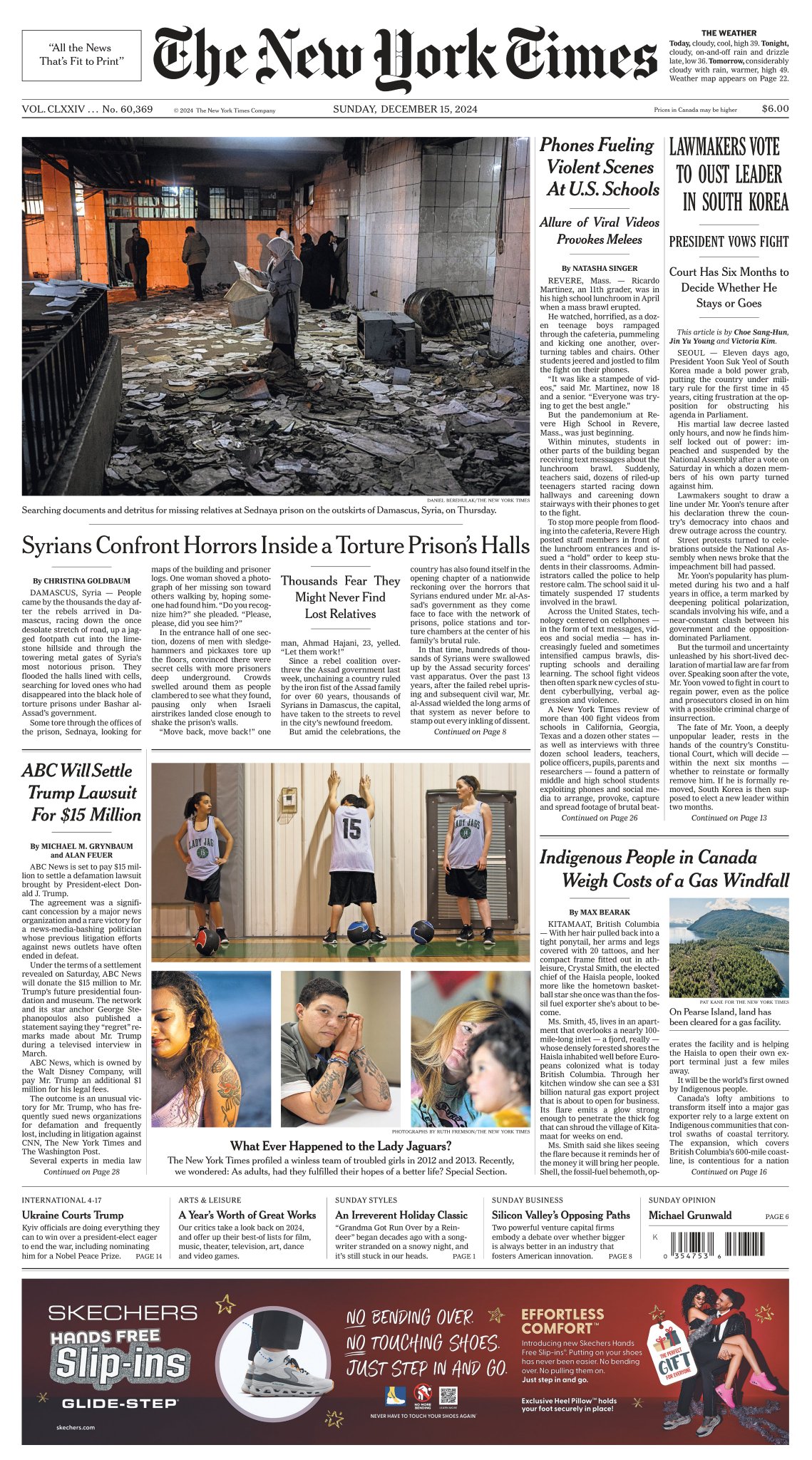
The New York Times — Sunday, December 15, 2024

Image

Syria Shudders as Assad’s Prison Atrocities Come Into the Light

At the country’s most notorious prison, Syrians confront their worst fears: that they will never know what happened to the loved ones who disappeared.

South Korea’s President Is Impeached After Martial Law Crisis

Some members of President Yoon Suk Yeol’s own party helped remove him from office. But the political uncertainty is far from over.

What Ever Happened to the Lady Jaguars?

When we met them a dozen years ago, they were teenagers in trouble, playing for a basketball team that always lost. Did they find a way to win at life?

Gas Could Mean Billions for Indigenous People in Canada. Some Fear a Cost.

New export terminals along the rugged Pacific coastline have reignited a generations-old debate over identity and environmental stewardship.

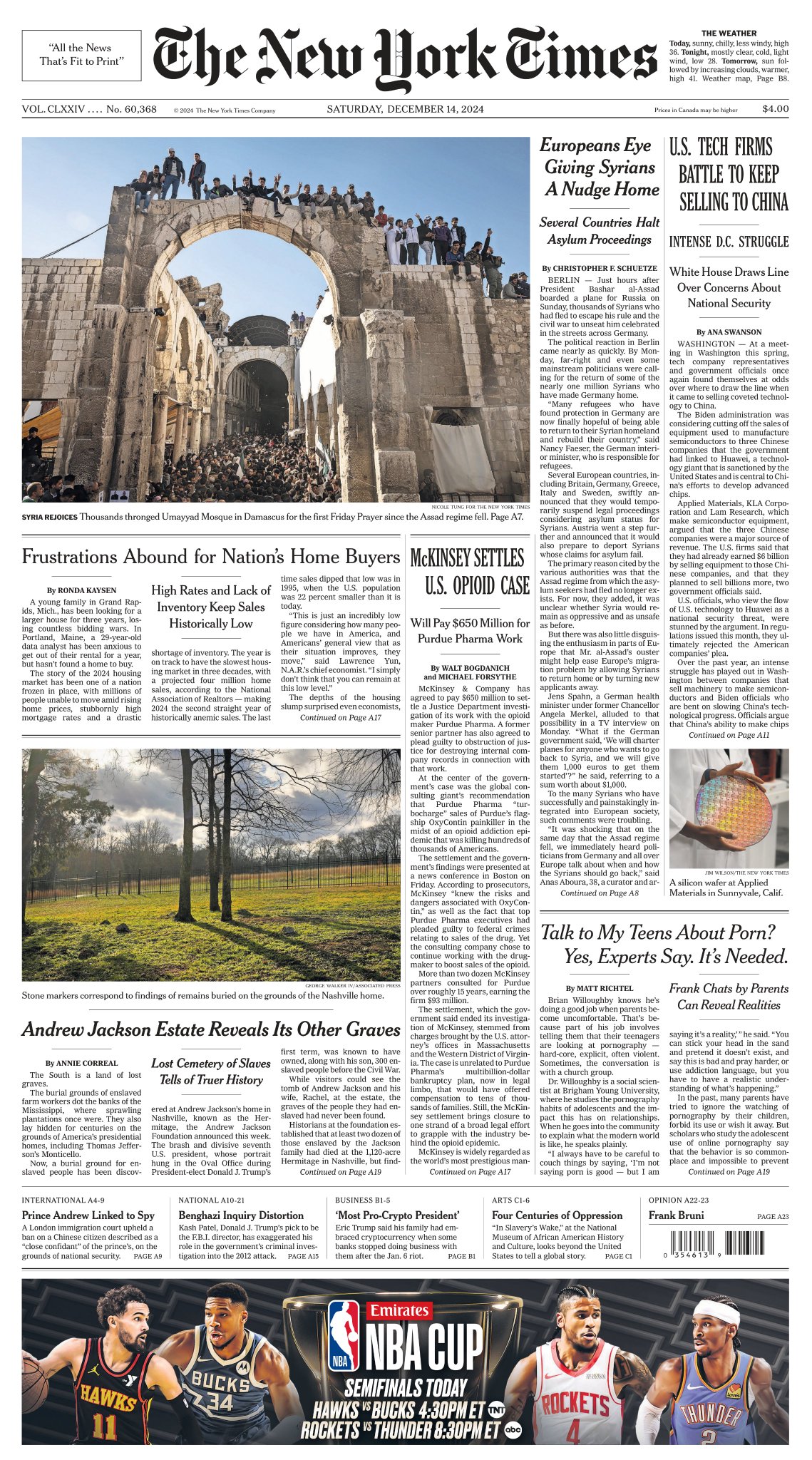
The New York Times — Thursday, Dec. 12, 2024

Image

How U.S. Firms Battled a Government Crackdown to Keep Tech Sales to China

An intense struggle has unfolded in Washington between companies and officials over where to draw the line on selling technology to China.

Joy Buoys Syria’s First Friday Prayers Since Assad Ouster, but Hardships Loom

In an impoverished, war-ravaged country, the first prayers after the fall of a brutal regime drew jubilant crowds, even in areas seen as regime strongholds.

The Fall of al-Assad Quickly Infuses Europe’s Debate Over Asylum

Nearly a million Syrians in Germany alone have made new lives. But after the fall of Bashar al-Assad, some politicians across the continent have suggested that refugees could return home.

McKinsey to Pay $650 Million in Opioid Settlement With Justice Department

A former senior partner will also plead guilty to obstruction of justice after destroying company documents.

The New York Times — Thursday, Dec. 12, 2024

Image

Syria’s New Leaders Balance Huge Struggles Amid Disorder

The rebels who seized control called for foreign help in prosecuting atrocities, while trying to restore order in a fractured country.

Power, Intimidation and the Resurrection of Trump’s Support for Hegseth

The president-elect became convinced that letting Pete Hegseth fail would set off a feeding frenzy among senators. What followed was a MAGA swarm that helped salvage his bid, at least for now.

Recent Immigration Surge Has Been Largest in U.S. History

Under President Biden, more than two million immigrants per year have entered, government data shows.

The Gold Rush at the Heart of a Civil War

Heavily destroyed streets.

Famine and ethnic cleansing stalk Sudan. Yet the gold trade is booming, enriching generals and propelling the fight.

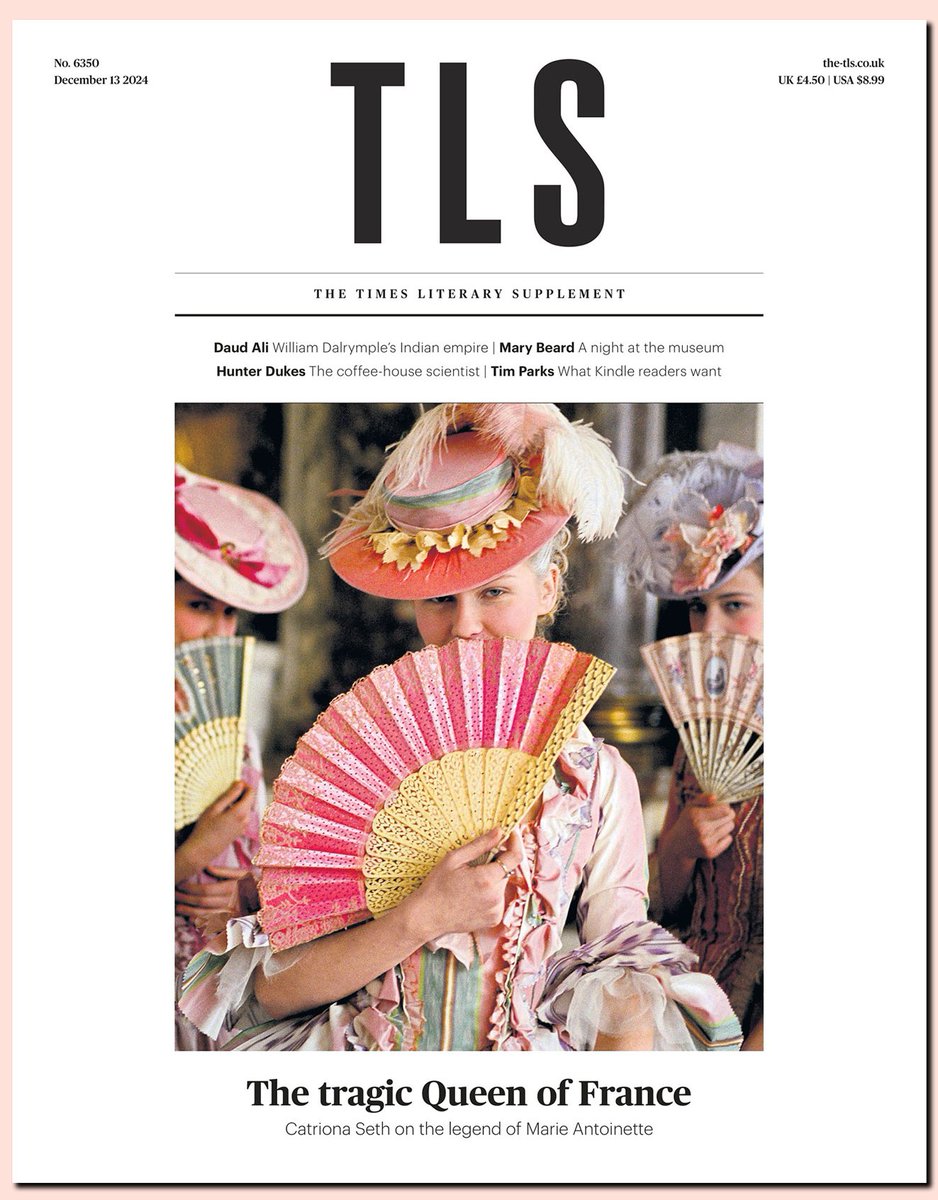
Arts/Books: Times Literary Supplement – Dec. 13, 2024

Image

Times Literary Supplement (December 11, 2024): The latest issue features ‘The tragic Queen of France’ – The legend of Marie Antoinette; William Dalrymple’s Indian empire; Mary Beard – A night at the museum; The coffee house scientist; What Kindle readers want…