From a The Lancet online article:
Effective physicians interrogate their patients’ choice of words as well as their body language; they attend to what they leave out of their stories as well as what they put in. More than 2000 years after Hippocrates, there remains as much poetry in medicine as there is science.
 WHO’s definition of health is famously “a state of complete physical, mental, and social well-being and not merely the absence of disease or infirmity”. One of the oldest medical texts we know of, The Science of Medicine attributed to Hippocrates, sets out the goal of medicine in comparable terms: “the complete removal of the distress of the sick”.
In my working life as a physician, I’ve never found the distinction between arts and sciences a particularly useful one. In the earliest ancient Greek texts, medicine is described as a techne—a word better translated as “know-how”. It conveys elements of science, art, and skill, but also of artisanal craft. The precise functions of medicine may have subtly shifted over the ages, but our need as human beings for doctors remains the same; we go to them because we wish to invoke some change in our lives, either to cure or prevent an illness or influence some unwelcome mental or bodily process. The goal of medicine is, and always has been, the relief of human suffering—the word patient, from the Latin patientem, means sufferer. And the word physician is from the Greek phusis, or nature: to be engaged in clinical work is to engage oneself with the nature of illness, the nature of recovery, the nature of humanity.
Read entire article

 Listen to a chat with Julia Adler-Milstein, the author of an editorial that comments on a recent Annals of Internal Medicine study detailing the amount of time clinicians typically spend hunched over their EHRs during a patient visit.



 In this video, best-selling author Abraham Verghese, MD, discusses the origins of the study he coauthored identifying 5 practices that foster meaningful connections between physicians and patients.
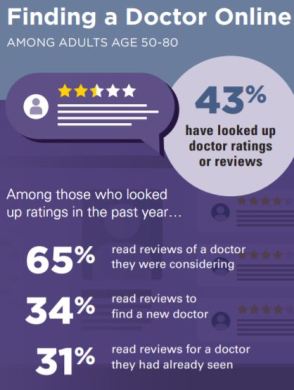 Among older adults age 50–80, 43% had ever reviewed doctor ratings; 14% had reviewed ratings more than once in the past year, 19% had done so once in the past year, and 10% had reviewed ratings more than one year ago.
 Ratings and reviews for nearly everything can be found online these days, including doctors. How are older adults using these ratings in their decisions about choosing doctors? In May 2019, the University of Michigan National Poll on Healthy Aging asked a

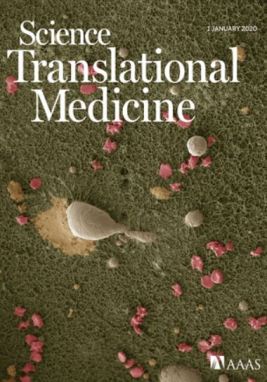 “This is an entirely new approach with no current treatments able to change scar in this way,” says Associate Professor James Chong who led the research. “By improving cardiac function and scar formation following heart attack, treatment with rhPDGF-AB led to an overall increase in survival rate in our study.”
 Boomers Daily