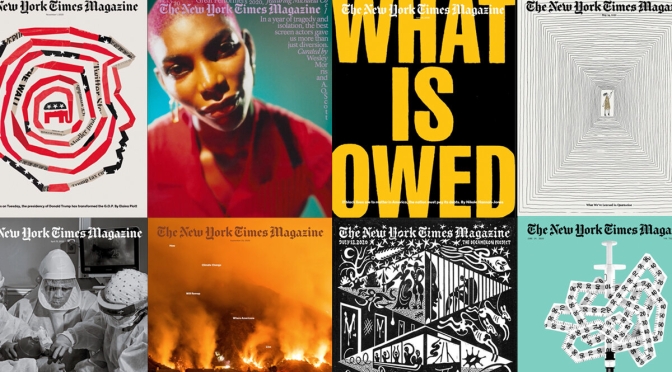
THE NEW YORK TIMES MAGAZINE: Thelatest issue features ‘The Victims Who Fought Back’ – A new law was supposed to help free women convicted of killing their abusers. Why are nearly all of them still in prison?
The arrest of Andrew Mountbatten-Windsor last week, after allegations he had shared confidential information with the late US sex offender Jeffrey Epstein, sent shock waves around the world.
What happens next is unclear, but the ramifications will go far beyond the former prince, who has consistently denied any wrongdoing related to Epstein. It was one of the most consequential days for Britain’s monarchy in generations, shattering the traditional aura of royal mystique and raising questions of accountability, deference and whether the royal family should have acted sooner.
In a powerful essay for our big story this week, Stephen Bates asks whether the royal family can survive the unfolding scandal.
Spotlight | The limits to the supreme court’s assent Last week’s declaration by the conservative-heavy court that Trump’s sweeping tariffs are unlawful is a major setback for the president, writes Ed Pilkington
Health | Why big pharma stands to gain from weight-loss pills Oral tablets could bring obesity treatment into the mainstream, with the sector predicted to be worth $200bn by the end of the decade. Julia Kollewe reports
Special report | The road to war in Ukraine In a remarkably detailed piece drawing on more than 100 interviews with senior intelligence officials and other insiders, Shaun Walker explains how the CIA and MI6 got hold of Putin’s Ukraine plans – and why nobody believed them
Opinion | A degree? A trade? Every rung for young people is a trap Is it to be a degree and heavy debt when graduate jobs are shrinking? Or forgoing a degree, knowing society still worships them? Confused, angry: who wouldn’t be, asks Jason Okundaye
Culture | Big in Beijing (but less so in Blackpool) James Balmont’s band, Swim Deep, plays to crowds of hundreds across the UK – but in China, they perform in front of tens of thousands. And they’re not the only ones
Jean-Paul Thorbjornsen is a leader of THORChain, a blockchain that is not supposed to have any leaders—and is reeling from a series of expensive controversies.
Fast, stealthy, and cheap—autonomous, semisubmersible drone boats carrying tons of cocaine could be international law enforcement’s nightmare scenario. A big one just came ashore.
Allison Nixon had helped arrest dozens of members of the Com, a loose affiliation of online groups responsible for violence and hacking campaigns. Then she became a target.
Ian McKellen Swings from Shakespeare to Gandalf to Virtual Reality
On a visit to New York, the actor reflected on mortality and coming out, and unleashed an Elizabethan anti-ICE monologue on “Colbert” that went viral. By Henry Alford
James Talarico Puts His Faith in Texas Voters
The Senate candidate believes that Democrats can win by appealing to higher values. Can he succeed in the age of Trump? By Tad Friend
Why the World Cup Can Feel Like War
Soccer stadiums can be dominated by violence, tribalism, chauvinism, and near-religious fervor‚ animated by the memory of old hostilities and the power of ritual. By Ian Buruma
The Trial of Gisèle Pelicot’s Rapists United France and Fractured Her Family
After fifty-one men were convicted, Pelicot became a feminist hero. But additional accusations left her children struggling to accept her new role. By Rachel Aviv
THE NEW YORK TIMES MAGAZINE:The 2.22.26 Issue features Lulu Garcia-Navarro interviews Gisèle Pelicot; Caitlin L. Chandler on Europe’s harsh new immigration policy; Reid Forgrave on the olympic cross-country skier Jesse Diggins; and more.
In 1994, the Olympics were rocked by a giant skating scandal. When it was all over, three athletes waited for their medals. Interviews by Charley Locke
The Sahara has cycled between eons of bountiful life and arid desolation. What will it mean when the world’s largest desert turns green once again? By Henry Wismayer | Photographs by Marcus Westberg
Choreography that changed the language of dance, avant-garde costumes by runway designers, music that defined a new American sound. As her company turns 100, an inside look at the enduring world of Martha Graham. Photographs by ioulex | Text by Jacoba Urist
She was known as Vicky With Three Kisses—a German radio star whose singing and sweet talk comforted weary Nazi soldiers. She was actually a secret weapon in a little-known Allied propaganda effort. By April White
In central Texas, ranchers are beset by threats, from coyotes to drought and foreign competition. To protect their flocks from predators and help preserve their own way of life, they’re turning to the ancient know-how of man’s best friend. By Chris Pomorski | Photographs by Jordan Vonderhaar
The first shots of an infamous day were fired in Rio’s Complexo da Penha favela at 4.30am. It was 28 October 2025 and the deadliest police raid in Brazil’s history had just begun. By the end of the day, 122 people, including five police, were dead.
The raid, nicknamed Operation Containment, was intended to apprehend members of one of the country’s most powerful organised crime groups, the Red Command – and in particular its kingpin, Edgar Alves de Andrade, who is also known as “the Bear”.
But the list of 100 arrest warrants justifying the operation featured none of the 117 people killed, and at least one of the dead was not involved in organised crime at all. The Bear, meanwhile, remains at large. Activists, security experts and even Brazil’s president, Luiz Inácio Lula da Silva, have described the operation as a futile massacre.
Now, in a forensic investigation encompassing interviews with community leaders, lawyers, security specialists and bereaved relatives, the Guardian’s South America correspondents Tom Phillips and Thiago Rogero have pieced together the full, previously untold story of what happened.
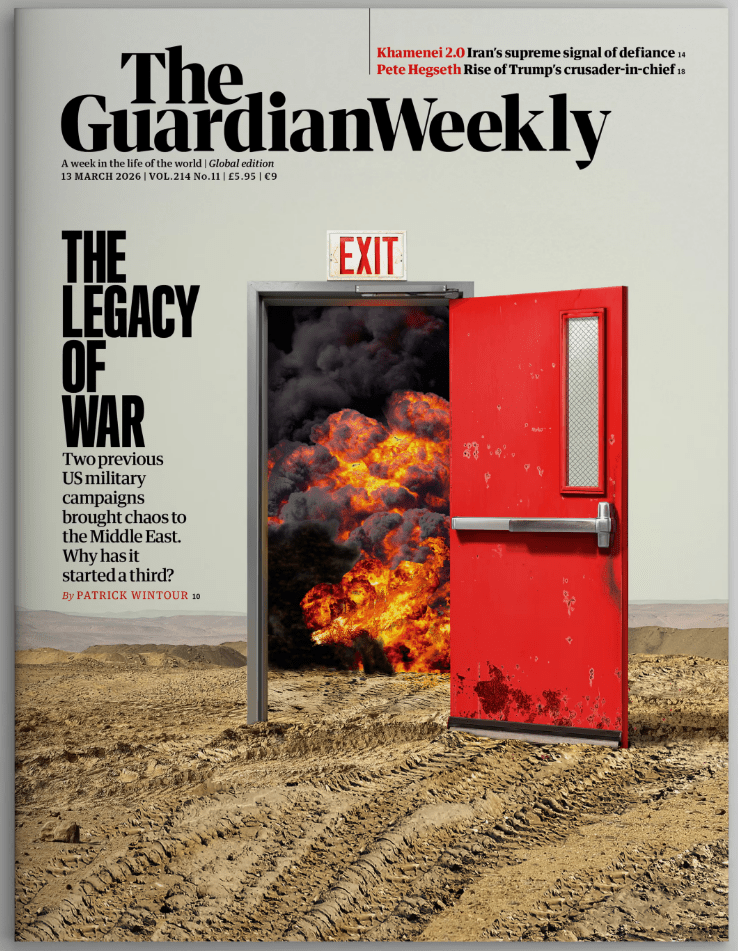
The big story | Continental drift in Munich Europe’s leaders met to discuss the continent’s future safety at the Munich Security Conference, a gathering characterised by mistrust of the US Trump administration and divisions over Ukraine. Patrick Wintour was there
Spotlight | Pressure mounts for Andrew to talk to police As calls for the former prince to cooperate with the investigation become deafening, this may be the reckoning the British king’s brother cannot escape. Caroline DaviesandAlexandra Topping investigate
Interview | Tracey Emin on reputation and radical honesty She scandalised the art world in the 1990s with her unmade bed, partied hard in the 2000s – then a brush with death turned the artist’s life upside down. Now Tracey Emin is as frank as ever, as Charlotte Higgins discovered
Opinion | Iran’s 1979 revolution offers some present-day pointers The similarities between Iran’s current crisis and events preceding the shah’s exile are striking. The radical clerics benefited then – but, asks Jason Burke, who would prevail this time?
Culture | Thundercat on funk, lost friends and being fired by Snoop Dogg The genre-hopping bass virtuoso has backed Ariana Grande and Herbie Hancock, appeared in Star Wars and become a boxer. Stephen Bruner explains his polymath mindset to Alexis Petridis