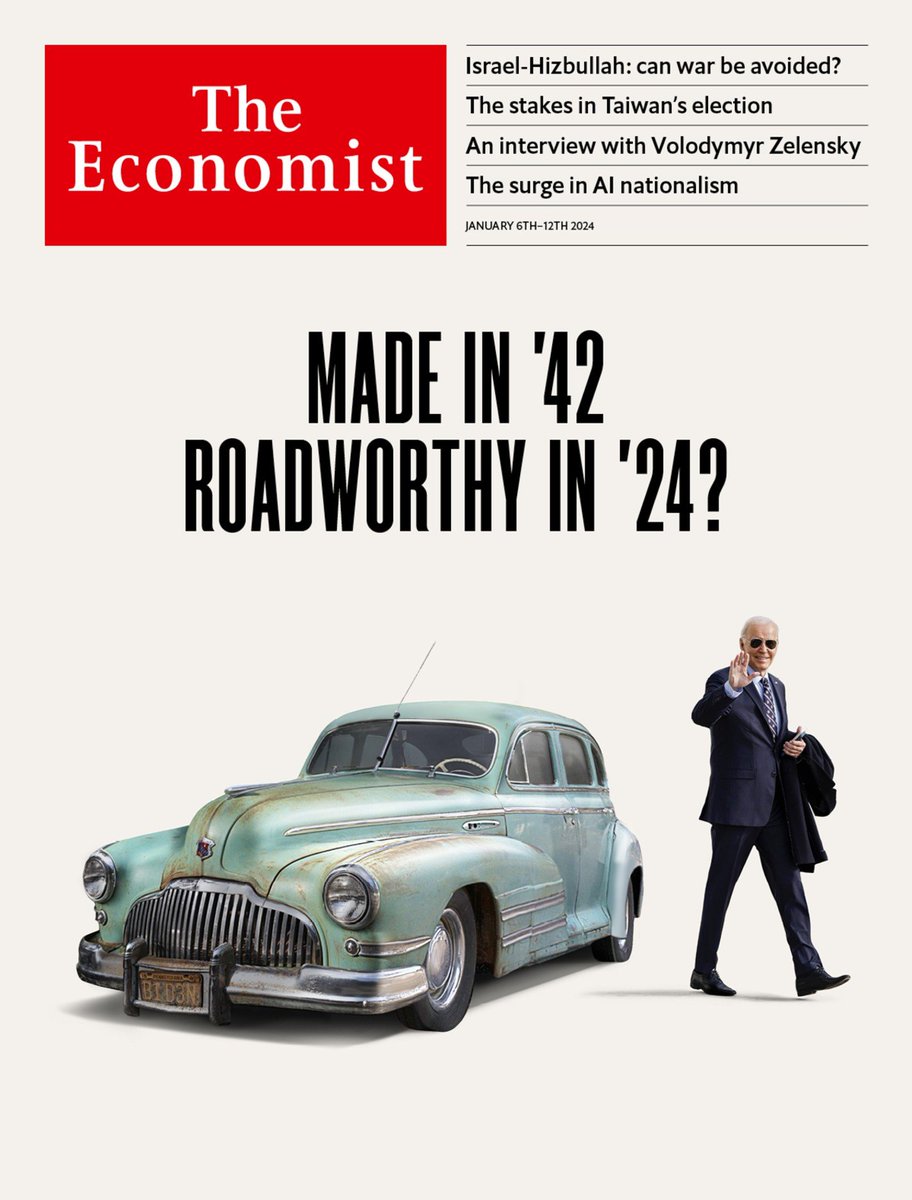
The Economist Magazine (January 4, 2024): The latest issue features‘The man supposed to stop Donald Trump is an unpopular 81-year-old; Israel-Hizbullah – Can war be avoided?; The stakes in Taiwan’s election; An interview with Volodymyr Zelensky; The surge in AI nationalism…
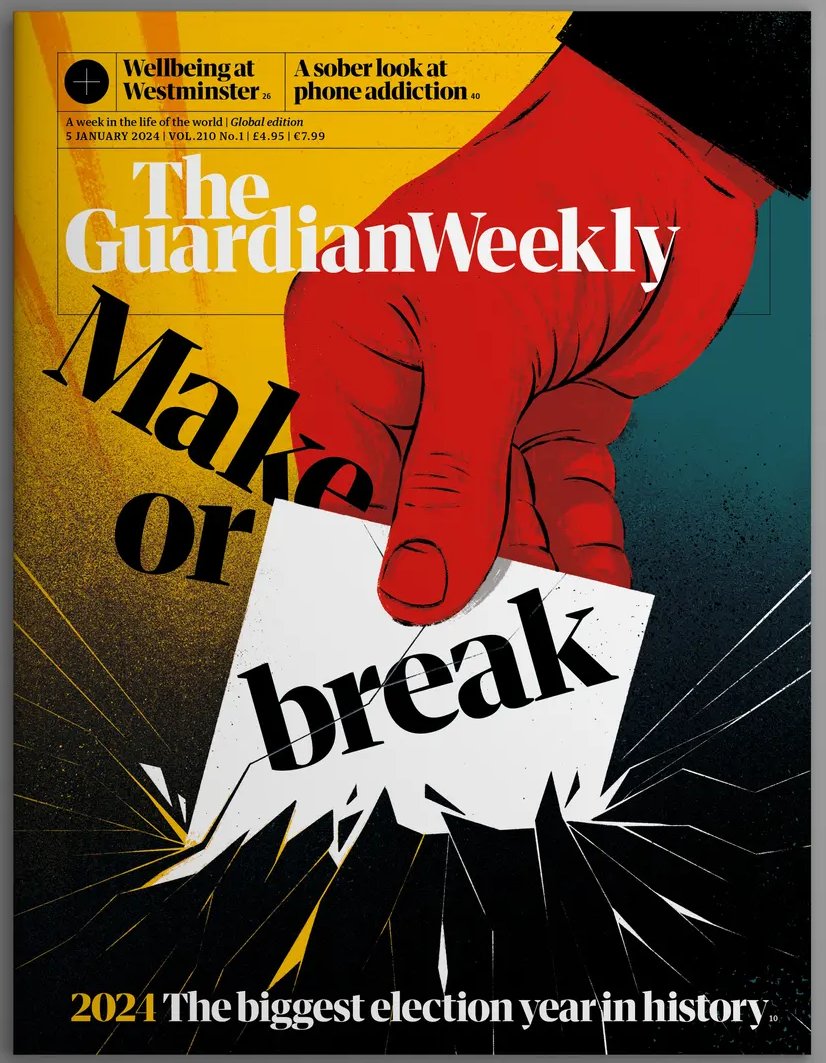
About 2 billion people have the opportunity to cast their ballots in polls that span the globe from the United States to Taiwan, and India to Mexico in 2024. The outcomes, as our analysts and correspondents explain in our big story, have implications for us all.
Washington bureau chief David Smith looks at the likely rerun of 2020’s Biden v Trump contest in November and explores what has changed and what has not in the US as the old adversaries square up. It is an almost foregone conclusion that Narendra Modi will be back for a third term as Indian prime minster, reports Hannah Ellis-Petersen from Delhi where analysts fear his victory will further imperil the country’s Muslim minority. And while Vladimir Putin will certainly continue as president in Russia, Pjotr Sauer explains why the man about to become fifth-time president might allow other candidates onto the ballot list. From Taiwan’s poll on 13 January to the 27-state European elections in June, how citizens vote will influence the geopolitical landscape for us all, while the conduct of campaigns will reveal how vulnerable democracies now are to misinformation and cyber interference from malign actors.
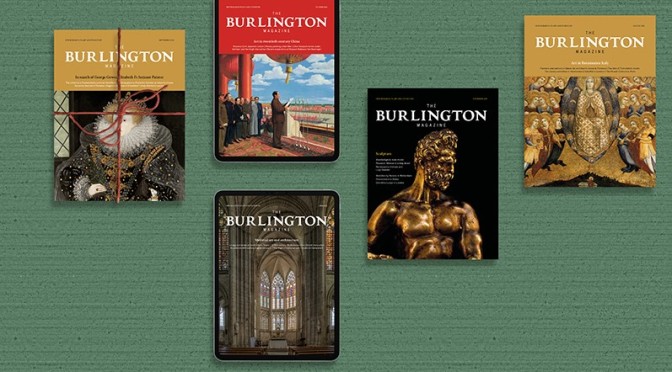
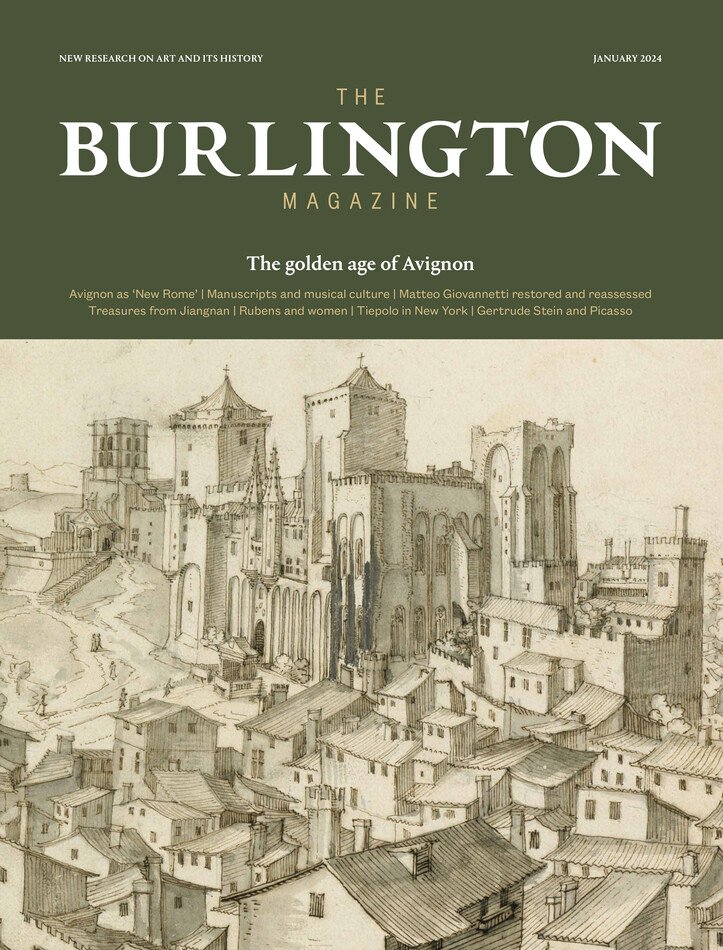
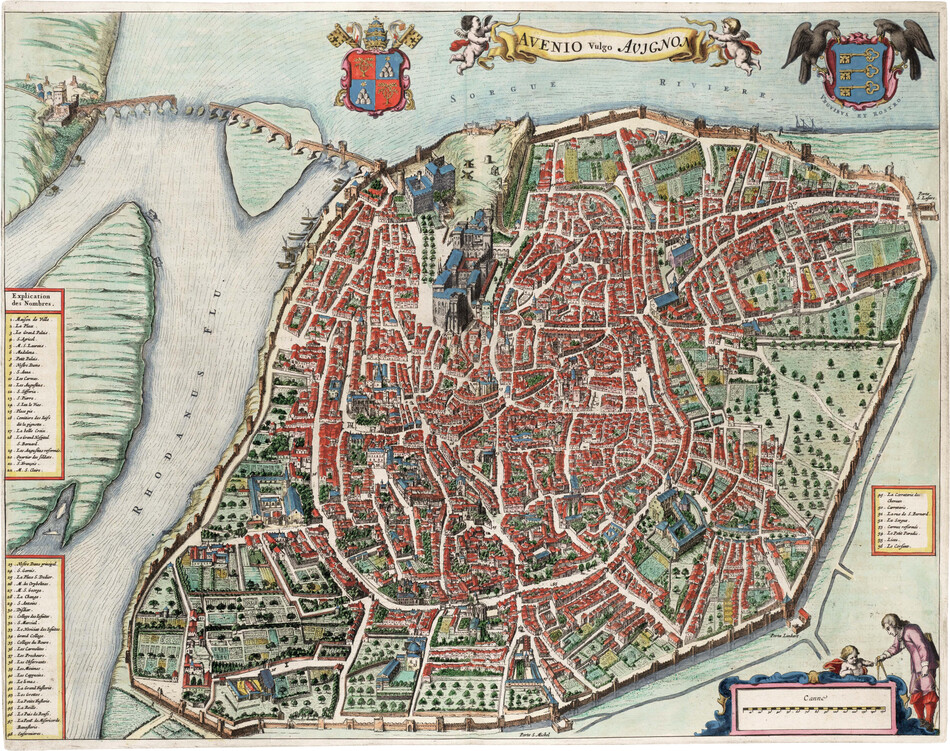
The Burlington Magazine – January 3, 2024:The new issue features ‘The Golden Age of Avignon’ – Avignon as ‘New Rome’; Rubens and women; Tiepolo in New York; Gertrude Stein and Picasso, and more….
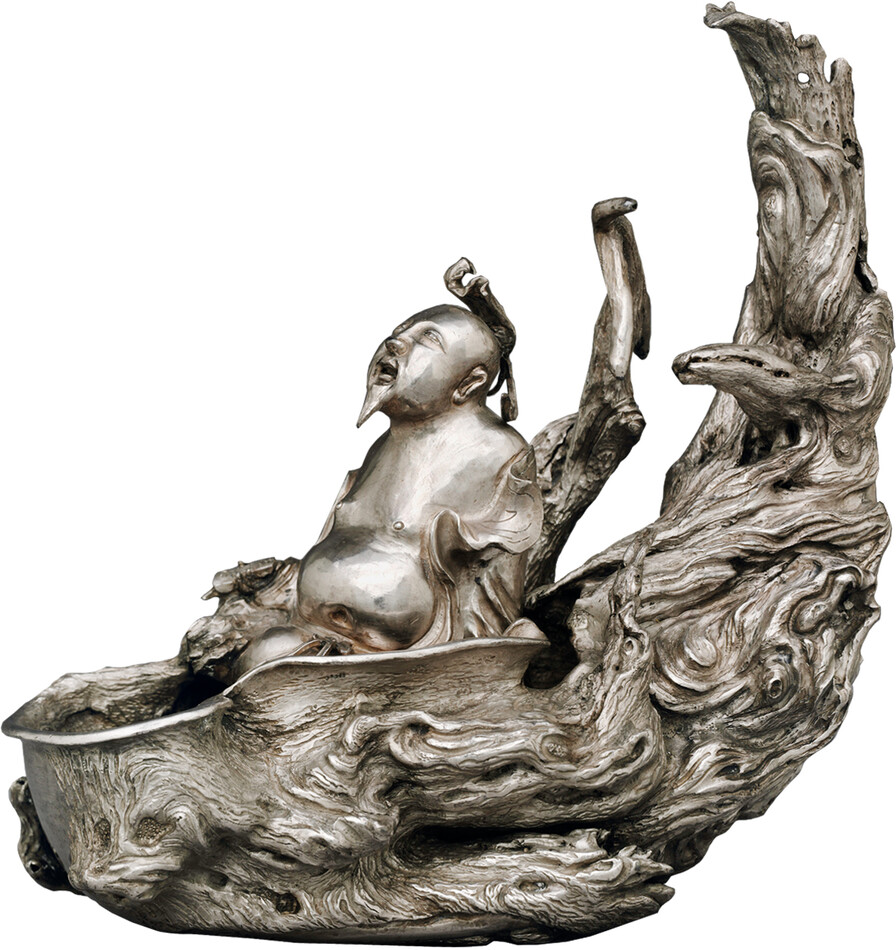
A vivid photograph of a lotus pond ushers visitors into this ambitious exhibition on the arts and culture of Jiangnan. Lying to the south of the Yangtze – its name literally means ‘south of the river’ – this part of China includes such major cities as Shanghai, Hangzhou and Suzhou. Curated by Clarissa von Spee, Chair of Asian Art and the James and Donna Reid Curator of Chinese Art at the Cleveland Museum of Art (CMA), this is the first exhibition outside China to present an encyclopaedic view of the cultural history of this historically affluent region.
Ever since the Walpole Society was founded in London in 1911 ‘with the object of promoting the study of the history of British art’, The Burlington Magazine has taken a close interest in an organisation with aims and principles so close to our own: this is the sixth Editorial we have devoted to the subject. The first, written by the art historian August F. Jaccaci, who edited the Magazine’s ‘Art in America’ section, appeared in 1913 on the occasion of the publication of the first of the annual volumes that are the society’s raison d’être.
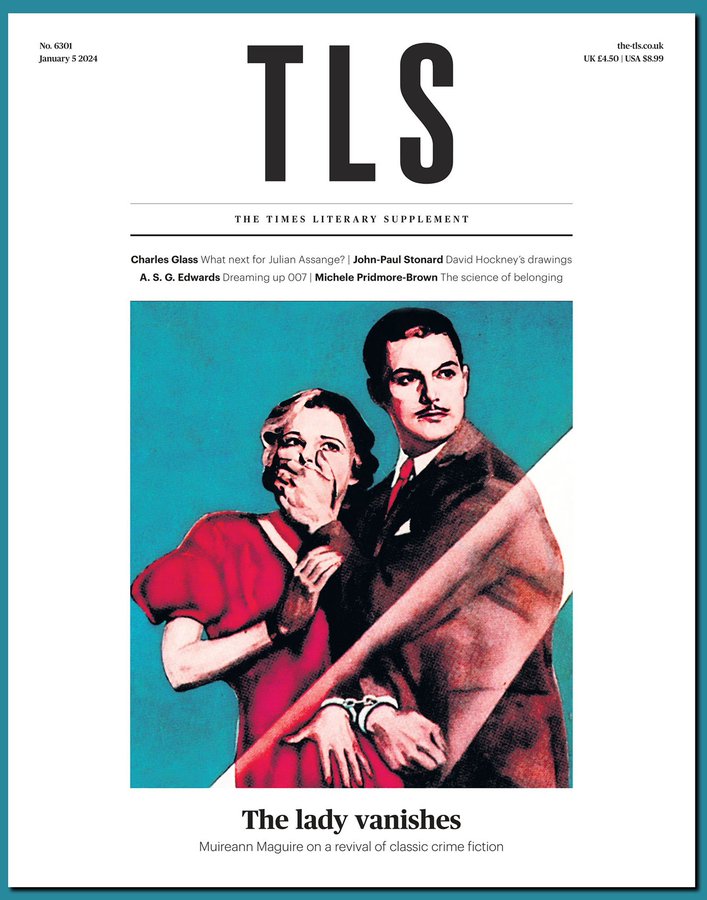
Times Literary Supplement (January 3, 2024): The latest issue features ‘The Lady Vanishes’ – Muireann Maguire on a revival of classic crime fiction; What next for Julian Assange; David Hockney’s drawings; Dreaming up 007; The science of belonging and more…
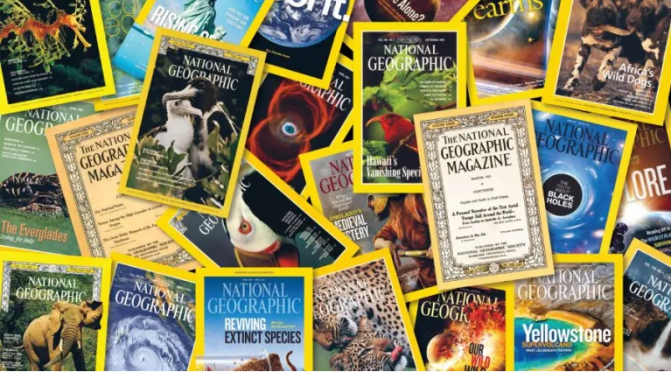
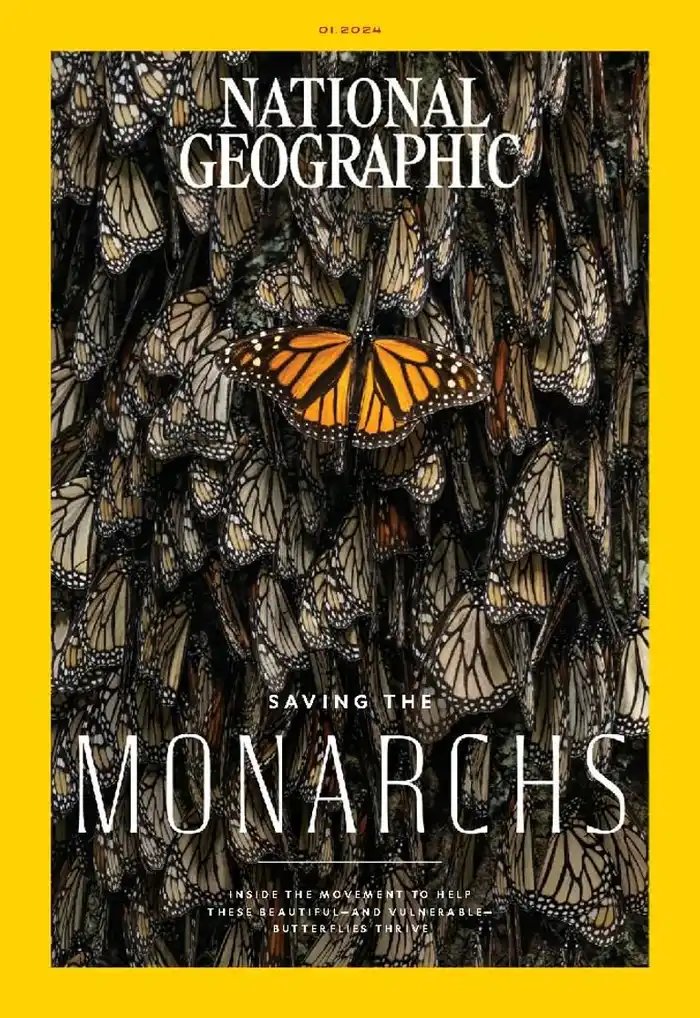
National Geographic Magazine (January 1, 2024) – The new issue features ‘Saving The Monarchs’ – Inside the movement to help these beautiful and vulnerable butterflies thrive; Can monarchs adapt to a rapidly changing world? – Extreme weather and rising temperatures threaten their epic migration, but scientists say targeted habitat restoration can help….
The iconic North American butterfly’s annual migration patterns are under threat from habitat loss and extreme weather, causing its devoted fans to research solutions and push for protection from the Endangered Species Act.
Jasper Doest spent nearly two months photographing the Netherlands’ Rottumeroog, where visitors are usually prohibited and he found a new sense of freedom.
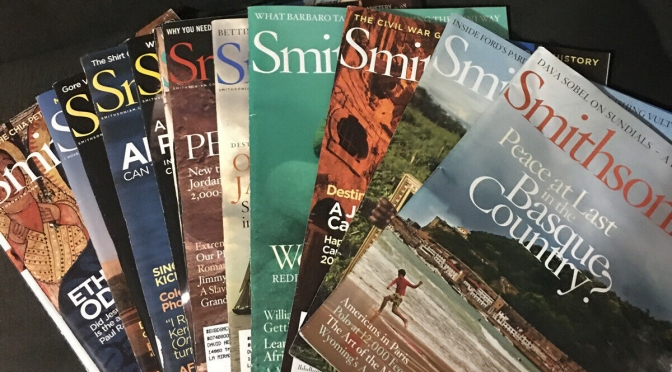
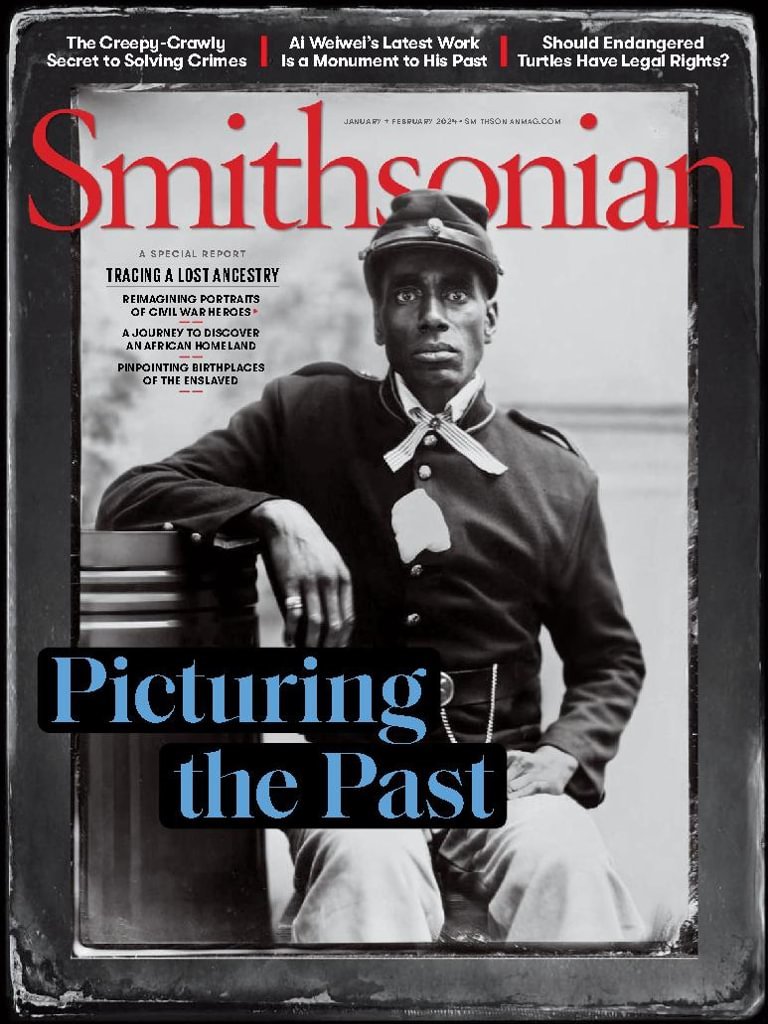
Smithsonian Magazine (January 1, 2024) –The latest issue features ‘Picturing The Past’ – A special report on Tracing A Lost Ancestry; Reimagining Portraits of Civil War Heroes; A Journey to Discover an African Homeland; Pinpointing Birthplaces of the Enslaved, and more…
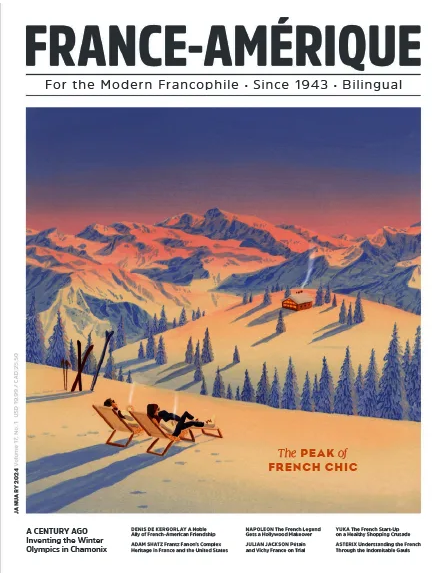
France-Amérique Magazine – December 30, 2023 – The new issue features ‘The Peak of French Chic’; A Century Ago – Inventing the Winter Olympics in Chamonix…
From Washington D.C. to New York City and from New Orleans to Paris, many philanthropic organizations continue to nurture the bonds connecting France and the United States through history, politics, economics, language, and culture.
She fell in love with a future president at 17. Marriage never waylaid her dreams.
By MICHAEL PATERNITI
Three miles lie between this life and another, between their two houses, hers in downtown Plains, Ga., and his family farm in the country surrounded by peanuts planted in red clay. Three miles between the ordinary and extraordinary.
Uncovering the unlikely story behind the singer’s first album.
By JOHN JEREMIAH SULLIVAN
To say that Sinead O’Connor never quite regained the musical heights of her 1987 debut album, “The Lion and the Cobra,” is not to slight the rest of her output, which contained jewels. There is no getting back to a record like that first one. It was in some sense literally scary: The label had to change the original cover art, which showed a bald O’Connor hissing like a banshee cat, for the American release. In the version we saw, she looks down, arms crossed, mouth closed, vulnerable. The music had both sides of her in it.
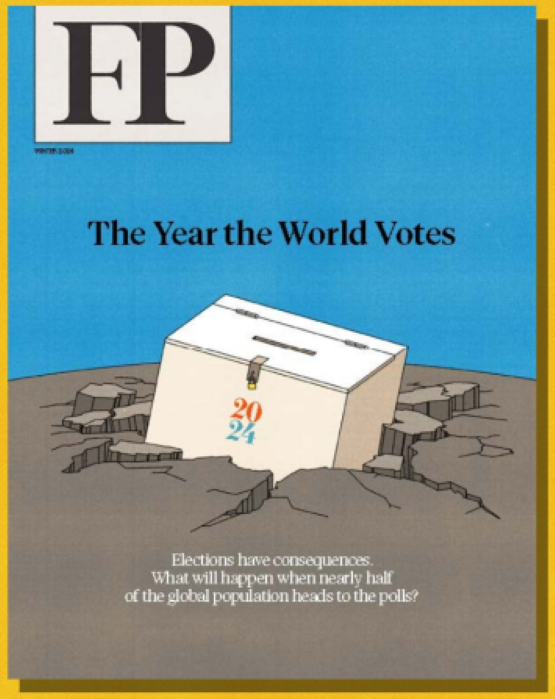
Foreign Policy Magazine – December 28, 2023: The new issue features ‘The Year The World Votes’ – Elections have consequences. What will happen when nearly half of the global population heads to the polls?
The world’s most dismal science could make Eurasia safe for illiberalism and predation—or protect it from those forces.
By Hal Brands, a professor of global affairs at the Johns Hopkins School of Advanced International Studies.
Alexander Dugin is a bit of a madman. The Russian intellectual made headlines in the West in 2022, when his daughter was killed, apparently by Ukrainian operatives, in a Moscow car bombing likely meant for Dugin himself. Dugin would have been targeted because of his unapologetic, yearslong advocacy for a genocidal war of conquest in Ukraine. “Kill! Kill! Kill!” he screeched after Russian President Vladimir Putin’s first invasion of that country in 2014, adding: “This is my opinion as a professor.” Even at his daughter’s funeral, Dugin stayed on message. Among her first words as an infant, he claimed, were “our empire.”
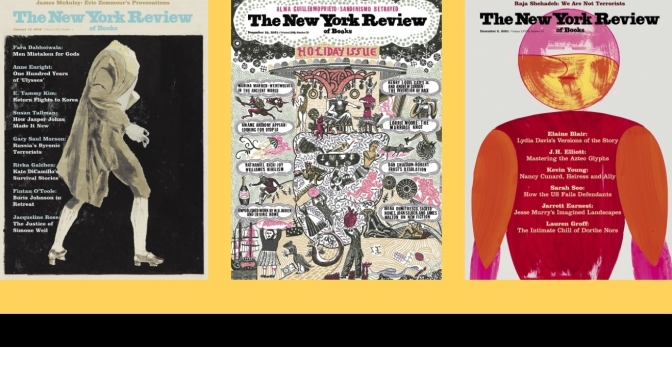
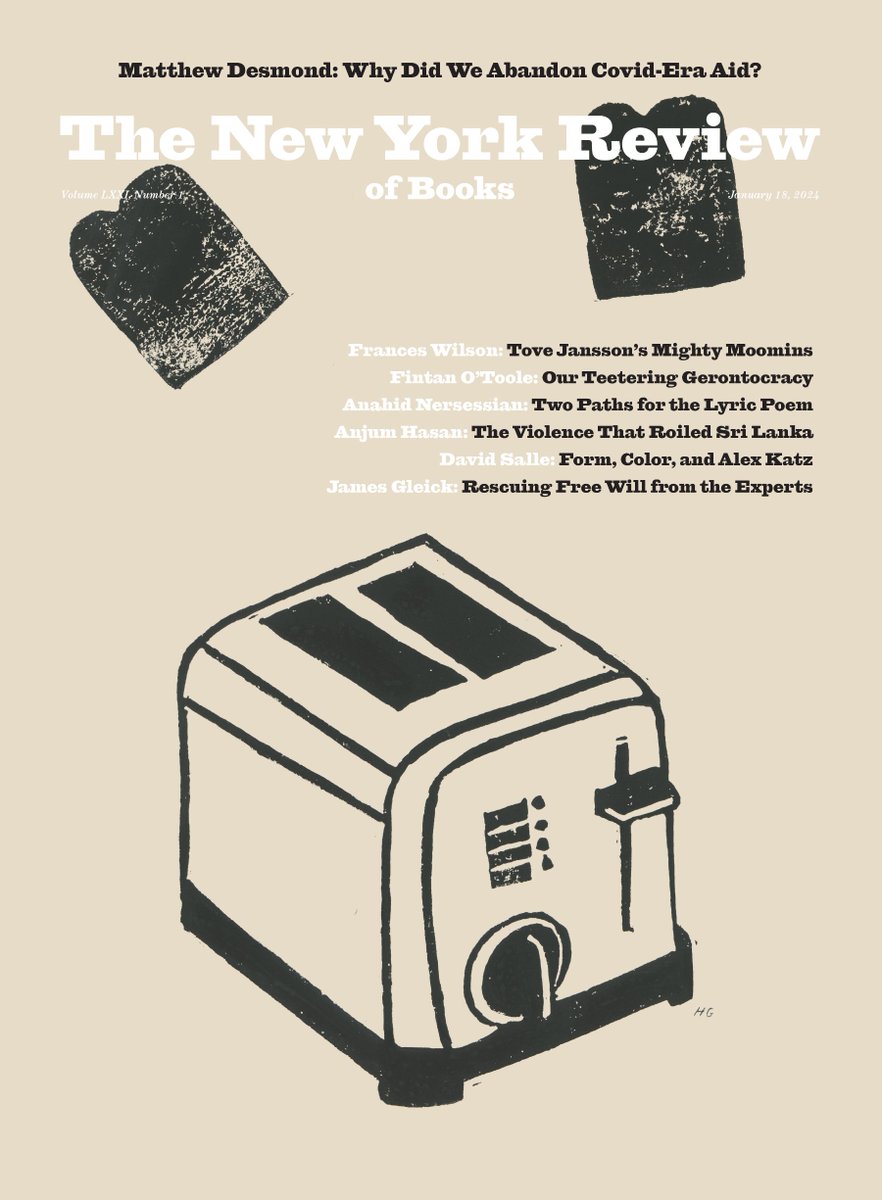
The New York Review of Books (December 28, 2023) – The latest issue featuresBen Tarnoff on Elon Musk, Julian Bell on Peter Paul Rubens, Fintan O’Toole on the American gerontocracy, Anjum Hasan on recent Sri Lankan fiction, Matthew Desmond on America’s Covid-era experiment with a social safety net, Francine Prose on a vampiric celluloid Pinochet, James Gleick on the science of free will, Frances Wilson on Tove Jansson and the Moomintrolls, Álvaro Enrique on indigenous Americans in Europe, Katie Trumpener on Alexander Kluge, two poems by Jack Underwood, and more.
Nobody was holding a gun to your head when you started reading this. You made a choice. Surely it felt that way, at least. A sense of agency—of control over our actions, of continual decision-making—is part of the experience of being human, moment by moment and day by day. True, we sometimes just drift, like robots or zombies, but at other times we gird our loins and exert our will. David Hume defined will nearly three centuries ago as “the internal impression we feel and are conscious of, when we knowingly give rise to any new motion of our body, or new perception of our mind.” The feeling was universal then and it’s universal now.












/https://tf-cmsv2-smithsonianmag-media.s3.amazonaws.com/filer_public/84/75/8475af37-08ad-4be0-8440-c1fafcdba98f/gettyimages-1783943875_web.jpg)







 Boomers Daily