Monocle on Saturday, January 6, 2024: What lasting effect has the Capitol Hill riot had on the US over the past three years? Monocle’s Christopher Chermak discusses how views and memories of that day have changed. How will Asia’s elections this month impact the rest of the world?
Monocle’s Naomi Xu Elegant looks ahead. And is ‘Saltburn’ a perfect satire or does it fall flat? Join journalist Vincent McAviney and Georgina Godwin for a review of the week’s news and culture.
If your Medicare modified adjusted gross income is on the edge of a tax bracket, you could save thousands of dollars a year by keeping it from going over.
Japan was once the world’s hottest stock market, before falling into a decadeslong slumber. It revived in 2023, awakening investors to its long-term potential. How to invest in the country now.
THE NEW YORK TIMES BOOK REVIEW (January 5): The latest issue features ‘Read This And Learn’ – For decades, Juan Rulfo’s novel, “Pedro Páramo,” has cast an uncanny spell on writers. A new translation may bring it broader appeal.
For decades, Juan Rulfo’s novel, “Pedro Páramo,” has cast an uncanny spell on writers. A new translation may bring it broader appeal.
By Valeria Luiselli
Readers of Latin American literature may have heard one of the many versions of this story:
It is 1961 and Gabriel García Márquez has just arrived in Mexico City, penniless but full of literary ambition, trying desperately to work on a new novel. One day, he is sitting in the legendary Café La Habana, where Fidel Castro and Che Guevara were said to have plotted the Cuban Revolution. Julio Cortázar walks in, carrying a copy of Juan Rulfo’s novel “Pedro Páramo.” With a swift gesture, as if he’s dealing cards, Cortázar throws the book on García Márquez’s table. “Tenga, pa que aprenda,” he says. “Read this and learn.”
Early in 1935, a blizzard blew through New York City. The storm was so fierce, it virtually emptied Central Park. But Willa Cather spent her morning there, sledding with the violin prodigy Yehudi Menuhin and his sisters.
Amazing Places on Our Planet (January 5, 2024) – The Maltese Archipelago, located in the middle of the Mediterranean Sea, is made up of three islands: Malta, Gozo, and Comino.
Video timeline:00:00 Gozo Island 07:36 Island of Comino 10:09 Island of Malta 14:54 Valletta and The Three Cities 21:06 More from the Island of Malta
With a history spanning over eight thousand years, the archipelago boasts not only a rich cultural heritage but also stunning landscapes. The seven megalithic temples in Malta were built between 6,000 to 4,500 years ago.
Over the centuries, the Maltese islands have been ruled by various powers, including the Phoenicians, Carthaginians, Greeks, Romans, Arabs, Normans, Aragonese, the Order of the Knights of St John, French, and British. Malta has three Unesco Heritage Sites and seven on the Tentative List.
The Wall Street Journal (January 5, 2024) – Iran-backed groups connect to form a land bridge across the Middle East and form an alliance that Tehran calls the ‘Axis of Resistance.’ This land bridge can be used to transport equipment and personnel, but also allows for positions in Iraq and Syria to attack U.S. interests or threaten Israel closer to its borders.
Video timeline: 0:00 ‘Axis of Resistance’ 0:37 Iran’s allies 1:44 Iran’s history 3:22 U.S. in the Middle East 4:14 Attacks since Oct. 7
WSJ explains what to know about the alliance that includes Hamas in Gaza, Hezbollah in Lebanon and the Houthis in Yemen.
THE NEW YORK TIMES MAGAZINE (January 5, 2024): The new issue features “Letting Naomi Die” – Treatment wasn’t helping her anorexia, so doctors allowed her to stop, no matter the consequences. But is a ‘palliative’ approach to mental illness really ethical?
Treatment wasn’t helping her anorexia, so doctors allowed her to stop — no matter the consequences. But is a “palliative” approach to mental illness really ethical?
By Katie Engelhart
The doctors told Naomi that she could not leave the hospital. She was lying in a narrow bed at Denver Health Medical Center. Someone said something about a judge and a court order. Someone used the phrase “gravely disabled.” Naomi did not think she was gravely disabled. Still, she decided not to fight it. She could deny that she was mentally incompetent — but this would probably just be taken as proof of her mental incompetence. Of her lack of insight. She would, instead, “succumb to it.”
What If People Don’t Need to Care About Climate Change to Fix It?
By David Marchese
“It seems like we’ve been battling climate change for decades and made no progress,” Dr. Hannah Ritchie says. “I want to push back on that.” Ritchie, a senior researcher in the Program on Global Development at the University of Oxford and deputy editor at the online publication Our World in Data, is the author of the upcoming book, “Not the End of the World.” In it, she argues that the flood of doom-laden stats and stories about climate change is obscuring our ability to imagine solutions to the crisis and envision a sustainable, livable future.
The Globalist Podcast (January 5, 2024) – A discussion of the effect of the Israel-Gaza war on Lebanon and the potential for a broader fallout after a series of Israeli strikes on Hezbollah.
Also, the latest on Russia’s war in Ukraine, following the biggest prisoner swap since the beginning of the invasion. Plus: Louis Vuitton’s first luxury hotel, film news and Helsinki’s annual light-art festival.
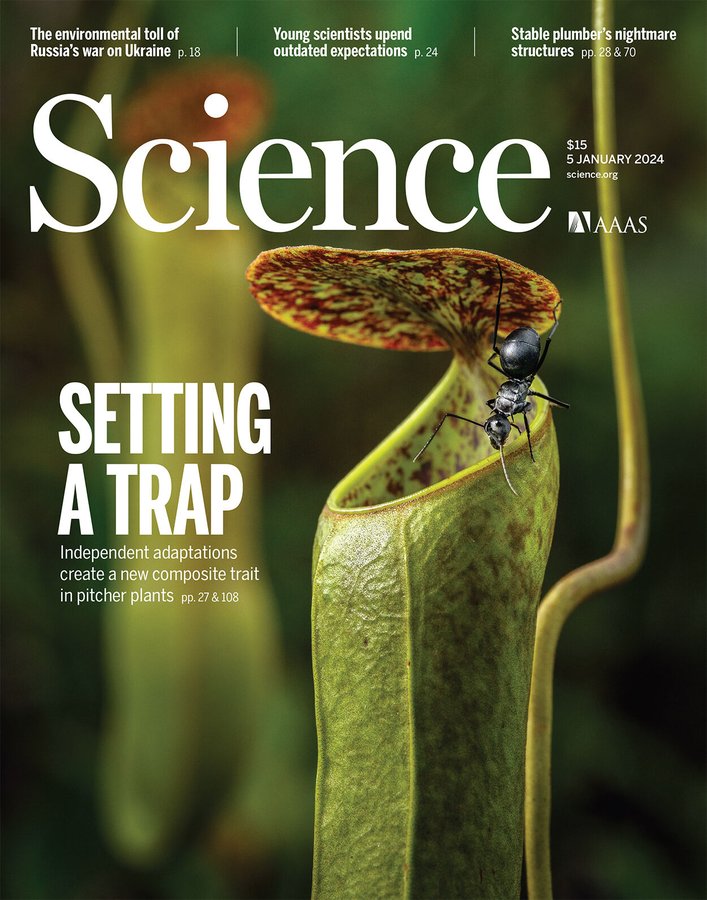
Science Magazine – December 21, 2023: The new issue featuresa carnivorous Nepenthes gracilis pitcher plant luring an ant into a precarious position under the roof-like trap lid.
The Economist (January 4, 2024) – A new wave of artificial intelligence is starting to transform the way the entertainment industry operates. Who will be the winners and losers?
Video timeline: 01:07 AI is changing the music business 04:09 How big data revolutionised entertainment industries 05:20 Can AI predict a film’s success? 09:26 How generative AI is creating new opportunities 12:36 What are the risks of generative AI?
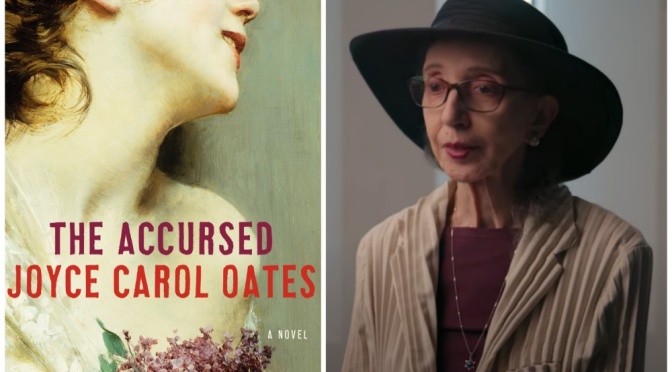
Louisiana Channel (January 4, 2024) – When writing, Joyce Carol Oates writes about people, often about a family, because “the family unit to me is like the nexus of all emotion, and people derive their meaning from the position in families,” she says.
Video timeline:0:00 On preferred subjects for writing 3:20 On Karen Blixen /Isak Dinesen 4:24 On families 6:54 On the mother figure 9:00 On the novel ‘Babysitter’ 17:27 On the novel ‘Night. Sleep. Death. And the Stars’ 22:48 How traveling resembles writing 28:47 On Donald Trump
“What is so exciting about the novel is that it mimics life and that you end up doing something you never thought you would do,” says Joyce Carol Oates, one of America’s greatest living novelists, when looking back on a life of writing.
It might be a violent event or something politically relevant, or it could be a racist experience that sets off a novel. In her storytelling, Oates finds it interesting to focus on girls at the beginning of puberty: “There’s a kind of wonderful neutrality of childhood that gets conditioned out when girls get to be 12 – 14 years old. And then, from that point on, when they’re so shaped by what we call the male gaze and the expectations of others that they grow into being someone who is this female image.”
But today, the family is very different and there are all kinds of families: “There are families of same-sex couples who got married and they may adopt a child or they may have a child of their own, but then there may be families that are like communes where people are living, sharing a house, but they are a family and they may have dogs and cats who know who they are. […] The so-called nuclear family – which is just a father, mother, and children – still exists, of course, but it’s not the only example of any longer, which is wonderful. It all begins with the emancipation of women”, Joyce Carol Oates concludes.
Oates feels attracted to writing because writing is storytelling and “what’s interesting about storytelling is that you have to have revelations. That you start off with a situation, and a little bit of a mystery evolves, and then you have to follow the tendrils and the roots of that mystery, like an investigator. And then there has to be a revelation.” This means that Oates focuses a lot in her writing on the pacing and the suspense and the movement, like “how long is a paragraph, how short is the dialogue, and how much dialogue is there in proportion to the exposition, and the craftsman side of writing is actually where many people write.“
News, Views and Reviews For The Intellectually Curious

















 The Wall Street Journal








 Boomers Daily