Tag Archives: Italy

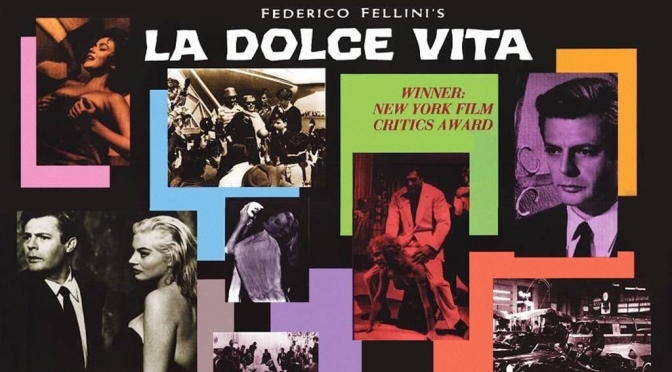
Film History: Federico Fellini’s “La Dolce Vita” (1960) At 60 Years (Video)

La Dolce Vita (“the sweet life” or “the good life”) is a 1960 comedy-drama film directed and co-written by Federico Fellini. The film follows Marcello Rubini (Marcello Mastroianni), a journalist writing for gossip magazines, over seven days and nights on his journey through the “sweet life” of Rome in a fruitless search for love and happiness. La Dolce Vita won the Palme d’Or (Golden Palm) at the 1960 Cannes Film Festival[ nd the Oscar for Best Costumes. The film was a worldwide box-office success.

From Wikipedia

Food & Drink: Prosecco – A Very “Sophisticated” Sparkling Wine These Days

From a UK The Week online article:

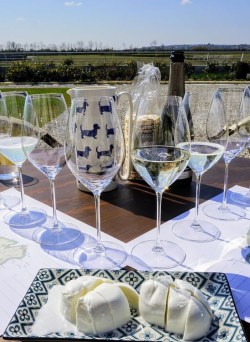
Visit Prosecco Italy Tasting Facebook PageWhile all their Proseccos are exceptional, it’s their Brut that blows everyone away. It recaptures a tantalising hint of the yeast I so loved from the Rifermentato in Bottiglia, all sharp apples and sourdough.

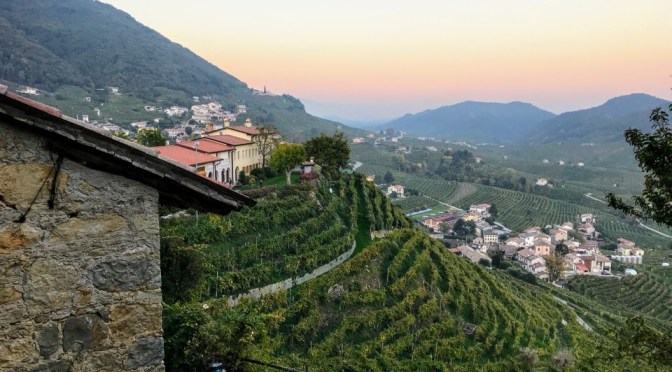
Tucked between the formidable fingers of the Dolomites and the enduring opulence of Venice is an overlooked area of Italian countryside. Its steep verdant hills and serene cobble-stone towns won’t be found on any tourist maps – but you will find their handiwork on just about every menu in the UK.

This is Prosecco country: the land that gave us all-you-can-sip sparkle. It’s easy to forget between the 6th and 7th bottomless brunch glass that someone, somewhere actually crafted this world-conquering wine. But craft it they do – carefully, consistently and often quickly – and what the UK sees is a mere price-prioritised glimpse of Prosecco’s true scope.

Read full article

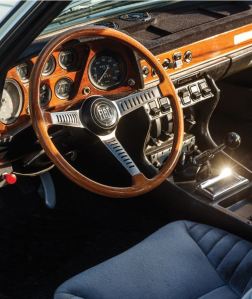
Classic Car Nostalgia: “1970 Fiat Dino 2400 Coupé”

From Wikipedia:

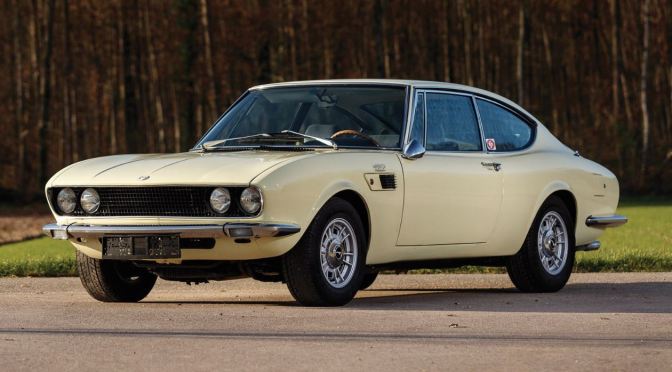
1970 Fiat Dino 2400 Coupé Interior Classic DriverThe Fiat Dino (Type 135) was a front-engine, rear-wheel-drive sports car produced by Fiat from 1966 to 1973. The Dino name refers to the Ferrari Dino V6 engine, produced by Fiat and installed on the cars to achieve the production numbers sufficient for Ferrari to homologate the engine for Formula 2 racing.

Fiat Dino 2400, 1969–1973

1970 Fiat Dino 2400 Spider – In 1969, both Ferrari and Fiat introduced new 2.4-litre Dino models. The Fiat Dino 2400 premiered in October 1969 at the Turin Motor show; besides the larger engine, another notable improvements was independent rear suspension.[8] The V6 now put out 180 PS (132 kW; 178 hp), and used a cast iron instead of the previous light alloy engine block; the same engine was installed on the Dino 246 GT, Ferrari’s evolution of the 206. Whereas the original Dino was equipped with a rigid axle suspended by leaf springs and 4 shock absorbers, 2.4-litre cars used a coil-sprung independent rear suspension with 2 shock absorbers derived from the Fiat 130. Rather than engine power and absolute speed, the most important consequence of the larger displacement was a marked increase in torque, available at lower engine speeds; the Dino 2400 had much better pickup, and it was found more usable, even in city traffic.

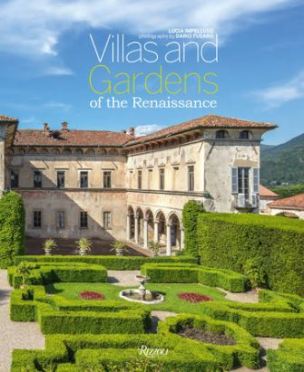
Travel & Photography: “Villas And Gardens Of The Renaissance” (Rizzoli)

Rizzoli New York Publishers logoAn historical text introduces each property, giving an overview of its origins. The villas have been specially photographed for this book by Dario Fusaro, with views of both the palace interiors and their grounds, as well as the gardens, glimpses of the halls, details of the furnishings, and a focus on the frescoes, where still preserved. Explanatory text offers insights on the most Villas and Gardens of the Renaissance Photographed by Dario Fusaro, Text by Lucia Impelluso Rizzoli 2019interesting frescoes, such as those of Veronese at Villa Barbaro. For the first time, Fusaro also employs a drone with the purpose of capturing the architectural structure and elements of each Italian Renaissance garden, from above and as a whole.

A stunning collection of photographs celebrating the excellence of the Italian Renaissance period through palaces and gardens built between the fifteenth and sixteenth centuries.

The book illustrates nine locations of extraordinary artistic and architectural interest, conceived by prominent Italian families and dynasties as urban villas or country houses centered around the pursuit of entertainment and leisure. These lavishly decorated and frescoed palaces are adorned with handcrafted furniture and works of art and surrounded by gardens that retain their original layout to this day–a very rare feature.

To read more and/or purchase: https://www.rizzoliusa.com/book/9788891821324

Classic Car Nostalgia: The “1965 ASA 1000 GT” Was A “Ferrarina” (Little Ferrari)

From Wikipedia:

1965 ASA 1000 GT Classic Driver December 2019The ASA 1000 GT originated in a late 1950s experimental project by Ferrari engineers to create a less expensive, compact alternative to existing Ferrari GT cars. This project was designated “854” by the factory (for 850cc, 4 cylinders), however it was commonly but unofficially named “Ferrarina,” meaning “Little Ferrari.”[3]

ASA (Autocostruzioni Società per Azioni) was an Italian automobile manufacturer active from 1961 to 1969, who is known for manufacturing the ASA 1000 GT. This car was developed by Ferrari engineers in the late 1950s as a less expensive, compact alternative to existing Ferrari GT cars. ASA used inline-four and straight-six engines derived from the “250” 3-litre V12 designed by Gioacchino Colombo. The chassis was developed Giotto Bizzarrini, and derived from the tubular frame of the 250 GTO.

The prototype that would become the ASA 1000 GT was first presented by Carrozzeria Bertone (Geneva 1961) under the name “Mille”. Following this debut in late 1961, Enzo Ferrari decided to not sell the new car as a Ferrari and entrusted production to a close friend, Oronzio de Nora. The car was manufactured in Milan by a newly formed company called ASA (owned by the De Nora Electrochemical Group) from 1964 to 1969. The 1000 GT model was officially introduced in 1962, but due to production difficulties series production did not begin until 1964.[1][2]

Photos from Classic Driver: https://www.classicdriver.com/en/car/asa/1000-gt/1965/725030

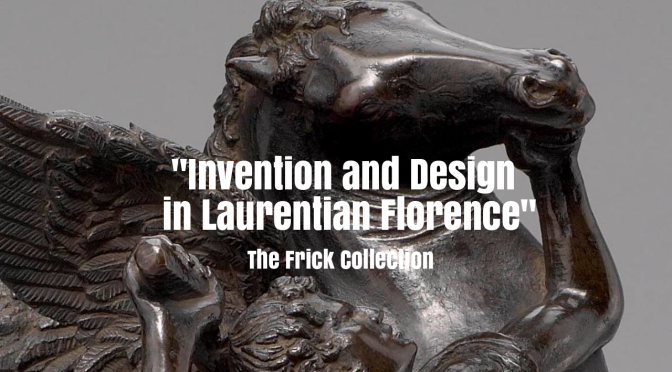
Art: “Invention And Design In Laurentian Florence” (Frick Collection Video)

https://www.youtube.com/watch?v=BRPxbqsB6IE

“Invention and Design in Laurentian Florence”

Patricia Lee Rubin Institute of Fine Arts, New York University

The promotion of Florentine excellence in all of the arts was a mainstay of Lorenzo de’ Medici’s cultural politics. Bertoldo di Giovanni’s sculptural production took place in a context of intense creative competition, resulting in works that are innovative, inventive, and beautiful, qualities explored in this lecture. This lecture is funded by Dino and Raffaello Tomasso.

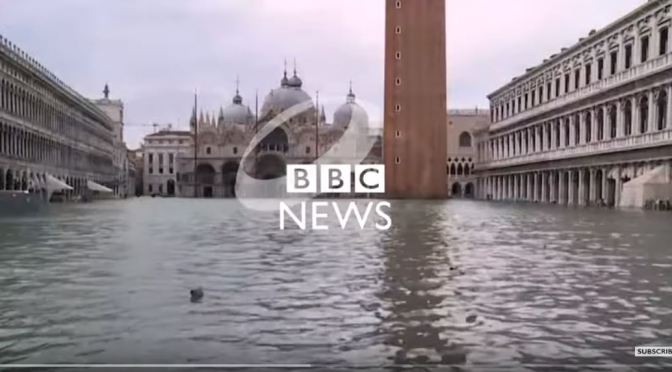
Travel: “The Fight To Stop Venice From Flooding” (BBC News Video)

t’s a month since high tides struck Venice, causing devastating flooding. The city’s mayor estimated damage at over a billion euros.

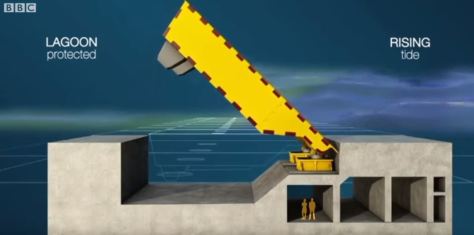
A system of floodgates called MOSE, under construction for years, should have prevented the disaster. But it’s been delayed and mired in corruption.

The fight to stop Venice from flooding BBC News Video Dec 18 2019

So is MOSE the lifeline Venice needs – or is it doomed to failure?

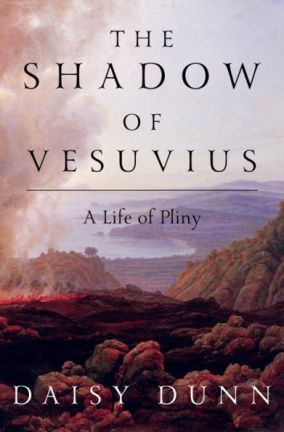
New Biographies: “The Shadow Of Vesuvius -A Life Of Pliny” By Daisy Dunn

The Shadow of Vesuvius A Life of Pliny by Daisy Dunn Dec 2019When Pliny the Elder perished at Stabiae during the eruption of Vesuvius in 79 AD, he left behind an enormous compendium of knowledge, his thirty-seven-volume Natural History, and a teenaged nephew who revered him as a father. Grieving his loss, Pliny the Younger inherited the Elder’s notebooks—filled with pearls of wisdom—and his legacy. At its heart, The Shadow of Vesuvius is a literary biography of the younger man, who would grow up to become a lawyer, senator, poet, collector of villas, and chronicler of the Roman Empire from the dire days of terror under Emperor Domitian to the gentler times of Emperor Trajan. A biography that will appeal to lovers of Mary Beard books, it is also a moving narrative about the profound influence of a father figure on his adopted son. Interweaving the younger Pliny’s Letters with extracts from the Elder’s Natural History, Daisy Dunn paints a vivid, compellingly readable portrait of two of antiquity’s greatest minds.

Classic Car Nostalgia: “1968 Triumph TR6” – 1st Year (Classic Driver)

From a Classic Driver online listing:
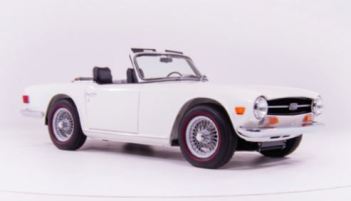
1968 Triumph TR6 Classic Driver

Offered as an affordable, six-cylinder sports car, the first Triumph TR6 rolled off the production line in 1968 as a 1969 model. It’s intended target was to rival similar sports cars at the time, and although most were designed with sleek, curved lines, the TR6 was squared off at both ends, making it stand out from it’s competitors. With just a seven year production span, the TR6 grew to become a true British classic.

The Triumph TR6 was offered as a convertible only, with a factory steel hard top available optionally.

Triumph produced a range of TR models, from the TR1 right up to a limited run of the TR8, but it was the sixth car in the range that really stood out from a sales point of view. The TR5 enjoyed a very brief thirteen-month period of manufacture between 1967 and 1968. Less than 3,000 units were produced before the TR6 came in to improve on many of the specifications. Unlike its predecessors, the Triumph TR6 was more reliable mechanically, which means that there are many original models still on our roads.

Website: https://www.classicdriver.com/en/car/triumph/tr6/1968/723270

Motor Scooter Nostalgia: “1968 Lambretta 125 E” (Classic Driver)

Description from a Wikipedia listing:

1968 Lambretta 125 EAlong with the Vespa, Lambretta was an iconic vehicle of the 1950s and 1960s when they became the adopted vehicle of choice for the UK youth-culture known as Mods. The character Jimmy from the influential scooter movie Quadrophenia rode a Lambretta Li 150 Series 3. Of the 1960s models, the TV (Turismo Veloce), the Special (125 and 150), the SX (Special X) and the GP (Grand Prix) are generally considered the most desirable due to their increased performance and refined look; the “matte black” fittings on the GP model are said to have influenced European car designs throughout the 1970s. These three models came with a front disc brake made by Campagnolo. The TV was the world’s first production two-wheeled vehicle with a front disc brake.

Pictures from Classic Driver: https://www.classicdriver.com/en/bike/lambretta/125-e/1968/478697

To read more: https://en.wikipedia.org/wiki/Lambretta