Tag Archives: Art History

Art: “Before Pennsylvania Station” By American Realist Painter George Bellows (1882-1925)

George Bellows, Pennsylvania Station Excavation, c. 1907–08, oil on canvas, 79.2 x 97.1 cm (Brooklyn Museum), a Seeing America video.

Smarthistory LogoSpeakers: Dr. Margarita Karasoulas, Assistant Curator, American Art, Brooklyn Museum and Dr. Steven Zucker

Website

George Wesley Bellows (August 12 or August 19, 1882 – January 8, 1925) was an American realist painter, known for his bold depictions of urban life in New York City. He became, according to the Columbus Museum of Art, “the most acclaimed American artist of his generation”.

Bellows first achieved widespread notice in 1908, when he and other pupils of Henri organized an exhibition of mostly urban studies. While many critics considered these to be crudely painted, others found them welcomely audacious, a step beyond the work of his teacher. Bellows taught at the Art Students League of New York in 1909, although he was more interested in pursuing a career as a painter. His fame grew as he contributed to other nationally recognized juried shows.

Bellows’ urban New York scenes depicted the crudity and chaos of working-class people and neighborhoods, and satirized the upper classes. From 1907 through 1915, he executed a series of paintings depicting New York City under snowfall. In these paintings Bellows developed his strong sense of light and visual texture,[14] exhibiting a stark contrast between the blue and white expanses of snow and the rough and grimy surfaces of city structures, and creating an aesthetically ironic image of the equally rough and grimy men struggling to clear away the nuisance of the pure snow. However, Bellows’ series of paintings portraying amateur boxing matches were arguably his signature contribution to art history.[11] They are characterized by dark atmospheres, through which the bright, roughly lain brushstrokes of the human figures vividly strike with a strong sense of motion and direction.
Pennsylvania Station New York City

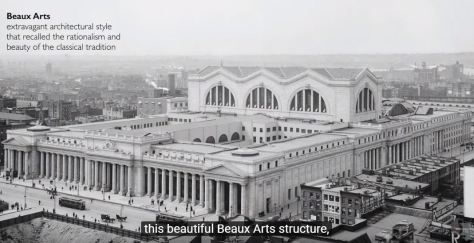
Pennsylvania Station, also known as New York Penn Station or Penn Station, is the main intercity railroad station in New York City and the busiest in the Western Hemisphere, serving more than 600,000 passengers per weekday as of 2019.mPenn Station is in Midtown Manhattan, close to Herald Square, the Empire State Building, Koreatown, and Macy’s Herald Square. Entirely underground, the station is located in Midtown South beneath Madison Square Garden, between Seventh and Eighth Avenues, and between 31st and 33rd Streets, with additional exits to nearby streets.

Penn Station has 21 tracks fed by seven tunnels (the two North River Tunnels, the four East River Tunnels, and the single Empire Connection tunnel). It is at the center of the Northeast Corridor, a passenger rail line that connects New York City with Boston, Philadelphia, Washington, D.C., and intermediate points. Intercity trains are operated by Amtrak, which owns the station, while commuter rail services are operated by the Long Island Rail Road (LIRR) and NJ Transit (NJT). Connections are available within the complex to the New York City Subway, and buses. An underground passageway formerly provided an indoor connection with the 34th Street–Herald Square subway station and 33rd Street PATH station.[7]

Penn Station is named for the Pennsylvania Railroad (PRR), its builder and original tenant, and shares its name with several stations in other cities. The current facility is the remodeled underground remnant of the original Pennsylvania Station, a more ornate station building designed by McKim, Mead, and White and considered a masterpiece of the Beaux-Arts style. Completed in 1910, it enabled direct rail access to New York City from the south for the first time. Its head house was torn down in 1963, galvanizing the modern historic preservation movement.[8] The rest of the station was rebuilt in the following six years, while retaining most of the rail infrastructure from the original station.
From Wikipedia

Art History Podcasts: “Understanding the Medieval World through Books” (Getty Museum)

Getty Museum PodcastsWhat was the world like from 500 to 1500 CE? This period, often called medieval or the Middle Ages in European history, saw the rise and fall of empires and the expansion of cross-cultural exchange.
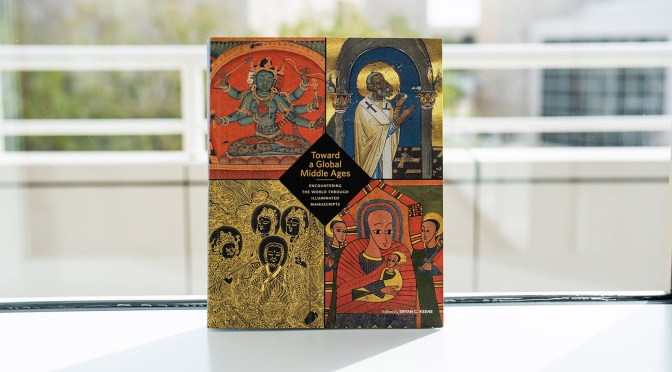
Getty curator Bryan C. Keene argues that illuminated manuscripts and decorated texts from Africa, Asia, Australasia, the Americas, and Europe are windows through which we can view the interconnected history of humanity. In this episode, he discusses his recent book Toward a Global Middle Ages: Encountering the World through Illuminated Manuscripts, highlighting the challenges and opportunities of the emerging discipline known as the Global Middle Ages.

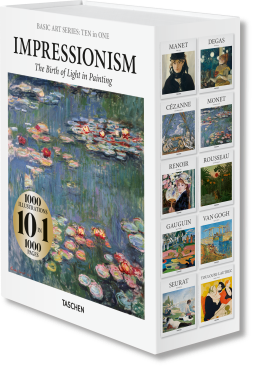
Top New Art Books: “Ten In One – The Impressionists” (Taschen, March 2020)

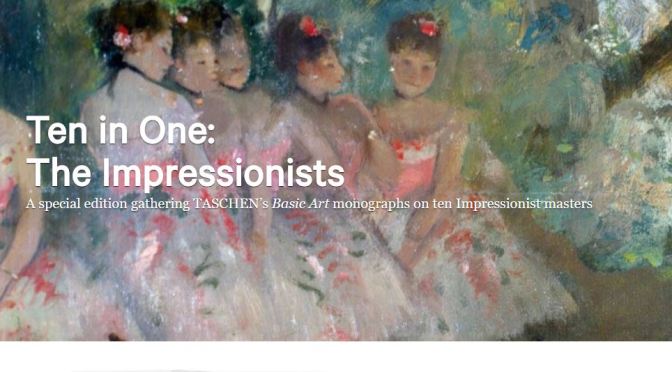
Ten In One Impressionism The Birth of Light in Painting Taschen March 2020The lives and oeuvres of Impressionist pillars Cézanne, Degas, Gauguin, Manet, Monet, Renoir, Rousseau, Seurat, Toulouse-Lautrec, and van Gogh are each explored in-depth in TASCHEN’s Basic Art series. Now, this volume combines all 10 monographs into one for the price of three.
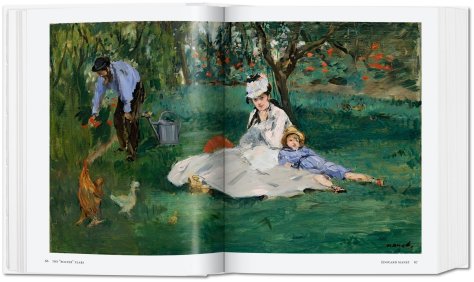
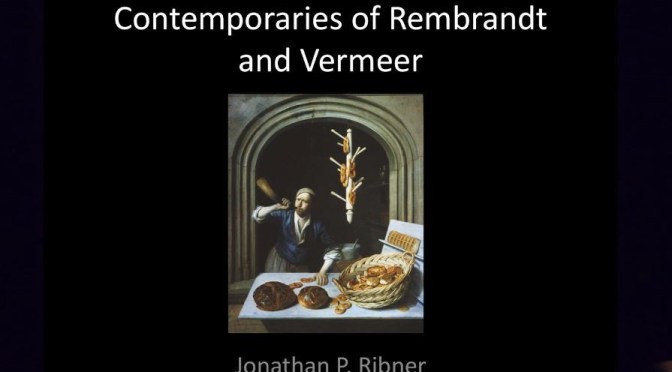
“These seductive books have slick production values, excellent illustrations, and smart texts. Each one is a fast-food, high-energy fix on the topic at hand.” – The New York Times Book Review

This book gathers ten Basic Art monographs into one volume featuring:

  • Cézanne, Degas, Gauguin, Manet, Monet, Renoir, Rousseau, Seurat, Toulouse-Lautrec, and van Gogh
  • a detailed chronological summary of the life and oeuvre of each artist, covering their cultural and historical importance
  • approximately 1,000 illustrations with explanatory captions

Ten In One Impressionism The Birth of Light in Painting Taschen March 2020

With blockbuster exhibitions, record-breaking auction prices, and packed museums, Impressionism remains close contender for the world’s favorite period of painting. Its favorite subjects— from dappled harbor scenes and summer days to vibrant Parisian salons and gardens—brim with optimism and joie de vivre. The works once dismissed as unfinished or imprecise are now beloved for their atmospheric evocation of time and place, as well as the stylistic flair of rapid brushstrokes upon canvas.

What we take for granted today—the relativity of perception depending on the viewer, lighting mood, or location to the object—was then the inspiration for some of the finest paintings in art history. Consider Monet’s 30+ variations of the Rouen Cathedral, Cézanne’s dazzling experimentation with color, Gauguin’s primitivist innovations, or Manet’s scandalous nudes: rarely has a single genre produced so many brilliant artists in such a short time.

Since 1985, TASCHEN’s Basic Art series has published some 200 individual volumes, making it the world’s most successful art-book series. Each title contains an extensive text on the artist’s life and work, a detailed biography, and some 100 high-quality color illustrations with explanatory captions. With Ten in One, TASCHEN now presents ten Basic Art monographs in one volume. A must for every art lover!

Read more or purchase

Art: “The Rediscovery Of Gaston Lévy’s Collection” Of Paul Signac & Camille Pissarro (Sotheby’s Video)

Known best as the author of Paul Signac’s first catalog raisonné, Gaston Lévy was perhaps the most remarkable art collector in pre-war Paris. After the Nazi regime seized his properties and dispersed his paintings, masterpieces were thought to have been lost to the Lévy family forever.

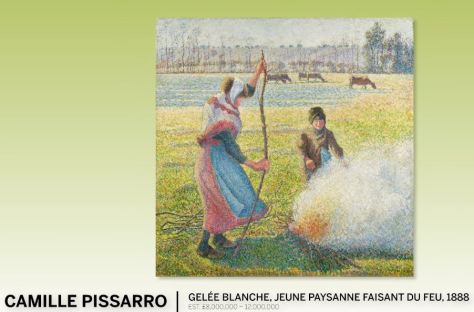
Camille Pissarro Gelée blanche Jeune Paysanne Faisant Du Feu 1888

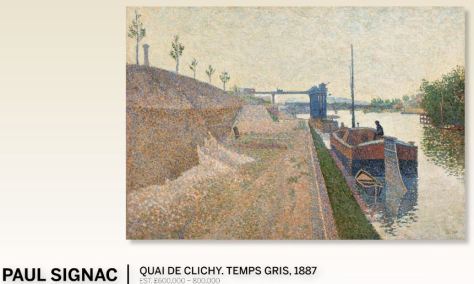
However, This February Sotheby’s is proud to offer three recently restituted masterworks from the Lévy collection in our Impressionist & Modern Art Evening Sale. In this episode of Expert Voices, Sotheby’s Head of Restitution Lucian Simmons chronicles the story of Gaston Lévy’s collection and explores the extraordinary talent of Paul Signac and Camille Pissarro through their works Gelee Blache, Quai de Clichy and La Corne D’or.

Paul Signac Quai De Clichy Temps Gris 1887

(4 February | London)

Art History: “The Rivalry Of Rembrandt And Jan Lievens” (Sotheby’s)

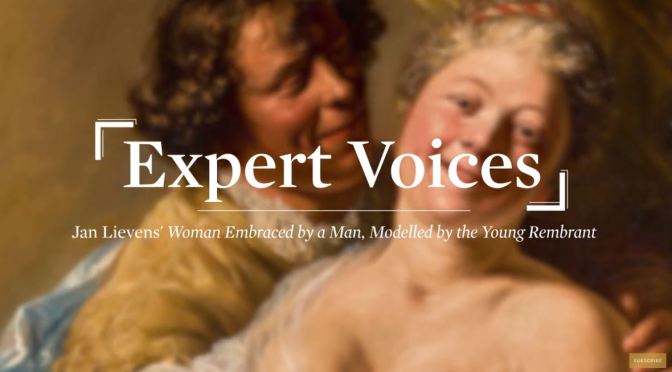
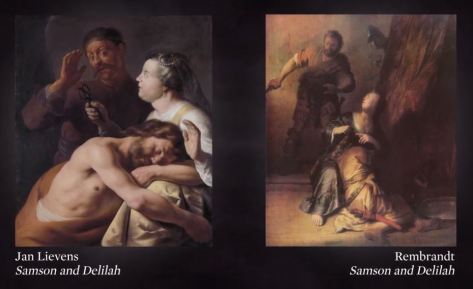
In this episode of Expert Voices, Otto Naumann explores their friendship and budding rivalry through Lievens’ masterwork Woman Embraced by a Man, Modelled by the Young Rembrandt. From the outset of his career, Lievens was at times bolder than Rembrandt, and the two constantly learned from one another during this critical period in their development.

The Rivalry of Rembrandt and Jan Lievens Sotheby's video January 17 2020

In early 17th century Holland, a young Rembrandt spent his days studying and working with fellow artist Jan Lievens. After apprenticing together in Amsterdam, the two likely shared a studio in their hometown of Leiden and even depicted each other in their compositions.

This signature audacity is on full display in in Woman Embraced by a Man, which will be offered as a highlight of Sotheby’s Master Painting Evening Sale. (29 January | New York)

Fine Arts: “Metropolitan Museum Of Art” 150th Anniversary (1870 – 2020)

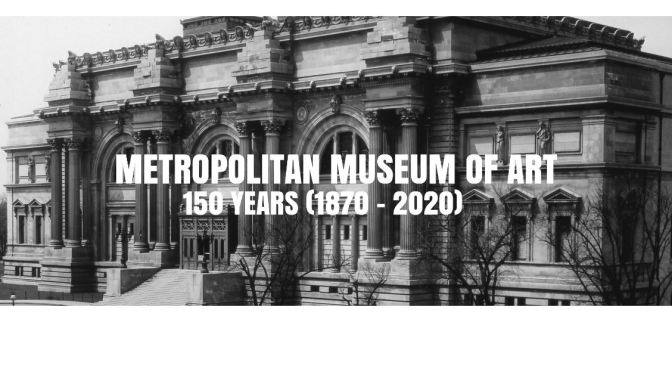
The MET 150Watch Episode 1, “Looking back to look forward,” in which Met image archivist Stephanie Post, educator and former-Project Runway host Tim Gunn, and New York City Ballet dancer Silas Farley share how their encounters with history and the Museum inform their sense of self and their creative practices.
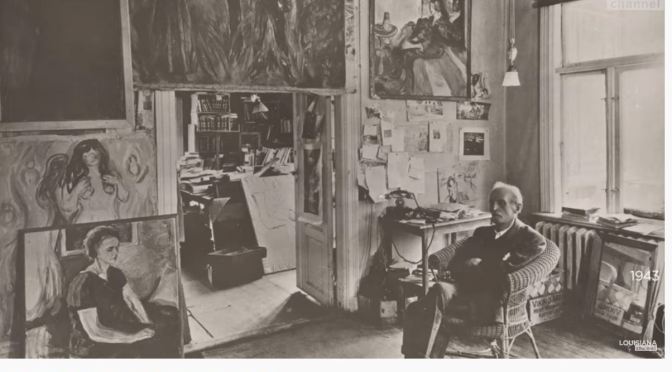

As part of The Met’s 150th anniversary, Met Stories is a new video series and year-long social media initiative that shares unexpected and compelling stories gathered from the many people who visit The Met, whether artists, teachers, curators, actors, museum staff, designers, thought-leaders, or public figures.

Website

Art History: Peter Doig & Karl Ove Knausgård On Edvard Munch (Video)

Louisiana Channel logoEnjoy this engaging and far-reaching conversation between two giants of art and literature, Scottish artist Peter Doig and Norwegian author Karl Ove Knausgård about the legendary Norwegian painter Edvard Munch (1863-1944).
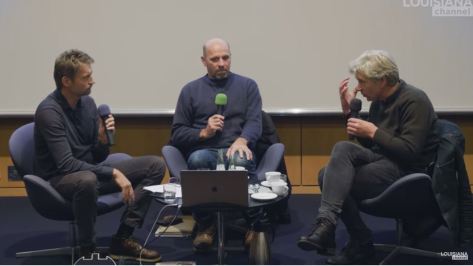
Peter Doig (b. 1959) is a Scottish artist, who is celebrated as one of the most important representational painters working today. He has held several solo exhibitions including at the Scottish National Gallery in Edinburgh, Faurschou Foundation in Beijing, Louisiana Museum of Modern Art in Humlebæk, Musée des Beaux-Arts de Montreal, Musée d’Art Moderne de la Ville de Paris, and Tate Britain in London. His works are held in the collections of the Art Institute of Chicago, the National Gallery of Art in Washington, D.C., and Schirn Kunsthalle in Frankfurt, among others. Doig has received several prestigious awards such as the Prix Eliette von Karajan (1994) and the Wolfgang Hahn Prize of the Society for Modern Art (2008).

Peter Doig & Karl Ove Knausgård On Edvard Munch Louisiana Channel January 6 2020 video

Karl Ove Knausgård (b. 1968) is a Norwegian author, internationally recognized for his prizewinning novel ‘My Struggle’. The novel, in which the author describes his own life, is in six volumes spanning over 3,000 pages. He is also the author of a four-volume series following the seasons – ‘On Spring’, ‘On Summer’, ‘On Fall’ and ‘On Winter’ (2015-16), ‘Inadvertent (Why I Write) (2018), and ‘So Much Longing in So Little Space: The Art of Edvard Munch’ (2019). Knausgård is the recipient of several prestigious prizes including the Austrian State Prize for European Literature.

Edvard Munch (1863-1944) is a Norwegian painter and one of the most important artists of the early 20th century. Munch was part of the Symbolist movement in the 1890s, and a pioneer of Expressionism. Among his most iconic paintings are ‘The Scream’ and ‘The Sick Child’.

Peter Doig and Karl Ove Knausgård were on stage with Christian Lund at Kunstsammlung Nordrhein-Westfalen in Düsseldorf in connection with the exhibition ‘Edvard Munch’, curated by Karl Ove Knausgård, in November 2019.

Camera: Jakob Solbakken

Edited by Klaus Elmer

Produced by Christian Lund

Website

Art: “Invention And Design In Laurentian Florence” (Frick Collection Video)

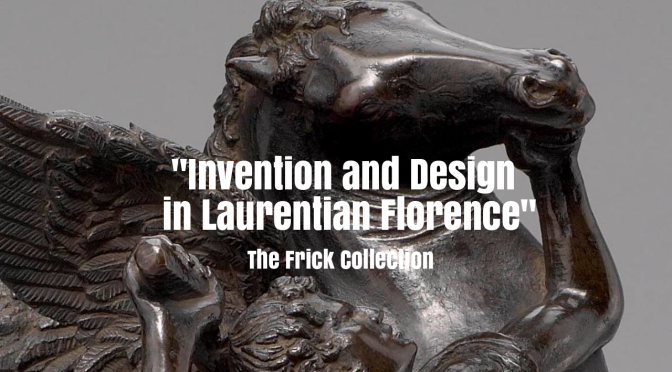
“Invention and Design in Laurentian Florence”

Patricia Lee Rubin Institute of Fine Arts, New York University

The promotion of Florentine excellence in all of the arts was a mainstay of Lorenzo de’ Medici’s cultural politics. Bertoldo di Giovanni’s sculptural production took place in a context of intense creative competition, resulting in works that are innovative, inventive, and beautiful, qualities explored in this lecture. This lecture is funded by Dino and Raffaello Tomasso.

History: “Aztec Art And The Fragility Of Empire” (Art Institute Chicago)

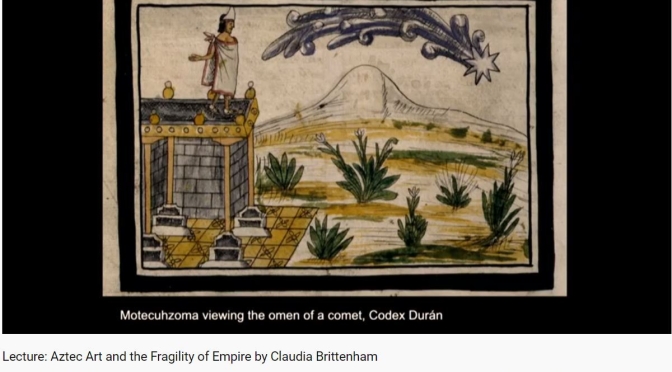
Aztec art drew on the Mesoamerican past, citing works from the ancient cities of Teotihuacan and Tula to lend authority and legitimacy to the new empire. But this engagement with the past also provoked reflection on the inevitable end of empire and the cyclicality of time, themes that resonate as the five hundredth anniversary of the Spanish invasion of Mexico unfolds this year. In this illustrated lecture, Claudia Brittenham, University of Chicago, discusses how Aztec art reflects this engagement with this historical past. This lecture delivered on October 31, 2019, was generously sponsored by the Boshell Foundation Lecture Fund.