
President Biden has released a health care plan that proposes reducing the age of eligibility for Medicare to 60 years and introducing a public option. Larry Levitt, MPP, Executive Vice President for Health Policy at the Kaiser Family Foundation, and Karen Joynt Maddox, MD, MPH, Co-Director of the Center for Health Economics and Policy (CHEP) at @Washington University School of Medicine, and Lawrence O. Gostin, JD from the O’Neill Institute for National and Global Health Law at Georgetown University discuss prospects for health care reform under the new administration.
Tag Archives: Analysis
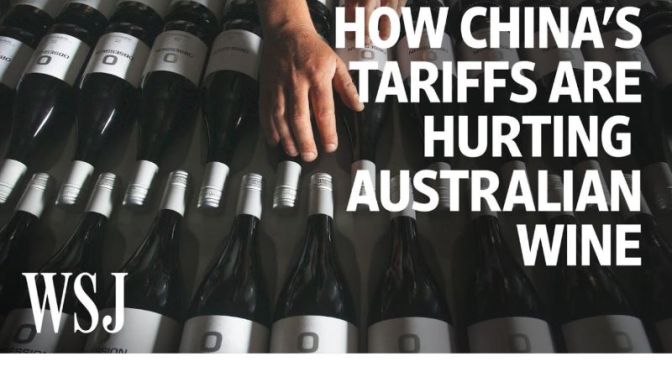
Analysis: The Effects Of Chinese Tariff’s Of Up To 212% On Australian Wine
China imposed tariffs of up to 212% on Australian wine, prompting politicians around the world to criticize what they call Beijing’s “bullying.” WSJ visits a winemaker who hopes global attention will help the industry. Photo: Lisa Maree Williams/Getty Images

Retirement: How Monthly ‘Social Security’ Benefits Are Calculated (Video)
Planning to save for retirement might not be a priority. Luckily, you’ll have some help from Social Security. Different salaries can drastically raise or lower your Social Security benefits. Here’s how much you can expect, based on six different salaries. The average Social Security check in 2020 is $1,503. Figuring out how much you can expect every month when you retire depends on a few criteria. The size of your payment will be based on income from your working years, the year you were born and the age when you decide to start receiving benefits. Luckily, CNBC did the math for a wide range of salaries, and we can estimate your future benefits if you make between $30,000 and $100,000 per year. Remember: Social Security was not envisioned as your sole source of money for retirement, and the totals are always changing. Watch this video for a breakdown of how much you will get and how your monthly benefit will be calculated based on multiple different salaries.

Covid-19: ‘What Is Known About The New Mutations’
As new coronavirus variants sweep across the world, scientists are racing to understand how dangerous they could be. WSJ explains. Illustration: Alex Kuzoian/WSJ

Analysis: Can Cheesecake Factory Recover From Covid? (CNBC Video)
Americans love The Cheesecake Factory. The restaurant known for its massive 21-page menu, dozens of dessert options and ancient Egypt-inspired decor was ranked as one of the top casual dining restaurants in the U.S. in 2019. But the eatery popular with everyone from NBA stars to cheesecake aficionados has fallen on hard times as the coronavirus pandemic has wreaked havoc on the restaurant industry. In October, The Cheesecake Factory reported third-quarter sales fell by 12% and same-stores sales were down 23% from a year earlier. So after 40 years in business will The Cheesecake Factory be able to regain its momentum and will the chain’s takeout and delivery service be enough to offset the decline of the dine-in restaurant experience?

Analysis: Donald Trump’s Reckoning, Innovation & Gorbachev’s Afterlife
A selection of three essential articles read aloud from the latest issue of The Economist. This week: Donald Trump’s reckoning, the new era of innovation (9:20), and Mikhail Gorbachev’s afterlife (16:45).

Covid-19: Will Digital Vaccine Verification ‘Passports’ Work? (Video)
A number of start-ups and major tech companies like Microsoft, Ticketmaster, Apple, and Google are interested in vaccine or immunization passports to help reopen the economy. But public health officials are weary, warning the apps are pointless without more knowledge about the efficacy of the vaccines. Watch the video above to learn more about digital vaccine verifications and how you could possibly prove your immunity to coronavirus before attending an event or entering a building.
Business: ‘LEGO – A $38 Billion Toy Empire’ (Video)
The LEGO brick may not look like much but it is the cornerstone of the $38.5 billion Danish company. Today, LEGO’s blockbuster portfolio includes collaborations with The Beatles, Star Wars, and Frozen, a mega-hit movie franchise and 8 LEGOland theme parks. A toy that was once thought of for little boys is seeing its largest growth coming from girls and adults. But in the early 2000s, the company made several missteps and came extremely close to declaring bankruptcy. Here’s how LEGO reclaimed its status as one of the most successful toy companies in the world.
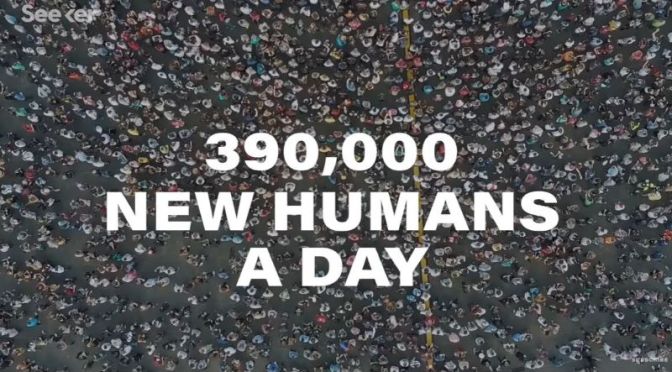
Analysis: Overpopulation – Are Environmental Issues Caused By It? (Video)
Around 390,000 new humans are born every day. So, on a planet with dwindling resources and an increasing strain on natural systems… is curbing our booming population the key to solving our environmental woes?
In 2018, just North America and China were responsible for almost half of the world’s CO2 emissions. These are also the countries with the highest concentrations of the world’s wealthiest people. Their populations are living longer and having fewer babies, so their population growth is actually slowing down. By contrast, the poorest half of the world—where most global population growth is currently concentrated — produces only 10% of the world’s CO2 emissions.
These populations typically lack the technology and wealth that result in high energy expenditure, increased industrialization, and pollution. So, in climate change projections that take these imbalances into account, it’s been shown that redistributing wealth—so, reducing both extreme wealth and extreme poverty—has as much impact on carbon emissions as reducing overall population would.
Even in projected scenarios where a reduction in population does make a difference in emissions, it’s not enough of a difference to affect projected temperature rise. No amount of population reduction would achieve the reduction in emissions necessary to keep global warming below 2 degrees Celsius in our near future.
Anaylysis: Is Obesity Driven By Food Industry Profits & Low Prices? (Video)
Marion Nestle, Goddard Professor in the Department of Nutrition at New York University, discusses the U.S. food industry being in a highly competitive environment where profits are paramount and public health is not a priority.
 Boomers Daily