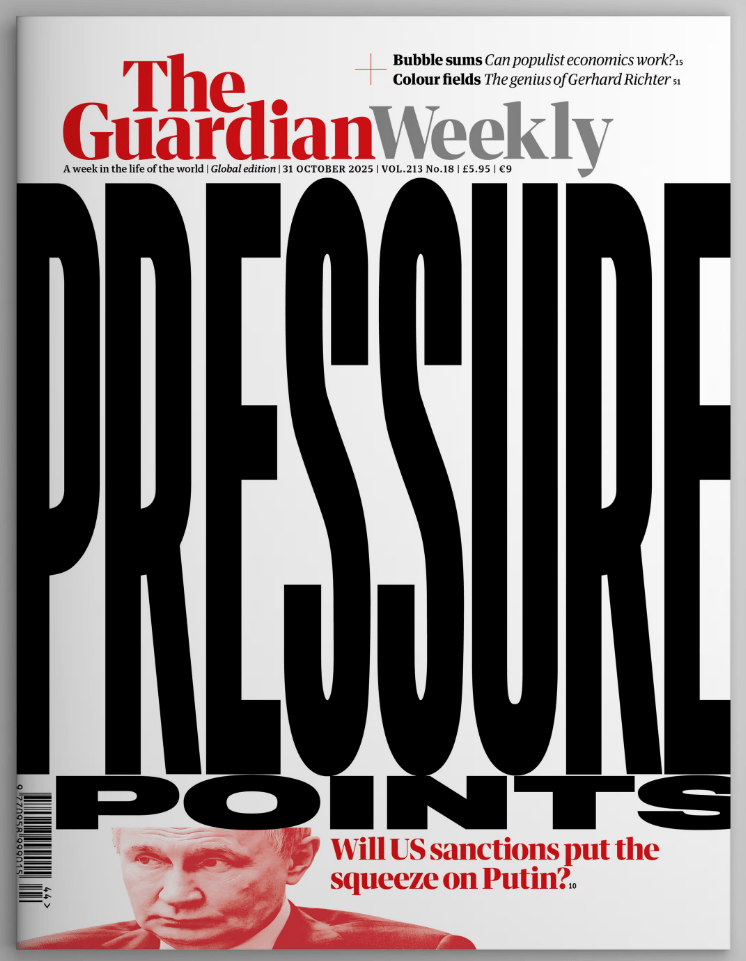
BARRON’S MAGAZINE – SEPTEMBER 1, 2025 PREVIEW

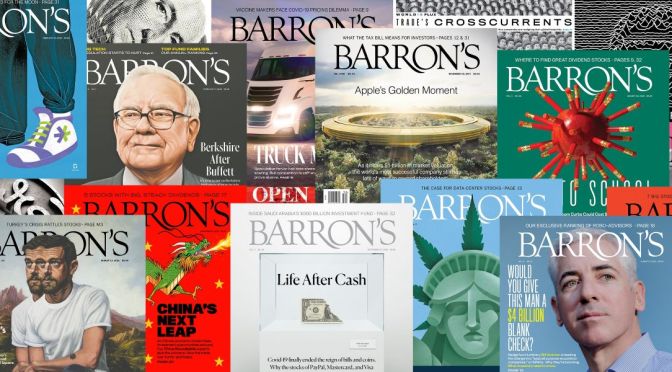
BARRON’S MAGAZINE: The latest issue features ‘Citadel’s Ken Griffin on Markets, the Fed, and Building His Firm for the Next Century’

Citadel’s Ken Griffin on Markets, the Fed, and Building His Firm for the Next Century

Griffin’s ambition, strategic vision, and tech savvy have propelled Citadel into Wall Street’s upper echelons. This could be just the start.

Big Changes Are Coming to Charitable Giving. How to Get Maximum Savings.

Many Americans may get a new tax break, but those who itemize face new limits on deductions. Planning now makes sense.

Hedge Funds’ New Secret Weapon

New companies are collecting any kind of business and consumer economic activity they can get their hands on and selling it to investors.

Small-Cap Stocks Are Rallying Again. This Time It’s Real.

Paul R. La Monica

THE NEW YORK TIMES – SATURDAY, AUGUST 30, 2025

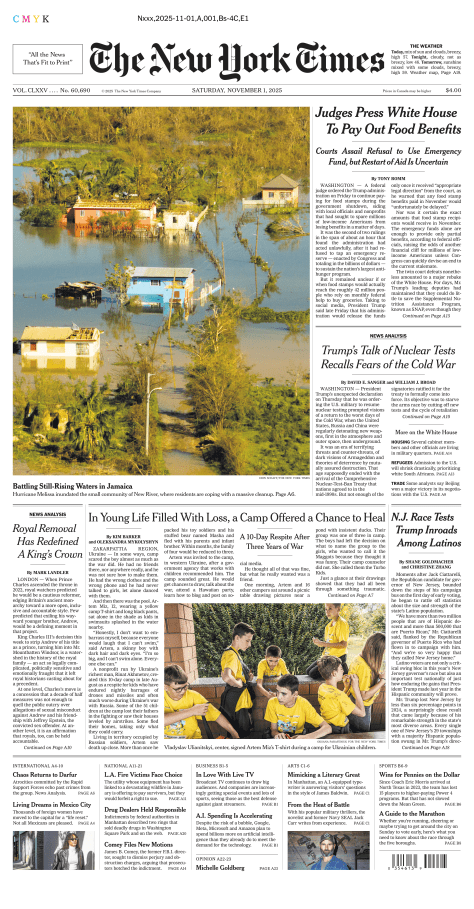
Targeting Iran’s Leaders, Israel Found a Weak Link: Their Bodyguards

Israel was able to track the movements of key Iranian figures and assassinate them this spring by following the cellphones carried by their security forces.

Trump’s Sweeping Tariffs Are Invalidated by Appeals Court

The judges delayed the implementation of their order until October, allowing President Trump to keep the duties in place for now and appeal the ruling.

Tracking the Tariffs on Every Country

He Plagiarized and Promoted Falsehoods. The White House Embraces Him.

Benny Johnson, a right-wing podcaster, has enjoyed rare access and promotion from the Trump administration.

The Nobel Prize and a Testy Phone Call: How the Trump-Modi Relationship Unraveled

President Trump’s repeated claims about having “solved” the India-Pakistan war infuriated Prime Minister Narendra Modi of India. And that was only the beginning.

THE MAN WHO INVENTED THE MODERN THRILLER

Before Hitchcock or Highsmith, there was Pietro Aretino—Renaissance Venice’s scandalous satirist who turned gossip into cliffhangers and obscenity into art. The man who terrified popes may also have invented the modern thriller.

By Michael Cummins, Editor, August 29, 2025

Venice, 1537

The candle gutters in its brass dish, casting a crooked halo on the damp walls of a salon off the Grand Canal. Pietro Aretino leans back in his chair, one boot propped on a velvet footstool, his voice curling through the smoke like a blade. He does not write—he dictates. A scribe, young and ink-stained, hunches over parchment, trying to keep pace. The letter—addressed, perhaps, to a cardinal, perhaps to a painter—will contain more than pleasantries. It will contain a threat, veiled as an observation, wrapped in a joke.

“Princes fear me more than the plague,” Aretino murmurs, eyes half-lidded. “For I do not kill bodies—I murder reputations.”

The scribe pauses, startled. Aretino waves him on. “Write it. Let them tremble.”

Tomorrow, this page will cross the lagoon, board a courier’s horse, and ignite tremors in Rome or Paris. It may be copied, whispered, condemned. It may be burned. But it will be read.

It was Aretino’s genius to recognize that scandal was not merely gossip—it was architecture. A scaffolding of insinuation and revelation designed to leave its victim dangling. In his six volumes of Lettere (1537–1557), he sharpened that architecture to a fine point. Written to popes, kings, artists, and courtesans, the letters are part autobiography, part political commentary, and wholly performance. “I speak to the powerful as I would to a neighbor,” he crowed, “for truth makes no bow.” What terrified his recipients was not what he said but what he withheld. His words worked like cliffhangers: each letter a suspense novel in miniature.

Aretino liked to imagine himself not born in Arezzo, as the records claimed, but in his own tongue. The myth suited him: a man conjured out of ink and scandal rather than flesh and baptismal water. By the 1520s, he was notorious as the flagello dei principi—the scourge of princes. The title was not a label pinned on him by enemies; it was one he cultivated, polished, and wore like armor. “I carry more lives in my inkpot than the hangman in his noose,” he declared, and few doubted it.

His life was a play in which he cast himself as both author and protagonist. When Pope Clement VII hesitated to pay him, Aretino wrote slyly, “Your Holiness, whose charity is beyond compare, surely requires no reminder of the poverty that afflicts your devoted servant.” In another letter, he praised the Pope’s mercy while threatening to reveal “those excesses which Rome whispers but dares not record.” He lived by double edge: each compliment a prelude, each benediction a warning.

The tactic was not confined to popes. To Michelangelo he sent fulsome admiration: “Your brush moves like lightning, striking down the pride of the ancients.” To Titian he became impresario, writing to Francis I of France that no royal gallery could be complete without Titian’s brush. But the same pen could turn against friend or patron in an instant. A single phrase from Aretino could undo a reputation; a withheld rumor could ruin a night’s sleep.

His enemies often answered with violence. In Rome, in 1525, mercenaries burst into his lodgings after he lampooned the papal indulgence sellers in his Frottole. They dragged him into the street and beat him nearly to death. Neighbors recalled him crawling, bloodied, back to his rooms. Later, when asked why he returned to writing almost immediately, he grinned through broken teeth: “Even death cannot silence a tongue as sharp as mine.” The scars became his punctuation. “My scars,” he wrote in the Lettere, “are the punctuation marks of my story.”

Aretino’s letters functioned like serialized thrillers. Each installment built tension, each cliffhanger left its audience half-terrified, half-delighted. He understood that suggestion could be more devastating than revelation, that anticipation was more dangerous than disclosure. He used ambiguity as a weapon, seeding his pages with conditional phrases: “It is said,” “One hears,” “Were I less discreet…” They were not evasions. They were traps.

One courtier compared the experience to “sitting at supper and finding the meat still bleeding.” The reader was implicated, made complicit in the scandal’s unfolding. Aretino’s genius lay in turning the audience into co-conspirators.

And Venice—city of masks, labyrinths, and whispered betrayals—was practically designed as the birthplace of the thriller. Long before the genre had a name, its ingredients were already steeping in the canals: duplicity, desire, surveillance, and the ever-present threat of exposure. Aretino didn’t write thrillers in form, but he mastered their emotional architecture. His letters were suspenseful, his dialogues scandalous, his persona a walking cliffhanger. Venice gave him the perfect mise-en-scène: a place where truth wore a disguise and reputation was currency. The city itself functioned like a thriller plot—beautiful on the surface, treacherous underneath.

And consider the mechanics: the masked ball becomes the thriller’s false identity. The gondola ride at midnight becomes the covert rendezvous. The whispered rumor in a candlelit salon becomes the inciting incident. The Contarini garden becomes the secret meeting place where alliances shift and truths unravel. It is no accident that Henry James, Daphne du Maurier, Patricia Highsmith, and Donna Leon all returned to Venice when they wanted to explore psychological tension and moral ambiguity. The city doesn’t just host thrillers—it is one.

Imagine a summer evening in 1537. The garden is fragrant with jasmine and fig. Aretino reclines beneath a pergola, flanked by Titian and a Greek scholar from Crete. A courtesan named Nanna pours wine into silver cups.

“You paint gods,” Aretino says to Titian, “but I paint men. And men are far more dangerous.”

Titian chuckles. “Gods do not pay commissions.”

The scholar leans in. “And men do not forgive.”

Nanna smirks, leaning on the marble balustrade. “And yet men pay both of you—in gold for their portraits, in secrets for his letters.”

Aretino raises his cup. “Which is why I never ask forgiveness. Only attention.”

Venice itself became a character: beautiful, deceptive, morally ambiguous. Its canals mirrored the duplicity of its citizens. Its masks—literal and figurative—echoed Aretino’s own performative identity.

But letters were only one weapon. In 1527, Aretino detonated another: the Sonetti lussuriosi, written to accompany Giulio Romano’s engravings known as I Modi. The sonnets made no attempt at discretion. In one, a woman gasps mid-embrace, “Oh God, if this be sin, then let me sin forever!” In another, a lover interrupts her partner’s poetic boasting with the sharp command: “Speak less and thrust more.” The verses shocked even worldly Rome. Pope Clement VII banned the work, copies were burned, and Aretino’s name became synonymous with obscenity. Yet suppression only heightened its allure. “My verses are daggers,” he later said, “that caress before they strike.”

He followed with the Ragionamenti (1534–1536), dialogues between prostitutes and matrons that turned confession into carnival. In the Dialogo della Nanna e della Antonia, one woman scoffs, “The cardinals pray with their lips while their hands wander beneath the skirts.” In the Dialogo nel quale la Nanna insegna a la Pippa, the older courtesan instructs a young girl in survival: “A woman must learn to wield her body as men wield their swords.” These were not just bawdy jokes but philosophical inversions. They exposed hypocrisy with laughter and turned vice into discourse.

His comedies struck with equal force. In La Cortigiana (1534), a satire of Roman society, a friar assures his audience: “Do as I say, not as I do—for my sins are a privilege of office.” In Il Marescalco, a groom forced into marriage laments, “Better to wed a sword than a wife, for steel at least does not betray.” In La Talanta, he boasted with characteristic swagger: “My tongue is the scourge of princes and the trumpet of truth.” These plays were not staged fantasies but mirrors held to the world. Rome and Venice recognized themselves, and recoiled.

Even his occasional pieces carried teeth. During the sack of Rome, he penned the Frottole (1527), short verses filled with bitter humor: “The Germans loot the altars, the Spaniards strip the nuns, and Christ hides his face behind the clouds.” Earlier still, in Il Testamento dell’Elefante Hanno (1516), he composed a mock will for Pope Leo X’s pet elephant. The beast bequeathed its tusks to the cardinals and its dung to the faithful: “For the people, my eternal gift, what Rome already feeds them daily.” Juvenile, grotesque, and brilliant, it set the tone for a lifetime of satiric violence.

Was Aretino a moralist or a manipulator? The question haunts his legacy. Like Machiavelli, he understood power. Like Montaigne, he understood performance. His satire was not disinterested—it was strategic. He exposed corruption, yes, but he also profited from it. His critics accused him of blackmail, of cruelty, of vulgarity. But Aretino saw himself as a mirror. “I do not invent,” he wrote, “I reflect.” The discomfort lay not in his words, but in their accuracy.

The dilemma still feels modern. When does exposure serve truth, and when does it become spectacle? Is scandal a form of justice—or just another form of entertainment? To read Aretino is to feel that question sharpen into relevance. He knew the intoxicating pleasure of watching a hypocrite stripped bare, but he also knew the profit of keeping the knife just shy of the skin.

For centuries, Aretino was dismissed as a pornographer and blackmailer, an obscene footnote beside Petrarch and Ariosto. But scandal has a way of surviving. Nineteenth-century Romantics rediscovered him as a prophet of modernity. Today, critics trace his fingerprints across satire, reportage, and fiction. Balzac’s Parisian intrigues, Wilde’s aesthetic scandals, Patricia Highsmith’s Venetian thrillers—all echo Aretino’s mix of desire and dread.

And then there are the heirs who claimed him outright. The Marquis de Sade, that relentless anatomist of transgression, drew directly from Aretino’s playbook. Sade’s philosophical obscenities echo the structures of the Ragionamenti and the Sonetti lussuriosi: dialogues in which sexuality becomes both performance and interrogation, the bed a courtroom, the embrace a cross-examination. Like Aretino, Sade deployed eroticism not only to shock but to dismantle. Both men wielded obscenity as an intellectual weapon, stripping religion and politics of their sanctity by exposing their hypocrisies in the stark light of desire. When Sade has his libertines sneer at clerics who preach chastity while gorging on pleasure, he repeats Aretino’s barbed observation from a century earlier: “The cardinals pray with their lips while their hands wander beneath the skirts.”

Sade shared Aretino’s radical anti-clericalism, his love of dialogue as a tool of exposure, and his cultivation of notoriety as a literary strategy. The “Divine Marquis” may have been locked in the Bastille, but he carried in his cell Aretino’s scandalous legacy: the belief that obscenity could be philosophy, that provocation itself could be a mode of truth-telling.

Three centuries later, Guillaume Apollinaire would rediscover Aretino with a different eye. In the early twentieth century, Apollinaire praised him as a master who combined “the obscene with the sublime.” In works like Les Onze Mille Verges (The Eleven Thousand Rods), Apollinaire blurred the line between pornography and poetry, scandal and art, just as Aretino had done in his Venetian salons. He admired Aretino’s ability to turn audacity into literature, to make provocation itself a kind of aesthetic. “There is,” Apollinaire wrote of Aretino, “a grandeur in obscenity when it reveals the soul of an age.”

Apollinaire saw in Aretino a precedent for his own experiments: erotic audacity, satirical edge, literary innovation, and a fascination with scandal as aesthetic principle. Where Aretino staged dialogues between courtesans and matrons, Apollinaire crafted delirious erotic parables; where Aretino mocked clerics in his comedies, Apollinaire mocked bourgeois morality with surreal extravagance. Both men made literature dangerous again—texts that could be banned, burned, whispered, yet still survive.

In this long genealogy, Aretino is less a Renaissance curiosity than the origin point of a scandalous tradition that threads through Sade’s prisons, Apollinaire’s Paris, and our own scandal-hungry media. Each recognized that literature need not be safe, that scandal could be structure, that provocation could outlast sermons.

Most uncanny is how current Aretino feels. “What is whispered,” he mused in the Ragionamenti, “weighs more than what is spoken.” That line could be Twitter’s motto, or the tagline of an exposé-driven news cycle. Aretino would have thrived online: the cryptic tweet, the artful insinuation, the screenshot without context. He would have understood the logic of cancel culture, the way scandal circulates as performance, the way innuendo becomes currency.

Imagine him at the end, older now, dictating one last letter. The room is quieter, the scars deeper, the city outside still murmuring with intrigue. He knows his enemies wait for him to fall silent, but he also knows the page will outlive him. The candlelight no longer dances—it trembles. His scribe, older now too, no longer rushes. They have learned the rhythm of Aretino’s menace: slow, deliberate, inevitable.

He pauses mid-sentence, gazing out toward the lagoon. The bells of San Zanipolo toll the hour. A gondola glides past, its oars whispering against the water. Somewhere in the Palazzo Contarini dal Zaffo garden, jasmine blooms in the dark.

“Write this,” he says finally. “To be feared is to be remembered. To be remembered is to be read.”

The scribe hesitates. “And to be read?”

Aretino smiles. “Is to survive.”

He signs his name with a flourish—Pietro Aretino—and sets the quill down. The letter will travel, as they always have, faster than truth and deeper than rumor. It will be copied, misquoted, condemned, and preserved. It will be read by those who hate him and those who become him.

Centuries later, in a world of digital whispers and algorithmic outrage, his voice still echoes. In every scandal that unfolds like a story, in every tweet that wounds like a dagger, in every exposé that trembles with withheld revelation—Aretino is there. Not as ghost, but as architect. He understood what we are still learning: that scandal is not the opposite of art. It is one of its oldest forms. And in the hands of a master, it becomes not just spectacle, but structure. Not just provocation, but prophecy.

The trumpet still sounds. The question is not whether we hear it. The question is whether we recognize the tune.

THIS ESSAY WAS WRITTEN AND EDITED UTILIZING AI

SCIENCE MAGAZINE – AUGUST 28, 2025

Science issue cover

SCIENCE MAGAZINE: The latest issue features ‘Return of The Herd’ – Ecosystem effects of migrating bison.

Bison move through Yellowstone’s Lamar Valley at sunrise. Their movements and grazing accelerate the nitrogen cycle, increasing the annual nutrition that plants provide to herbivores. After decades of recovery, bison now add heterogeneity that sustains soil nutrient storage and plant productivity while allowing plant communities to become more diverse, highlighting the importance of restoring native grazers in large numbers and with freedom to move. See page 904.

New clues found about the assembly of life’s first proteins

Lab study shows how RNA could have helped amino acids join up—without preexisting protein machinery

Europe’s biggest quake may foretell Atlantic ‘ring of fire’

Earth’s mantle is peeling from the crust in the eastern Atlantic, a possible sign of the ocean’s eventual closure

THE NEW YORK TIMES – FRIDAY, AUGUST 29, 2025

How the Future of the Fed Came to Rest on Lisa Cook

President Trump’s effort to oust the Federal Reserve governor has started a legal battle that will have major consequences for the institution’s independence.

2 Weeks, 1,000 Arrests: How a Surge of Federal Agents Changed D.C. Policing

Crime has fallen since agents began policing the streets of Washington in large numbers. Records show that the focus has often been on low-level offenses.

Trump Revokes Kamala Harris’s Secret Service Protection

President Trump terminated an extension to Kamala Harris’s Secret Service protection arranged by President Biden. She will lose her detail on Monday.

The Shattering of Wednesday Mass: Minnesota Parish Reels From Attack

Annunciation Catholic Church and School has been a neighborhood anchor in Minneapolis for more than a century.

THE ECONOMIST MAGAZINE – AUGUST 30, 2025 PREVIEW

THE ECONOMIST MAGAZINE: The latest issue features ‘What Brazil Can Teach America’

Brazil offers America a lesson in democratic maturity

It is a test case for how countries recover from a populist fever

Humiliation, vindication—and a giant test for India

Trump has triggered a trade and defence crisis: how should Modi respond?

How much danger is America’s central bank in?

Whether Lisa Cook stays or goes, important norms have been broken

France’s government is on the brink of collapse, again

Emmanuel Macron looks likely to lose another prime minister over an attempt to curb public debt

Don’t forget the downsides of China’s innovation push

China’s industrial policy attracts fans abroad, critics at home

MIT TECHNOLOGY REVIEW – SEPT/OCT 2025 PREVIEW

MIT TECHNOLOGY REVIEW: The Security issue issue – Security can mean national defense, but it can also mean control over data, safety from intrusion, and so much more. This issue explores the way technology, mystery, and the universe itself affect how secure we feel in the modern age.

How these two brothers became go-to experts on America’s “mystery drone” invasion

Two Long Island UFO hunters have been called upon by some domestic law enforcement to investigate unexplained phenomena.

Why Trump’s “golden dome” missile defense idea is another ripped straight from the movies

President Trump has proposed building an antimissile “golden dome” around the United States. But do cinematic spectacles actually enhance national security?

Inside the hunt for the most dangerous asteroid ever

As space rock 2024 YR4 became more likely to hit Earth than anything of its size had ever been before, scientists all over the world mobilized to protect the planet.

Taiwan’s “silicon shield” could be weakening

Semiconductor powerhouse TSMC is under increasing pressure to expand abroad and play a security role for the island. Those two roles could be in tension.

THE NEW YORK TIMES – THURSDAY, AUGUST 28, 2025

Fired C.D.C. Director’s Lawyers Say Kennedy Is Weaponizing Public Health

Susan Monarez was said to have refused to adopt Robert F. Kennedy Jr.’s stance on vaccinations. A lawyer for Dr. Monarez said the firing was “legally deficient.”

The Fate of the Fed May Turn on Two Words: ‘For Cause’

The Supreme Court has said the Federal Reserve Board’s independence warrants protection. President Trump’s effort to fire a member will test that commitment.

Russian Missile and Drone Attack Kills at Least 15 in Kyiv

The strikes on Ukraine’s capital, nearly two weeks after the U.S.-Russia summit in Alaska, injured at least 45 people, officials said.

Russian Drones Are Flying Over U.S. Weapons Routes in Germany, Officials Say

U.S. and European military officials are increasingly concerned about the flights, even as Russian acts of sabotage have declined.

Möbius Dreams: A Journey Of Identity Without End

From Nietzsche’s wanderings to Brodsky’s winters in Venice, identity loops like a Möbius strip—and augmented reality may carry those returns to us all.

By Michael Cummins, Editor, August 25, 2025

It begins, as so many pilgrimages of mind and imagination do, in Italy. To step into one of its cities—Florence with its domes, Rome with its ruins, Venice with its waters—is to experience time folding over itself. Stones are worn by centuries of feet; bells still toll hours as they did five hundred years ago; water mirrors façades that have witnessed empires rise and fall. Italy resists linearity. It does not advance from one stage to another; it loops, bends, recurs. For those who enter it, identity itself begins to feel less like a straight line than like a Möbius strip—a single surface twisting back on itself, where past and present, memory and desire, fold into one another.

Friedrich Nietzsche felt that pull most keenly. His journeys through Italy in the 1870s and 1880s were more than therapeutic sojourns for his fragile health; they were laboratories for thought. He spent time in Sorrento, where the Mediterranean air and lemon groves framed his writing of Human, All Too Human. In Genoa, he walked the cliffs above the port, watching the sun rise and fall in a rhythm that struck him as recurrence itself. In Turin, under its grand porticoes, he composed letters and aphorisms before his final collapse in 1889. And in Venice, he found a strange equilibrium between the city’s music, its tides, and his own restlessness. To his confidant Peter Gast, he wrote: “When I seek another word for ‘music,’ I never find any other word than ‘Venice.’” The gondoliers’ calls, the bells of San Marco, the lapping water—all repeated endlessly, yet never the same, embodying the thought that came to define him: the eternal return.

For Nietzsche, Italy was not a backdrop but a surface on which recurrence became tangible. Each city was a half-twist in the strip of his identity: Sorrento’s clarity, Genoa’s intensity, Turin’s collapse, Venice’s rhythm. He sensed that to live authentically meant to live as though each moment must be lived again and again. Italy, with its cycles of light, water, and bells, made that philosophy palpable.

Henry James —an American expatriate author with a different temperament—also found Italy less a destination than a structure. His Italian Hours (1909) reveals both rapture and unease. “The mere use of one’s eyes in Italy is happiness enough,” he confessed, yet he described Venice as “half fairy tale, half trap.” The city delighted and unsettled him in equal measure. He wandered Rome’s ruins, Florence’s galleries, Venice’s piazzas, and found that they all embodied a peculiar temporal layering—what he called “a museum of itself.” Italy was not history frozen; it was history repeating, haunting, resurfacing.

James’s fiction reflects that same looping structure. In The Aspern Papers, an obsessive narrator circles endlessly around an old woman’s letters, desperate to claim them, caught in a cycle of desire and denial. In The Portrait of a Lady, Isabel Archer discovers that the freedom she once thought she had secured returns as entrapment; her choices loop back on her with tragic inevitability. Even James’s prose mirrors the Möbius curve: sentences curl and return, digress and double back, before pushing forward. Reading James can feel like walking Venetian alleys—you arrive, but only by detour.

Joseph Brodsky, awarded the 1987 Nobel Prize in Literature after being exiled from the Soviet Union in 1972, found in Venice a winter refuge that became ritual. Each January he returned, until his death in 1996, and from those returns came Watermark (1992), a prose meditation that circles like the canals it describes. “Every January I went to Venice, the city of water, the city of mirrors, perhaps the city of illusions,” he wrote. Fog was his companion, “the city’s most faithful ghost.” Brodsky’s Venice was not Nietzsche’s radiant summer or James’s bustling salons. It was a city of silence, damp, reflection—a mirror to exile itself.

He repeated his returns like liturgy: sitting in the Caffè Florian, notebook in hand, crossing the Piazza San Marco through fog so dense the basilica dissolved, watching the lagoon become indistinguishable from the sky. Each January was the same, and yet not. Exile ensured that Russia was always present in absence, and Venice, indifferent to his grief yet faithful in its recurrence, became his Möbius surface. Each year he looped back as both the same man and someone altered.

What unites these three figures—Nietzsche, James, Brodsky—is not their similarity of thought but their recognition of Italy as a mirror for recurrence. Lives are often narrated as linear: childhood, youth, adulthood, decline. But Italy teaches another geometry. Like a Möbius strip, it twists perspective so that to move forward is also to circle back. An old anxiety resurfaces in midlife, but it arrives altered by experience. A desire once abandoned returns, refracted into new form. Nietzsche’s eternal return, James’s recursive characters, Brodsky’s annual exiles—all reveal that identity is not a line but a fold.

Italy amplifies this lesson. Its cities are not progressions but palimpsests. In Rome, one stands before ruins layered upon ruins: the Colosseum shadowed by medieval houses, Renaissance palaces built into ancient stones. In Florence, Brunelleschi’s dome rises above medieval streets, Renaissance paintings glow under electric light. In Venice, Byzantine mosaics shimmer beside Baroque marble while tourists queue for modern ferries. Each city is a surface where centuries loop, never erased, only folded over.

Philosophers and writers have groped toward metaphors for this looping. Nietzsche’s eternal return insists that each moment recurs infinitely. Derrida’s différance plays on the way meaning is always deferred, never fixed, endlessly circling. Borges imagined labyrinths where every turn leads back to the start. Gloria Anzaldúa’s Borderlands describes identity as hybrid, cyclical, recursive. Italy stages all of these. To walk its piazzas is to feel history as Möbius surface: no beginning, no end, only continuous return.

But the Möbius journey of return is not without strain. Increasing overcrowding in Venice has made Piazza San Marco feel at times like a funnel for cruise-ship day trippers, raising questions of whether the city can survive its admirers. Rising costs of travel —inflated flights, pricier accommodations, surcharges for access—place the dream of pilgrimage out of reach for many. The very recurrence that writers once pursued with abandon now risks becoming the privilege of the few. And so the question arises: if one cannot return physically, can another kind of return suffice?

The answer is already being tested. Consider the Notre-Dame de Paris augmented exhibition, created by the French startup Histovery. Visitors carry a HistoPad, a touchscreen tablet, and navigate 850 years of the cathedral’s history. Faux stone tiles line the floor, stained-glass projections illuminate the walls, recordings of tolling bells echo overhead. With a swipe, one moves from the cathedral’s medieval construction to Napoleon’s coronation, then to the smoke and flames of the 2019 fire, then to the scaffolds of its restoration. It is a Möbius strip of architecture, looping centuries in minutes. The exhibition has toured globally, making Notre-Dame accessible to millions who may never step foot in Paris.

Italy, with its fragile architecture and layered history, is poised for the same transformation. Imagine a virtual walk through Venice’s alleys, dry and pristine, free of floods. A reconstructed Pompeii, where one can interact with residents moments before the eruption. Florence restored to its quattrocento brilliance, free of scaffolding and tourist throngs. For those unable to travel, AR offers an uncanny loop: recurrence of experience without presence.

Yet the question lingers: if one can walk through Notre-Dame without smelling the stone, without hearing the echo of one’s own footsteps, have they truly arrived? Recurrence, after all, has always been embodied. Nietzsche needed the Venetian fog to sting his lungs. James needed to feel the cold stones of a Florentine palazzo. Brodsky needed the damp silence of January to write his Watermark. The Möbius loop of identity was sensory, mortal, physical. Can pixels alone replicate that?

Perhaps this is too stark a contrast. Italy itself has always been both ruin and renewal, both stone and scaffolding, both presence and representation. Rome is simultaneously crumbling and rebuilt. Florence is both painted canvas and postcard reproduction. Venice is both sinking and endlessly photographed. Italy has survived by layering contradictions. Augmented reality may become one more layer.

Indeed, there is hope in this possibility. Technology can democratize what travel once restricted. The Notre-Dame exhibition allows a child in Kansas to toggle between centuries in an afternoon. It lets an elder who cannot fly feel the weight of medieval Paris. Applied to Italy, AR could make the experience of recurrence more widely available. Brodsky’s fog, Nietzsche’s bells, James’s labyrinthine sentences—these could be accessed not only by the privileged traveler but by anyone with a headset. The Möbius strip of identity, always looping, would expand to include more voices, more bodies, more experiences.

And yet AR is not a replacement so much as an extension. Those who can still travel will always seek stone, water, and bells. They will walk the Rialto and feel the wood beneath their feet; they will stand in Florence and smell the paint and dust; they will sit in Rome’s piazzas and feel the warmth of stone in the evening. These are not illusions but recurrences embodied. Technology will not end this; it will supplement it, add folds to the Möbius strip rather than cutting it.

In this sense, the Möbius book of identity continues to unfold. Nietzsche’s Italian sojourns, James’s expatriate wanderings, Brodsky’s winter rituals—all are chapters inscribed on the same continuous surface. Augmented reality will not erase those chapters; it will add marginalia, footnotes, annotations accessible to millions more. The loop expands rather than contracts.

So perhaps the hopeful answer is that recurrence itself becomes more democratic. Italy will always be there for those who return, in stone and water. But AR may ensure that those who cannot return physically may still enter the loop. A student in her dormitory may don a headset and hear the same Venetian bells that Nietzsche once called music. A retiree may walk through Florence’s restored galleries without leaving her home. A child may toggle centuries in Notre-Dame and begin to understand what it means to live inside a Möbius strip of time.

Identity, like travel, has never been a straight line. It is a fold, a twist, a surface without end. Italy teaches this lesson in stone and water. Technology may now teach it in pixels and projections. The Möbius book has no last page. It folds on—Nietzsche in Turin, James in Rome, Brodsky in Venice, and now, perhaps, millions more entering the same loop through new, augmented doors.

The self is not a line but a surface, infinite and recursive. And with AR, more of us may learn to trace its folds.

THIS ESSAY WAS WRITTEN AND EDITED UTILIZING AI

THE NEW YORK TIMES – WEDNESDAY, AUG. 27, 2025

The A.I. Spending Frenzy Is Propping Up the Real Economy, Too

The trillions of dollars that tech companies are pouring into new data centers are starting to show up in economic growth. For now, at least.

Full Weight of U.S. Tariffs Slams Into India

As punishment for buying Russian oil, President Trump doubled the tariff on goods from India to 50 percent, jeopardizing its relationship with the U.S.

Trump’s Appointees Could Rule the Federal Reserve for Decades

If President Trump succeeds in replacing Lisa Cook, his nominees will make up a majority of the central bank’s seven-person board.

News, Views and Reviews For The Intellectually Curious