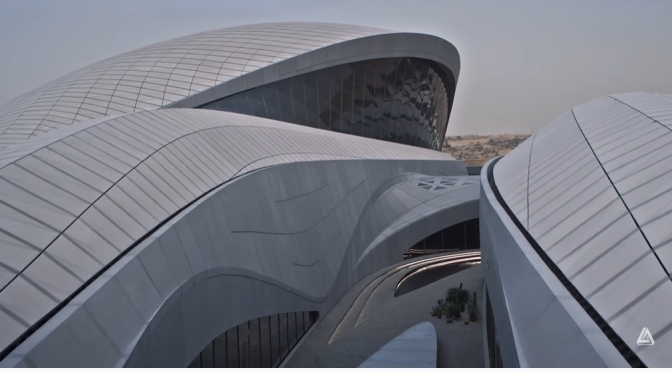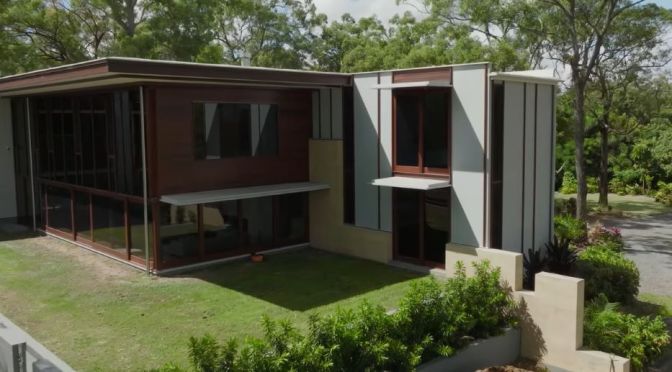
BEEAH Group’s new headquarters in Sharjah, #UAE, was opened on Wednesday, March 30 by His Highness Dr. Sheikh Sultan bin Muhammad Al Qasimi, Ruler of Sharjah.
Powered by its solar array and equipped with next-generation technologies for operations at LEED Platinum standards, the new headquarters has been designed by Zaha Hadid Architects (ZHA) to achieve net-zero emissions and will be the group’s management and administrative centre that sets a new benchmark for future workplaces…
The world is facing a growing waste problem, with 2bn tonnes produced last year alone. Is it possible to clean up this mess by turning trash into cash? 00:00 – The world has a huge waste problem.
Video timeline: 00:45 – Upcycling to reduce waste 02:46 – Building offices from recycled products 03:46 – The problem with traditional recycling 04:59 – Waste reduction relies on a circular economy 05:38 – Taiwan’s waste management success 08:20 – The problem with incineration 09:55 – Is the future zero waste? 10:43 – Consumption attitudes are changing Read our special report on waste here https://econ.st/3JrlD6y
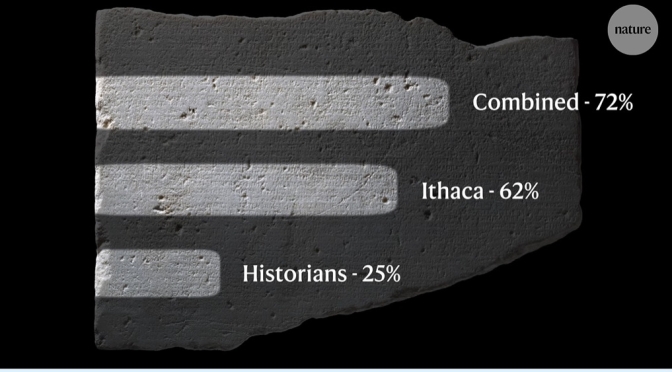
The origins of ancient inscriptions are often shrouded in mystery. Writing carved into stone millennia ago can be hard to read and is often missing entire sections of the text. Now a neural network, trained on thousands of existing inscriptions, could help historians figure out when and where a piece of writing comes from – as well as fill in missing words and characters.
Climate change, land degradation and deforestation have severely damaged Côte d’Ivoire’s natural surroundings. Many farmers are worried about their future. But Digitalization is bringing new hope.
Côte d’Ivoire is a West African country with beach resorts, rainforests and a French-colonial legacy. Abidjan, on the Atlantic coast, is the country’s major urban center. Its modern landmarks include zigguratlike, concrete La Pyramide and St. Paul’s Cathedral, a swooping structure tethered to a massive cross. North of the central business district, Banco National Park is a rainforest preserve with hiking trails.
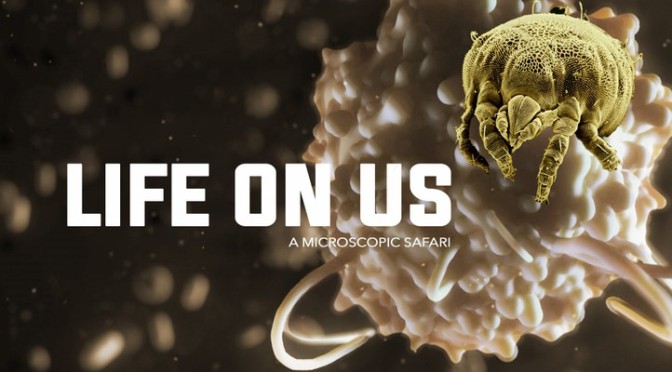
Among the unknown worlds in the universe, we can count our very own bodies. Like planet earth, each of us is made up of fascinating landscapes that are home to all kinds of wildlife.
The film takes the viewer on a unique microscopic safari, where we encounter some of the myriad creatures that live, thrive, compete, feed, are born and die on or inside our bodies. In fact, microscopic creatures play a more powerful role than we know: These life forms impact our health, our life expectancy, our physique and even our behavior.
The film renders these hidden worlds visible with the help of special effects: Combining cinematic electron microscopy with a super macro film technique. The documentary explains cutting-edge scientific findings, by turns surprising, enlightening and amazing. It raises questions about who we are, and how we exist in the unexplored, complex ecosystems that help constitute us.
We are born 100% human, but will die 90% microbial. Between these two points in our lives lies the unexplored terrain of ‘Life on Us’.
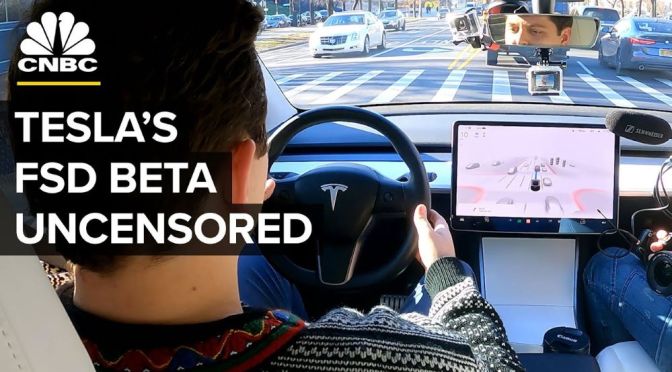
Tesla’s FSD Beta, which stands for ‘full-self driving’ beta, can best be summarized as a host of new driver assistant features that are not yet debugged. Chief among them is “autosteer on city streets,” which enables drivers to automatically navigate around complex urban environments without moving the steering wheel with their own hands.
Elon Musk has promised driverless cars since 2016, but FSD is not even close to a fully autonomous vehicle yet. The beta program is heavily scrutinized by regulators and has earned Tesla side-eye from competitors, who usually have professionally trained drivers, not customers, test driver assist features in their vehicles.
But for now, FSD Beta still available for thousands of Tesla owners to access, without the knowledge of drivers and pedestrians around them. CNBC went for a ride with three FSD Beta testers in different parts of the country to see how the system performs in the real world and explore what this program could mean for the future of vehicle automation.
AI has the power to transform health care. From more efficient diagnoses to safer treatments, it could remedy some of the ills suffered by patients. Film supported by @Maersk
Timeline: 00:00 – Can AI help heal the world? 00:45 – How can AI spot blindness? 04:01 – Protecting patients’ privacy 05:10 – How to share medical data safely 06:11 – Medical AI is rapidly expanding 08:02 – What do the sceptics say? 08.36 – Using AI for new medical devices 11:08 – What does the future hold for medical AI?
Cities around the world are facing an affordable housing shortage – and the Covid-19 pandemic has only worsened the crisis. A 2021 report revealed 88 out of 92 major cities are considered unaffordable. The least affordable of them is Hong Kong, where the median house price is more than 20 times the annual median household income.
But there is a potential solution that is garnering attention: factory-built homes. These houses – also known as modular homes – are constructed in controlled conditions and can take just a week or two to build.
“We can build 27 Top Hat homes for every one brick and mortar traditionally built house,’ said Jordan Rosenhaus, who is the CEO of modular housing factory, TopHat. “So, over the next week, we’ll finish approximately 10 houses, that’s just our production program for now. That can ramp up”.
So can this innovation solve the housing crisis? Watch the video above to learn more.
News, Views and Reviews For The Intellectually Curious