
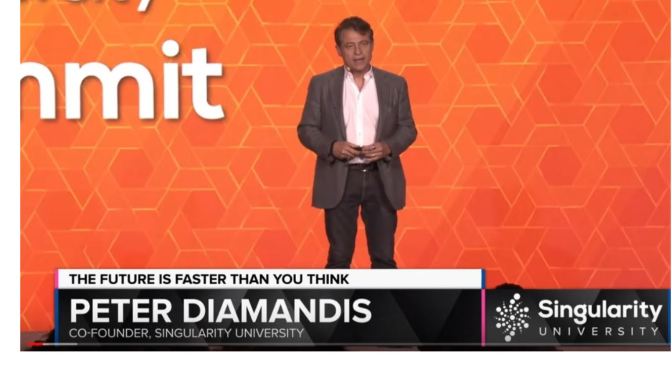
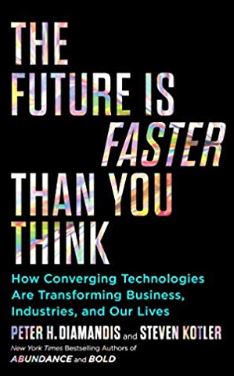
 Technology is accelerating far more quickly than anyone could have imagined. During the next decade, we will experience more upheaval and create more wealth than we have in the past hundred years. In this gripping and insightful roadmap to our near future, Diamandis and Kotler investigate how wave after wave of exponentially accelerating technologies will impact both our daily lives and society as a whole. What happens as AI, robotics, virtual reality, digital biology, and sensors crash into 3D printing, blockchain, and global gigabit networks? How will these convergences transform today’s legacy industries? What will happen to the way we raise our kids, govern our nations, and care for our planet?
 Recently named by Fortune as one of the “World’s 50 Greatest Leaders,” Peter H. Diamandis is the founder and executive chairman of the XPRIZE Foundation, which leads the world in designing and operating large-scale incentive competitions. He is also the executive founder of Singularity University, a graduate-level Silicon Valley institution that counsels the world’s leaders on exponentially growing technologies.
As an entrepreneur, Diamandis has started over 20 companies in the areas of longevity, space, venture capital and education. He is co-founder of BOLD Capital Partners, a venture fund with $250M investing in exponential technologies, and co-founder and Vice
Chairman of Celularity, Inc., a cellular therapeutics company.
Website: https://www.diamandis.com/
 Am I Still a Man?
 But while there is more great TV than ever before, the number of top-tier programs actually declined in 2018, making the task of assembling







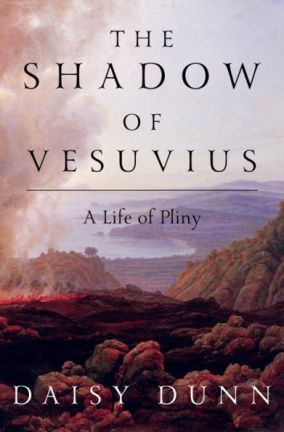 When Pliny the Elder perished at Stabiae during the eruption of Vesuvius in 79 AD, he left behind an enormous compendium of knowledge, his thirty-seven-volume Natural History, and a teenaged nephew who revered him as a father. Grieving his loss, Pliny the Younger inherited the Elder’s notebooks—filled with pearls of wisdom—and his legacy. At its heart, The Shadow of Vesuvius is a literary biography of the younger man, who would grow up to become a lawyer, senator, poet, collector of villas, and chronicler of the Roman Empire from the dire days of terror under Emperor Domitian to the gentler times of Emperor Trajan. A biography that will appeal to lovers of Mary Beard books, it is also a moving narrative about the profound influence of a father figure on his adopted son. Interweaving the younger Pliny’s Letters with extracts from the Elder’s Natural History, Daisy Dunn paints a vivid, compellingly readable portrait of two of antiquity’s greatest minds.




 Our idea was not to make this house feel like a building, but to free it from form. We wanted it to be just a borderless box that emerges out of nowhere in the sky, as if the thickness of the wall and roof were non-existent, but still able to make holes in the ceiling to install curtains, air conditioners, and embed lights. Our intention was to give an illusion to onlookers that the entire ceiling was in the same straight line even though we featured a drop ceiling and a slope that was intentionally used to make the wall and ceiling look thin.
 Boomers Daily