
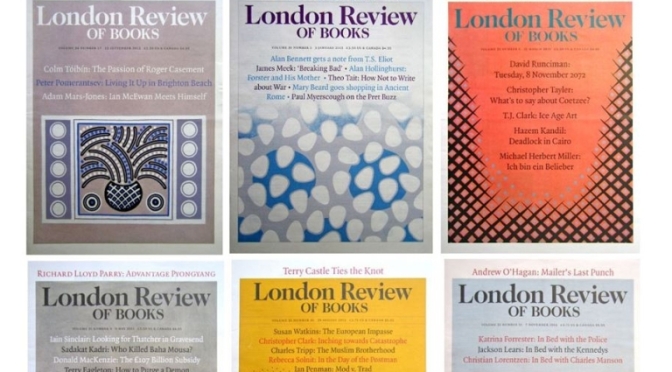
Our new issue is now live feat. @TomFStevenson in Kyiv, Florence Sutcliffe-Braithwaite on what the Welsh got right, @earlymodernjohn on a Livonian werewolf, Julian Barnes on Jacques Lartigue, Kevin Okoth on Black Marxism, and a cover by Alexander Gorlizki: https://t.co/xaTOjYd3Vr pic.twitter.com/JDniNvU2Nd
— London Review of Books (@LRB) March 30, 2022
Category Archives: Reviews

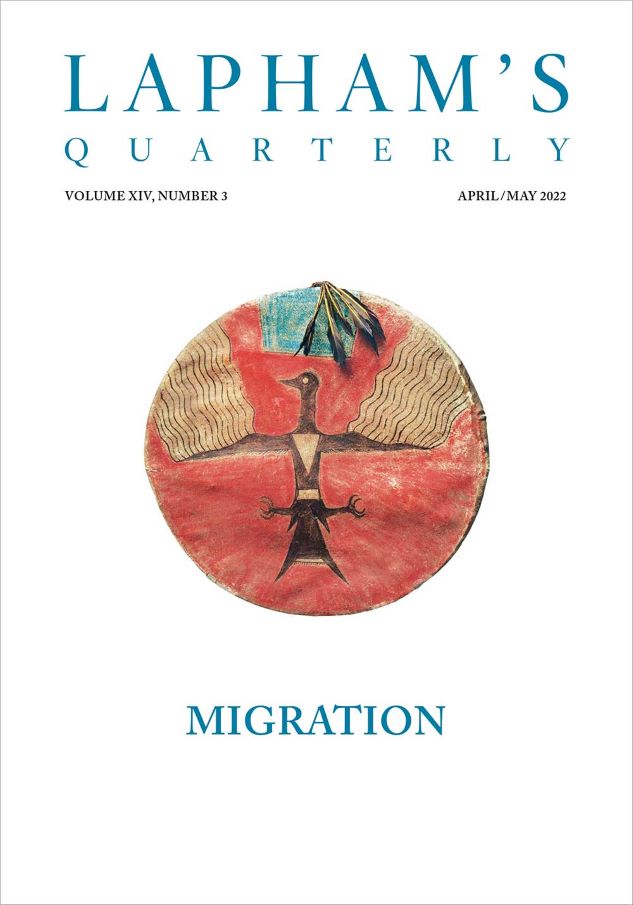
Cover Preview: Lapham’s Quarterly – April/May 2022

Art History: Van Gogh’s ‘Irises’ (Getty Museum)
Behind this iconic painting by Vincent van Gogh is the artist’s inspiring story about healing, as he struggled with the challenges of a psychiatric disorder. Learn more about this period in his life in which he produced some of his most famed work.
Getty has joined forces with Smarthistory to bring you an in-depth look at select works within our collection, whether you’re looking to learn more at home or want to make art more accessible in your classroom. This six-part video series illuminates art history concepts through fun, unscripted conversations between art historians, curators, archaeologists, and artists, committed to a fresh take on the history of visual arts.
View the Getty Conversations series: https://youtube.com/playlist?list=PLi…
Learn more about “Irises” in Getty’s collection online: https://www.getty.edu/art/collection/…

Architecture: The 2022 AIA Housing Awards Revealed
The American Institute of Architects has revealed the winners of the 2022 Housing Awards. The 14 projects span single-family, affordable housing, and specialized housing projects, and include new construction, renovations, and restorations.
Reviews: ‘The Week In Art’
We talk to Max Hollein, director of the Metropolitan Museum of Art, about the new plans for the museum’s wing of modern and contemporary art, including the appointment of the architect Frida Escobedo in place of David Chipperfield.
As The Art Newspaper is about to publish its annual museum attendance survey, showing that visitors are beginning slowly to return to museums after the height of the pandemic, we ask Hollein how the vision for the museum has changed following the events of the past two years. Plus, Aimee Dawson talks to the curator Sam Bardaouil about the exhibition Beirut and the Golden Sixties: A Manifesto of Fragility at the Gropius Bau in Berlin. And in this episode’s Work of the Week, as the Menil Collection in Houston, Texas, opens a major Meret Oppenheim survey, the show’s curator Natalie Dupecher discusses Oppenheim’s Surrealist object Ma gouvernante – My Nurse – Mein Kindermädchen (1936): a pair of white heels on a silver platter, trussed like a chicken.
The Art Newspaper’s visitor attendance survey is in the April print edition, and online next week at theartnewspaper.com, or on our app for iOS and Android, which you can get from the App Store or Google Play.
Beirut and the Golden Sixties: A Manifesto of Fragility, Gropius Bau, Berlin, until 12 June.
Meret Oppenheim: My Exhibition, Menil Collection, Houston, until 18 September; Museum of Modern Art, New York, 30 October-4 March 2023
Research: How Africa Keeps The Amazon Green
Jet streams sprinkle North African dust over the Amazon, providing the rain forest with much needed nutrients. Changing wind patterns and increasing smoke may shift the system.
Science: Subgiant Stars Age, Yellowstone’s Hot Water, Birds & The Moon
Precisely ageing subgiant stars gives new insight into the Milky Way’s formation, and uncovering Yellowstone’s hydrothermal plumbing system.
In this episode:
00:45 Accurately ageing stars reveals the Milky Way’s history
To understand when, and how, the Milky Way formed, researchers need to know when its stars were born. This week, a team of astronomers have precisely aged nearly a quarter of a million stars, revealing more about the sequence of events that took place as our galaxy formed.
Research article: Xiang and Rix
News and Views: A stellar clock reveals the assembly history of the Milky Way
09:53 Research Highlights
Archaeologists reveal an ancient lake was actually a ritual pool, and how the Moon’s phase affects some birds’ altitude.
Research Highlight: Ancient ‘harbour’ revealed to be part of fertility god’s lavish shrine
Research Highlight: These birds fly high when the full Moon hangs in the sky
12:34 Uncovering Yellowstone’s hot water plumbing
Yellowstone National Park’s iconic geothermal geysers and volcanic landmarks are well studied, but very little was known about the ‘plumbing system’ that feeds these features. Now a team of researchers have mapped the underground hydrothermal system, showing the specific faults and pathways that supply the park.
Research article: Finn et al.
19:27 Briefing Chat
We discuss some highlights from the Nature Briefing. This time, 0why an Australian university has been suspended from winning a research foundation’s fellowships, and the ongoing debate about the cause of ‘COVID toes’.
Nature: Funder bars university from grant programme over white-male award line-up
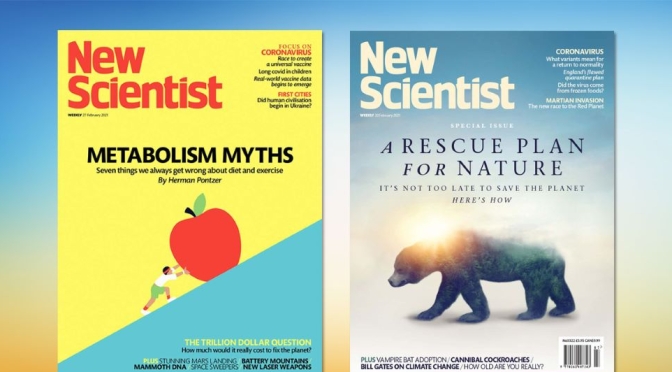
Preview: New Scientist Magazine – March 26, 2022

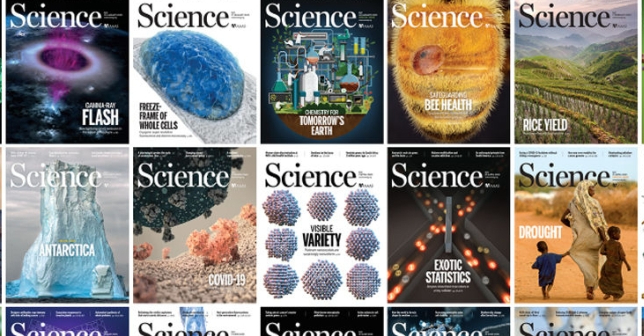
Cover Preview: Science Magazine – March 25, 2022
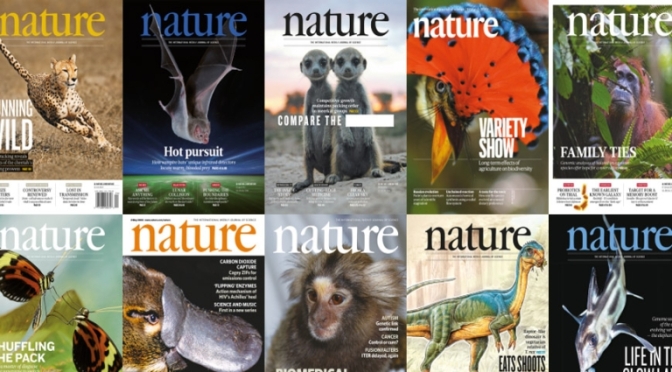
Cover Previews: Nature Magazine – March 24, 2022
Volume 603 Issue 7902, 24 March 2022
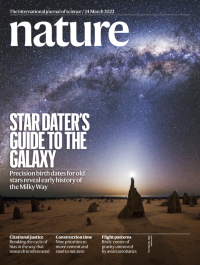
Star dater’s guide to the Galaxy
The cover image shows a view of the Milky Way captured at Nambung National Park in Western Australia. To understand how the Galaxy formed requires precision age dating of the stars that it contains. In this week’s issue, Maosheng Xiang and Hans-Walter Rix of the Max Planck Institute for Astronomy in Heidelberg, Germany, present an analysis of the birth dates for nearly 250,000 stars in their subgiant evolutionary phase, when they can serve as precise stellar clocks. The researchers found that the individual ages of the stars ranged from about 1.5 billion to more than 13 billion years old. Tripling the age-dating precision for such a large stellar sample allowed the researchers to infer the sequence of events that initiated our Galaxy’s formation. Using this information, Xiang and Rix were able to determine that the oldest part of our Galaxy’s disk had already begun to form about 13 billion years ago, just 800 million years after the Big Bang, and that the formation of the inner Galactic halo was completed some 2 billion years later.
 Boomers Daily