
Category Archives: Reviews
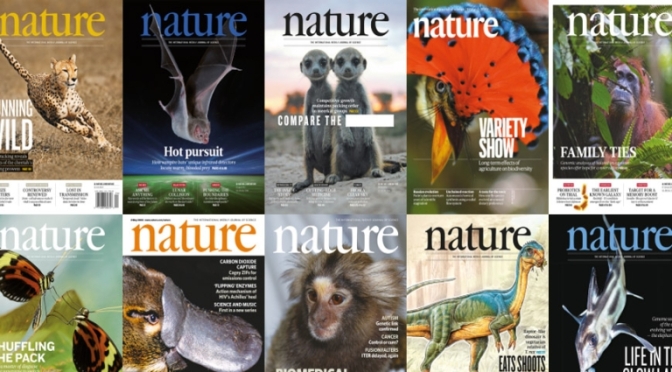
Cover Preview: Nature Magazine – April 7, 2022


Previews: Times Literary Supplement – April 8, 2022
Analysis: Ukraine Victory Importance, Anti-Media In China, Social Influencers
A selection of three essential articles read aloud from the latest issue of The Economist. This week, why a Ukrainian victory would transform the security of Europe, a terrible plane crash prompts a revealing anti-media backlash in China (11:20) and the serious business of social influencers (18:30).

Science: Probing Earth’s Inner Core, Complete Read Of Human Genome
On this week’s show: A journey to the center of the center of the Earth, and what was missing from the first human genome project.
Staff Writer Paul Voosen talks with host Sarah Crespi about the many mysteries surrounding the innermost part of our planet—from its surprisingly recent birth to whether it spins faster or slower than the rest of the planet.
Next, Sarah chats with Adam Phillippy about the results from the Telomere-to-Telomere (T2T) Consortium, an effort to create a complete and detailed read of the human genome. Phillippy, a senior investigator and head of the Genome Informatics Section at the National Human Genome Research Institute, explains what we can learn by topping up the human genome with roughly 200 more megabases of genetic information—practically a whole chromosome’s worth of additional sequencing.
See all the T2T papers.
This week’s episode was produced with help from Podigy.
[Image: V. Altounian/Science; Music: Jeffrey Cook]
[alt: An array of the human chromosomes showing newly sequenced parts from the Telomere-to-Telomere Consortium with podcast symbol overlay]
Authors: Sarah Crespi; Paul Voosen
Episode page: https://www.science.org/doi/10.1126/science.abq1885
Reviews: ‘The Week In Art’
This week: the Art Basel and UBS Global Art Market Report 2022 is out—is the market’s recovery as good as it sounds?
We talk to Melanie Gerlis, art market columnist for The Art Newspaper and the Financial Times, about the sixth edition of the market report, what the headline figures tell us and what we can read between the lines.
As the exhibition Hideouts: The Architecture of Survival, opens at the Zacheta National Gallery of Art in Warsaw—focusing on the spaces in Poland and Ukraine used by Holocaust survivors to escape Nazi persecution—we talk to the artist behind it, Natalia Romik. Though long planned, the show has gained a troubling topicality as the Russian invasion and destruction of Ukraine continues.
And in this episode’s Work of the Week, coinciding with the 150th anniversary of Piet Mondrian’s birth, we discuss his painting Victory Boogie Woogie (1942-44). Caro Verbeek, the co-curator of Mondrian Moves, an exhibition opening this week at the Kunstmuseum den Haag in the Hague, the Netherlands, tells us about the feverish creation and unfinished nature of the Dutch artist’s final work.
Natalia Romik’s exhibition, Hideouts: The Architecture of Survival, Zachęta National Gallery of Art, Warsaw, until 17 July; TRAFO Center for Contemporary Art, Szczecin, Poland, 4 August-6 November
Mondrian Moves, Kunstmuseum den Haag, the Hague, Netherlands, 2 April-25 September. Mondrian Evolution, Fondation Beyeler, Basel, Switzerland, 5 June-9 October; K20, Düsseldorf, Germany, 29 October-10 February 2023
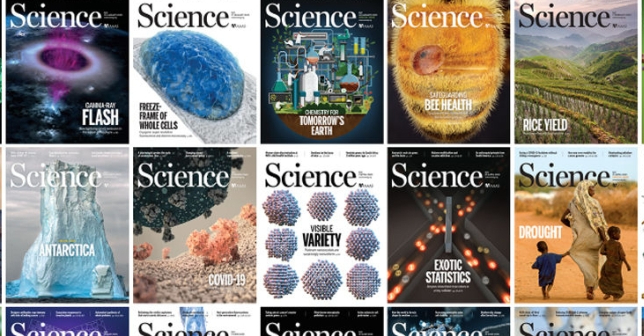
Cover Preview: Science Magazine – April 1, 2022
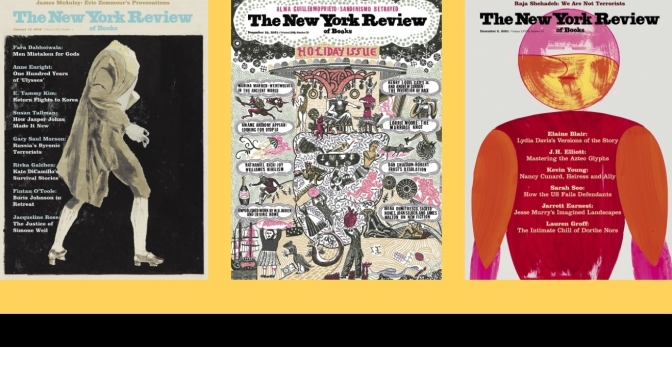
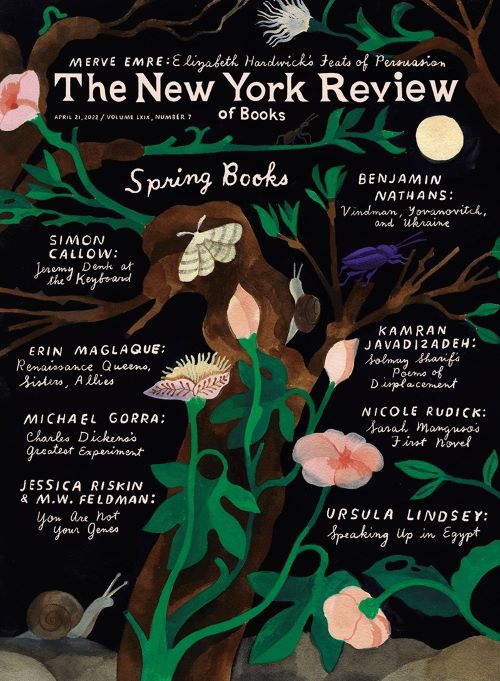
Previews: The New York Review Of Books – April 21
Science: Navigating Life, Coastal Storminess, Boa Constrictors, Old Trees
Your ability to find your way may depend on where you grew up and how coastal storminess is changing.
00:47 Your ability to find your way may depend on where you grew up
Researchers have long been trying to understand why some humans are better at navigating than others. This week, researchers show that where someone grew up plays an important role in their ability to find their way; the more winding and disorganised the layouts of your childhood were, the better navigator you’ll be later in life.
Research article: Coutrot et al.
08:57 Research Highlights
How boas can squeeze without suffocating themselves, and why being far from humans helps trees live a long life.
Research Highlight: How boa constrictors squeeze and breathe at the same time
Research Highlight: Where are Earth’s oldest trees? Far from prying eyes
11:39 How coastal storminess is changing
Coastal flooding causes billions of dollars in damage each year. Rising sea levels are known to be a key driver, but the importance of another factor, storm surges, is less clear. Typically after accounting for increasing sea level, they’re not thought to make much of an impact. However new research suggests that this may not be the case.
Research article: Calafat et al.
16:10 Briefing Chat
We discuss some highlights from the Nature Briefing. This time, a brain implant allows a person who is completely paralysed to communicate, and penguin-like bone density suggests Spinosaurus may have hunted underwater.
Science: In a first, brain implant lets man with complete paralysis spell out thoughts: ‘I love my cool son.’
National Geographic: Spinosaurus had penguin-like bones, a sign of hunting underwater
 Boomers Daily