Financial Times (October 18, 2023) – The rush back to the Moon has begun. The US and China are planning permanently crewed bases on the lunar surface. Billions of dollars in contracts are up for grabs as companies are launching ambitious new support projects, from growing food in space to a new lunar internet.
The FT’s Peggy Hollinger asks if the next great leap forward in space is a lunar economy?
The Metropolitan Museum of Art (October 18, 2023) – Over an intense nine weeks in the summer of 1905 in the modest fishing village of Collioure on the French Mediterranean, Henri Matisse and Andre Derain embarked on a partnership that led to a wholly new, radical artistic language later known as Fauvism.
Their daring, energetic experiments with color, form, structure, and perspective changed the course of French painting; it marked an introduction to early modernism and introduced Matisse’s first important body of work in his long career.
This exhibition, which is co-organized by The Metropolitan Museum of Art and the Museum of Fine Arts, Houston, emphasizes as never before the legacy of that summer and examines the paintings, drawings, and watercolors of Matisse and Derain through sixty-five works on loan from national and international museums, including Musée National d’Art Moderne, Centre Pompidou; National Galleries of Scotland; National Gallery of Art, Washington, D.C.; San Francisco Museum of Modern Art; and the Museum of Modern Art, New York; as well as private collections.
DW Documentary (October 18, 2023) – Butterflies and moths. Graceful and beautiful, they flit about our spring and summer skies. Their delicate choreographies and dazzling colors are among the most amazing in the animal kingdom. But beauty is not their only quality!
Through the lenses of powerful microscopes, scientists discover unexpected secrets about these fragile creatures that can be adapted and applied to make our world better and more sustainable. This film is a journey into the nano-dimensions of butterflies, taking viewers from high-tech labs to dense forests and lavender fields around the world. We take a close look at the iconic morpho butterfly and find out how its iridescent blue wings reveal a way to produce structural color, a discovery which allows researchers to control light.
Physicist Chunlei Guo, whose work involves reproducing butterfly structures, has created a material capable of absorbing all the colors of the spectrum, a discovery that might revolutionize the field of renewable energies. He is also investigating how the amazing hydrophobic properties of butterfly wings could be used to create an unsinkable metal, which could be useful for constructing floating cities if ocean levels continue to rise.
The blue morpho, the industrious silk moth, the transparent glasswing butterfly, the resistant Heliconius, the enigmatic monarch and the delicate white cabbage butterfly – all have inspired discoveries. These have taken place in many different scientific fields, including energy efficiency and medicine — and even in the detection of toxins, thereby helping save lives in the event of chemical or gas attacks. We take a look at the work of researchers, biologists and geneticists.
We also talk to experts, such as physicist and biomimicry expert Serge Berthier, as well as to Jessica Ware, an entomologist at the American Museum of Natural History, about butterflies’ incredible behaviors and capacities. Tiny as they are, butterflies and moths can inspire groundbreaking scientific progress. And they also serve as a warning about what’s at stake if we fail to protect our extraordinary natural environment.
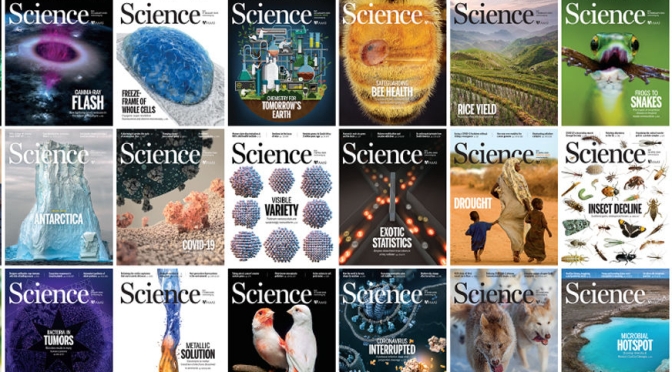
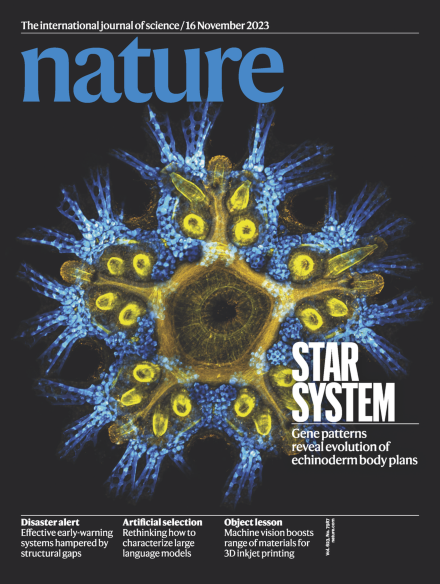
nature Magazine – October 19, 2023: The latest issue features how humans develop in the very early stages when a newly formed embryo is implanted in the wall of the uterus, largely because of the physical and ethical challenges that are presented by studying early human embryos.
The test 30 years ago of what remote sensing could tell us about our own planet shows the value of looking with unbiased eyes at what we think we already know.
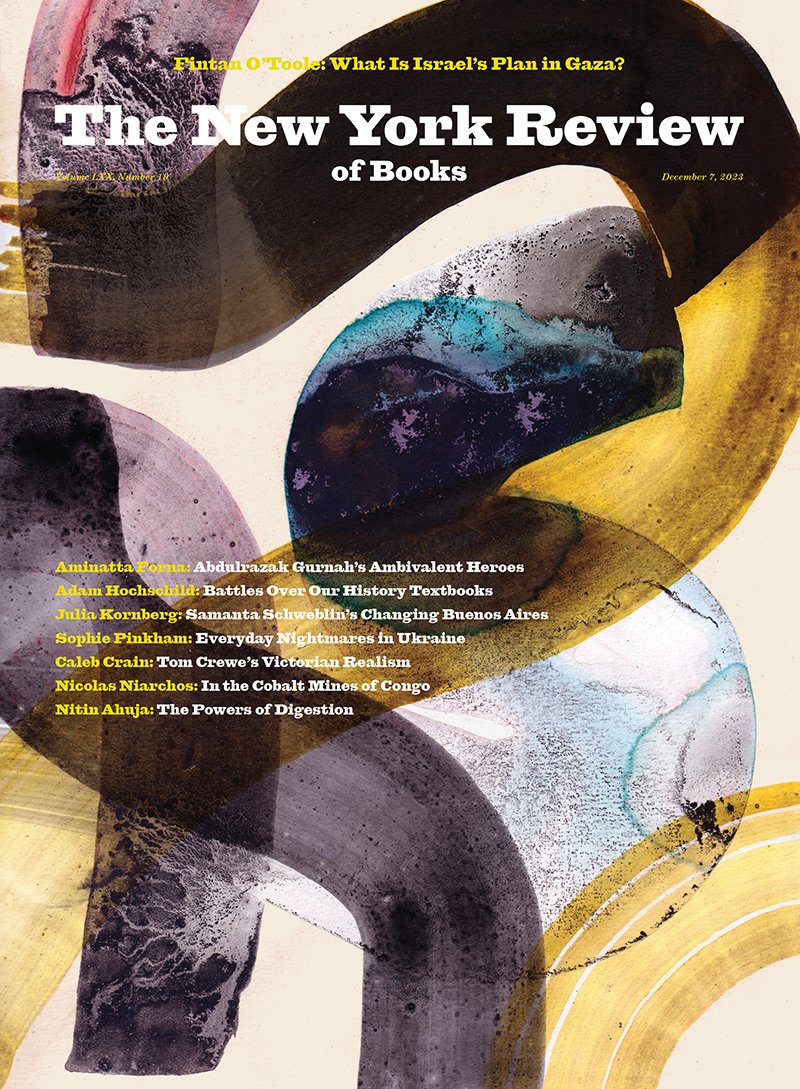
The Guardian Weekly (October 20, 2023) – The new issue features escalating events in Israel and Gaza that continue to cause deep distress and alarm,with several thousand people known to be dead or wounded on either side of the border. US president Joe Biden was expected to visit Israel this week, amid growing expectations of a ground invasion of Gaza and fears of a wider regional escalation.
Also, a primer on the historical background to events by Chris McGreal, while on the opinion pages the Israeli author and historian Yuval Noah Harari and Guardian US columnist Naomi Klein provide thoughtful and grounded perspectives.
There was sadness for many Aboriginal Australians after a move to recognise Indigenous people in the country’s constitution was rejected in a referendum, as Sarah Collard and Elias Visontay report. Also from Oceania, Henry Cooke examines what aspects of Jacinda Ardern’s political legacy might survive after New Zealand elected a new conservative government.
From Egypt to Hong Kong, the 2010s were a decade when mass protest movements looked set to change the world.But in most cases, the hope embodied by many massive street demonstrations was soon crushed by authoritarian regimes. Vincent Bevins asks organisers and others who were there where it all went wrong.
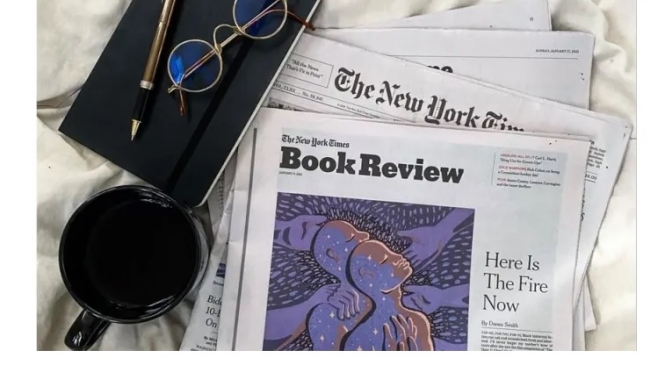
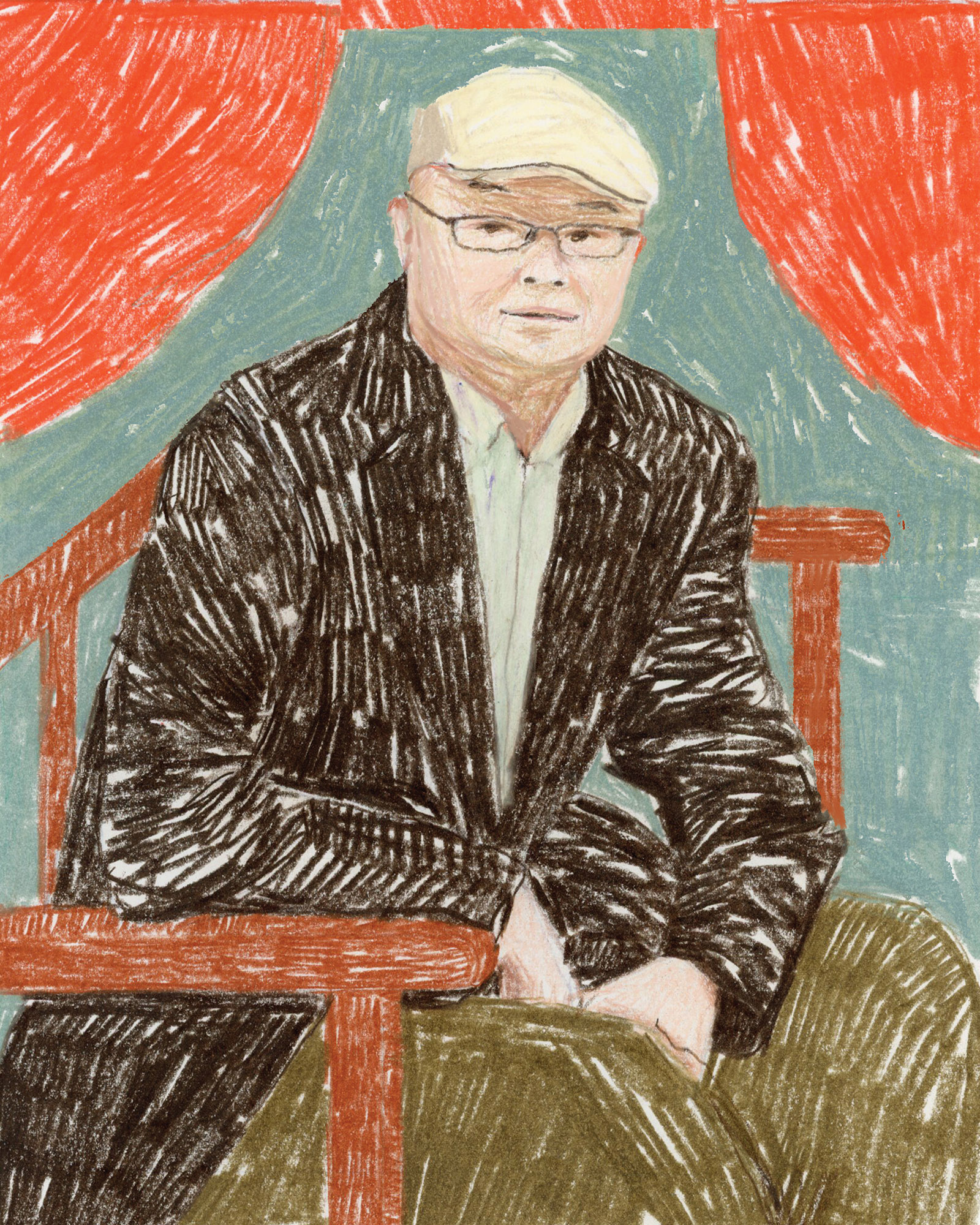
Times Literary Supplement (October20, 2023): The new issue features ‘Rocket Man’ – North Korea’s dictator is no joke; A snapshot of Teju Cole; Daniel Dennett’s evolution; Monet’s muses; John le Carré undercover, and more…
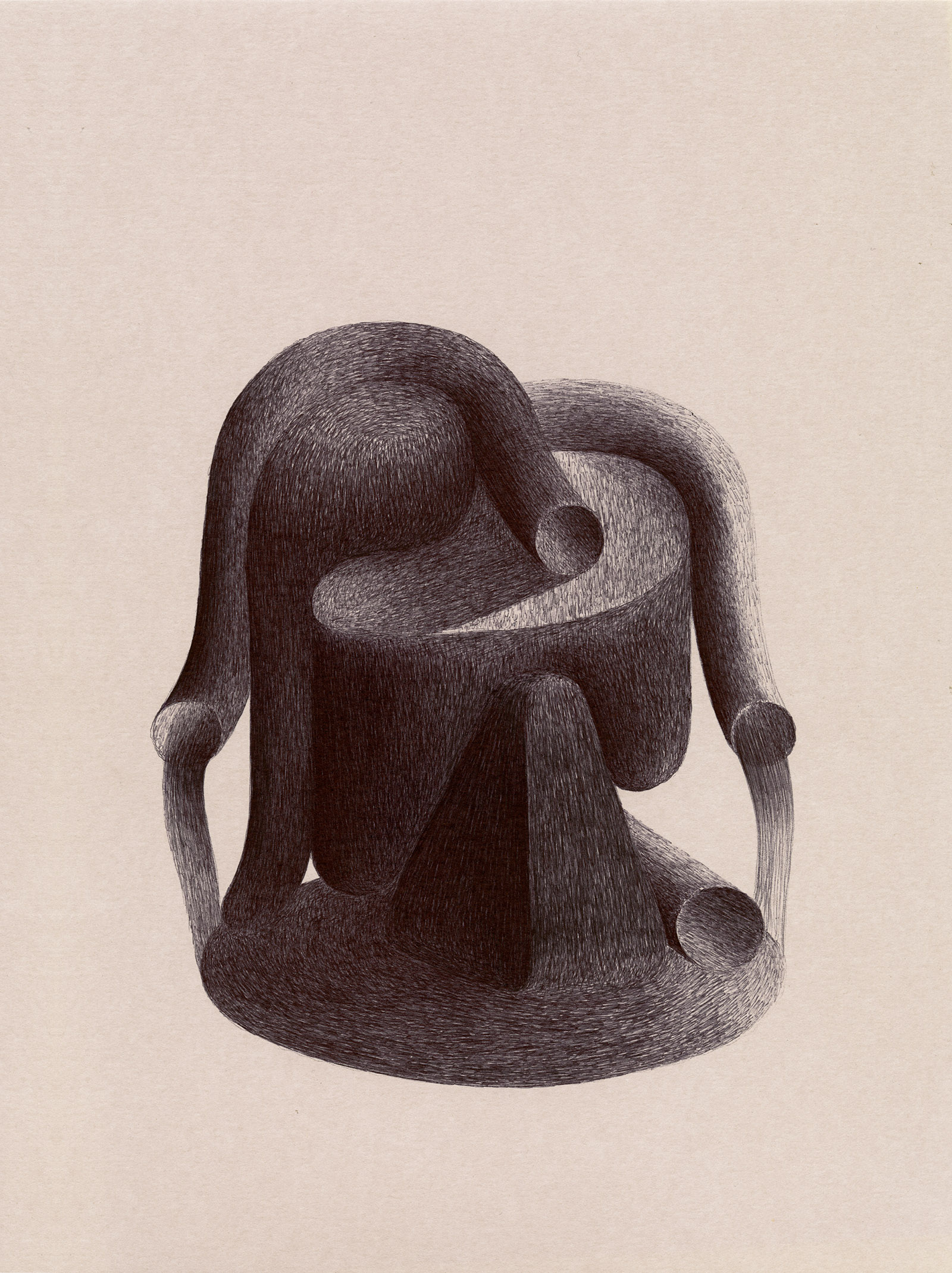
Scientific American – November 2023: The issue features Woman The Hunter – New science debunks the myth that men evolved to hunt and women to gather; Interspecies Organ Transplants; Materials Made in Space; The Legacy of the Endangered Species Act, and more…
The Endangered Species Act requires that every U.S. plant and animal be saved from extinction, but after 50 years, we have to do much more to prevent a biodiversity crisis
Summary: The average U.S. household contains a trove of potentially reusable goods worth roughly $4,500. That’s a lot of trapped value, and companies are at last getting serious about accessing it—by developing new resale capabilities. Resale has been with us for a very long time, of course—at yard sales, on used-car lots, in classified ads.
An advanced AI model considers much more than what competitors are charging.
Summary: In today’s fast-paced world of digital retailing, the ability to revise prices swiftly and on a large scale has emerged as a decisive differentiator for companies. Many retailers now track competitors’ prices via systems that scrape rivals’ websites and use this information as an input to set their own prices manually or automatically. A common strategy is to charge X dollars or X percent less than a target competitor. However, retailers that use such simple heuristics miss significant opportunities to fine-tune pricing.
Country Life Magazine – October18, 2023: The latest issue features Norfolks – Little pockets of fun; The real Macnab – great adventures in the field; Britain’s loneliest trees; Beethoven’s Austria and Amsterdam’s canal life, and more…
I’m still standing
In memory of the Sycamore Gap tree, so callously cut down, we salute its fellow arboreal sentinels of Britain
Following in the footsteps of John Macnab
The Editor and The Judge set off across the Tulchan estate in pursuit of a stag, a brace of grouse and a salmon, in the spirit of John Buchan’s hero
Country Life International
Anna Tyzack uncovers Monaco’s unexpectedly magnificent restoration
Deborah Nicholls-Lee settles in to an Amsterdam canal house
Tom Parker Bowles gorges on Alpine cheese
Russell Higham explores the Austrian countryside that inspired Beethoven
Holly Kirkwood picks the best Caribbean properties
Mark Frary straps on his pads for a spot of cricket in the Windward Islands
Felix Francis’s favourite painting
The author picks a scene full of the thrill of the racecourse
Totally foxed
The rural people of Scotland are reeling under a prejudiced new law on hunting. Jamie Blackett despairs for the fox
The Englishness of English architecture
What makes a building English? Steven Brindle considers the answer, from soaring cathedral vaults to austere Palladian villas and rambling country piles
Native breeds
Kate Green luxuriates in the luscious locks of the Leicestershire Longwool
Come hell or high water
Few creatures face as difficult a journey as the salmon does to and from its spawning grounds. Simon Lester follows in its wake
Interiors
A dramatic kitchen and why it’s time to cuddle up in British wool
Plant theatre
Charles Quest-Ritson takes the well-worn path to the famed nursery of Larch Cottage in Cumbria
Having a field day
Behind hounds or on the marsh, casting for a salmon or stalking a stag, nothing stirs Adrian Dangar’s heart as fieldsports do
Kitchen garden cook
Melanie Johnson finds the perfect pairing for hazelnuts
IN THE LATE 2000s, Rachel Carmody was spending a lot of time counting calories. An anthropology graduate student at Harvard, she was studying whether cooking changed the number of calories the gut can extract from food. When humans invented cooking thousands of years ago, she and her advisor Richard Wrangham wondered, had they opened the door to a new source of energy?
DURING THE past two decades, the number of annual cancer deaths in the United States has fallen by 27 percent, a remarkable improvement driven by new precision diagnoses and treatments tailored to individual patients. Today, oncologists can detect cancer in its earliest stages and deliver drugs that enlist the patient’s own immune system to improve their odds of survival. Yet cancer remains the second deadliest disease in the United States, claiming more than 600,000 lives every year. Its persistence underscores the urgent need for a deeper understanding of how cancer interacts with the body. Assistant professor of neurology Humsa Venkatesh believes she may have found a promising new pathway for highly effective cancer treatments in the most unexpected of places: the human brain.
News, Views and Reviews For The Intellectually Curious