Category Archives: Reviews

SCIENCE MAGAZINE – OCTOBER 9, 2025

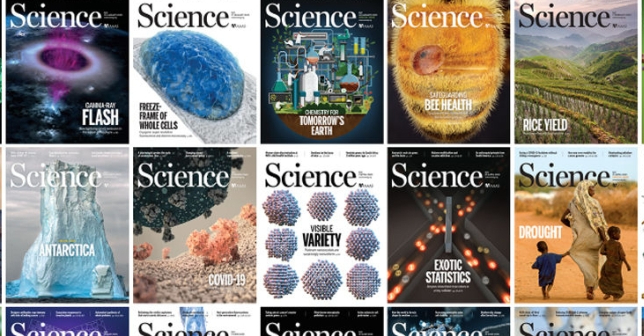
SCIENCE MAGAZINE: The latest issue features ‘Eclipsing the Sun’ – A unique cosmic event shows an influence of light on bird behavior.

Research on immune system’s ‘police’ garners Nobel

Three scientists honored for revealing how regulatory T cells prevent autoimmune disease

Quantum effects in circuits honored with Physics Nobel

Breakthrough paved the way to many of today’s budding quantum computers

Steadying the output of fiber lasers

High-power fiber lasers are used in a range of scientific fields in addition to their standard use for technology. However, increases in laser output power are limited by nonlinear effects that can damage the optical components and reduce the beam quality. Rothe et al. used a spatial wavefront-shaping technique for multimode fiber lasers that mitigates their detrimental processes, thus enabling output power to be increased appreciably while maintaining beam quality.

PHILOSOPHY NOW MAGAZINE – OCTOBER/NOVEMBER 2025

PHILOSOPHY NOW MAGAZINE: The latest issue features ‘Moral Issues

Challenging Times & Moral Issues

De-Extinction: Bringing Back Beasts or Playing God?

John Kennedy Philip revives the ethical debate around resurrecting species.

Forced Vaccination

Naina Krishnamurthy asks if it’s ethical or egregious.

Moral Decision-Making for a Job Search

Norman Schultz wonders when working is wrong.

What My Sister Taught Me About Humanity

Lee Clarke argues that we need a more inclusive view of moral personhood.

Collective Action & Climate Change

Nevin Chellappah says we can’t dodge responsibility by our effects being small.

The Mediation of Touch

A conversation between Emma Jones and Luce Irigaray.

Macmurray on Relationship

Jeanne Warren presents aspects of John Macmurray’s philosophy of the personal.

Quantum Physics & Indian Philosophy

Punit Kumar and Sanjeev Kumar Varshney look into entangled worlds.

Alchemy, Mining, Speculation & Experimentation

Okan Nurettin Okur investigates the philosophy of chemistry.

Can AI Teach Our Grandmothers To Suck Eggs?

Louis Tempany wonders whether the problem is with the machines or with us.

Edward Gibbon (1737-1794)

John P. Irish considers some principles of history through the history of a historian.

New Scientist Magazine – October 11, 2025

New Scientist issue 3564 cover

New Scientist Magazine: This issue features ‘Decoding Dementia’ – How to understand your risk of Alzheimer’s, and what you can really do about it.

Why everything you thought you knew about your immune system is wrong

One of Earth’s most vital carbon sinks is faltering. Can we save it?

What’s my Alzheimer’s risk, and can I really do anything to change it?

Autism may have subtypes that are genetically distinct from each other

20 bird species can understand each other’s anti-cuckoo call

Should we worry AI will create deadly bioweapons? Not yet, but one day

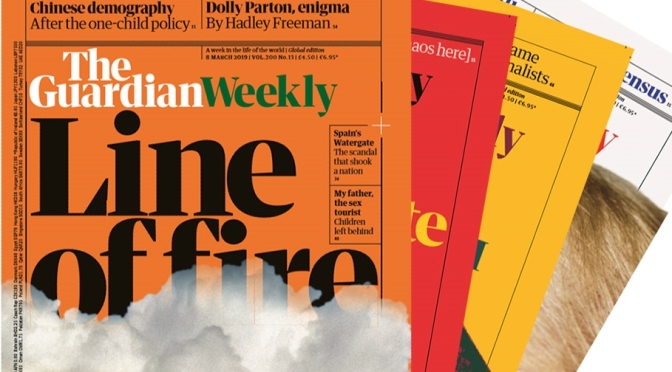
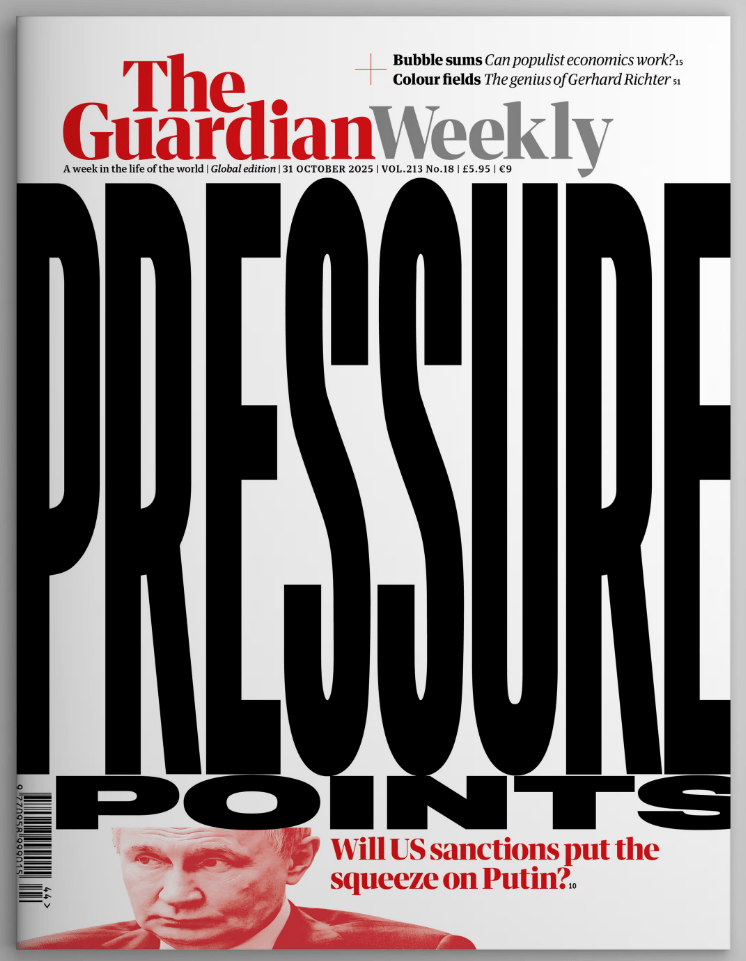
THE GUARDIAN WEEKLY – OCTOBER 11, 2025 PREVIEW

THE GUARDIAN WEEKLY: The latest issue features ‘Day Of Darkness’ – With antisemitism on the rise in Britain, was the Manchester attack inevitable?

Last week was Yom Kippur, the holiest day in the Jewish calendar. A day of prayer and staying away from news. As people made their way to Heaton Park synagogue in north Manchester, they saw a small car being driven erratically before it crashed into the gates. In seconds, Jihad al-Shamie had jumped from the vehicle and started stabbing those nearby. Within six minutes three people had been killed, including the attacker, who was shot by armed police.

For our cover story, Chris Osuh and Geneva Abdul speak to members of the Jewish community about how they feared such an assault was likely, as well as their hopes for unity in the face of hatred. Our reporting team pieces together what is known about Shamie, and Jonathan Freedland says the terror attack was no surprise amid rising antisemitism, but must be a turning point.

Five essential reads in this week’s edition

Spotlight | A chilling message
David Smith reports on how Donald Trump is stepping up attacks on Democratic donors little more than a year before the midterm elections for Congress

Science | Catching Zs
If you’ve ever found yourself awake in the small hours, mind whirring, you’re not alone. Jillian Pretzel asks experts about what causes maintenance insomnia – inability to stay asleep – and which treatments can help to tackle it

Feature | Broken connection
A volcanic eruption in the South Pacific in 2022 ripped apart the underwater cables that connect Tonga to the world. Samanth Subramanian examines how losing the internet catapulted the archipelago back in time

Opinion | Man without a plan?
Latin American governments are fretfully watching a big US military buildup around Venezuela as Donald Trump steps up action against drug cartels. The president’s efforts to act as a neighbourhood policeman, writes Simon Tisdall, are regressive, dangerous and almost certain to backfire

Culture | Boss mode
New biopic Springsteen: Deliver Me from Nowhere captures the musician at a pivotal point in his career. Alexis Petridis speaks to the film’s cast and crew about bringing the musical icon to life

The London Magazine – October/November 2025

THE LONDON MAGAZINE (April 2, 2025): The latest issue features…. 

Essay | The Aesthetic Life by Zsófia Paulikovics

Essays

‘Several broadly millennial acquaintances confess that reading the book made them feel a sort of sickening recognition.’

Essay | No Designated Venue: An Oral History of London’s Music and Poetry Scenes

Yasmina Snyder spoke to writers, poets, musicians and event organisers based in London about the connections between live music and poetry, and the spaces that host them.

Essay | Why Magazines Fail by Tristram Fane Saunders

‘There’s big trouble in the world of little magazines. In the last two years, an alarming number have vanished into that second-hand bookshop in the sky. Each leaves the world a little quieter, a little poorer.’

THE NEW YORKER MAGAZINE – OCTOBER 13, 2025 PREVIEW

The cover of the October 13 2025 issue of The New Yorker in which a man creates a leaf motif with a leaf blower.

THE NEW YORKER MAGAZINE: The latest cover features Brian Stauffer’s “Winds of Change” – A gust of fall.

Donald Trump, Pete Hegseth, and the “War from Within”

Peace abroad and war at home? It’s an unusual note to strike in an electoral democracy. By Benjamin Wallace-Wells

Before Kimmel, the Smothers Brothers Ate It

President Nixon got the brothers’ variety show cancelled after they wouldn’t let up on Vietnam. In the wake of the new late-night wars, Dick Smothers is having flashbacks. By Bruce Handy

The Prime Minister Who Tried to Have a Life Outside the Office

As the thirtysomething leader of Finland, Sanna Marin pursued an ambitious policy agenda. The press focussed on her nights out and how she paid for breakfast. By Jennifer Wilson

The Hague on Trial

The chief prosecutor has obtained warrants against Israeli leaders for war crimes—but faces allegations of sexual misconduct. By David D. Kirkpatrick

THE NEW YORK TIMES MAGAZINE – OCTOBER 5, 2025

Current cover

THE NEW YORK TIMES MAGAZINE: The 10.5.25 Issue features Matthieu Aikins and Victor J. Blue reporting on crimes and impunity in the U.S. Special Forces.

They Celebrated Vigilante Justice on the Battlefield. Then They Brought It Home.

Pete Hegseth’s advocacy for service members accused of war crimes, and Trump’s pardons of them, have helped usher in an era of military aggression and disregard for the rule of law. By Matthieu Aikins  and  Victor J. Blue

Did a Green Beret Unit Commit One of the Worst U.S. War Crimes in Decades?

In 2012, after a team member was nearly killed, a Special Forces unit went on a rampage that might have been one of the worst war crimes in recent U.S. history. By Matthieu Aikins and Victor J. Blue

How War-Crime Accusations Against Green Berets Were Denied and Buried

As cases of lawless behavior and extrajudicial killings mounted, the Special Forces had to decide how to respond — and whom to protect. By Matthieu Aikins and Victor J. Blue

THE CHRYSANTHEMUM PARADOX

Japan’s first female prime minister promises history, but her ascent may only deepen the old order.

By Michael Cummins, Editor, October 4, 2025

Sanae Takaichi has become Japan’s first female prime minister—a milestone that might look like progress but carries a paradox at its core. Takaichi, sixty-four, rose not by challenging her party’s patriarchal order but by embracing it more fiercely than her male rivals. Her vow to “work as hard as a carriage horse” captured the spirit of her leadership: endurance without freedom, strength yoked to duty. In a nation where women hold less than sixteen percent of parliamentary seats and most are confined to low-paid, “non-regular” work, Takaichi’s ascension is less rupture than reinforcement. She inherits the ghost of Shinzo Abe, with whom she shared nationalist loyalties, and she confronts a fragile coalition, an aging electorate, and a looming Trump visit. Her “first” is both historic and hollow: the chrysanthemum blooms, but its shadow may reveal that Japan’s old order has merely found a new face.

Under the humming fluorescent lights of the Liberal Democratic Party’s headquarters in Tokyo, the old men in gray suits shifted in their seats. The air was thick with the stale perfume of cigarettes and the accumulated dust of seventy years in power. The moment came suddenly, almost anticlimactically: after two rounds of voting, Sanae Takaichi was named leader. The room stirred, applause pattered weakly. She stepped to the podium, bowed with a precision that was neither humble nor triumphant, and delivered the line that will echo through history: “I will work as hard as a carriage horse.”

Why that image? Why not the fox of Japanese cunning, or the crane of elegance, or the swift mare of legend? A carriage horse is strength without freedom. It pulls because it must. Its labor is endurance, not glory. In that metaphor lay the unsettling heart of the moment: Japan’s first woman prime minister announcing herself not as a breaker of chains but as the most dutiful beast of burden. Ushi mo aru kedo, hito mo aru—“Even cattle have their place, but so do people.” Here, in this paradoxical victory, the human became the horse.

In Japan, the ideal of gaman—stoic endurance in the face of suffering—is praised as virtue. The samurai ethos of bushidō elevated loyalty above will. Women, in particular, have long been praised for endurance in silence. Takaichi’s metaphor was no slip. It was a signal: not rebellion, but readiness to shoulder a system that has never bent for women, only asked them to carry it. In the West, the “first woman” often suggests liberation; in Japan, Takaichi presented herself as a woman who could wear the harness more tightly than any man.

The horse metaphor might also be personal. Takaichi was not a scion of a dynasty like her rival, Koizumi. Her mother served as a police officer; her father worked for a car company. Her strength was forged in the simple, demanding work of postwar Japan—the kind of tireless labor she was now vowing to revive for the nation.

For the newspapers, the word hajimete—first—was enough. But scratch the lacquer, and the wood beneath showed a different grain. The election was not of the people; it was an internal ballot, a performance of consensus by a wounded party. Less than one percent of Japan had any say. The glass ceiling had not been lifted by collective will but punctured by a carefully aimed projectile. The celebration was muted, as if everyone sensed that this “first” was also a kind of last, a gesture of desperation dressed in history’s robes.

Deru kugi wa utareru—“The nail that sticks out gets hammered down.” Takaichi did not stick out. She was chosen precisely because she could wield the hammer.

Her rise was born of collapse. The LDP, which had dominated Japanese politics like Mount Fuji dominates the horizon, was eroded, its slopes scarred by landslides. In the 2024 Lower House election alone, it lost sixty-eight seats, a catastrophic erosion. After another defeat in 2025, it found itself, for the first time in memory, a minority in both houses of the Diet. Populist formations shouting Nippon daiichi!—Japan First—had seized the public imagination, promising to protect shrines from outsiders and deer in Nara from the kicks of tourists. Stagnant wages, rising prices, and the heavy breath of globalization made their slogans ring like temple bells.

Faced with collapse, the LDP gambled. It rejected the fresh-faced Shinjiro Koizumi, whose cosmopolitan centrism seemed too fragile for the moment, and crowned the hard-line daughter of Nara, the protégé of Shinzo Abe. In choosing Takaichi, the LDP announced that its path back to power would not be through moderation, but through continuity.

The ghost of Abe hovers over every step she takes. His assassination in 2022 froze Japan in a perpetual twilight of mourning. His dream—constitutional revision, economic reflation, nationalist revival—remained unfinished. Takaichi walks in his shadow as if she carries his photograph tucked inside her sleeve. She echoes his Abenomics: easy money, big spending. She continues his visits to Yasukuni Shrine, where the souls of Japan’s war dead—among them Class A criminals—are enshrined. Each bow she makes is both devotion and provocation.

Hotoke no kao mo san-do—“Even a Buddha’s face only endures three times.” How many times will China and South Korea endure her visits to Yasukuni?

And yet, for all the historic fanfare, her stance on women is anything but transformative. She has opposed allowing a woman to reign as emperor, resisted reforms to let married couples keep separate surnames, and dismissed same-sex marriage. Mieko Nakabayashi at Waseda calls her bluntly “a roadblock to feminist causes.” Yet she promises to seat a cabinet of Nordic balance, half men and half women. What does equality mean if every woman chosen must genuflect to the same ideology? One can imagine the photograph: a table split evenly by gender, yet every face set in the same conservative mold.

In that official photograph, the symmetry was deceptive. Each woman had been vetted not for vision but for loyalty. One wore a pearl brooch shaped like a torii gate. Another quoted Abe in her opening remarks. Around the table, the talk was of fiscal stimulus and shrine etiquette. Not one mentioned childcare, wage gaps, or succession. The gender balance was perfect. The ideological balance was absolute.

This theater stood in stark opposition to the economic reality she governs. Japan’s gender wage gap is among the widest in the OECD; women earn barely three-quarters of men’s wages. Over half are trapped in precarious “non-regular” work, while fewer than twelve percent hold managerial posts. They are the true carriage horses of Japan—pulling without pause, disposable, unrecognized. Takaichi, having escaped this trap herself, now glorifies it as national virtue. She is the one horse that broke free—only to tell the herd to pull harder.

The global press, hungry for symbols, crowned her with headlines: “Japan Breaks the Glass Ceiling.” But the ceiling had not shattered—it had been painted over. The myth of the female strongman—disciplined, unflinching, ideologically pure—has become a trope. Conservative systems often prefer such women precisely because they prove loyalty by being harsher than the men who trained them. Takaichi did not break the mold; she was cast from it.

Other nations offer their mirrors: Thatcher, the Iron Lady who waged war on unions; Park Geun-hye, whose scandal-shattered rule rocked South Korea; Indira Gandhi, who suspended civil liberties during India’s Emergency. Each became a vessel for patriarchal power, proving strength through obedience rather than disruption. Takaichi belongs to this lineage, the chrysanthemum that blooms not in a wild meadow but in a carefully tended imperial garden.

Her campaign rhetoric made plain her instincts. She accused foreigners of kicking sacred deer in Nara, of swinging from shrine gates. The imagery was almost comic, but in Japan symbols are never trivial. The deer, protectors of Shinto shrines, bow to visitors as if performing eternal reverence. To strike them is to wound purity. The torii gates mark thresholds between profane and sacred worlds; to defile them is to profane Japan itself. By weaponizing these cultural symbols, Takaichi sought to steal the thunder of far-right groups like Sanseitō, consolidating the right-wing vote under the LDP’s battered banner.

But the weight of Takaichi’s ideological baggage—the nationalism that served her domestically—was instantly transferred to the fragile carriage of Japan’s foreign policy. To survive, the LDP must keep its coalition with Komeito, the Buddhist-backed party rooted in Soka Gakkai’s pacifism. Already the monks grumble. Nationalist education reform? No. Constitutional militarism? Impossible. Imagine the backroom: tatami mats creaking, voices low, one side invoking the Lotus Sutra, the other brandishing polls. Ni usagi o ou mono wa issai ezu—“He who chases two rabbits catches none.”

Over all this looms America. Donald Trump, swaggering toward a late-October Asia tour, may stop in Tokyo. Takaichi once worked in the U.S.; she speaks the language of its boardrooms. But she campaigned as a renegotiator, a fighter against tariffs. Now reality intrudes. Japan has already promised $550 billion in investment and loan guarantees to secure a reprieve from harsher duties. How she spends it will define her. To appear submissive is to anger voters; to defy Trump is to risk reprisal. Imagine the summit: Trump beaming, Takaichi bowing, their hands clasped in an awkward grip, photographers snapping.

Even her economics carry ghosts. She revives Abenomics when inflation demands restraint. But Abenomics was of another time, when Japan had fiscal breathing room. Reviving it now is less a strategy than nostalgia, an emotional tether to Abe himself.

These contradictions sharpen into paradox. She is the first woman prime minister, yet she blocks women from the throne. She promises parity, yet delivers loyalty. She vows to pull the carriage harder than any man, yet the cart itself has only three wheels.

Imagine the year 2035. A museum exhibit in Tokyo titled The Chrysanthemum Paradox: Japan’s Gendered Turn. Behind glass: her campaign poster, a porcelain deer, a seating chart from her first cabinet. A small screen plays the footage of her victory speech. Visitors lean in, hear the flat voice: “I will work as hard as a carriage horse.”

A child tugged at her mother’s sleeve. “Why is the horse sad?” she asked, pointing to the animated screen where a cartoon carriage horse trudged endlessly. The mother hesitated. “She worked very hard,” she said. “That’s what leaders do.” The child frowned. “But where was she going?”

Outside, chrysanthemums bloom in autumn, petals delicate yet precise, the imperial crest stamped on passports and coins. The carriage horse keeps pulling, hooves clattering against cobblestones, sweat darkening its flanks. Will the horse break, or the carriage? And if both break together, what then?

Shōji wa issun saki wa yami—“The future is pitch-dark an inch ahead.” That is the truth of her victory. The chrysanthemum shines, but its shadow deepens. The horse pulls, but no one knows toward what horizon. The first woman had arrived, but the question lingered like incense in an empty hall: Was this history’s forward march, or merely the perfect, tragic culmination of the old order?

THIS ESSAY WAS WRITTEN AND EDITED UTILIZING AI

Reviews: ‘The Week In Art’

THE WEEK IN ART (October 2, 2025): The latest episode feature a new exhibition at the Fitzwilliam Museum in Cambridge, UK, called Made in Ancient Egypt, reveals untold stories of the people behind a host of remarkable objects, and the technology and techniques they used.

The Art Newspaper’s digital editor, Alexander Morrison visits the museum to take a tour with the curator, Helen Strudwick. One of the great revelations of the past two decades in scholarship about women artists is Michaelina Wautier, the Baroque painter active in what is now Belgium in the middle of the 17th century. The largest ever exhibition of Wautier’s work opened this week at the Kunsthistorisches Museum in Vienna, and travels to the Royal Academy of Arts in London next year.

Ben Luke speaks to the art historian who rediscovered this extraordinary painter, Katlijne Van der Stighelen, who has also co-edited the catalogue of the Vienna show. And this episode’s Work of the Week is Robert Rauschenberg’s Bed (1955), one of the most important works of US art of the post-war period. It features in the exhibition Five Friends: John Cage, Merce Cunningham, Jasper Johns, Robert Rauschenberg, Cy Twombly, which this week arrives at the Museum Ludwig in Cologne.

We speak to Yilmaz Dziewior, the co-curator of the exhibition.

Made in Ancient Egypt, Fitzwilliam Museum, Cambridge, UK, 3 October-2 April 2026

Michaelina Wautier, Painter, Kunsthistorisches Museum, Vienna

30 September-22 February 2026; Royal Academy of Arts, London

27 March – 21 June 2026.

Five Friends: John Cage, Merce Cunningham, Jasper Johns, Robert Rauschenberg, Cy Twombly, Museum Ludwig, Cologne, Germany,

3 October-11 January 2026

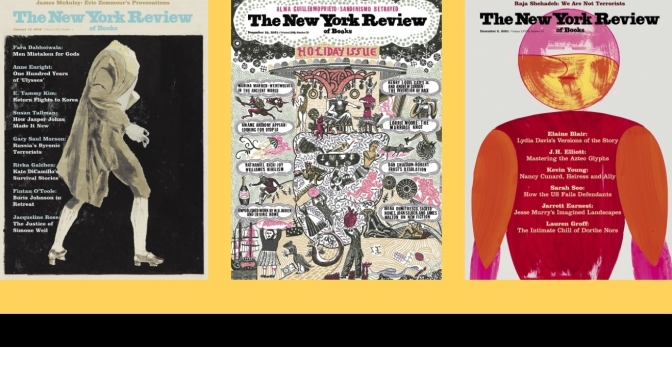
THE NEW YORK REVIEW OF BOOKS – OCTOBER 23, 2025

Home | The New York Review of Books

THE NEW YORK REVIEW OF BOOKS: The latest issue features Jacob Weisberg on deep fake news, Elaine Blair on istoriya feminisma, Eric Foner on the underground railroad at sea, Andrew Katzenstein on Pynchon’s Shadow Ticket, Suzanne Schneider on Friedrich Hayek’s bastard children, Nicole Rudick on Ben Shahn’s compassion, Jay Neugeboren on the working homeless, Vicente L. Rafael on an American massacre in the Philippines, Ariel Dorfman on Pinochet’s favorite Nazi, David Cole on Trump’s summary killings in international waters, a poem by Victoria Chang, and much more.

Algorithm Nation

Fights about digital filtering tools have turned more and more bitter. That’s because of their extraordinary power to shape both political opinion and mass culture.

Invisible Rulers: The People Who Turn Lies into Reality by Renée DiResta

Character Limit: How Elon Musk Destroyed Twitter by Kate Conger and Ryan Mac

Filterworld: How Algorithms Flattened Culture by Kyle Chayka

Equality Without Feminism?

The Soviet Union’s ambitious program of gender equality could never be separated from its abuses of power.

Motherland: A Feminist History of Modern Russia, from Revolution to Autocracy by Julia Ioffe

The Big Cheese

Shadow Ticket is brisker than Thomas Pynchon’s other work, but it’s full of his usual vaudevillian sensibility, and it addresses his favorite theme: how to live freely under powerful systems of control.

Shadow Ticket by Thomas Pynchon