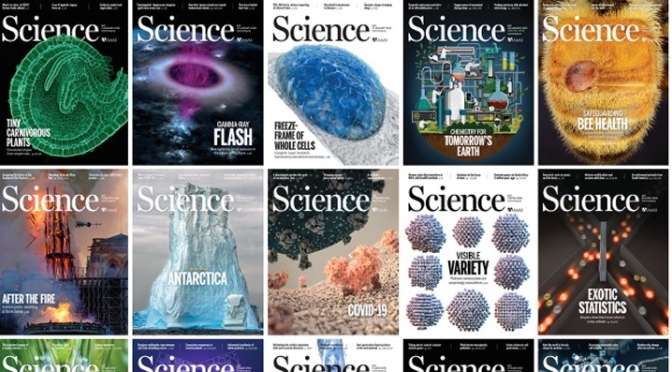
SCIENCE MAGAZINE (January 16, 2025): The latest issue features ‘Shear Wonder’ – Chain-like materials manifest complex strain responses..

SCIENCE MAGAZINE (January 16, 2025): The latest issue features ‘Shear Wonder’ – Chain-like materials manifest complex strain responses..


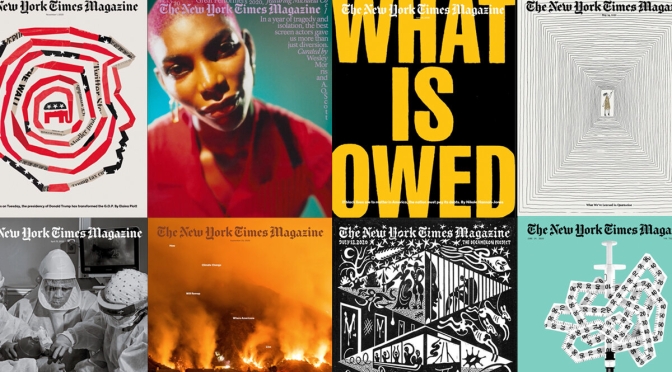
THE NEW YORK TIMES MAGAZINE (December 21, 2024): The 12,22,24 issue features ‘Escape From Gaza’…
The war is nearly impossible to flee — except for a small number of sick and wounded who are offered a dramatic path to safety. By Nicholas Casey
Fifty years since he left the Soviet Union, he insists on using his huge fame to bring attention to difficult, esoteric art. By Jason Diamond
Users are now flocking to Bluesky. But every social media platform becomes a wasteland in the end. By J Wortham
BARRON’S MAGAZINE (December21, 2024): The latest issue features ‘Buy Now, Cry Later’…
The rise of affiliate links, Buy Now buttons, and other technology has made it easier than ever to binge, often with dire consequences.
The company is firing on all cylinders, but its valuation has become concerning. Shares now trade for 53 times projected earnings.
Trump’s policies are a wild card for markets. Making these portfolio moves could help smooth your ride.
Some wealthy families look elsewhere to invest as private-equity funds become too big. The strategies aren’t for the average investor.


THE NEW YORK TIMES MAGAZINE (December 14 2024): The 12.15.24 issue features ‘The Silence of Alice Munro’…
The Nobel-winning author’s husband was a pedophile who targeted her daughter and other children. Why did she stay silent?
In Louisa, an unbearable social crisis has become the main source of economic opportunity.
Officials in Oklahoma are laying the groundwork to push Christianity into public schools.
BARRON’S MAGAZINE (December 7, 2024): The latest issue features ‘Outlook 2025’….
Wall Street’s market forecasts are too tepid. The S&P 500 could rally next year on a combination of AI growth and deregulation. But investors should prepare for a wilder ride.
The Federal Reserve could find it harder to balance growth and inflation next year, given the incoming Trump administration’s policies. So far, the forecast looks sunny.
Millennials see real estate as a speculative asset. That makes them less apt to buy than their parents did at similar ages.
Wringing savings from the program could result in worse customer service. What you need to know.

An injectable HIV drug with a novel mechanism shows remarkable ability to prevent infection
When the forces of plate tectonics tear continents apart, it’s an incredibly violent process, unfolding in slow motion. It was also thought to be very local: Magma from hot, rising mantle rock seeds volcanoes along the rift zone, while the far-removed cold interiors of continents remain intact.
Microscopic algalike fossils from China reported early this year astounded evolutionary biologists with their extreme age. Dated at 1.6 billion years old, the specimens suggest one of the hallmarks of complex life—multicellularity—arose far earlier than previously thought.
For 98 years, physicists knew of two types of permanently magnetic materials. Now, they’ve found a third. In familiar ferromagnets such as iron, unpaired electrons on neighboring atoms spin in the same direction, magnetizing the material so that, for example, it sticks to a refrigerator. Antiferromagnets such as chromium have zero overall magnetism, but they possess an atomic-scale magnetic pattern, with neighboring electrons spinning in opposite directions. Novel altermagnets—hypothesized 5 years ago—share aspects of both.

Commentary Magazine (December 12, 2024) – The latest issue features ‘The Anti-Woke King Of Hollywood Lets Loose’ – Taylor Sheridan’s shows explain how and why we got Trump again…
Taylor Sheridan’s shows explain how and why we got Trump again by Rick Marin

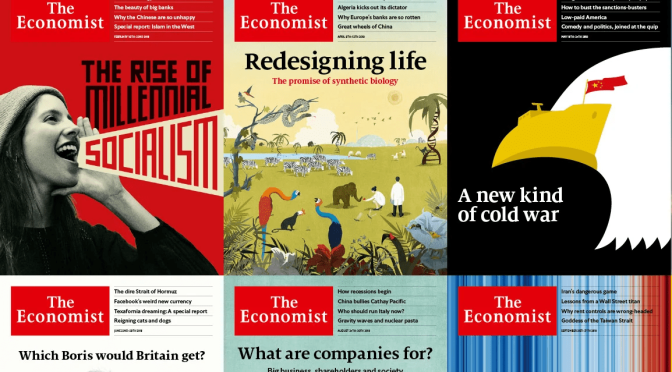
The Economist Magazine (December 12, 2024): The latest issue features ‘What Now?’…
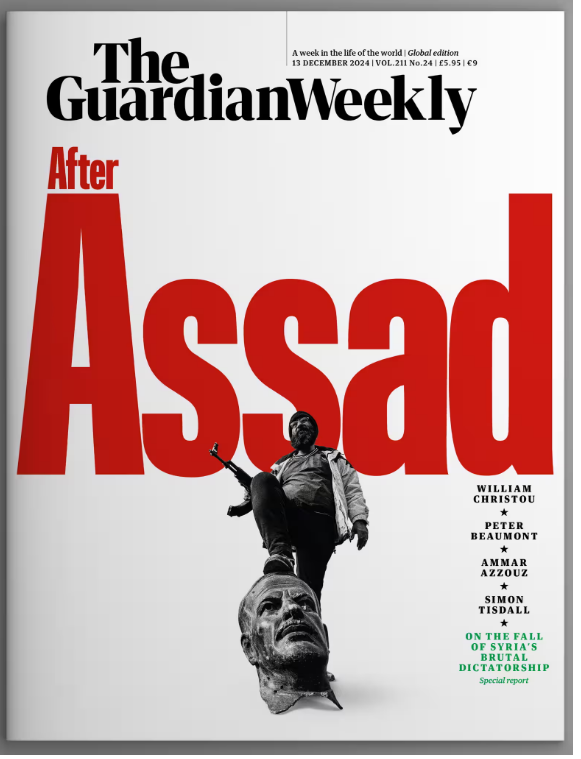
The end of the house of Assad. Much will go wrong. But for now, celebrate a tyrant’s fall
Our number-crunching suggests it was the best-performing rich economy in 2024
Financial innovation is just as much to blame as the technological sort
Even bail-outs are getting expensive
The Guardian Weekly (December 11, 2024): The new issue features The fall of Syria’s brutal dictatorship. Plus The best books of 2024.
Not even the most optimistic of rebels could have predicted the rapid collapse, last weekend, of the Assad dynasty that ruled Syria with an iron fist for more than 50 years. Yet while there was relief and joy both inside Syria and among the nation’s vast displaced diaspora, it was also accompanied by apprehension over what might come next.
1
Spotlight | Russia and Ukraine wait warily for Trump transition
The idea of the US president-election as a saviour for Ukraine, as unlikely as it may seem, holds an appeal for an exhausted nation without a clear path to victory. Shaun Walker and Pjotr Sauer report
2
Environment | The jailed anti-whaler defiant in face of extradition threat
Capt Paul Watson talks to Daniel Boffey about his arrest on behalf of the Japanese government, his ‘interesting’ Greenland prison, and separation from his children
3
Feature | The growing threat of firearms that can be made at home
One far-right cell wanted to use 3D-printed guns to cause ‘maximum confusion and fear’ on the streets of Finland. Could the police intercept them in time? By Samira Shackle
4
Opinion | Farage is lying in wait. Britain can’t afford for Starmer to fail
It is not enough for the Labour leader’s ‘milestones’ to be achieved. Voters must feel the improvement in their daily lives, says Guardian columnist Jonathan Freedland
5
Culture | The best books of 2024
From a radical retelling of Huckleberry Finn to Al Pacino’s autobiography, our critics round up their favourite reads of the year
Nature Magazine – December 11, 2024: The latest issue features ‘Digestive Tracks’ – Fossilized vomit and poo reveal how dinosaurs came to dominate ancient ecosystems…
Largest study of links between consumption of the beverage and gut diversity finds coffee-loving bacteria.
Chemistry of the planet’s atmosphere suggests that its interior has never held water.
Artefacts from a Mesopotamian archaeological site suggest that people in the region founded and later rejected an early form of the organized state.