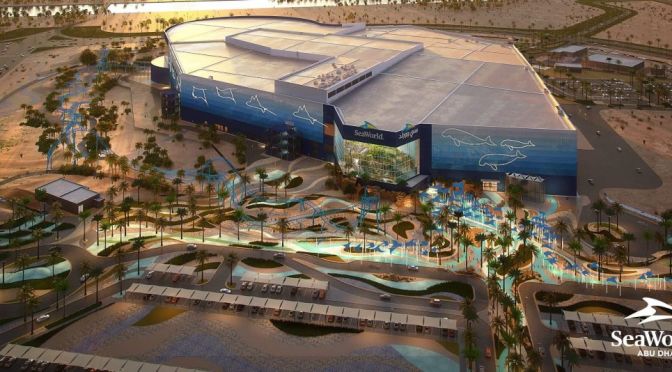
The B1M – ABU DHABI has built some of the world’s most striking construction projects. And it’s not done yet. Work is underway to build a record-breaking aquarium, one that will blow all the others out of the water.
The Shedd Aquarium in Chicago holds about 19M litres of water. Chimelong Ocean Kingdom in China holds 49M, and is currently the world’s largest – but when Sea World Abu Dhabi completes, it’ll likely contain a whopping 58M litres of water. That’s the same as 23.2 Olympic pools.
Designing and building a tank this big poses an extreme engineering challenge. It has to withstand immense water pressure, let in the right amount of light for tens of thousands of species to survive and immerse millions of visitors in an underwater world.
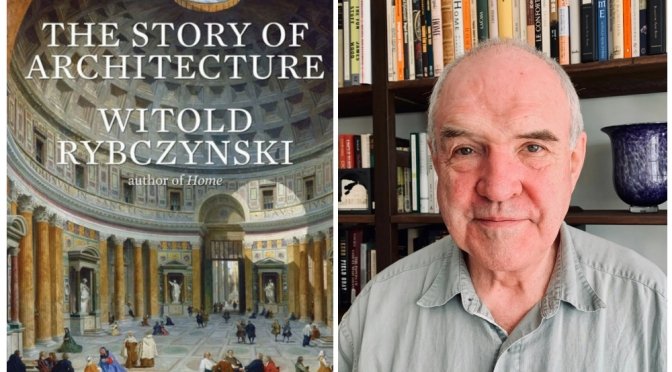
An inviting exploration of architecture across cultures and centuries by one of the field’s eminent authors
In this sweeping history, from the Stone Age to the present day, Witold Rybczynski shows how architectural ideals have been affected by technological, economic, and social changes—and by changes in taste. The host of examples ranges from places of worship such as Hagia Sophia and Brunelleschi’s Duomo to living spaces such as the Katsura Imperial Villa and the Alhambra, national icons such as the Lincoln Memorial and the Sydney Opera House, and skyscrapers such as the Seagram Building and Beijing’s CCTV headquarters. Rybczynski’s narrative emphasizes the ways that buildings across time and space are united by the human desire for order, meaning, and beauty.
This is the story of architecture’s physical manifestation of the universal aspiration to celebrate, honor, and commemorate, and an exploration of the ways that each building is a unique product of patrons, architects, and builders. Firm in opinion, even-handed, and rooted in scholarship, this book will delight anyone interested in understanding the buildings they use, visit, and pass by each day.
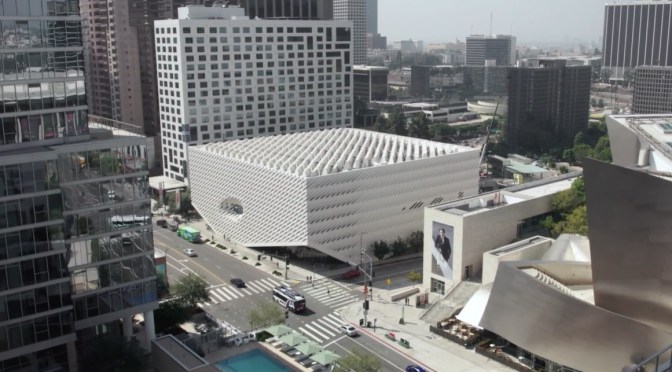
Dezeen – Architect Elizabeth Diller explains how The Broad Museum in Los Angeles was designed to feel “extremely welcoming” in the next instalment of Dezeen’s Concrete Icons series produced in collaboration with Holcim.
The video features The Broad in Los Angeles designed by Diller’s studio Diller Scofidio + Renfro, a three-storey museum that houses an expansive collection of contemporary and post-war artworks. Speaking to Dezeen in an exclusive video interview filmed at the Diller, Scofidio + Renfro office in New York City, Diller explained how the building was designed to feel inviting to visitors with a porous facade that allows light to be gently diffused into the gallery.
“It doesn’t really feel like a traditional museum,” Diller said. “There’s no sense of authority. When you step off the street, no one tells you where to go. There’s no information desk, there’s no admissions desk. You don’t pay, it’s free. It feels extremely welcoming.”
Isabel Allen’s Editorial for AT322 discusses how the Architecture Today Awards subverted the traditional role of the crit, transforming it into powerful tool for judging the merits and performance of buildings that already exist.
A sharp, trapezoidal marquee hoisted on spindly pilot is points the way towards the primary pedestrian entrance on the long eastern front.
Dezeen – In the first instalment of Dezeen’s new Concrete Icons series produced in collaboration with Holcim, MAD Architects founder Ma Yansong explains how his firm’s sinuous concrete library in Haikou, China encourages visitors to use their imagination.
Yansong is the first participant in Concrete Icons, a new video series profiling the most iconic contemporary concrete buildings by the world’s leading architects. The video focusses on MAD’s Cloudscape of Haikou, a library with a flowing form cast in white concrete located in a waterside park in Haikou on the island of Hainan.
Completed in 2021, the 1,000-square-metre structure houses a library, cafe, restrooms, showers, a nursery room, and bike storage, and acts as a waystation for visitors to the park. Speaking to Dezeen in an exclusive video interview filmed at MAD’s offices in Beining, Yansong explained how the building is designed to put visitors in a contemplative or imaginative state of mind.
MAD Architects, led by Ma Yansong, has announced the opening of the Cloudscape of Haikou is located on the southern tip of China. A unique urban public and cultural space for citizens and visitors to Haikou, this flowing, sculptural concrete form was named as one of the “most anticipated architecture projects of 2021” by The Times of London.
A prominent port city on the southern tip of China, Haikou was once an important stop on the Maritime Silk Road. With the establishment of the Hainan International Tourism Island and Hainan Free Trade Zone, Haikou’s influence has seen a gradual resurgence in modern times. Meanwhile, Haikou’s government is also enriching the city’s cultural importance, through enhancing the social attributes of the city’s public spaces, and strengthening the connection between the city, humanities, and architecture. The Cloudscape of Haikou is one such culmination of this effort.
The Cloudscape of Haikou is the first of sixteen coastal pavilions commissioned by the Haikou Tourism and Culture Investment Holding Group to rejuvenate the historic port city, with the aim of improving public space along the coastline. Known as “Haikou, Pavilions by the Seaside,” the initiative invited teams of internationally recognized architects, artists, and interdisciplinary professionals to create sixteen landmark public stations.
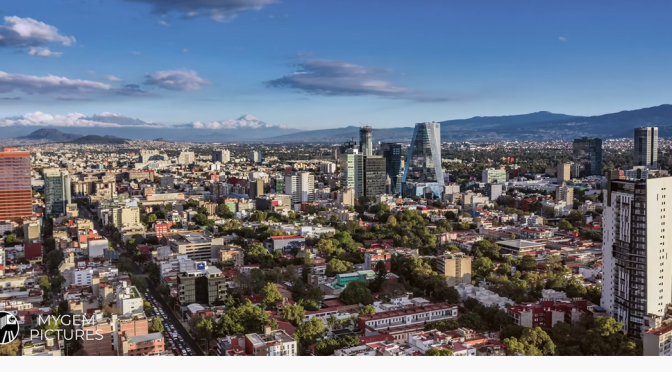
The B1M – TAKE a look at Mexico’s cities and you might spot some similarities.
You’ll see it’s a country that clearly knows a thing or two about urban sprawl, with hardly a skyscraper in sight. But look closely and you’ll find that skyscrapers do exist, just not really in any great numbers.
That’s because it’s one of the toughest places on Earth to build tall and engineers must grapple with the extremes of the elements, unforgiving ground conditions, congestion and the absence of some key resources.
Now though, after decades of building outwards instead of upwards, skyscrapers in Mexico are seriously on the rise and construction crews are managing to meet some immense challenges.
Architectural Digest – Today on AD Architect Lynda Dossey leads us on a walking tour of Chicago, highlighting the captivating details found in its storied architecture.
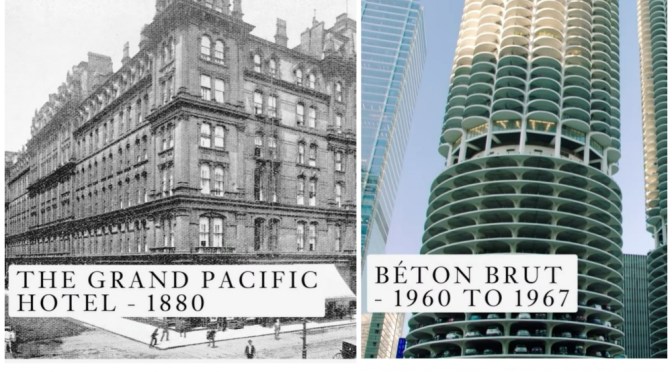
From exploring The Loop and Marina City to detailing the history of The Thompson Center and iconic Willis Tower, discover the history behind Chicago’s most famous buildings and neighborhoods through Lynda Dossey’s expert eye.
The challenges of redesigning the Dali museum in Florida were two-fold: deliver an iconic design befitting of its subject, and defy conventional building methods to make it strong enough to withstand a hurricane. The result: a landmark structure, as enduring as the work of the great artist himself.
The original Dalí Museum opened in St. Petersburg in 1982, after community leaders rallied to bring the Morses’ superlative collection of Dalí works to the area. The Dalí’s stunning new building opened on January 11, 2011. Designed by architect Yann Weymouth of HOK, it combines the rational with the fantastical: a simple rectangle with 18-inch thick hurricane-proof walls out of which erupts a large free-form geodesic glass bubble known as the “enigma”.
The Enigma, which is made up of 1,062 triangular pieces of glass, stands 75 feet at its tallest point, a twenty-first century homage to the dome that adorns Dalí’s museum in Spain. Inside, the Museum houses another unique architectural feature – a helical staircase – recalling Dalí’s obsession with spirals and the double helical shape of the DNA molecule.
Will the cities of the future be climate neutral? Might they also be able to actively filter carbon dioxide out of the air? Futurologist Vincente Guallarte thinks so. In fact, he says, our cities will soon be able to absorb CO2, just like trees do.
To accomplish this, Guallarte wants to bring sustainable industries and agriculture to our urban centers, with greenhouses atop every building. But in order for Guallarte’s proposal to work, he says, cities will have learn to submit to the laws and principles of nature. Urban planners also have big plans for our energy supply. In the future, countries like Germany could become energy producers.
In Esslingen am Neckar, residents are working on producing green hydrogen in homes, to be used as fuel for trucks. It’s a project that‘s breaking new ground, says investor Manfred Norbert. Our future cities will be all about redefining a new normal. Architects and urban planners are expecting to see entirely new approaches to communal living, as well as new urban concepts for autonomous supply chains. The repurposing of old buildings, and the generation of food as well as energy, are other important topics.
The architect Arno Brandhuber thinks the current building stock available, and the possibilities it offers, have been underestimated. His spectacular business headquarters are located in an old silo in Berlin’s Lichtenberg district. His most provocative project, something he calls his “Anti-villa,” is a repurposed East German factory for cotton knitwear. It‘s a prime example of sustainable design.
Situated within the Surrey Green Belt in Hampshire, the sustainable three-bedroom house responds to its surrounding natural environment and creates minimal visual impact. Aggregate foundations, locally sourced flint, and a CLT timber structure shape the contemporary design, blending it harmoniously into its picturesque setting, and also proving that it’s possible to recycle, re-source, and reduce impact in construction.
Japanese designer Yuma Kano has creatively worked with forest debris to create ForestBank, a new type of wood that looks to minimise waste.
This pioneering material design makes use of debris from the forest floor that would normally be considered worthless for furniture construction. Formed out of small trees, foliage, bark, seeds, and soil, ForestBank seeks to determine the full value of our local woodlands and in turn it creates an artistic and aesthetically pleasing material out of unutilised debris.
News, Views and Reviews For The Intellectually Curious











 Boomers Daily