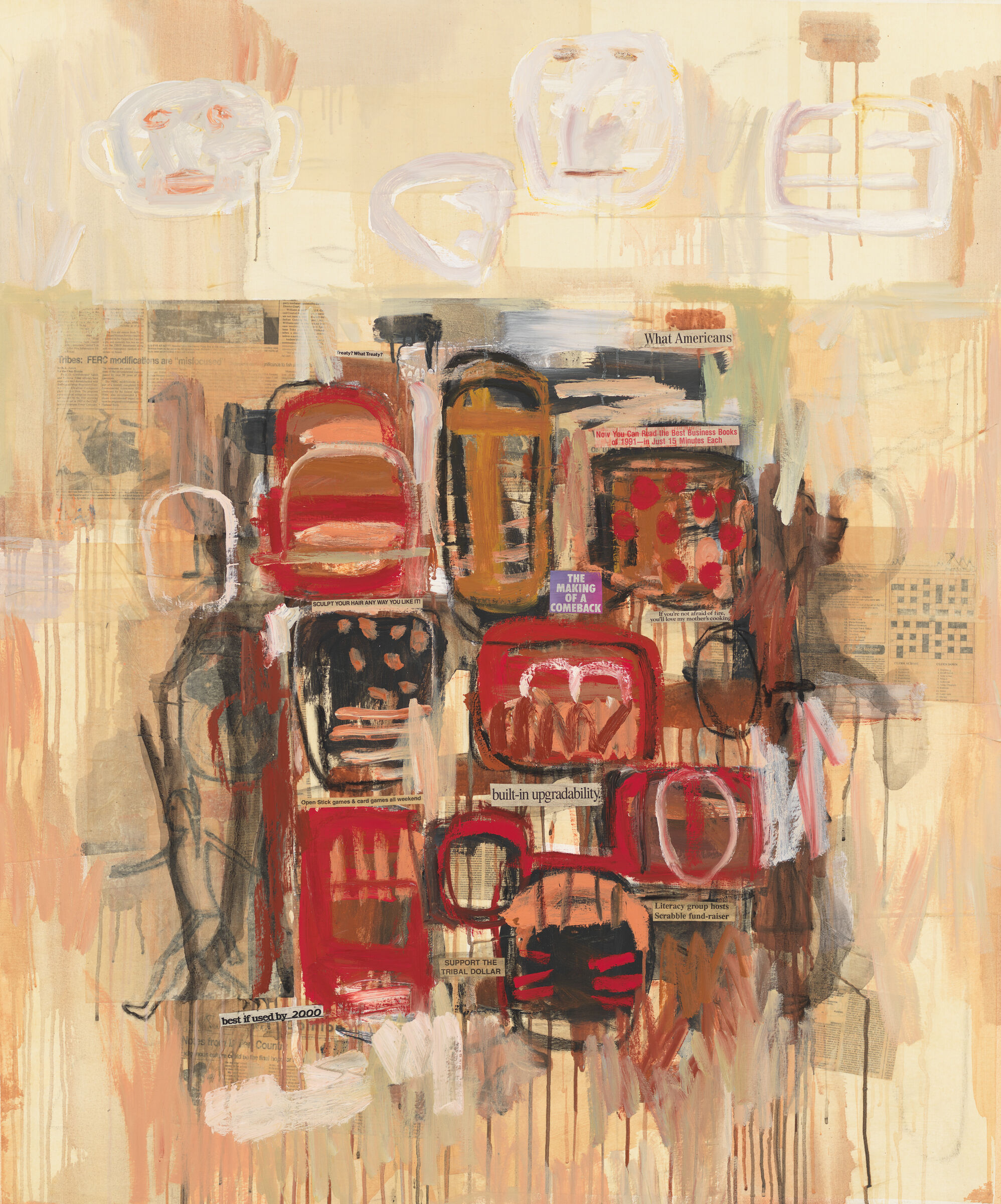

BERRY CAMPBELL GALLERY (April 30, 2023): An exhibition of Abstract Expressionist Ethel Schwabacher (1903-1984). Schwabacher joins the gallery’s stable of women artists whose ambitious, independent, and insightful art is essential to a complete historical understanding of the ‘downtown’ art scene in the 1950s.
Many of the thirteen works have not been on view since they were shown at one of her five solo exhibitions at Betty Parsons Gallery, including the large-scale center piece to the show entitled, Prometheus (1959). Ethel Schwabacher: Woman in Nature(Paintings from the 1950s) focuses on Schwabacher’s unique brand of abstraction, which is characterized by both automatic drawing and sweeping brushstrokes that swirl across the surface of the canvas and which explores themes of motherhood, landscape, and creativity.
As part of the resurgence of women artists, Ethel Schwabacher was one of the twelve women artists included in the landmark traveling exhibition Women of Abstract Expressionism organized by the Denver Art Museum in 2016. Concurrently with the Berry Campbell exhibition, Action! Gesture! Paint! is on view at the Whitechapel Gallery in London featuring 91 international women artists, including a major Ethel Schwabacher painting from the 1950s.
Sotheby’s (April 28, 2023) –Looking for some inspiration for your next museum visit? This month, we’re taking a tour of six of the world’s most exciting and innovative museum exhibitions with Tim Marlow, Director of the Design Museum, London.
Doris Salcedo – Fondation Beyeler, Riehen, 21 May–17 September 2023 – Salcedo is a Colombian-born artist, whose central subject is human trauma and tragedy. Though much of her work emanates from the violent conflict over the last three decades in her native land, its resonance is universal. Doris Salcedo presents eight major series of works from across her career – from untitled pieces of wooden furniture filled with concrete to the remarkable Palimpsest in which the names of over 300 refugees and migrants who died at sea quite literally weep before our eyes.
Vincent van Gogh 2023 marks the 170th anniversary of Vincent van Gogh. Three exhibitions opening this month look set to enhance our understanding of the great Dutch painter:
Van Gogh and the Avant Garde The Art Institute of Chicago 14 May–4 September 2023 – Van Gogh and the Avant Garde takes the modern landscape as its central subject and looks at how the artist – along with Seurat, Signac and others – turned his attention from urban Parisian life to wrestling with the surrounding countryside with a formal inventiveness that set the tone for the development of Modernism.
Van Gogh’s Cypresses The Metropolitan Museum of Art, New York 22 May–27 August 2023 – From the religious connotation of trees in graveyards to their role as the backdrop of his incarceration at the asylum in Saint-Remy, the artist’s flame-like evergreens will be presented with all their evocative resonance in Van Gogh’s Cypresses,
Van Gogh in Auvers. His Final Months Van Gogh Museum, Amsterdam 12 May–3 September 2023 – The unsurpassable Van Gogh Museum will celebrate its own 50th anniversary with Van Gogh in Auvers. His Final Months – an exhibition delving into the tremendously productive final period of his life, in which he made several of his most renowned masterpieces.
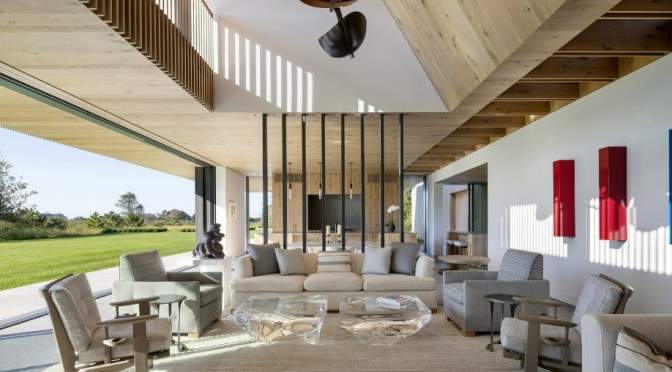
The Local Project – (April 28, 2023) – Inside an heirloom home, unification lies at the centre. In designing Wainscott Residence, Bates Masi + Architects considers the fabric of the area and the immediate and future needs of the house.
Video timeline:00:00 – Introduction to the Heirloom Home 00:22 – The Salt Box 00:47 – Acknowledging the Culture of Place 00:57 – The Brief 01:40 – A Walkthrough of the Heirloom Home 02:06 – The Art Cube 02:39 – Intertwining Domestic and Vacation Living 02:58 – The Future Needs of the Materials 03:41 – The Interiors Palette 04:07 – Unifying the Home and Immersing in its Surrounds 04:55 – Coming Together to Form One Voice
Its structure and materiality connect the residing family to the landscape, art and heritage of the area, whilst also bringing them together through considered multigenerational living. Bates Masi + Architects thoughtfully responds to the needs of the future home’s inhabitants, who came with a desire to display a significant art collection inside an heirloom home, to maintain views of the landscape and to house their two adult children as the family grows.
This forms the basis of the residence’s distinct structure, which is made of three individual volumes that operate just as seamlessly separately as they do together. Wainscott Residence reveals what lies inside an heirloom home. It is inherently linked to the surrounding landscape, dominated by picturesque green lawns, trees and a distant skyline that give a fresh, vibrant feel that is echoed in the coveted art collection. The southern aspect connects to the surroundings; every south-facing room opens up to the outside, with the doors pocketed into the walls so that the house can be completely unified with the landscape.
The Art Newspaper April 27, 2023: This week: AI and art. We explore some of the key aspects relating to artificial intelligence and its use in the art world: the works being made using AI technologies and exploring their impact; anxieties about machines replacing humans; the idea of AIs being able to think and create independently; and whether we can truly grasp the significance and possible effects of the technologies and those who control it, and more.
Host Ben Luke talks to Noam Segal—an associate curator at the Solomon R. Guggenheim Museum, New York, whose focus is on technology-based art—about AI, its history in art, its social and environmental effects, and how artists are using it today. The Art Newspaper’s live editor, Aimee Dawson, talks to the artist and writer Gretchen Andrew about making art with AI and together they explore its wider application across the art world.
And this episode’s Work of the Week is Pseudomnesia: The Electrician, an image made using AI by the photographer Boris Eldagsen. The piece caused controversy earlier this month when it was awarded a prize at the Sony World Photography Awards, which Eldagsen refused to accept. The researcher and photographer Lewis Bush discusses the work, the controversy and wider questions around AI and photography.
François Ghebaly Gallery, New York City (April 27, 2023) – François Ghebaly is proud to present Station by Matt Bollinger. Ithaca-based artist Matt Bollinger works from a complex interdisciplinary base: as painter, draftsman, animator, and elegist, he creates work that straddles the projects of both visual art and narrative fiction.
His stories, by and large, are of America’s rural working class–each is told through a bricolage of memory, family history, direct observation, art-historical research, and literary invention. For his latest exhibition, Bollinger chronicles the semi-fictional inhabitants of a rural central Missourian community, offering in the process ruminative, disillusioned vignettes of the real ‘American Dream.’
Matt Bollinger, Brothers V, 2022.
Spanning the far wall, Uncle Dave (2023) is the most ambitious work in Bollinger’s show–with its impressive vertical dimension, some eight feet-tall, the painting acts as an anchor to the New York gallery space, drawing the eye in and upward. The work depicts three sanitation workers surrounding the bright yellow cab of a dump truck. Framed by wildflowers underfoot and the scintillating glare of another truck’s headlight, the men are shown in progressive life stages.
Matt Bollinger, Cape Hollow II, 2022.
At the far right, the youth holds a rake and stares listlessly out of view. The middle-aged man, partially obscured, gestures forward with a lighter and a yellow traffic flag, while the eldest is positioned above the other men and descends from the cab, directly confronting the viewer’s gaze. The work’s triadic symbol of labor, class, and the passage of time ––alongside compositional affinities, somewhere between Courbet and religious genre painting ––underscores many of the themes latent both in the exhibition title and in the artist’s work at large.
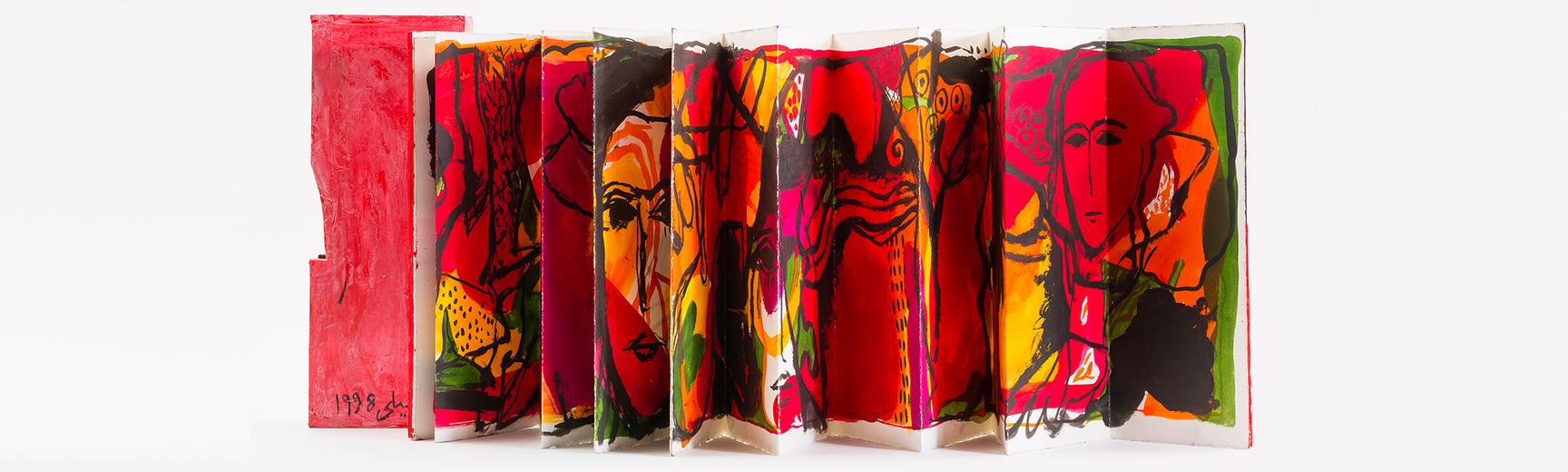
Ashmolean Museum (April 26, 2023): ‘The Arab world’s most influential living artist’, Dia al-Azzawi is best known for monumental and colourful canvasses. His work spans many genres, including a type of artist books known in Arabic as ‘dafatir’.
Here Francesca Leoni, curator of Dia al-Azzawi: Painting Poetry at the Ashmolean, introduces us to the work of this important contemporary artist and takes us through the exhibition currently on display at the Ashmolean Museum.
Dia Al-Azzawi is an Iraqi painter and sculptor, now living and working in London, and one of the pioneers of modern Arab art. He is noted for incorporating Arabic script into his paintings.
Dia al-Azzawi: Painting Poetry is open and free to visit until 10 June 2023.
The Local Project – (April 25, 2023) – Overlooking the city of Los Angeles, Sheats-Goldstein Residence by John Lautner and James Goldstein is an iconic and action packed home that ignites the idea that a residence is an expression of its owner.
Video timeline:00:00 – Inside the Iconic and Action Packed Home 00:49 – A Reflection of Mentality and Personality 01:16 – A 1972 Purchase of Amazing Design and Views 02:14 – The First Step in the 45-year long Renovation Process 03:14 – No Separation between Inside and Outside 03:42 – John Lautner’s Dislike of Box-like Forms 04:09 – A Focus on the Natural Elements 04:43 – The Addition of Tropical Vegetation 05:30 – A James Turrell Skyspace 06:05 – The Continuation of John Lautner’s Legacy 06:45 – Two Rebels Working in Cohesion 07:21 – Preserving History and Hard Work
Built and designed to reflect James’s life and experiences, the house asserts a dominance over the landscape with its frameless glass walls, hidden wonders and angled corners and turns. After buying the residence in 1972, James sought the help of John Lautner to re-model the home after observing the previous owner’s undesirable changes to the original design. Part of James’s wish was to return the structure’s lost character through dramatic improvements.
After John’s passing and having resided in the home for 45 years, James has continuously worked on adding to character of the iconic and action packed home, with respect to John’s original vision. Opposed to building anything that resembled a box or came to a 90-degree angle, John Lautner designed the home with angular walls, built-in furniture and open plan floor spaces. Wanting the residence to feel natural, the use of concrete floors is used to help imbue the feeling of openness, while carpets used within the home are designed to look like small stones and deepen the natural impression.
Additionally, the frameless glass wall that occupies the living room continues to unite the indoor and outdoor spaces and enables views of the tropical foliage and vegetation that surround the building. Spanning across over 1.5 hectares of hillside, the home’s landscape is saturated with thick foliage and vegetation that holds hidden walkways, ponds and open grassy areas. Additionally, the unique character of the iconic and action packed home is further emphasised with the James Turrel skyscraper. Tucked into the lower hillside of the home, the building acts as a form of art, allowing for one to sit back and delve into the appreciation of light and shadow.
ST. PETERSBURG, FLA.- After a hiatus of more than three years, Myers Fine Art will return to the auction spotlight on April 30 with a 459-lot gallery auction that bears all the hallmarks of their signature style. Bidders can look forward to seeing a high-quality, estate-fresh selection of scrupulously researched artworks with impeccable provenance.
Each and every item has been personally curated by Myers’ owners Mike Myers and Mary Dowd, whose combined decades of experience in the fine art sector serve as the basis for auction catalogs whose scholarly descriptions are both lauded and trusted throughout the art world.
The Local Project – (April 21, 2023) – Imbued with a sense of calm and tranquillity, Tonkin Zulaikha Greer Architects creates a dream home that encourages contemplation. A neutral approach to materiality is complemented by an extensive art collection and sculptural furnishings, inspiring stillness and a sense of wonder for what lies beneath the structure’s outward façade.
Video timeline:00:00 – Introduction to the Art Lovers Dream Home 00:29 – The Location of Almora House 00:44 – The Clients and The Brief 01:15 – The Organisation of the Home 01:55 – A Walkthrough of the Home 02:59 – An Enduring, Timeless and Maintenance Free Home 03:37 – Where The Spatial Richness is Derived From 04:11 – The Most Enjoyable Project for the Architect 04:46 – Favourite Parts of the Home
Located in the coastal refuge of Balmoral Beach in Sydney’s Mosman, Almora House is a collection of unique spaces. The clients have resided in the house for over twenty years and have come forward with the brief to design an enduring, timeless, maintenance-free dream home that would accommodate their extensive art collection. Almora House presents a distinctive shape that encourages a soft contemplation.
The form of the house itself is organised around a spine that runs almost north-south — the structure stretching its way along this spine, with a series of rooms that push out into the garden, creating small courtyards. Various features throughout the home also encourage contemplation, particularly the bookshelf. Housed in the upstairs library, the bookshelf’s rear side is made of slightly frosted glass, becoming an alluring abstract composition seen from the dining room. The spine design of the dream home creates an effortless sense of flow in its layout. Inside the front door, there is a guest bathroom and bedroom that open into a courtyard.
As you walk south along the spine, the first of the living rooms, a dining room with double-height ceilings and a kitchen unfurl to the left. Beyond the kitchen is an informal room with four glass walls that open into the garden. Upstairs are the master bedroom and powder room, a study and a gallery. Thoughtful choices surrounding materiality also create a dream home that embodies a poignant sense of calm and introspection. Glass is used to welcome the serenity of the surrounding greenery into the home.
A concrete frame is used as a neutral material that showcases the art within the home and inspires calm. Almora House reveals itself to incite tranquillity, stillness and retrieve from the constant movement of daily life. Tonkin Zulaikha Greer Architects perfectly balances an appreciation of practicality, art and craftsmanship to create a dream home that acts as a container of curiosities and a hub for the calm moments integral to being present in our fast-paced, modern world.
News, Views and Reviews For The Intellectually Curious