Architectural Digest (July 25, 2023) – Today architect Nick Potts joins AD in New York City for an in-depth walking tour of Billionaires’ Row in Midtown Manhattan.
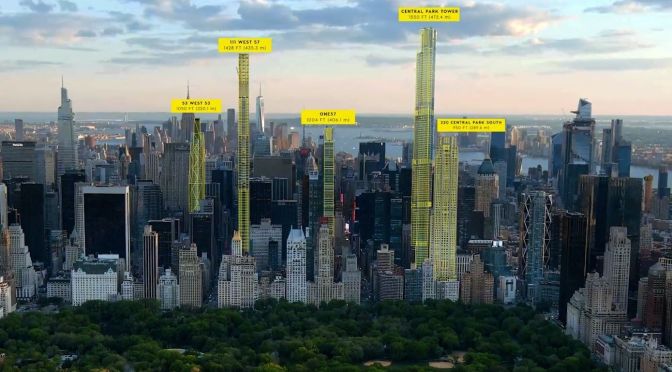
West 57th Street has been attracting Manhattan’s wealthiest residents for centuries–a former amalgamation of brownstone and gothic mansions in the 1800s, the street has evolved into a hotspot for supertall luxury skyscrapers boasting the three tallest residential buildings in the world.
Join Nick as he deep-dives into the area’s rich history and explains why Billionaires’ Row could only be built on 57th Street.
Buildings account for approximately two-thirds of greenhouse gas emissions in New York City and Mayor de Blasio has pledged to address these emissions as part of his plan to make the city carbon neutral by 2050.
Local Law 97 is one of the most ambitious plans for reducing emissions in the nation. Local Law 97 was included in the Climate Mobilization Act, passed by the City Council in April 2019 as part of the Mayor’s New York City Green New Deal.
Under this groundbreaking law, most buildings over 25,000 square feet will be required to meet new energy efficiency and greenhouse gas emissions limits by 2024, with stricter limits coming into effect in 2030. The goal is to reduce the emissions produced by the city’s largest buildings 40 percent by 2030 and 80 percent by 2050. The law also established the Local Law 97 Advisory Board and Climate Working Groups to advise the city on how best to meet these aggressive sustainability goals.
Local Law 97 generally covers, with some exceptions:
Buildings that exceed 25,000 gross square feet;
Two or more buildings on the same tax lot that together exceed 50,000 square feet;
Kirsten Dirksen Films (April 30, 2023) – When we planned a visit to NYC, our friend Hasier Larrea, who makes “furniture with superpowers” offered us a tiny studio filled with his robotic furniture to see how it could expand to fit our family of 5.
On the 54th floor of a skyscraper overlooking downtown Manhattan, the space starts small, but the moving walls expand into an office pod and a walk-in closet and the bed drops from the ceiling to convert the living room into a bedroom. Setting up for the night in an apartment made for two was an experiment. We had single air mattresses and expanding rooms.
Hasier’s colleague at Ori suggested opening the Pocket Closet and Pocket Office to create bedrooms. The closet was a few inches too small, but the office was just the right size. Our 10-year-old claimed the window seat for his bed, with the best view in the house. Hasier told us to test the furniture. He said it wouldn’t break and would stop when it sensed an obstacle. Our 10-year-old spent a lot of time sitting on the bed while his sisters tried to raise it (it wouldn’t) and getting in and underneath moving parts that left him without a scratch.
All the transforming took a few extra minutes, but being able to tuck away the bed without having to make it was a bonus. The whole experience felt a bit nautical with adapt-as-you-need-it furniture and panoramic views.
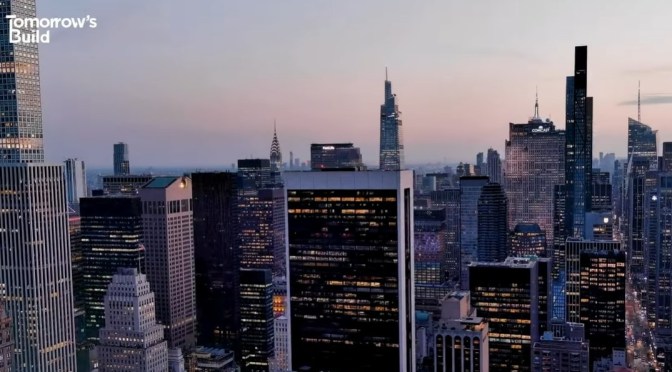
Architectural Digest (March 24, 2023) – Michael Wyetzner of Michielli + Wyetzner Architects returns to AD, this time breaking down five of the most common skyscraper styles dotting the New York City skyline. From set back ‘wedding cakes’ to the supertall buildings of the future, Michael gives expert insight on the different skyscraper styles that coalesce into one unforgettable view.
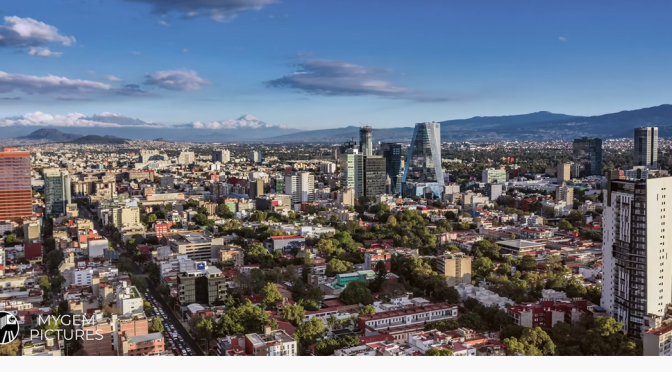
The B1M – TAKE a look at Mexico’s cities and you might spot some similarities.
You’ll see it’s a country that clearly knows a thing or two about urban sprawl, with hardly a skyscraper in sight. But look closely and you’ll find that skyscrapers do exist, just not really in any great numbers.
That’s because it’s one of the toughest places on Earth to build tall and engineers must grapple with the extremes of the elements, unforgiving ground conditions, congestion and the absence of some key resources.
Now though, after decades of building outwards instead of upwards, skyscrapers in Mexico are seriously on the rise and construction crews are managing to meet some immense challenges.
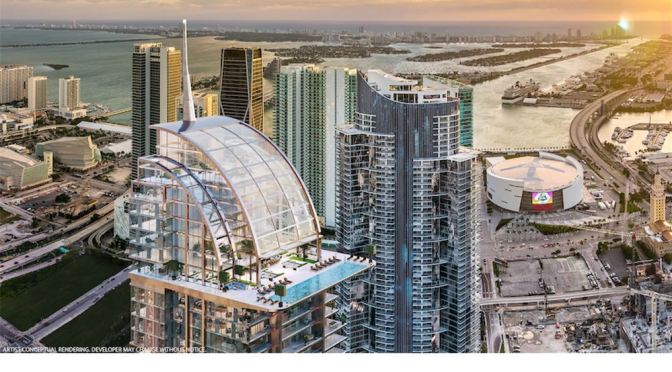
Miami’s skyscraper boom is happening on the frontlines of the climate crisis.
Miami, city, seat (1844) of Miami-Dade county, southeastern Florida, U.S. A major transportation and business hub, Miami is a leading resort and Atlantic Ocean port situated on Biscayne Bay at the mouth of the Miami River. The Everglades area is a short distance to the west. Greater Miami, the state’s largest urban concentration, comprises all of the county, which includes the cities of Miami Beach (across the bay), Coral Gables, Hialeah, North Miami, and many smaller municipalities and unincorporated areas; together, these make up the southern section of Florida’s “Gold Coast.”
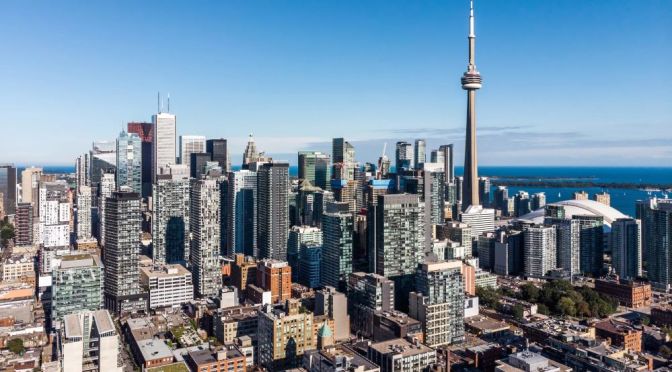
Canada’s biggest city is experiencing a skyscraper boom. Toronto, the capital of the province of Ontario, is a major Canadian city along Lake Ontario’s northwestern shore. It’s a dynamic metropolis with a core of soaring skyscrapers, all dwarfed by the iconic, free-standing CN Tower. Toronto also has many green spaces, from the orderly oval of Queen’s Park to 400-acre High Park and its trails, sports facilities and zoo.
Mumbai is a city of contrasts. Here, the super-rich and slum dwellers live side by side. As more and more luxury skyscrapers go up, slums are forced to make way for them. Conflicts ensue. So what is life like, in a megacity with 20 million inhabitants?
In Dharavi, Asia’s largest slum, more than a million people live in extremely crowded conditions. But the neighbourhood is dynamic. We meet Mahesh, 27, who was born in the slum and has never left. Today, he runs a recycling plant that employs about 20 people. Dharavi’s shadow economy is said to bring in 800 million euros a year.
However, the future of the neighbourhood is uncertain, as it sits on valuable property — located right in the city centre. With the support of local authorities, real estate magnate Babulal Varma is tearing down slums to build luxury housing for the upper classes. Will Dharavi survive? Mumbai is already one of the most populous cities in the world.
By 2035, the population is projected to rise drastically — to 30 million. The city’s inevitable expansion affects not only the people who live there, but also the forests that surround it. These include the “Sanjay Gandhi National Park”. Now, the leopards living in the park have started to make regular forays into new housing developments, looking for food. They attack stray dogs, as well as humans. As urbanization continues, the conflict between humans and wild animals is sure to become more dire.







 Boomers Daily