

From commuting to office time, automation to virtual reality – here’s how we’ll be working in 2030
Tag Archives: Reviews

Innovation: ‘Brooklyn Dumpling Shop’ Rolls Out ‘Automat’ Food Service
Moving towards the future – by taking from the past? This is the story of how one restauranteur is drawing upon nostalgia in order to break into a new era of innovation in the food industry.
AUTOMAT HISTORY
Originally, the machines in U.S. automats took only nickels. In the original format, a cashier sat in a change booth[citation needed] in the center of the restaurant, behind a wide marble counter with five to eight rounded depressions. The diner would insert the required number of coins in a machine and then lift a window, hinged at the top, and remove the meal, usually wrapped in waxed paper. The machines were replenished from the kitchen behind. All or most New York automats had a cafeteria-style steam table where patrons could slide a tray along rails and choose foods, which were ladled from tureens.
The first automat in the U.S. was opened June 12, 1902, at 818 Chestnut St. in Philadelphia by Horn & Hardart; Horn & Hardart became the most prominent American automat chain. Inspired by Max Sielaff’s AUTOMAT Restaurants in Berlin, they became among the first 47 restaurants, and the first non-Europeans, to receive patented vending machines from Sielaff’s Berlin factory. The automat was brought to New York City in 1912 and gradually became part of popular culture in northern industrial cities.
The automats were popular with a wide variety of patrons, including Walter Winchell, Irving Berlin and other celebrities of the era. The New York automats were popular with unemployed songwriters and actors. Playwright Neil Simon called automats “the Maxim’s of the disenfranchised” in a 1987 article.

Analysis: Why U.S. Houses Are So Expensive (CNBC)
With Covid encouraging city-dwellers to emigrate to the suburbs and families looking for home offices and bigger yards, prices for the American dream home have skyrocketed. Home prices surged in March 2021 up 13% from the year prior, according to the S&P Case-Shiller index. With homeowners unwilling to sell, a record-low supply of homes for sale has forced buyers into intense bidding wars. At the end of April 2021 there were only 1.16 million houses for sale in the U.S. down more than 20.5% from the year prior. Higher costs for land, labor and building materials including lumber have also impacted homebuilders. With the 30-year fixed mortgage rate hovering near a 50-year low and strong demand pushing prices to all-time highs, why is the housing supply so meager? Watch the video to find out if the U.S. is running out of houses.
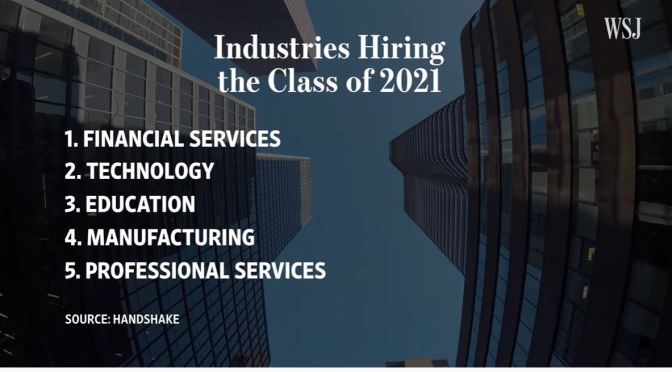
Analysis: The Job Market That Awaits 2021 Grads
The labor market is red-hot again after more than a year on ice. The class of 2021 college graduates are looking at a new jobs landscape, but the competition is fierce. What should new grads expect from the job market and the job hunting process? Photo: Hoang ‘Leon’ Nguyen/The Republican via AP

Green Housing: ‘Nature Village’ – Denmark (Video)
Copenhagen-based studio EFFEKT has presented plans for a residential development that forms part of its contribution to the upcoming venice architecture biennale. titled ‘naturbyen’, a name that translates as ‘nature village’, the project will see a field in denmark transformed into a completely new forest-neighborhood district comprising more than 200 homes. the development seeks to demonstrate how sustainable housing development can be combined with ambitious afforestation, increased biodiversity, and circular resource thinking. ‘as humanity is facing its greatest challenge ever with the imminent threat of climate change, habitat loss and depletion of natural resources — not to mention the ongoing pandemic — we need to rethink the way we live together on this planet. not only as humans, but across all species and ecosystems,’ EFFEKT tells designboom, discussing how the project responds to the biennale’s theme — ‘how will we live together?’. Responding to denmark’s goal of covering 20% of its landmass with forest by 2100, EFFEKT developed the project in collaboration with the town of middelfart. the site, currently an agricultural field, will be densely planted with a mix of native tree seedlings — an approach based on interviews and insight from industry experts, anders busse nielsen and björn wiström. ‘with a project like ‘naturbyen’ we try to address the growing need for more housing while also restoring natural habitats in close proximity to our cities, increasing biodiversity and through afforestation sequester carbon over time,’ EFFEKT explains.

Analysis: Race In America, Green Investment Boom, Nato Soldiers’ Phones
A selection of three essential articles read aloud from the latest issue of The Economist. This week: race in America, the green investment boom (10:00), and why NATO increasingly sees its soldiers’ phones as a liability (21:50).

Vaccine Passports: Legal & Medical Issues Are Raised
The CDC says fully vaccinated Americans can resume many normal activities but should people have to prove they have gotten those shots? Brook Silva-Braga reports on the pros and cons of so-called “vaccine passports” and the medical and legal issues raised.

Shakespeare: ‘Hamnet’ Author Maggie O’Farrell
Maggie O’Farrell’s “Hamnet,” one of last year’s most widely acclaimed novels, imagines the life of William Shakespeare, his wife, Anne (or Agnes) Hathaway, and the couple’s son Hamnet, who died at 11 years old in 1596.
On this week’s podcast, O’Farrell says she always planned for the novel to have the ensemble cast it does, but that her deepest inspiration was to capture a sense of the young boy at its center.
“The engine behind the book for me was always the fact that I think Hamnet has been overlooked and underwritten by history,” she says. “I think he’s been consigned to a literary footnote. And I believe, quite strongly, that without him — without his tragically short life — we wouldn’t have the play ‘Hamlet.’ We probably wouldn’t have ‘Twelfth Night.’ As an audience, we are enormously in debt to him.”

Political Analysis: The U.S.-China Tussle Over Taiwan
Taiwan has long been a U.S.-China flashpoint, but its tech and military capabilities have come into sharper focus under the Biden administration. WSJ travels to three places on the island to explain how both superpowers could determine Taiwan’s future. Photo: Wally Santana/AP
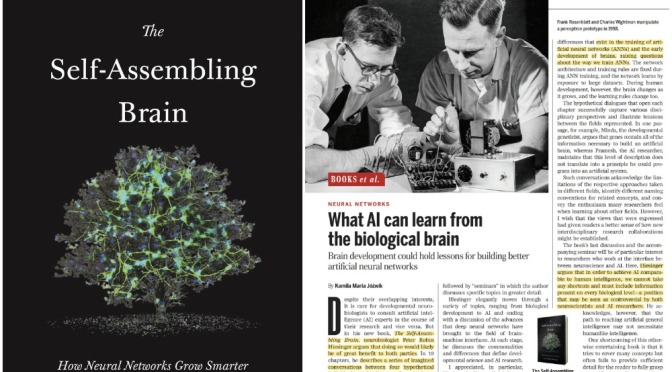
Book Reviews: ‘The Self-Assembling Brain’ – The Future Benefits For AI


As Peter Robin Hiesinger argues, “the information problem” underlies both fields, motivating the questions driving forward the frontiers of research. How does genetic information unfold during the years-long process of human brain development―and is there a quicker path to creating human-level artificial intelligence? Is the biological brain just messy hardware, which scientists can improve upon by running learning algorithms on computers? Can AI bypass the evolutionary programming of “grown” networks? Through a series of fictional discussions between researchers across disciplines, complemented by in-depth seminars, Hiesinger explores these tightly linked questions, highlighting the challenges facing scientists, their different disciplinary perspectives and approaches, as well as the common ground shared by those interested in the development of biological brains and AI systems. In the end, Hiesinger contends that the information content of biological and artificial neural networks must unfold in an algorithmic process requiring time and energy. There is no genome and no blueprint that depicts the final product. The self-assembling brain knows no shortcuts.
 Boomers Daily