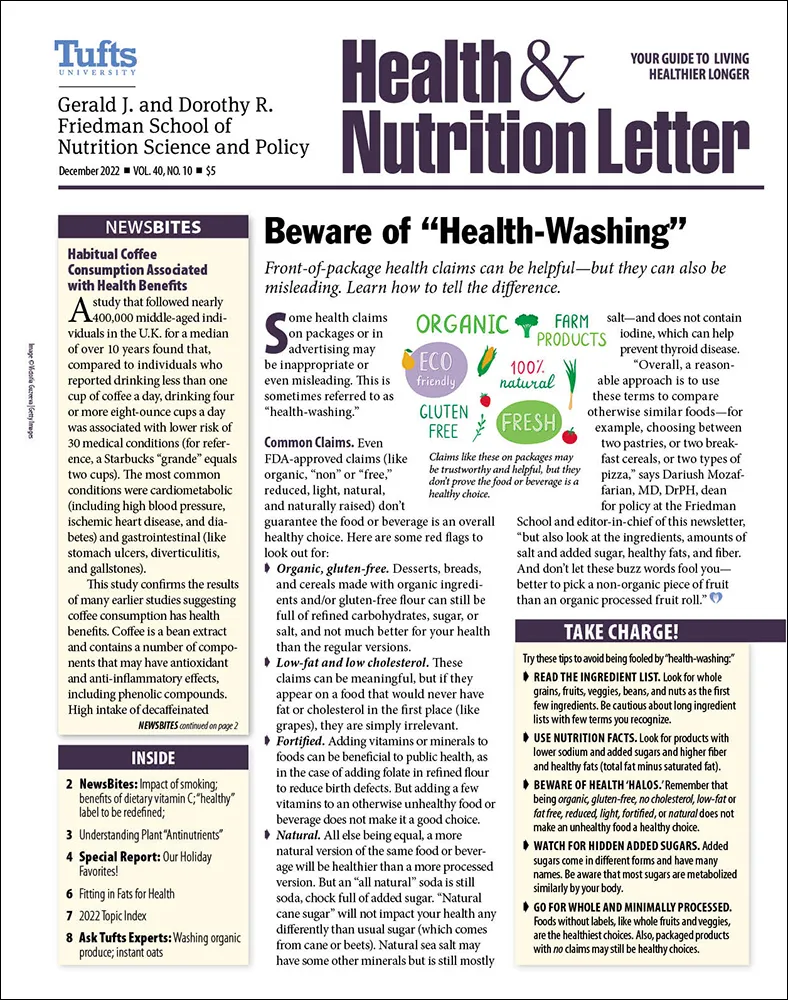
A study that followed nearly 400,000 middle-aged individuals in the U.K. for a median of over 10 years found that, compared to individuals who reported drinking less than one cup of coffee a day, drinking four or more eight-ounce cups a day was associated with lower risk of 30 medical conditions.
The U.S. Food and Drug Administration (FDA) recently proposed new draft guidelines for food manufacturers who want to label their products as “healthy.” This term was last defined in the 1990s. According to the FDA, “our current definition permits manufacturers to use the claim ‘healthy’ on some foods that, based on the most up-to-date nutrition.
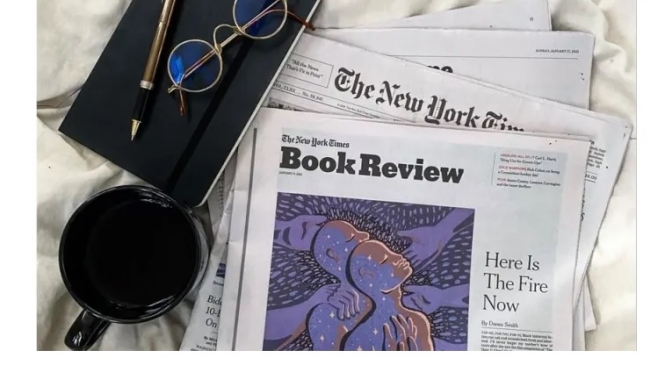
You don’t need to have read Egan’s Pulitzer-winning “A Visit From the Goon Squad” to jump feet first into this much-anticipated sequel. But for lovers of the 2010 book’s prematurely nostalgic New Yorkers, cerebral beauty and laser-sharp take on modernity, “The Candy House” is like coming home — albeit to dystopia. This time around, Egan’s characters are variously the creators and prisoners of a universe in which, through the wonders of technology, people can access their entire memory banks and use the contents as social media currency. The result is a glorious, hideous fun house that feels more familiar than sci-fi, all rendered with Egan’s signature inventive confidence and — perhaps most impressive of all — heart. “The Candy House” is of its moment, with all that implies.
Bennett, a British writer who makes her home in Ireland, first leaped onto the scene with her 2015 debut novel, “Pond.” Her second book contains all of the first’s linguistic artistry and dark wit, but it is even more exhilarating. “Checkout 19,” ostensibly the story of a young woman falling in love with language in a working-class town outside London, has an unusual setting: the human mind — a brilliant, surprising, weird and very funny one. All the words one might use to describe this book — experimental, autofictional, surrealist — fail to convey the sheer pleasure of “Checkout 19.” You’ll come away dazed, delighted, reminded of just how much fun reading can be, eager to share it with people in your lives. It’s a love letter to books, and an argument for them, too.
Kingsolver’s powerful new novel, a close retelling of Charles Dickens’s “David Copperfield” set in contemporary Appalachia, gallops through issues including childhood poverty, opioid addiction and rural dispossession even as its larger focus remains squarely on the question of how an artist’s consciousness is formed. Like Dickens, Kingsolver is unblushingly political and works on a sprawling scale, animating her pages with an abundance of charm and the presence of seemingly every creeping thing that has ever crept upon the earth.
After losing her brother when she was 12, one of the narrators of Serpell’s second novel keeps coming across men who resemble him as she works through her trauma long into adulthood. She enters an intimate relationship with one of them, who’s also haunted by his past. This richly layered book explores the nature of grief, how it can stretch or compress time, reshape memories and make us dream up alternate realities. “I don’t want to tell you what happened,” the narrator says. “I want to tell you how it felt.”
Diaz uncovers the secrets of an American fortune in the early 20th century, detailing the dizzying rise of a New York financier and the enigmatic talents of his wife. Each of the novel’s four parts, which are told from different perspectives, redirects the narrative (and upends readers’ expectations) while paying tribute to literary titans from Henry James to Jorge Luis Borges. Whose version of events can we trust? Diaz’s spotlight on stories behind stories seeks out the dark workings behind capitalism, as well as the uncredited figures behind the so-called Great Men of history. It’s an exhilarating pursuit.
An Immense World: How Animal Senses Reveal the Hidden Realms Around Us, by Ed Yong
Yong certainly gave himself a formidable task with this book — getting humans to step outside their “sensory bubble” and consider how nonhuman animals experience the world. But the enormous difficulty of making sense of senses we do not have is a reminder that each one of us has a purchase on only a sliver of reality. Yong is a terrific storyteller, and there are plenty of surprising animal facts to keep this book moving toward its profound conclusion: The breadth of this immense world should make us recognize how small we really are.
In this quietly wrenching memoir, Hsu recalls starting out at Berkeley in the mid-1990s as a watchful music snob, fastidiously curating his tastes and mercilessly judging the tastes of others. Then he met Ken, a Japanese American frat boy. Their friendship was intense, but brief. Less than three years later, Ken would be killed in a carjacking. Hsu traces the course of their relationship — one that seemed improbable at first but eventually became a fixture in his life, a trellis along which both young men could stretch and grow.
Strangers to Ourselves: Unsettled Minds and the Stories That Make Us, by Rachel Aviv
In this rich and nuanced book, Aviv writes about people in extreme mental distress, beginning with her own experience of being told she had anorexia when she was 6 years old. That personal history made her especially attuned to how stories can clarify as well as distort what a person is going through. This isn’t an anti-psychiatry book — Aviv is too aware of the specifics of any situation to succumb to anything so sweeping. What she does is hold space for empathy and uncertainty, exploring a multiplicity of stories instead of jumping at the impulse to explain them away.
Under the Skin: The Hidden Toll of Racism on American Lives and on the Health of Our Nation, by Linda Villarosa
Through case histories as well as independent reporting, Villarosa’s remarkable third book elegantly traces the effects of the legacy of slavery — and the doctrine of anti-Blackness that sprang up to philosophically justify it — on Black health: reproductive, environmental, mental and more. Beginning with a long personal history of her awakening to these structural inequalities, the journalist repositions various narratives about race and medicine — the soaring Black maternal mortality rates; the rise of heart disease and hypertension; the oft-repeated dictum that Black people reject psychological therapy — as evidence not of Black inferiority, but of racism in the health care system.
O’Toole, a prolific essayist and critic, calls this inventive narrative “a personal history of modern Ireland” — an ambitious project, but one he pulls off with élan. Charting six decades of Irish history against his own life, O’Toole manages to both deftly illustrate a country in drastic flux, and include a sly, self-deprecating biography that infuses his sociology with humor and pathos. You’ll be educated, yes — about increasing secularism, the Celtic tiger, human rights — but you’ll also be wildly, uproariously entertained by a gifted raconteur at the height of his powers.
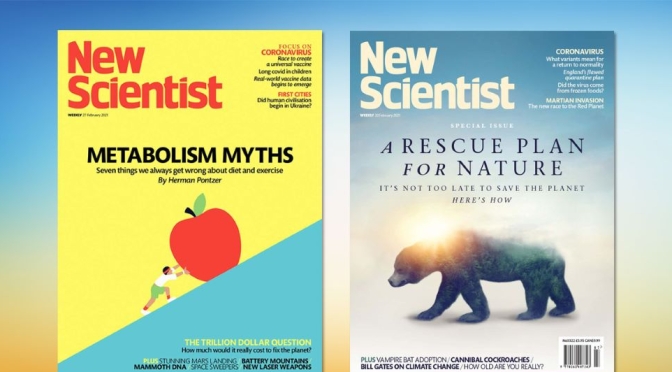
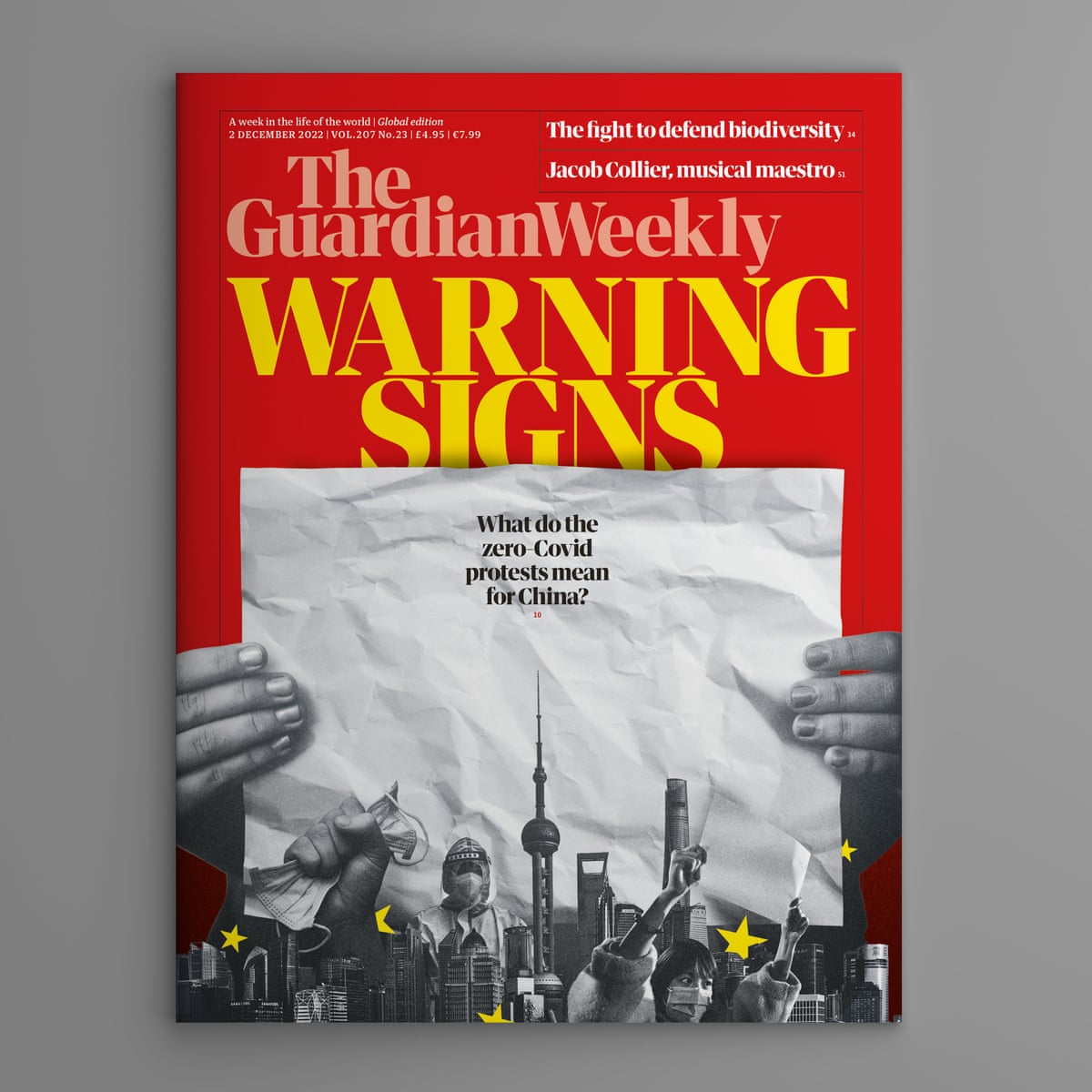
Discontent over China’s zero-Covid suppression policy came to a head last weekend in a series of unprecedented protests across the country. The civil disobedience – remarkable just for the fact it was happening at all in a state where such behaviour is rarely tolerated – seemed to have been smothered by police by the start of the week. Even so it revealed to the world signs of a hitherto unseen fracture in China’s totalitarian political system.
From one Cop to another: hot on the heels of the recent climate conference comes this month’s global summit on biodiversity, which is being held in Montreal. To set the scene, biodiversity reporter Phoebe Weston explains how the damage done to the natural world is a tale of decline spanning thousands of years. Can delegates at Cop15 seize their chance to change the narrative?
With five Grammy awards off the back of four albums spanning everything from folk to jazz and pop, the British multi-instrumentalist Jacob Collier is a global phenomenon. But despite being feted by music royalty including Stormzy, Chris Martin and Herbie Hancock, the 28-year-old has kept a relatively low profile. Global music critic Ammar Kalia takes a trip into Collier’s colourful, polyharmonic world of quarter-tones and non-standardised pitch.
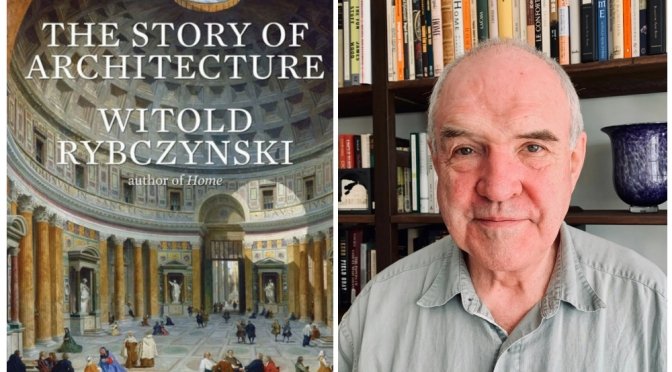
An inviting exploration of architecture across cultures and centuries by one of the field’s eminent authors
In this sweeping history, from the Stone Age to the present day, Witold Rybczynski shows how architectural ideals have been affected by technological, economic, and social changes—and by changes in taste. The host of examples ranges from places of worship such as Hagia Sophia and Brunelleschi’s Duomo to living spaces such as the Katsura Imperial Villa and the Alhambra, national icons such as the Lincoln Memorial and the Sydney Opera House, and skyscrapers such as the Seagram Building and Beijing’s CCTV headquarters. Rybczynski’s narrative emphasizes the ways that buildings across time and space are united by the human desire for order, meaning, and beauty.
This is the story of architecture’s physical manifestation of the universal aspiration to celebrate, honor, and commemorate, and an exploration of the ways that each building is a unique product of patrons, architects, and builders. Firm in opinion, even-handed, and rooted in scholarship, this book will delight anyone interested in understanding the buildings they use, visit, and pass by each day.
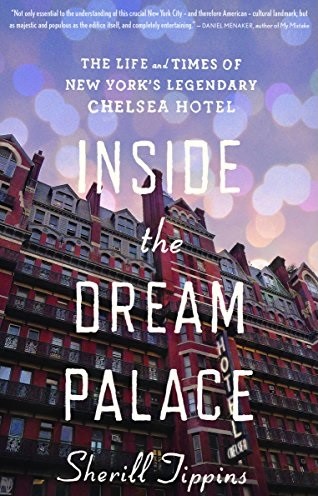
CBS Sunday Morning – Since opening its doors in 1884, New York City’s Chelsea Hotel has welcomed artists, writers and cutting-edge thinkers who shaped America’s cultural landscape. Today, the storied landmark is being developed into a luxury boutique hotel.
Correspondent Alina Cho talks with residents, and with “Inside the Dream Palace” author Sherill Tippins, about the Chelsea’s unique history; and with developer Sean MacPherson about his determination to approach the Hotel Chelsea’s restoration with reverence.
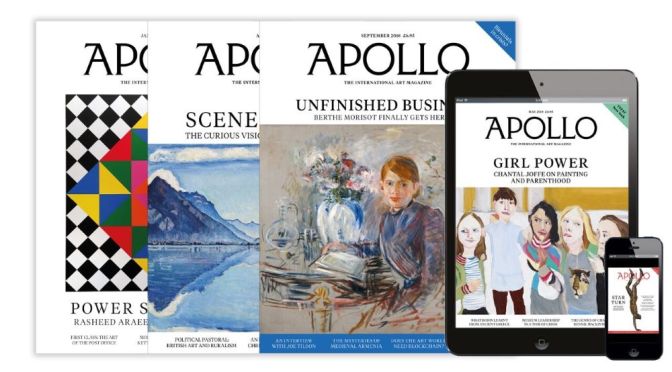
Plus: reframing the Fitzwilliam Museum, a brief history of mulled wine, what’s next for NFTs and, in reviews: the triumph of the Tudors, ways of seeing at the Wellcome Collection and the unfashionable art of Ruskin Spear
You enter a troubling parallel universe in Henry Fuseli’s drawings of women: a place of exaggeration and highly sexualised imagery, where his subjects engage in role-play and the theatrical and erotic and idiosyncratic collide. It’s an inventive, private realm: not one of the drawings in the Courtauld’s fascinating exhibition was displayed in public during the artist’s life.
In the early 20th century, Albert Kahn dispatched photographers to more than 50 countries – and the magical results can be found in the Paris museum that bears his name
Butler to the World: How Britain Became the Servant of Tycoons, Tax Dodgers, Kleptocrats and Criminals by Oliver Bullough
Britain, according to this damning book, is a land of dirty money. It has become the country of choice for dictators wanting to hide their cash, and oligarchs wishing to launder their reputations. Yet instead of waging war on this illicit finance, we’re helping it to propagate. Our national debasement is a sordid story, but Oliver Bullough canters through it with wit and such a colourful set of case studies that it is at least a little easier to stomach. His account begins with the Suez crisis in 1956, which Bullough pinpoints as the moment when Britain’s imperial power crumbled and the nation searched for a new role in the world. The job we chose? Playing Jeeves to kleptocrats. Since the Brexit vote there has been a lengthy debate about what kind of country Britain should strive to be; Bullough argues convincingly that we haven’t spent enough time scrutinising what it has already become. Ros Urwin Profile, £20 Buy a copy of Butler to the World here
Megathreats: The Ten Trends that Imperil Our Future, and How to Survive Them by Nouriel Roubini
Nouriel Roubini is not known as “Dr Doom” for nothing, and this book from the economist who predicted the 2008 financial crisis is a bleak look at some of the horrible threats facing our survival on Earth, from economic collapse to a new cold war and the rise of artificial intelligence. But it is also an important wake-up call to how fragile modern civilisation is. Roubini lucidly lays out the challenges we face. Maybe save reading this until after the festive period. TK John Murray, £20 Buy a copy of Megathreats here
A Pipeline Runs Through It: The Story of Oil from Ancient Times to the First World War by Keith Fisher
In this epic, deeply researched history of oil, Keith Fisher, who spent 15 years on the book, takes us from the Byzantine era to the US oil boom of the 19th century and the rise of barons such as John D Rockfeller, and ends with the First World War. He unsparingly shows what a great but terrible industry oil exploration has been. No one comes out well, but the brutality involved in clearing indigenous communities to open up areas for exploitation are harrowing, especially the cruelty from what would become Royal Dutch Shell. TK Allen Lane, £35 Buy a copy of A Pipeline Runs Through It here















 Boomers Daily