National Institute on Aging – As 2022 comes to a close, NIA invites you to explore some of the most popular health information topics from this past year:
— Shingles is a disease that triggers a painful skin rash. About one in three people will get shingles, but there is a vaccine for older adults to help prevent the disease.
NASA Goddard – This video celebrates the 50th anniversary of Apollo 17 by talking with Lunar Module Pilot Jack Schmitt about the significance of that mission and how it laid the groundwork for future human exploration of the Moon.
Jack also discusses how the Lunar Reconnaissance Orbiter, which launched in 2009, has helped reinterpret Apollo-era data and given us new information about the lunar terrain that will help pave the way for the upcoming Artemis missions.
Apollo 17 was the sixth and final Apollo mission to land on the Moon. Following a 2-hour 40-minute delay, it launched at 11:33 p.m. CST on December 6, 1972, the only night launch of the Apollo program. Prior missions had explored the Moon’s early volcanic history and the role of large impact basins such as Imbrium. Accordingly, Apollo 17 was planned to collect ancient highlands crustal material far from the Imbrium basin and to search for possible young lunar volcanic activity, which would help to constrain our knowledge of the Moon’s thermal evolution.
“This cover feels simultaneously classic and entirely new. It’s slightly reminiscent of 1970s science fiction covers (albeit much more restrained), and yet I’ve never seen anything quite like it. That custom type! That illustration! Is it a world? An eye? Something else? All of the above? As a reader, I don’t typically gravitate toward sci-fi, but this cover is so compelling that it made me immediately want to buy the book.”
“There were so many eye-catching covers this year, but the one that constantly stood out for me because of its stunning simplicity, beauty and mystery was designed by John Gall: No Land in Sight. In a sea of gorgeous covers exploding with kaleidoscopic colorful backgrounds, with elements twisting and intertwining, with the title and author type set in sans-serif condensed fonts, Gall’s cover was refreshing for its clean layout, tasteful typography, elements that are balanced and non-overlapping, in an austere monochromatic palette. Timeless.”
[Cover Images: Picador]
MRS. DALLOWAY & THE HOURS, DESIGNED BY PABLO DELCAN
“The whole package is stunning and smart—words I use a lot to describe Pablo Delcan’s works. The covers evoke introspectiveness and intimacy in such a beautiful way. Everything from the type to the flower placement feels considered and intentional. I love how both sides mirror and work with each other visually and conceptually.”
“This cover is a feast of dualities: both a figurative scene and an abstract texture; a figure seen far off in the distance and a marbled paper viewed at almost 1:1 in scale; a formal, rigid, block colored layout, and a big, expressive interruption in the middle. The slightly muted colors are so refreshing, especially in a year when we’re reaching peak ‘pop,’ and David shows us here that you don’t need neon Pantones or massive type to create a big, bold, absorbing cover. I love that the type is almost pushed to the peripheries by the sprawl of the illustration, as if it’s something that’s happened over centuries; it makes everything feel massive in scale. Also, the silhouette of the figure is from a photo of the author, which is a perfect Pearson point of detail! There are worlds existing in this book cover, and I find it very easy to get lost in them.”
A selection of three essential articles read aloud from the latest issue of The Economist. This week, Xi Jinping’s zero-covid policy, why trustbusters should let Microsoft buy Activision Blizzard (11:44) and why emigration is in the air for Britons (16:38).
Given the relentlessly grim nature of the news this year, it’s hardly surprising that escapism in the form of cosy crime continues to challenge traditional crime/thriller bestsellers, with Richard Osman’s third Thursday Murder Club mystery, The Bullet That Missed (Viking), riding high in the charts. The last 12 months have seen a bumper crop of excellent books at the cosy end of the spectrum, from Ajay Chowdhury’s second crime novel, The Cook (Harvill Secker), set against the backdrop of an east London curry house, to veteran Canadian author Louise Penny’s 18th Armand Gamache novel,A World of Curiosities(Hodder & Stoughton).
Inventiveness appears to be on the rise, too. Janice Hallett’s second novel, The Twyford Code (Viper), told in transcribed audio files retrieved from an iPhone, succeeds in being fiendishly clever and very moving. Authors such as Gillian McAllister, whose Wrong Place Wrong Time (Michael Joseph) is an ingeniously plotted murder mystery in which time travels backwards, and Gabino Iglesias, whose high-octane southern noir thriller The Devil Takes You Home (Wildfire) has supernatural elements, are also giving the genre a welcome shot in the arm. Others have approached familiar tropes from new angles: the main character in CS Robertson’s The Undiscovered Deaths of Grace McGill (Hodder & Stoughton) is not a cop but a “death cleaner”.
Recent revelations have meant that the British public’s growing distrust of the police is very much a part of the UK’s permacrisis. Ian Rankin, creator of maverick cop John Rebus, commented recently that there are “big questions” for authors who write police procedurals. “In the current state of the world, how can you write about a police officer and make them the goody, when we look around us and see that so often the police are not the goodies?” In his latest Rebus novel, the splendid A Heart Full of Headstones (Orion), an officer who has been charged with domestic violence tries to make a deal by stitching up dodgy colleagues.
The year has been punctuated by the collective groans of crime fiction critics as the results of yet another male celebrity’s lockdown diversion landed on their doormats (presumably the female celebrities were too busy home schooling). The most impressive of these is Frankie Boyle’sMeantime(John Murray): set in Glasgow during the aftermath of the 2014 referendum on Scottish independence, it’s both funny and moving.
There have been plenty of excellent non-celebrity debuts. Standouts include Patrick Worrall’s complex spy thriller The Partisan (Transworld); Conner Habib’s Hawk Mountain (Transworld), a paranoid and unsettling tale of masculinity in crisis; and Wake (Hodder & Stoughton), Australian newcomer Shelley Burr’s sensitive exploration of the aftermath of trauma in a parched outback town. Katie Gutierrez’s More Than You’ll Ever Know (Michael Joseph) is an intelligent and nuanced examination of the complicated relationship between a true-crime writer and her subject, a female bigamist. And The Maid by Nita Prose (HarperCollins) will have you rooting for its titular heroine, neurodivergent Molly, as she finds herself caught up in a web of deception at the fancy Regency Grand Hotel.
There have been strong additions to other long-running and well-loved police series, such as Give Unto Others (Hutchinson Heinemann), the 31st novel to feature Donna Leon’s Commissario Brunetti, and The Murder Book (Little, Brown), 18th outing for Mark Billingham’s Tom Thorne. More recent additions to the police procedural canon include Elly Griffith’s DI Harbinder Kaur, who had her third outing in Bleeding Heart Yard(Quercus), and Alan Parks’s shambolic, mid-70s Glaswegian detective Harry McCoy, who had his fifth in May God Forgive (Canongate). Maror by Lavie Tidhar (Apollo), an epic, multi-generational thriller set in Israel, with an enigmatic cop at its centre, is also well worth the read.
Highlights in historical crime include Blue Water (Viper) by Leonora Nattrass, a shipboard thriller set in 1794, and The Lost Man of Bombay (Hodder & Stoughton), the third in Vaseem Khan’s excellent series set in post-partition India. Alternative history has been well served by the thoroughly chilling Queen High (Quercus), CJ Carey’s sequel to last year’s superb Widowland, which imagines a postwar Britain under Nazi rule.
Although translated crime fiction seems thinner on the ground at the moment, the quality is high: standouts include Olivier Norek’s impressive policier Breaking Point (MacLehose, translated from French by Nick Caister) and Antti Tuomainen’s delightfully funny The Moose Paradox (Orenda, translated from Finnish by David Hackston). All in all, the genre seems in good shape: a broader church, less formulaic and more exciting.
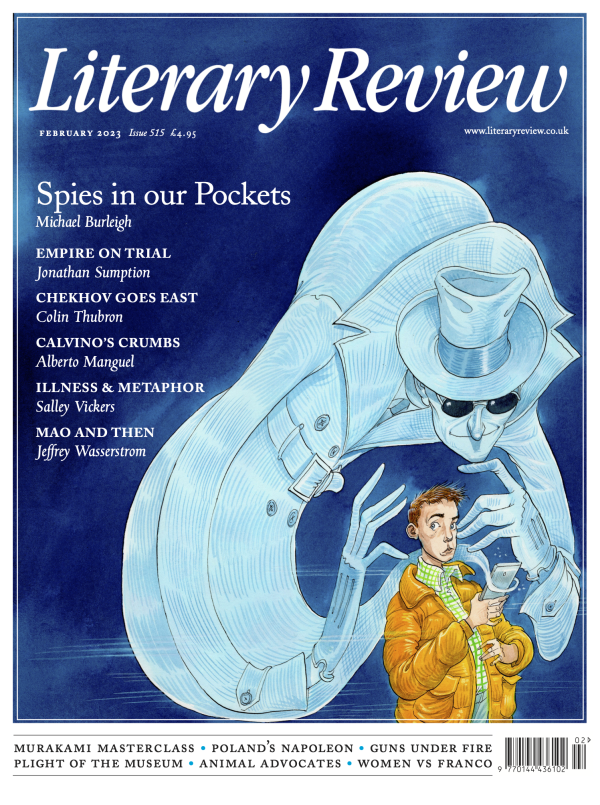
U.S. Customs and Border Protection is searching, downloading, and storing electronic data from thousands of travelers’ devices each year without a warrant.