Tag Archives: Reviews

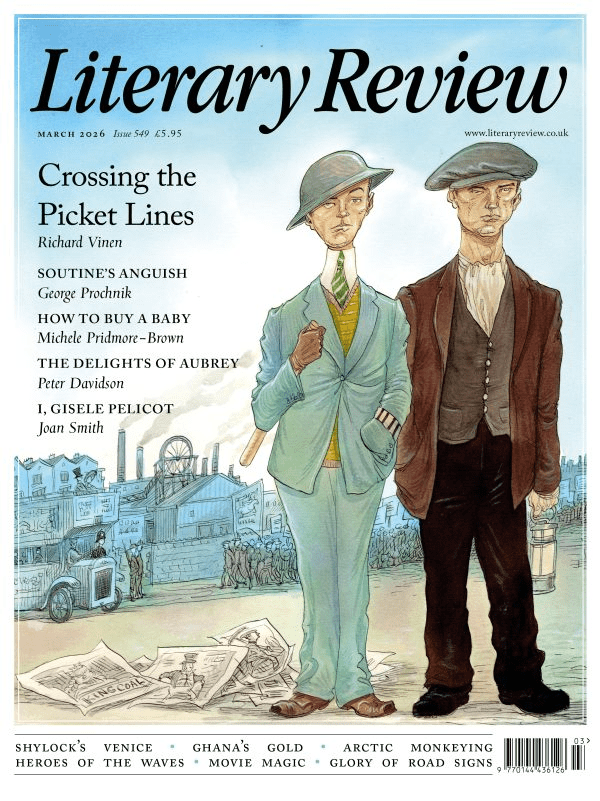
LITERARY REVIEW ———- MARCH 2026 PREVIEW

LITERARY REVIEW : The latest issue features Richard Vinen on the General Strike * George Prochnik on Chaim Soutine * Michele Pridmore-Brown on the fertility industry * Peter Davidson on John Aubrey * Joan Smith on Gisèle Pelicot * Piers Brendon on Kathleen Harriman * Jonathan Keates on the Venetian Ghetto * Erik Linstrum on Asante gold * Zoe Guttenplan on road signs * Holly E J Black on illustration * Michael Burleigh on the Arctic * Frances Cairncross on corporate scandals * Andrew Seaton on wind power

Not Funny, Not Forgotten

The historian A J P Taylor was at Oxford during the general strike of 1926. After it, he later recalled, relations between the minority of undergraduates, such as himself, who had gone to help the strikers and those who had signed on as special constables or volunteer strike-breakers were cordial. Only those sensible men who had stuck to their books and essays were disdained. The whole episode seemed funny in a stereotypically English way – like a Punch cartoon brought to life.

Chaim Soutine: Genius, Obsession, and a Dramatic Life in Art

By Celeste Marcus

The artist Chaim Soutine was obsessed with Rembrandt’s painting of a flayed and headless ox. After managing at the age of twenty, in 1913, to get from Smilovichi, a shtetl in present-day Belarus, to Paris, Soutine made many visits to the Louvre to study the canvas. In the mid-1920s, he decided to translate it into his own idiom: a voluminous impasto, churning with deep, febrile … 

Cash Cow: How the Maternal Body Became a Global Commodity – and the Hidden Costs for Women

By Alev Scott

Fuelled by desire and desperation, and considerable hucksterism, the global fertility industry is sometimes seen as having kinship with the sex trade. Its critics are keen to point out that it’s saturated with eugenicist values and geographic exploitation. In a not atypical scenario, a handful of ‘white eggs’ are purchased … 

John Aubrey at four hundred

Whenever I approach the blind corner on the path south of my house in Oxford, I ring my clear-toned bicycle bell and think of John Aubrey, who noted in the 17th century that church bells sound clearer after rain (which was true for my little bell today). I have often also passed on to tense students approaching their final exams Aubrey’s excellent advice that you are ‘more apt to study’ if you’ve played a gentle game of real tennis (or some less real modern equivalent). And whenever I find… 

THE NEW YORKER MAGAZINE – MARCH 9, 2026 PREVIEW

Two people brave the cold windy weather against a blue sky.

THE NEW YORKER MAGAZINE: The latest issue features Kadir Nelson’s “Cold Chill” – Trying to stay warm.

Can the Democrats Get It Together?

The fight over the 2028 primary calendar is one of several proxies for a broader battle about the future of the Party—and the search for the best nominee. By Amy Davidson Sorkin

Scandal, Protest, Goofiness, and Grandeur at the U.S. Bicentennial

This year marks the two-hundred-and-fiftieth anniversary of the nation’s founding. The two hundredth wasn’t exactly smooth sailing. By Jill Lepore

The Tree House and the Oil Pipeline

In the fight against climate change, sometimes you have to go out on a limb. By Robert Moor

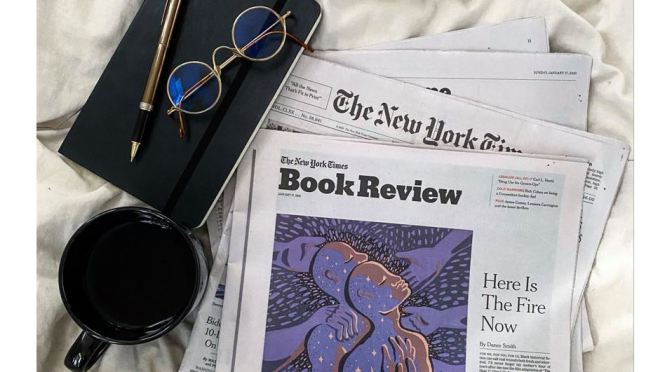
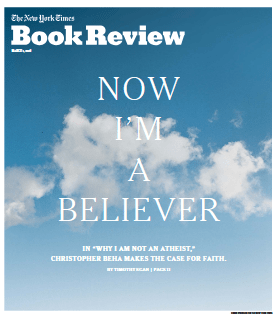
THE NEW YORK TIMES BOOK REVIEW – MARCH 1, 2026

THE NEW YORK TIMES BOOK REVIEW: The latest issue features ‘Now I’m A Believer’ – In “Why I am Not an Atheist”, Christopher Beha makes the case for faith…

Two Sisters Explore the Complex Legacy of Their Mother’s Art

“Backstitch,” a novel by Marian Mitchell Donahue, examines the stark contrast between public talent and private troubles.

Mario Vargas Llosa’s Swan Song Is an Ode to Peruvian Music

The final novel from a titan of Latin American literature follows a critic trying to capture the essence of his national culture.

History’s Most Prolific Female Killer, or a Victim of Disinformation?

A new book by Shelley Puhak dismantles the legend of Hungary’s infamous “blood countess,” separating fact from myth.

MONTHLY REVIEW MAGAZINE – MARCH 2026 PREVIEW

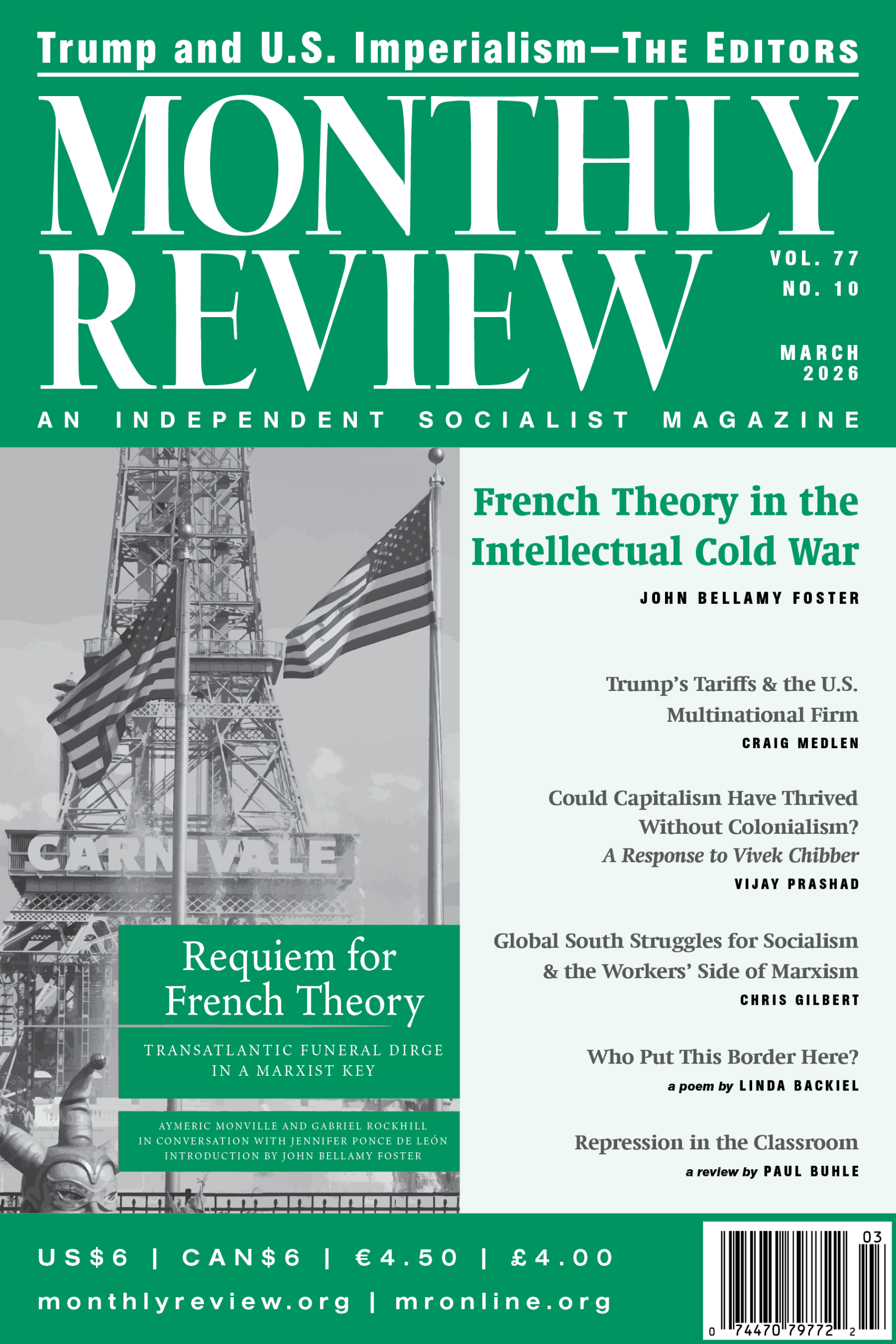
March 2026 (Volume 77, Number 10) - Monthly Review

MONTHLY REVIEW MAGAZINE: The latest issue feature ‘French Theory in the Intellectual Cold War’….

With the Trump administration’s backing down on its tariffs on China, its military abduction of Venezuelan President Nicolás Maduro, its insistence on seizing Greenland one way or another, its bombings in Nigeria, and its declaration that the official U.S. military budget will be increased by 50 percent in 2027—the last four events occurring in a two-week span in late December and early January—establishment commentators are all over the map.

Could Capitalism Have Thrived Without Colonialism? A Commentary on Vivek Chibber’s Jacobin Radio Interview

by Vijay Prashad

Vijay Prashad critiques the argument that colonialism was, at most, ancillary to the transition between capitalism and feudalism in Western Europe. Instead, Prashad argues, “capitalism as it historically emerged—industrial, global, racialized, and imperial—was inseparable from colonial expropriation.” This reality must fuel a Marxist conception of the global struggle for reparations for those who have been oppressed and exploited at the hands of empires past and present.

Repression in the Classroom

by Paul Buhle

In this dual review, Paul Buhle lends contemporary context to the histories of McCarthyism found in the recently published A Blacklist Education, by Jane S. Smith, and Operation Mind, by Natalie Zemon Davis and Elizabeth Donovan. In these two books, Buhle writes, readers can find parallels with the was that is today being waged against university professors and students for political activities—a stark reminder that political witch-hunts did not end with Joe McCarthy.

Trump’s Tariffs and the U.S. Multinational Firm

by Craig Medlen

Craig Medlen dissects the logic behind the Trump administration’s efforts to impose tariffs as a way to counteract “unfair” U.S. trade deficits. Situating these deficits in the longer history of U.S. trade hegemony and its crumbling position in the global economy, Medlen uses incontrovertible data to illustrate how mainstream economic orthodoxy fails to acknowledge the effects of foreign inputs that integral to the workings of U.S. monopoly capital.

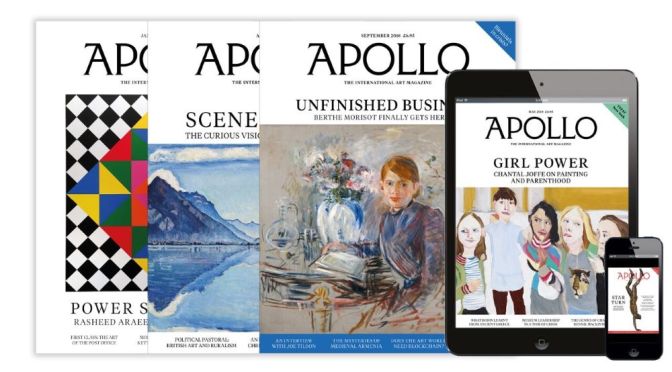
APOLLO MAGAZINE ——- MARCH 2026 PREVIEW

Anthony van Dyck | Exact Editions

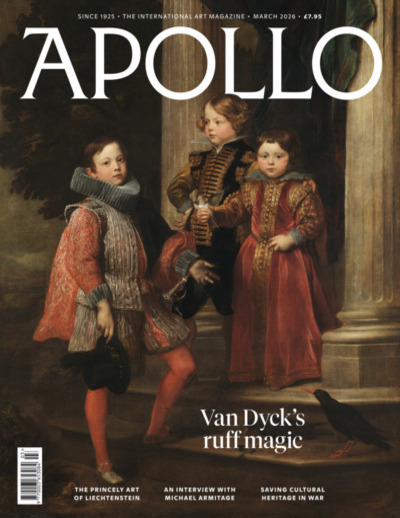
APOLLO MAGAZINE: The latest issue features ‘Van Dyck’s Ruff Magic’….

Was Henri Rousseau a sophisticate all along?

The self-taught painter had a trememdous sense of self-belief, despite being ridiculed in his lifetime. A landmark exhibition confirms him as a singularly modern artist

East Side success story: the Asia Society at 70

Since 1956, the New York institution has fostered cross-cultural understanding, equipped with a collection of masterpieces assembled by its founder, John D. Rockefeller

When art becomes an act of last resort

Joseph Koerner’s account of art made in extremis turns Bosch, Beckmann and Kentridge into unexpected associates across the ages

THE HUDSON REVIEW MAGAZINE – WINTER 2026

The Hudson Review | A Magazine of Literature and the Arts

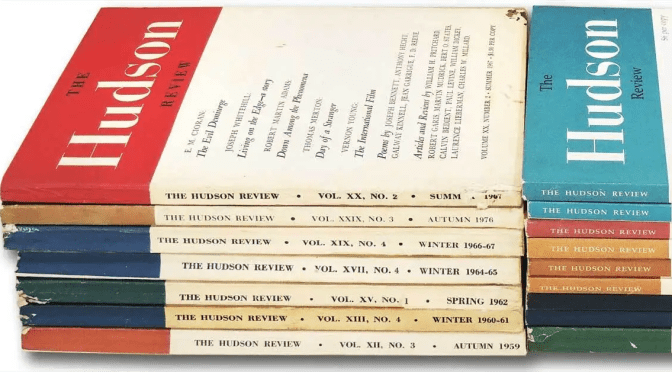
THE HUDSON REVIEW: The latest issue features….

ESSAYS

The Mysterious Case of Gothic Verse Narratives by Brian Brodeur
The Intertidal Zone by Michael Carson

FICTION

Krista Robinson, Age 21 3/4, Wants These Things to Be True by Leslie Pietrzyk

POETRY

The Fells by Natania Rosenfeld
Sonnet Upon the James Webb Space Telescope; The Names of the Seasons by Robert Schultz
A Dance by Brian Swann Memorable Figures by Ellen Kaufman
Stanley Moss by Priscilla Long

ARTS CHRONICLES

Dancing in New York: Variations on a Theme by Marina Harss
Recurring Themes at the New York Film Festival by Erick Neher
Balancing Acts by Becky Y. Lu
At the Galleries by Karen Wilkin

BOOK REVIEWS

Letters of T. S. Eliot, Vol. 10 by William H. Pritchard
Poet, Lucky Poet: The Poems of Seamus Heaney by Mark Jarman
Revivals, Pastorals, a Shroud of Golden Silk by Robert Archambeau
The Making of Gertrude Stein by David Mason

THE NEW YORK TIMES MAGAZINE- MARCH 1, 2026

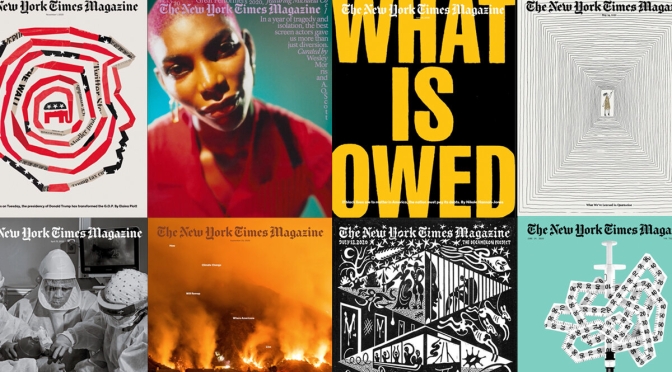
THE NEW YORK TIMES MAGAZINE: The latest issue features ‘The Victims Who Fought Back’ – A new law was supposed to help free women convicted of killing their abusers. Why are nearly all of them still in prison?

They Killed Their Abusers. Should They Spend Their Lives in Prison?

A new law was supposed to help reduce the sentences of survivors of domestic violence. Most are still behind bars.

They Fought for the C.I.A. in Afghanistan. In America, They’re Living in Fear.

A shooting in Washington, D.C., threw their immigration status into jeopardy — and brought attention to a long-hidden dimension of America’s war.

The Interview – Maggie Gyllenhaal Thinks Hollywood Likes Women to Direct ‘Little Movies’

THE ECONOMIST MAGAZINE – FEBRUARY 28, 2026 PREVIEW

THE ECONOMIST MAGAZINE: The latest issue features ‘Digging for victory’…

America’s dangerous pursuit of critical-mineral dominance

With a more focused approach, it could break China’s chokehold

Donald Trump is at risk of launching a war without purpose

A conflict with Iran without a clear objective would be recklessly dangerous

The right response to private-market dangers

Was a Blue Owl fund mismanaged, or did it reveal fundamental problems about the industry?

America’s states should beware of copying Europe too much

Welfare is rightly becoming more generous. But regulatory fragmentation is a problem

Heathrow’s third runway is turning into another infrastructure fiasco

The government must step in

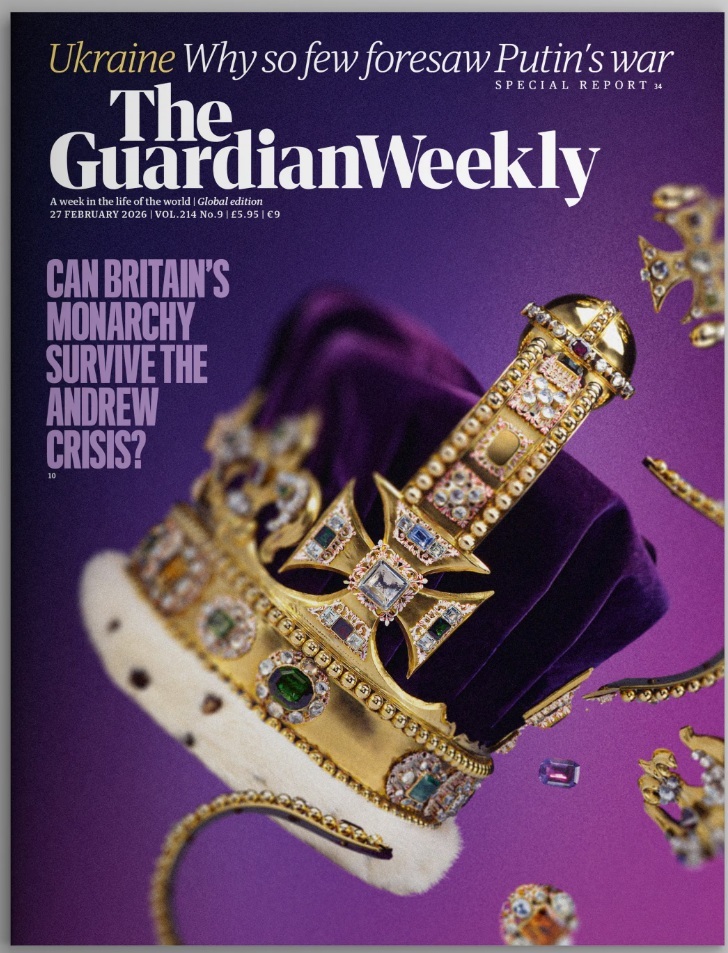
THE GUARDIAN WEEKLY – FEBRUARY 27, 2026 PREVIEW

THE GUARDIAN WEEKLY: The latest issue features ‘Can Britain’s Monarchy Survive the Andrew Crisis?’…

The arrest of Andrew Mountbatten-Windsor last week, after allegations he had shared confidential information with the late US sex offender Jeffrey Epstein, sent shock waves around the world.

What happens next is unclear, but the ramifications will go far beyond the former prince, who has consistently denied any wrongdoing related to Epstein. It was one of the most consequential days for Britain’s monarchy in generations, shattering the traditional aura of royal mystique and raising questions of accountability, deference and whether the royal family should have acted sooner.

In a powerful essay for our big story this week, Stephen Bates asks whether the royal family can survive the unfolding scandal.

Spotlight | The limits to the supreme court’s assent
Last week’s declaration by the conservative-heavy court that Trump’s sweeping tariffs are unlawful is a major setback for the president, writes Ed Pilkington

Health | Why big pharma stands to gain from weight-loss pills
Oral tablets could bring obesity treatment into the mainstream, with the sector predicted to be worth $200bn by the end of the decade. Julia Kollewe reports

Special report | The road to war in Ukraine
In a remarkably detailed piece drawing on more than 100 interviews with senior intelligence officials and other insiders, Shaun Walker explains how the CIA and MI6 got hold of Putin’s Ukraine plans – and why nobody believed them

Opinion | A degree? A trade? Every rung for young people is a trap
Is it to be a degree and heavy debt when graduate jobs are shrinking? Or forgoing a degree, knowing society still worships them? Confused, angry: who wouldn’t be, asks Jason Okundaye

Culture | Big in Beijing (but less so in Blackpool)
James Balmont’s band, Swim Deep, plays to crowds of hundreds across the UK – but in China, they perform in front of tens of thousands. And they’re not the only ones

THE NEW YORKER MAGAZINE – MARCH 2, 2026 PREVIEW

In the winter, a man sits between a window and a radiator and is both freezing and sweating.


THE NEW YORKER MAGAZINE : The latest issue features Rachel Aviv on the trial of Gisèle Pelicot’s rapists, Tad Friend on James Talarico, David Sedaris on being broke in New York, and more.

Ian McKellen Swings from Shakespeare to Gandalf to Virtual Reality

On a visit to New York, the actor reflected on mortality and coming out, and unleashed an Elizabethan anti-ICE monologue on “Colbert” that went viral. By Henry Alford

James Talarico Puts His Faith in Texas Voters

The Senate candidate believes that Democrats can win by appealing to higher values. Can he succeed in the age of Trump? By Tad Friend

Why the World Cup Can Feel Like War

Soccer stadiums can be dominated by violence, tribalism, chauvinism, and near-religious fervor‚ animated by the memory of old hostilities and the power of ritual. By Ian Buruma

The Trial of Gisèle Pelicot’s Rapists United France and Fractured Her Family

After fifty-one men were convicted, Pelicot became a feminist hero. But additional accusations left her children struggling to accept her new role. By Rachel Aviv