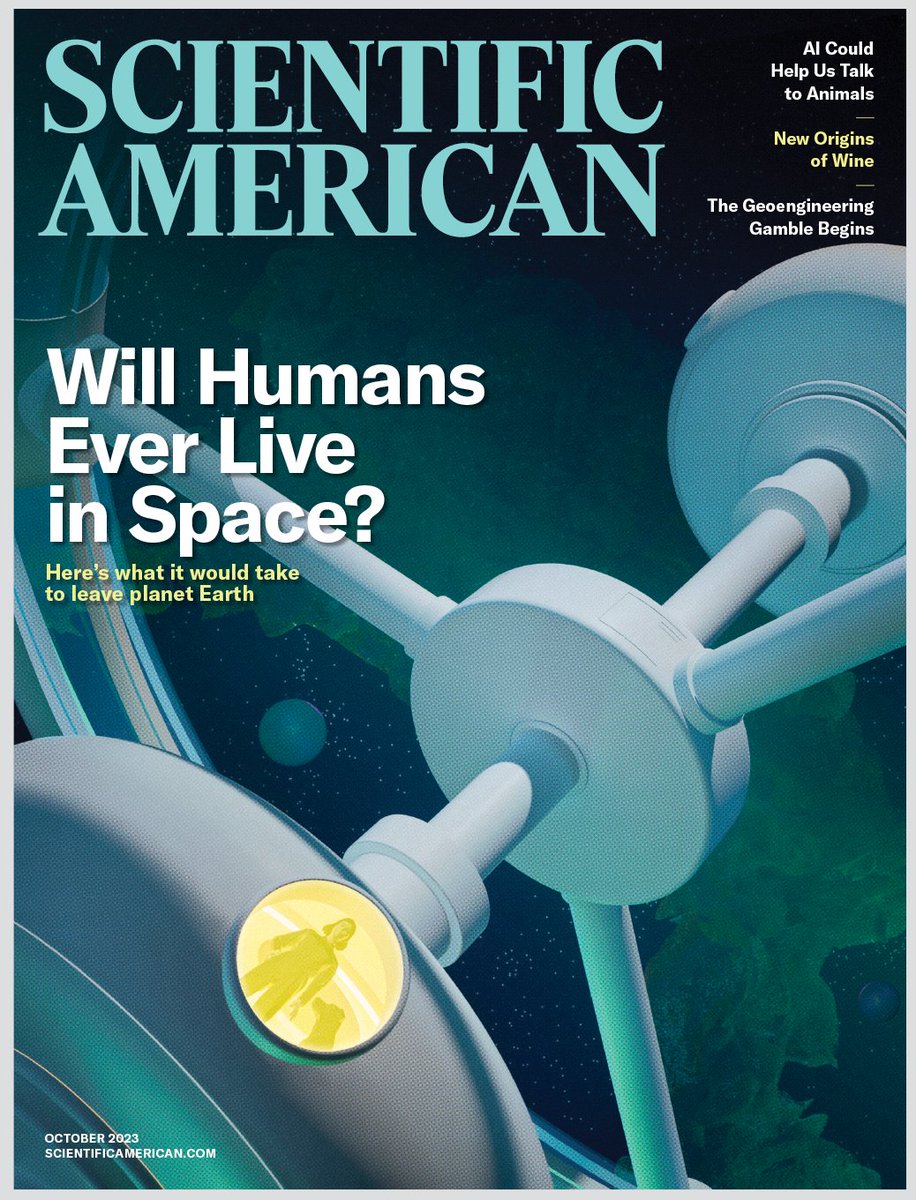

Scientific American – October 2023: The issue features ‘Will Humans ever Live in Space – Here’s what it will take to leave planet Earth’; AI could help us to talk to animals; New origins of wine, and more…
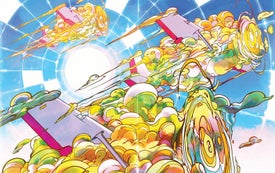
Global warming is so rampant that some scientists say we should begin altering the stratosphere to block incoming sunlight, even if it jeopardizes rain and crops
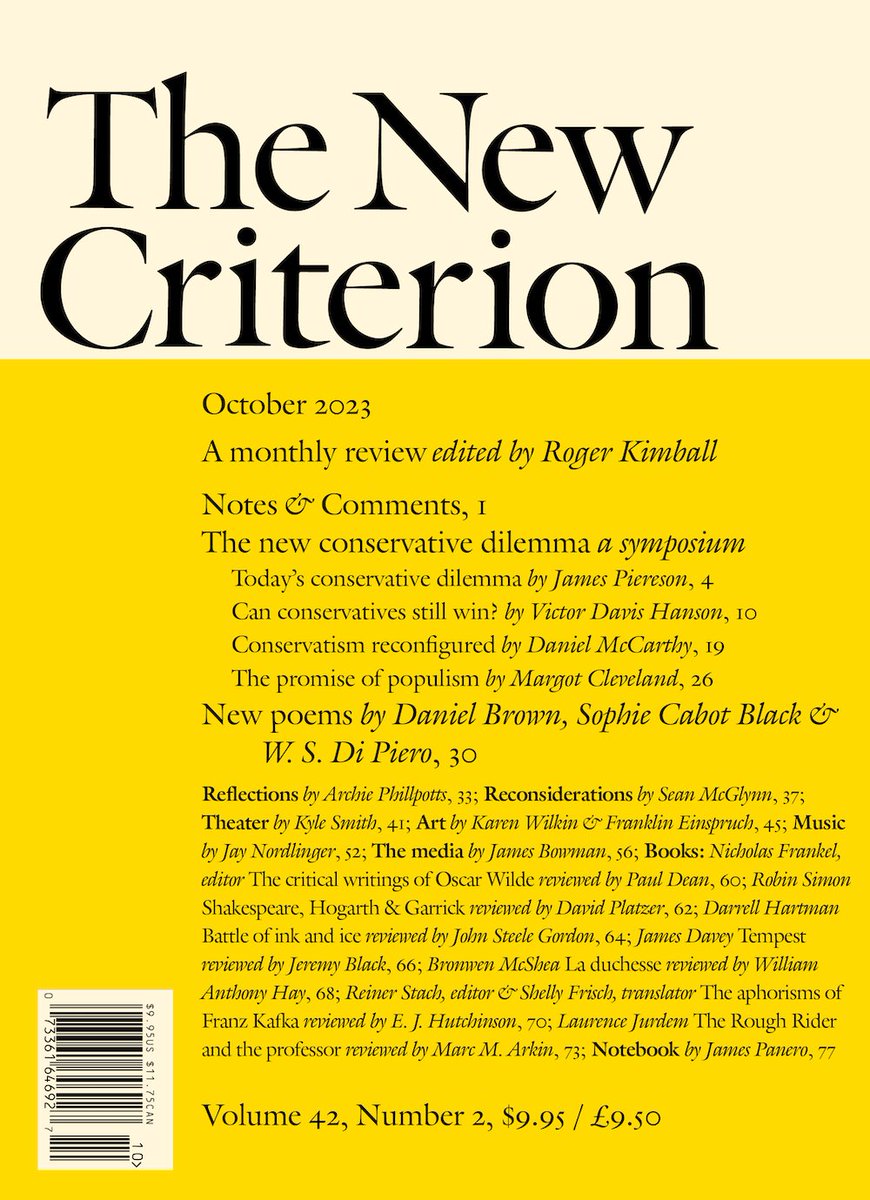
Today’s conservative dilemma by James Piereson Can conservatives still win by Victor Davis Hanson Conservatism reconfigured by Daniel McCarthy The promise of populism by Margot Cleveland
New poems by Daniel Brown, Sophie Cabot Black & W. S. Di Piero
Harper’s Magazine – OCTOBER 2023: This issue features ‘Craving A Choice’ – Insurgency and its Threat to the Democratic Party; The Spy – An Essay On seeing without being seen, and more…
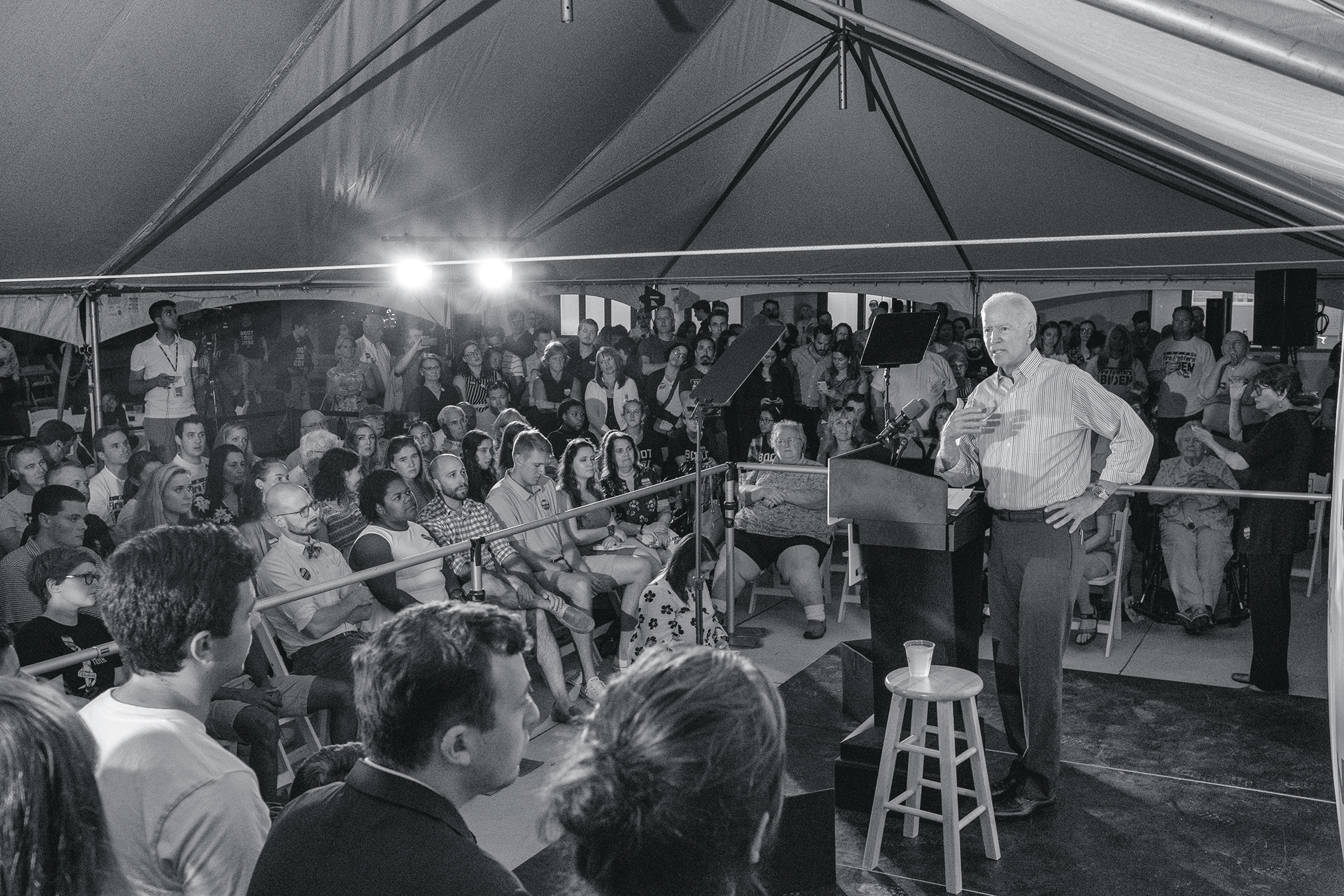
For decades, New Hampshire has generated brisk and gratifying drama with its first-in-the-nation presidential primary. The Granite State momentously destroyed a presidency in 1968, when the Minnesota senator Eugene McCarthy ran against President Lyndon Johnson on an antiwar platform.
Not long ago our mother died, or at least her body did—the rest of her remained obstinately alive. She took a considerable time to die and outlasted the nurses’ predictions by many days, so that those of us who had been summoned to her bedside had to depart and return to our lives.
The New Yorker – September 25, 2023 issue: The new issue features the Fall Style & Design issue which showcases the work of Diana Ejaita, an artist who has herself dabbled in the world of fashion.
The bohemian English circle that included Virginia Woolf, Duncan Grant, and Vanessa Bell revolted against Victorian formality—and their casually ornamental style is inspiring designers today.
In July, 1918, Virginia Woolf spent a weekend at Garsington—a country home, outside Oxford, owned by Lady Ottoline Morrell, a celebrated hostess of the era, and her husband, Philip Morrell, a Member of Parliament. The house, a ramshackle Jacobean mansion that the Morrells had acquired five years earlier, had been vividly redecorated by Ottoline into what one guest called a “fluttering parrot-house of greens, reds and yellows.” One sitting room was painted with a translucent seafoam wash; another was covered in deep Venetian red, and early visitors were invited to apply thin lines of gold paint to the edges of wooden panels. The entrance hall was laid with Persian carpets and, as Morrell’s biographer Miranda Seymour has written, the pearly gray paint on the walls was streaked with pink, “to create the effect of a winter sunset.” Woolf, in her diary, noted that the Italianate garden fashioned by Morrell—with paved terraces, brilliantly colored flower beds, and a pond surrounded by yew-tree hedges clipped with niches for statuary—was “almost melodramatically perfect.”
At the end of his first year at the architecture school of the Royal Danish Academy, Pavels Hedström went on a class trip to Japan. Hedström, a twenty-five-year-old undergraduate, revered Japanese culture and aesthetics, even though he had never visited the country. As a teen-ager growing up in rural Sweden, Hedström had been introduced to Zen meditation by his mother, Daina, and devoured manga and anime. In architecture school, Hedström was drawn to Japanese principles of design and how they applied to a world—and a profession—increasingly troubled by the climate crisis. Hedström was particularly influenced by Metabolism, a postwar Japanese architectural movement that imagined cities of the future as natural organisms: ephemeral, self-regulating, and subject to biological rhythms of growth, death, and decay. In 1977, Kisho Kurokawa, one of Metabolism’s founders, wrote, “Human society must be regarded as one part of a continuous natural entity that includes all animals and plants.”
THE NEW YORK TIMES MAGAZINE (September 17, 2023): The 9.17.23 Issue features Emily Bazelon on abortion rights being won through state ballots after the Dobbs decision; Audra D.S. Burch on the death of Elijah McClain in Aurora, Colorado and the city’s deep divide over policing; Teju Cole on Greek tragedies; Dan Brooks on the Italian rock band Måneskin; and more.
One by one, the five men — three police officers and two paramedics — walked up before the judge one afternoon this January. Their lawyers stood beside them, and the wooden benches of the Colorado courtroom were filled with family, friends and fellow police officers and paramedics.
The defense contractor spent heavily on acquisitions, then struggled during the pandemic. Now with new senior leadership working to fix its operational problems, its shares could fly.
With a full range of investment and planning services at their fingertips, independent financial advisors are managing more of America’s wealth. Here’s how they do it.
THE NEW YORK TIMES BOOK REVIEW (September 17, 2023): The new issue features An Illustrated Guide to Toppling the Patriarchy, New Thrillers, Appalachian Literature, The Good Virus, and more…
In its first half-century, Ms. magazine upended norms, disrupted the print world and made trouble. It was a start.
By Anna Holmes
50 YEARS OF MS.: The Best of the Pathfinding Magazine That Ignited a Revolution, edited by Katherine Spillar and the editors of Ms.
I had my first conscious interaction with Ms. magazine as a small child when I read — or rather, had read to me — a story-poem called “Black Is Brown Is Tan.”
Part of the magazine’s delightful kids’ section, “Black Is Brown Is Tan” is about a mixed-race family not unlike my own who go about their daily routines like any other Americans. Though I was young, I remember the illustrations, by Emily Arnold McCully, with acute clarity: the rosy cheeks of the white dad, the short Afro and hoop earrings of the Black mom, and, perhaps most important, the sense of safety and warmth that permeated every page. In our house, where my mother was careful about the messaging of the media and toys we consumed, the “Stories for Free Children” section was always welcome. As for the magazine they appeared in? Well, it was canon.
In Diana Evans’s new novel, “A House for Alice,” a woman who immigrated to Britain for marriage must decide whether or not to return to her country of origin after her husband dies.
By Tiphanie Yanique
A HOUSE FOR ALICE, by Diana Evans
Houses in Diana Evans’s new novel, “A House for Alice,” are a metaphor for family. They’re filled with rooms for sleeping, lovemaking, fighting; contain corridors that lead to areas of welcome and comfort; shelter spaces that hold secrets. And like a house, a family can be burned to nothing and rebuilt anew.
The Economist Magazine (September 16, 2023): The latest issue reviews How AI can revolutionize science; Donald Trump will “never” support Putin, says Volodymyr Zelensky; The hard right is getting closer to power all over Europe, and more…
Debate about artificial intelligence (ai) tends to focus on its potential dangers: algorithmic bias and discrimination, the mass destruction of jobs and even, some say, the extinction of humanity. As some observers fret about these dystopian scenarios, however, others are focusing on the potential rewards. ai could, they claim, help humanity solve some of its biggest and thorniest problems. And, they say, ai will do this in a very specific way: by radically accelerating the pace of scientific discovery, especially in areas such as medicine, climate science and green technology.
In the next decade regional tensions will build in India
The world has been seeing the bright side of India. In August it landed a spacecraft on the Moon. In the latest quarter gdp grew at an annual rate of 7.8%, making it the world’s perkiest big economy. Narendra Modi, the prime minister, has just hosted a g20 summit where other leaders, including Joe Biden, courted Asia’s rising behemoth. Yet inside India the talk has turned to whether Mr Modi’s hunger for power and dreams of national renewal could lead him to bend the constitution.
Times Literary Supplement (September 15, 2023): The new issue features what connects the novelist William Harrison Ainsworth, the Tichborne Trial and life on a sugar plantation in Jamaica? In a New Yorker essay Zadie Smith spelt out the preoccupations of The Fraud, her novel set in the Victorian era, as “fake identities, fake news, fake relationships, fake histories”. Ainsworth, in Smith’s view, was a fraud as a historical novelist.
Science Magazine – September 15, 2023: Blue jays, similar to other corvid songbirds, are known for their impressive cognitive abilities, presumably due to their relatively large brains.