Tag Archives: Poetry

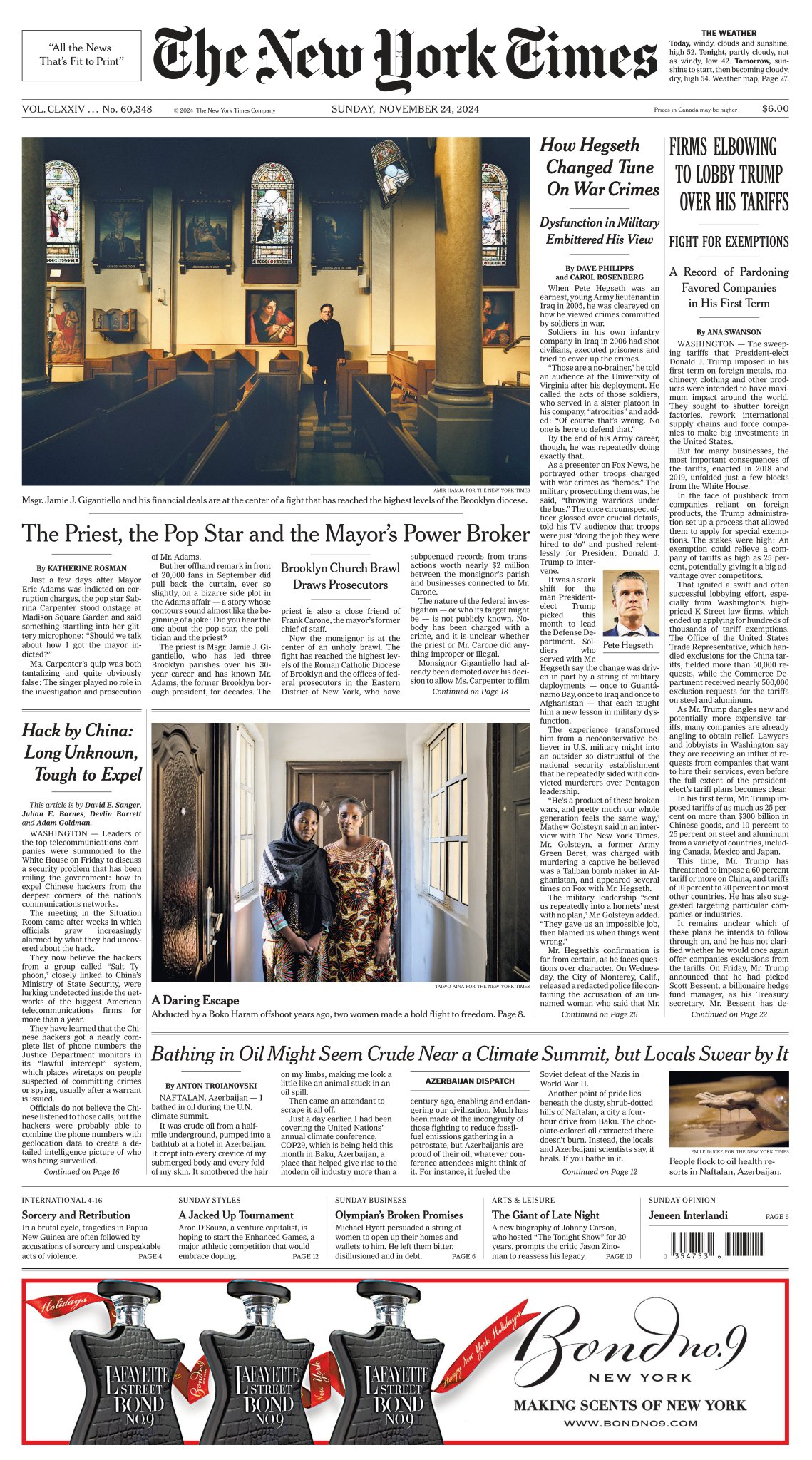
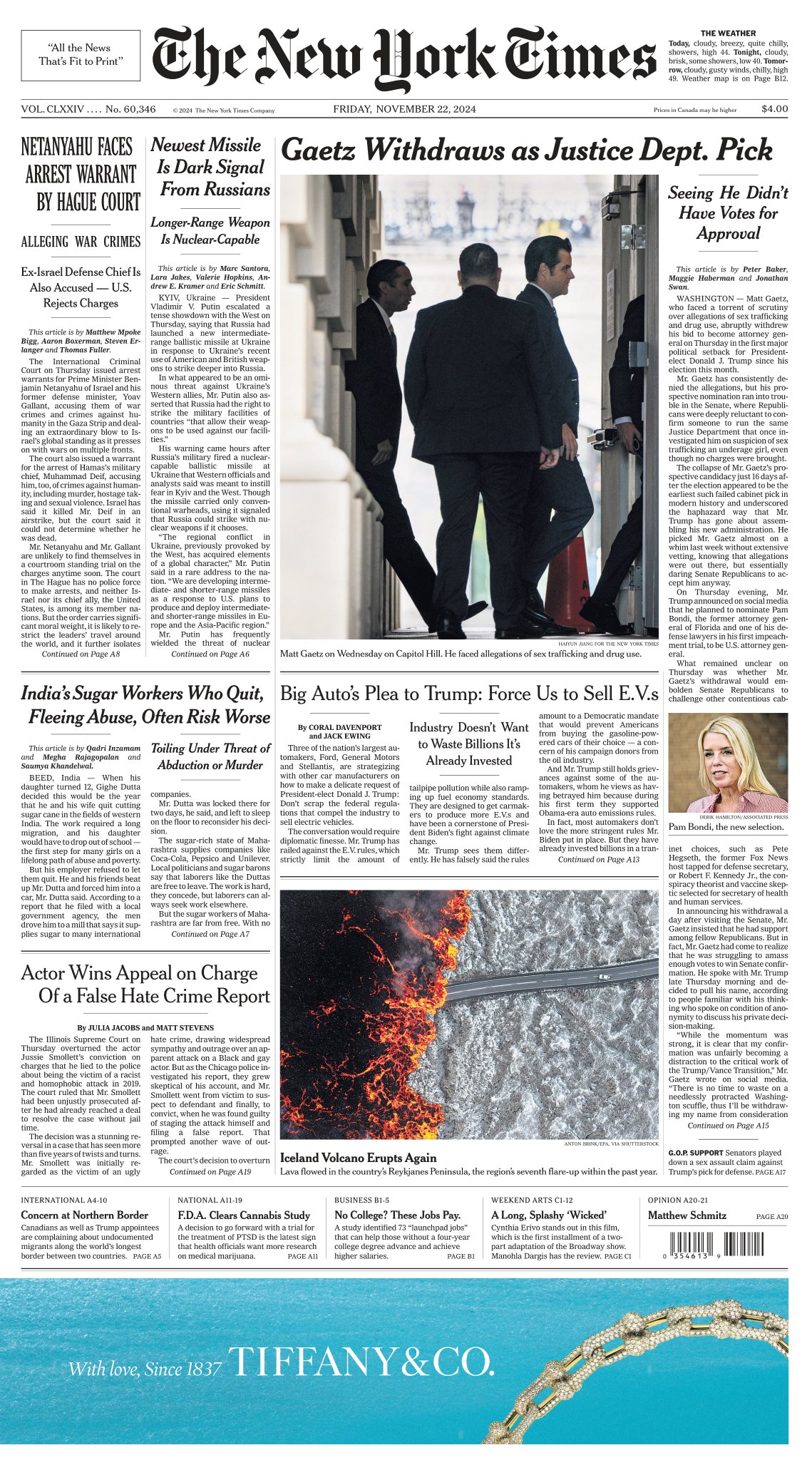
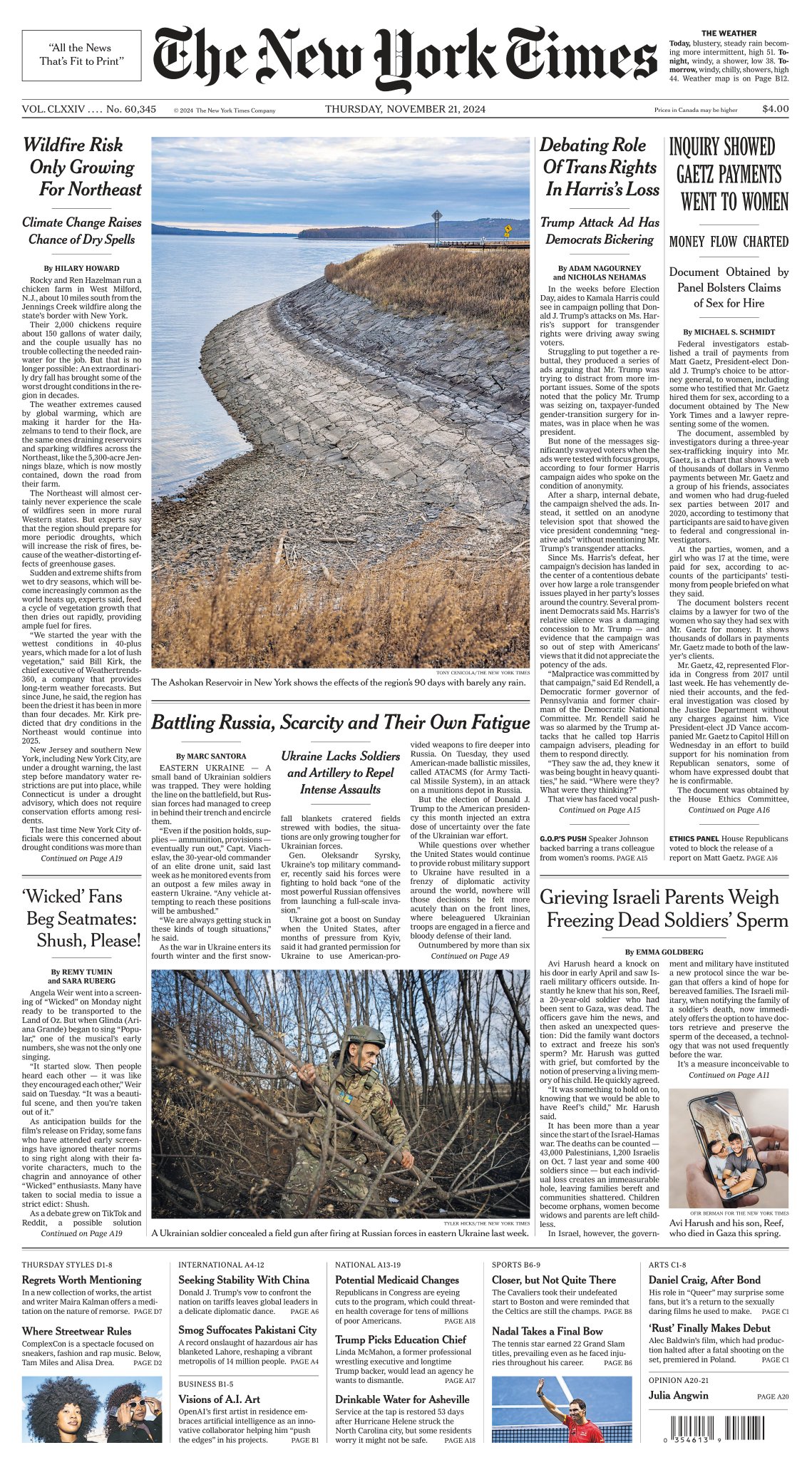
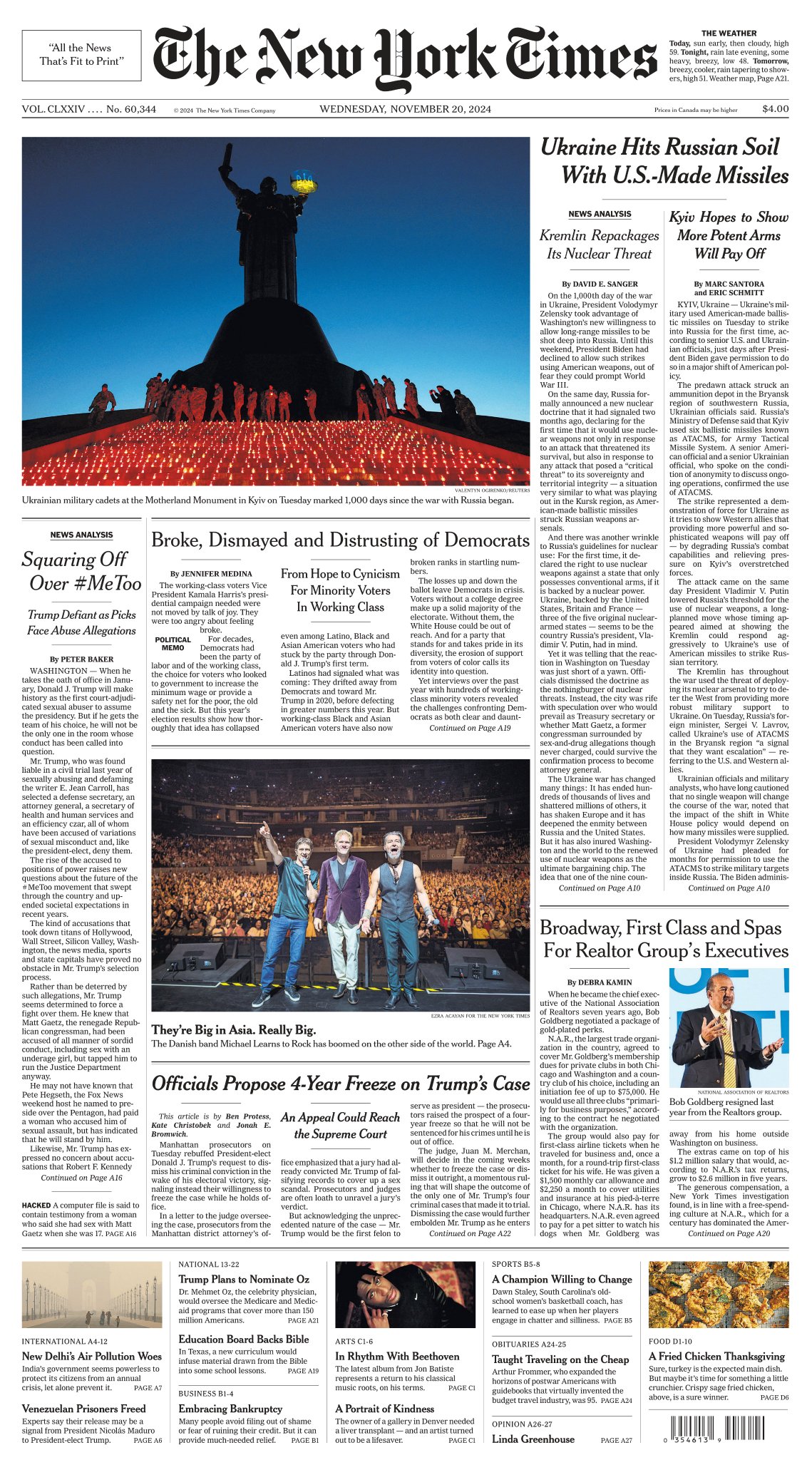
The New York Times — Friday, October 4, 2024

Image

After Successes, Israel’s Military Is in a ‘Long Game’ With No Clear Outcome

A year after perhaps the worst military and intelligence debacle in the country’s history, its armed forces have regained the momentum. Some ask: to what end?

3 Former Officers Acquitted of Most Serious Charge in Tyre Nichols’s Death

The former officers were found guilty of witness tampering but not of the charge that would have held them responsible for causing his death.

Trump Promised to Release His Medical Records. He Still Won’t Do It.

If elected again, he would become the oldest president by the end of his term. Yet he is refusing to disclose even basic health information.

Filing in Trump Election Case Fleshes Out Roles of a Sprawling Cast

Donald Trump is the only defendant in the special counsel’s case that charges him with a plot to remain in power after his 2020 loss. But a newly unsealed brief provides fresh details about many other figures.

Books: Literary Review Magazine – October 2024

Image

Literary Review – October 2, 2024: The latest issue features Richard Vinen on Churchill; @wendymoore99 on Marie Curie; Ritchie Robertson on Augustus the Strong; @robinsimonbaj on British art and @tomlamont on James Salter

Croquet & Conspiracy- “Churchill’s Citadel: Chartwell and the Gatherings Before the Storm” By Katherine Carter

‘It’s not a bad life for the leaders of the British bourgeoisie! There’s plenty for them to protect in their capitalist system!’ So wrote Ivan Maisky, the Soviet ambassador in London, after his first visit to Winston Churchill’s country house at Chartwell in Kent. He described the house thus: ‘A wonderful place! Eighty-four acres of land … all clothed in a truly English dark-blue haze.’

All for the Thrill of the Chase – “Augustus the Strong: A Study in Artistic Greatness and Political Fiasco” By Tim Blanning

Frederick Augustus (1670–1733), elector of Saxony and king of Poland, owed his sobriquet ‘the Strong’ to such feats as crushing a tin plate in his hand (mentioned by Rilke in the ‘Fifth Duino Elegy’) and to his vigorous sex life. Contemporaries credited him with fathering 354 illegitimate children; Tim Blanning soberly reduces the number to eight. This biography is concerned not with court gossip, however, but with Augustus’s political career and cultural achievements. Blanning celebrates Augustus as the virtual creator of the once-magnificent city of Dresden, where the kings of Saxony resided, and hence, surprisingly, as ‘a great artist, arguably the greatest of his age’.

London Review Of Books – October 10, 2024 Preview

London Review of Books (LRB) – October 2 , 2024: The latest issue features Hardy’s Bad Behavior; Fredric Jameson, Byond Balliol…

John Kerrigan

England’s Insular Imagining: The Elizabethan Erasure of Scotland by Lorna Hutson

A.E. Stallings

Poem: ‘The Plum Tree’

Helen Pfeifer

The Genius of Their Age: Ibn Sina, Biruni and the Lost Enlightenment by S. Frederick Starr

Katherine Harloe

The Muse of History: The Ancient Greeks from the Enlightenment to the Present by Oswyn Murray

David Runciman

Short Cuts: Just ask Tony

Terry Eagleton

The Years of Theory: Postwar French Thought to the Present by Fredric Jameson

James Vincent

Horny Robot Baby Voice

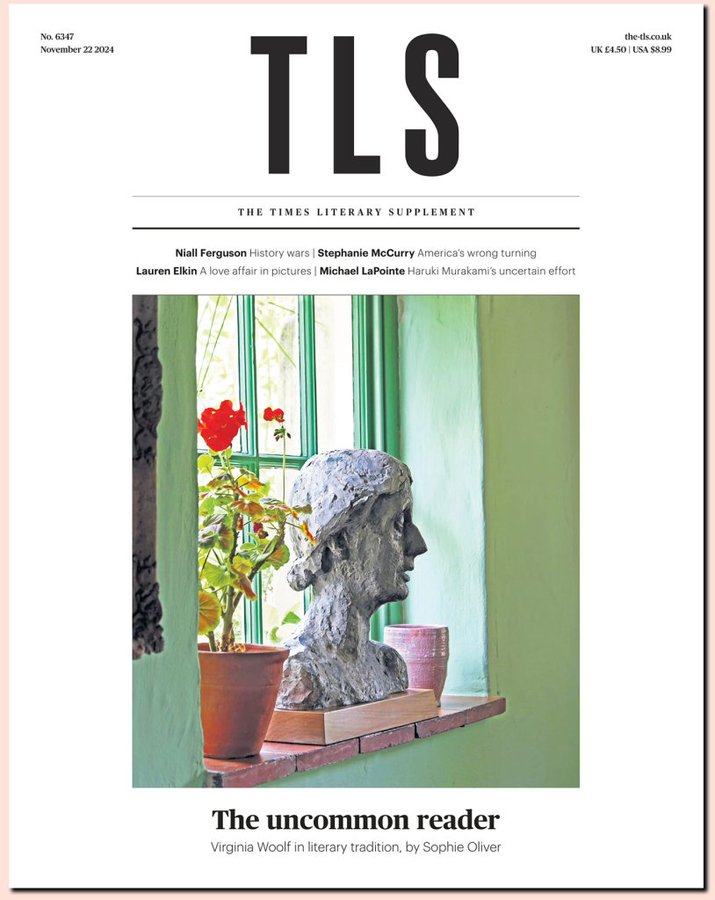
Arts/Books: Times Literary Supplement – Oct. 4, 2024

Image

Times Literary Supplement (October 2, 2024): The latest issue features ‘Canon Fire’ – Emma Smith and Brian Vickers on authorship in the golden age of theatre…

The New York Review Of Books – October 17, 2024

The New York Review of Books (September 26, 2024)The latest issue features:

‘The Death of Some Ideal’

The Irish novelist Anne Enright writes with great prowess and wit about women who make a virtue of getting on with things.

The Wren, the Wren by Anne Enright

The Fact Man

At the heart of Daniel Defoe’s fictional world is a feeling for change, of the mutability and shiftiness of modern life and the people who thrive in it.

The Oxford Handbook of Daniel Defoe edited by Nicholas Seager and J.A. Downie

The Problems with Polls

Political polling’s greatest achievement is its complete co-opting of our understanding of public opinion, which we can no longer imagine without it.

Strength in Numbers: How Polls Work and Why We Need Them by G. Elliott Morris

Arts/Books: Times Literary Supplement – Sept. 27, 2024

Times Literary Supplement (September 25, 2024): The latest issue features ‘Body and Soul’ – Noel Malcolm on Diamaid MacCulloch’s history of sex and Christianity; Jean Genet’s lost drama; Becoming Lucy Sante; Poor little kids and How the compass got its points…

London Review Of Books – September 26, 2024 Preview

London Review of Books (LRB) – September 20 , 2024: The latest issue features T.J. Clark on Fanon’s Contradictions; Linda Kinstler at the 6 January trials; Sally Rooney’s Couples and Kubrick Does It Himself….


Byzantine Intersectionality: 
Sexuality, Gender and Race in the Middle Ages by Roland Betancourt

At the Movies: ‘Only the River Flows’ by Michael Wood

From Tudor to Stuart: The Regime Change from Elizabeth I to James I by Susan Doran – Clare Jackson

Kubrick: An Odyssey by Robert P. Kolker and Nathan Abrams – David Bromwich

Arts/Books: Times Literary Supplement – Sept. 20, 2024

Image

Times Literary Supplement (September 18, 2024): The latest issue features ‘Autumn Fiction’ – Rachel Kushner, Olga Tokarczuk, László Krasznahorkai and Sally Rooney; Craig Brown on The Queen; A very Yorkshire horror; China’s Britain complex and The Looting of America…

Arts & Culture: The New Criterion -October 2024

The New Criterion – The October 2024 issue features

Democracy in America: a symposium

Tocqueville’s limitations by Glenn Ellmers

Democracy in America: an introduction by Roger Kimball

Our Athenian American democracy by Victor Davis Hanson

Tocqueville versus progressive democracy by Daniel J. Mahoney

The Washington octopus by James Piereson

Literary Previews: The Paris Review – Fall 2024

Paris Review Fall'24

Paris Review Summer 2024 (September 10, 2024) — The new issue features:

Not Enough about Frank: A Visit with James Schuyler

Peter Schjeldahl

undefined
From left, Frank O’Hara, John Button, Schuyler, and Joe LeSueur, ca. 1960. © Estate of John Button, courtesy of CLAMP, New York.

James Schuyler on Frank O’Hara: “I still can see Frank, standing on that street corner outside a pastry shop, holding a neatly tied-up box of God knows what—éclairs, perhaps.”

James Schuyler was born in Chicago in 1923, grew up in Washington, D.C., and East Aurora, New York, and spent most of his adult years in New York City and Southampton, Long Island. Although he is perhaps less widely known than the fellow New York School poets with whom he is associated, John Ashbery, Frank O’Hara, Barbara Guest, and Kenneth Koch, he published six full-length books of poetry during his lifetime—beginning with Freely Espousing, published by Doubleday and Paris Review Editions in 1969—as well as two novels, and a third written in collaboration with Ashbery. In 1981 he won the Pulitzer Prize for his collection The Morning of the Poem (1980). Mental illness plagued him intermittently, and there were times when his life threatened to veer out of control, but friends repeatedly rallied around him, and the years before his death in 1991 were happy and productive. 

Javier Cercas on the Art of Fiction: “Hell, to me, is a literary party.”

Prose by Josephine Baker, Caleb Crain, Marlene Morgan, Morgan Thomas, and Fumio Yamamoto.

Poetry by Hannah Arendt, Matt Broaddus, Sara Gilmore, Benjamin Krusling, Mark Leidner, James Richardson, and Margaret Ross.

Art by Ayé Aton and Ron Veasey, and cover by Sterling Ruby.