Tag Archives: NYC

Exhibitions: “Countryside, The Future” Through The Lens Of Architect Rem Koolhaas (Guggenheim)

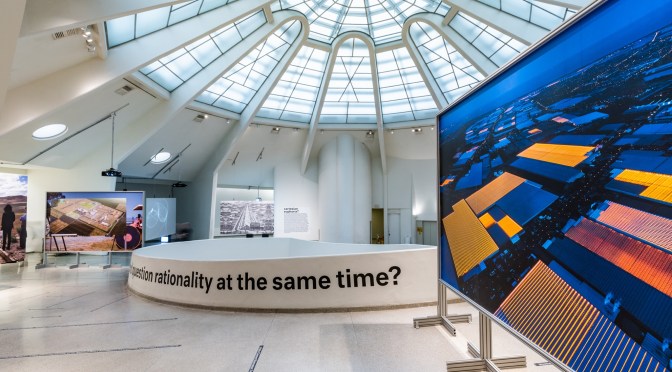
Countryside, The Future is an exhibition addressing urgent environmental, political, and socioeconomic issues through the lens of architect and urbanist Rem Koolhaas and Samir Bantal, Director of AMO, the think tank of the Office for Metropolitan Architecture (OMA).

A unique exhibition for the Guggenheim Museum, Countryside, The Future will explore radical changes in the rural, remote, and wild territories collectively identified here as “countryside,” or the 98% of the Earth’s surface not occupied by cities, with a full rotunda installation premised on original research. The project presents investigations Rem Koolhaas Architectby AMO, Koolhaas, with students at the Harvard Graduate School of Design; the Central Academy of Fine Arts, Beijing; Wageningen University, Netherlands; and the University of Nairobi. The exhibition will examine the modern conception of leisure, large-scale planning by political forces, climate change, migration, human and nonhuman ecosystems, market-driven preservation, artificial and organic coexistence, and other forms of radical experimentation that are altering landscapes across the world.

Rem Koolhaas (Rotterdam, 1944) founded OMA in 1975 together with Elia and Zoe Zenghelis and Madelon Vriesendorp. He graduated from the Architectural Association in London and in 1978 published Delirious New York: A Retroactive Manifesto for Manhattan. In 1995, his book S,M,L,XL summarized the work of OMA in “a novel about architecture”. He co-heads the work of both OMA and AMO, the research branch of OMA, operating in areas beyond the realm of architecture. His built work includes the Qatar National Library and the Qatar Foundation Headquarters (2018), Fondation Galeries Lafayette in Paris (2018), Fondazione Prada in Milan (2015/2018), Garage Museum of Contemporary Art in Moscow (2015), the headquarters for China Central Television (CCTV) in Beijing (2012), Casa da Musica in Porto (2005), Seattle Central Library (2004), and the Netherlands Embassy in Berlin (2003). Current projects include the Taipei Performing Arts Centre, a new building for Axel Springer in Berlin, and the Factory in Manchester. Koolhaas directed the 2014 Venice Architecture Biennale, is a professor at Harvard University, and is preparing a major exhibition for the Guggenheim museum to open in 2019 entitled Countryside: Future of the World.
Website

New Champagne Bars: “The Riddler” In New York City

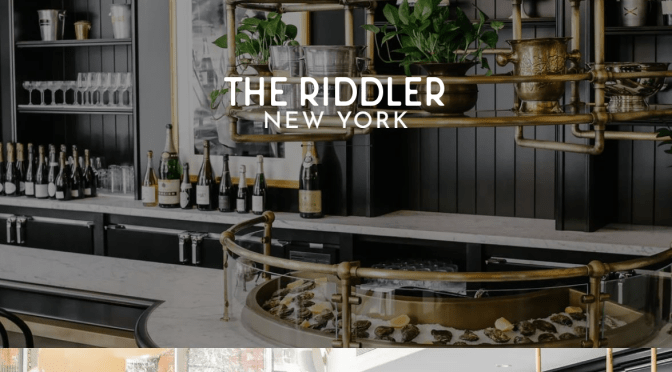
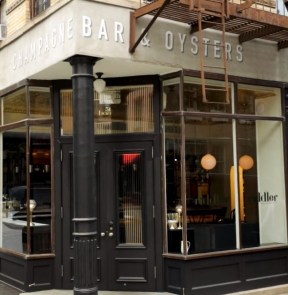
The Riddler Champagne Bar Outside New York CityA restaurant funded solely by female investors, The Riddler is a New York City champagne bar from owner Jen Pelka.
The Riddler is a Champagne bar with locations in the heart of New York’s West Village and San Francisco’s Hayes Valley. We have over 150 Champagnes by the bottle and dozens of sparkling wines by the glass to choose from: old and new, traditional classics and unusual discoveries, by the glass and by the bottle (or magnum or 9L). At the center of each space is an old wooden backbar that we’ve lined with a collection of vintage Champagne buckets and glassware that we’ve picked up at flea markets and estate sales over the last decade.

We’re a women-led team: 100% of our investors are women and most of our management team happens to be led by a crew of women. We love serious wines but don’t take ourselves too seriously: we pair our Champagne with French-inspired seasonal comforts, serve our caviar with potato chips, and offer free popcorn all day and all night.

Website

New Exhibits: “Peter Saul – Crime And Punishment” At The New Museum NYC

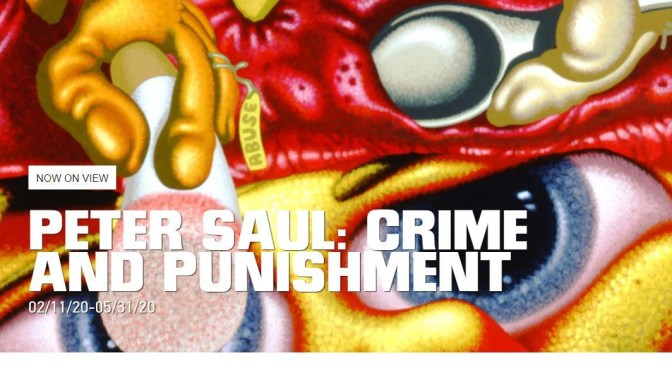
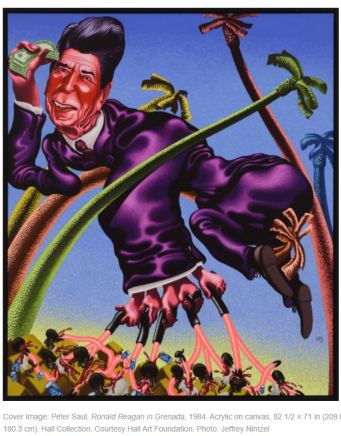
Peter Saul Ronald Reagan in Grenada 1984Beginning in the early 1960s, Peter Saul began to incorporate imagery borrowed from a range of pop-cultural sources into his exuberant, brightly colored paintings, adopting a style that has proven to be far ahead of its time. His work developed independently from concurrent art historical movements like Pop art, with which it shares some superficially similar concerns. Instead of the cool detachment of Andy Warhol and Roy Lichtenstein, however, Saul crafted his own unique blend of Surrealism, history painting, vernacular illustration, and the real-life shock and horror of current events.
Marking the artist’s first New York museum survey, this exhibition will bring together approximately sixty paintings from across his long career.

Saul’s earliest paintings, which he created in Paris, demonstrate a loose, gestural style of abstraction, yet he began to incorporate text, recognizable characters, and consumer products into his works as early as 1960. Around this time, he plucked figures like Donald Duck and Superman from the pages of comic books and deposited them into chaotic scenes representative of the avarice and violence of America. In the late 1960s and early 1970s, Saul created some of his most shocking and indelible works in response to the Vietnam War, with a series that captured the conflict’s grotesque brutality, racism, and destruction. A later group of paintings, which examines the chaotic sociopolitical fabric of urban life in California, reflects the dissolution of 1960s counterculture and the corruption, racism, and greed of US politics.

Saul extended his interrogation of American history in his portraits of infamous criminals like John Wayne Gacy, archetypes like cowboys and businessmen, and US presidents such as Ronald Reagan, George W. Bush, and Donald Trump, whom Saul depicts with disdain and condemnation. He has also looked further back to reimagine supposedly triumphant scenes from America’s past—including Columbus’s arrival in America, Washington crossing the Delaware, and Custer’s Last Stand—as moments of comical failure or disgrace. With a caustic sense of humor, Saul has continuously skewered America’s leaders, rendering their stretched, distorted bodies in Day-Glo colors. His disparate influences range from MAD magazine comics to Surrealist fantasies and American social realist painting from the 1930s.

Peter Saul is an American painter. His work has connections with Pop Art, Surrealism, and Expressionism. His early use of pop culture cartoon references in the late 1950s and very early 1960s situates him as one of the fathers of the Pop Art movement. He realised about 800 paintings during his career.

Website

New Exhibitions: Painter Andrew Wyeth (1917-2009) – The Forum Gallery NYC

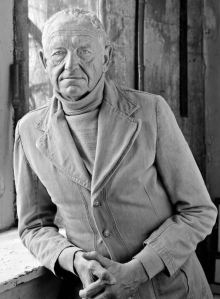
Photo of Andrew Wyeth by Peter Ralston In the Studio Courtesy of Ralston Gallery

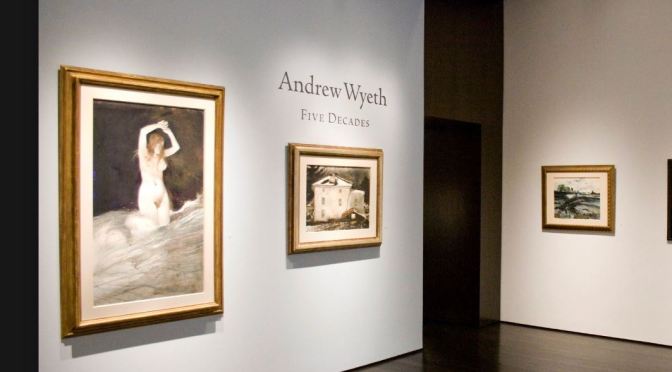
Forum Gallery, New York, presents an exhibition of works by Andrew Wyeth (1917-2009), who set the standard for American figurative art in the second half of the Twentieth Century. Working in pencil, watercolor, egg tempera and his much-beloved personal medium of drybrush, Wyeth, throughout his life, was a resolute champion of the universal life force of each person he chose to paint, and of the unique, difficult, ever-changing rural American world in which he chose to live. His art was controversial as it was popular, and he remains one of very few living artists to be celebrated by important single-person exhibitions at The Metropolitan Museum of Art in New York (1976) and the National Gallery of Art, Washington, DC (1987).

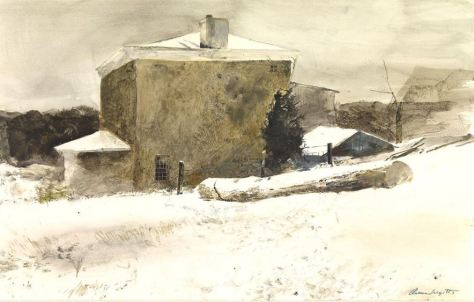
Firewood Study for Groundhog Day 1959 Andrew Wyeth
Firewood Study for Groundhog Day 1959 Andrew Wyeth (The Forum Gallery NYC)

“Andrew Wyeth: Five Decades” at Forum Gallery features paintings dated from 1940 through 1994, including landscapes that imply personal struggle and portray great beauty; and provocative figurative works, including examples from The Helga Pictures.

Forum Gallery NYC LogoWebsite


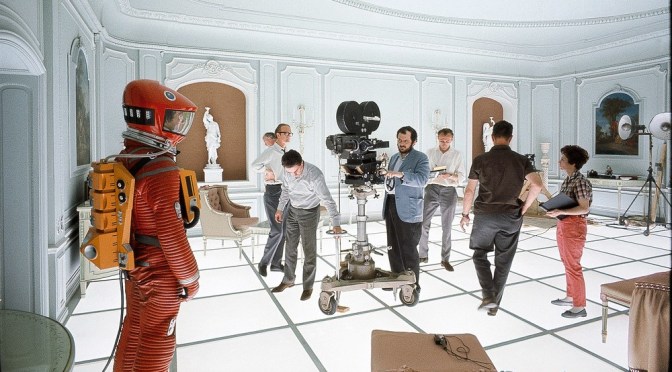
Exhibitions: “Envisioning 2001: Stanley Kubrick’s Space Odyssey” (MOMI NYC)

From a New York Times online review:

“Envisioning 2001” shows Kubrick as a director in command of all aspects of filmmaking, and it suggests that he and Clarke were no small obsessives when it came to understanding their subject matter. One of the first items in the exhibit is a request form from 1964, with Clarke’s name and address, sent to the United States Air Force. He sought information on a sighting — which turned out to be a satellite — that he and Kubrick, then developing the story for the movie, had seen in the sky over New York.

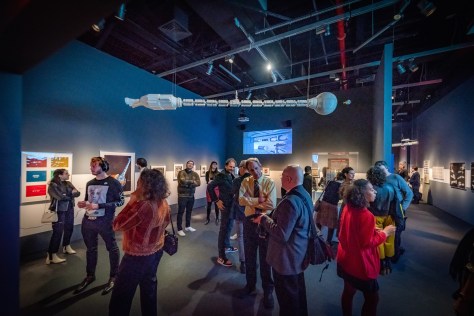
Some of the first visitors to see the exhibition Envisioning 2001 Stanley Kubrick's Space Odyssey. Photo by Thanassi Karageorgiou Nas Karas Studios Jan 16, 2020 at Museum of the Moving Image
Some of the first visitors to see the exhibition Envisioning 2001: Stanley Kubrick’s Space Odyssey. Photo by Thanassi Karageorgiou Nas Karas Studios Jan 16, 2020 at Museum of the Moving Image

As it approaches its 52nd birthday, “2001: A Space Odyssey” remains one of the most inventive and enduring of all movies. But from the vantage point of 2020, it can be difficult to appreciate the sheer breadth of imagination involved in its making.

Enter “Envisioning 2001: Stanley Kubrick’s Space Odyssey,” a new exhibit at the Museum of the Moving Image in Astoria, Queens, that runs through July 19. The show brings together original correspondence, sketches, storyboards, props, video clips and much more to illustrate how Kubrick, the film’s director, and Arthur C. Clarke, the science fiction author who collaborated with him on the screenplay, set about bringing the future to the screen.

Read full article

New Museum Openings: “Fotografiska New York” Showcasess The World’s Greatest Photographers

From a The Art Newspaper online release:

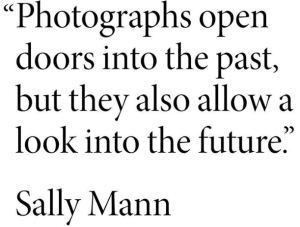
Fotografiska New York Museum Opened Dec 14 2019 Sally Mann quote“People want to see photography and right now there are not a lot of places to do that,” he says. Showing “the best photography in the world” remains Fotografiska’s core mission, Broman says.
The global expansion of Fotografiska is finally taking shape. The Stockholm-based photography hub, founded in 2010 by brothers Jan and Per Broman, will open its New York outpost on 14 December, almost two months later than previously announced.

fotografiska-new-york-museum-opening-dec-14-2019-exhibitions.jpg

https://www.fotografiska.com/nyc/

This follows a venue launched in June in Tallinn, Estonia, and anticipates the arrival in late 2020 of Fotografiska London, billed as the world’s largest photography gallery by the British Journal of Photography.

To read more: https://www.theartnewspaper.com/news/first-fotografiska-takes-manhattan

Art Criticism: “A Poet’s Response To Carpeaux’s ‘Why Born Enslaved!'” (MetCollects Video)

“It is critical to reckon with the power imbalance enacted when a white male artist transposes the body of a black woman into an emblem of enslavement.”

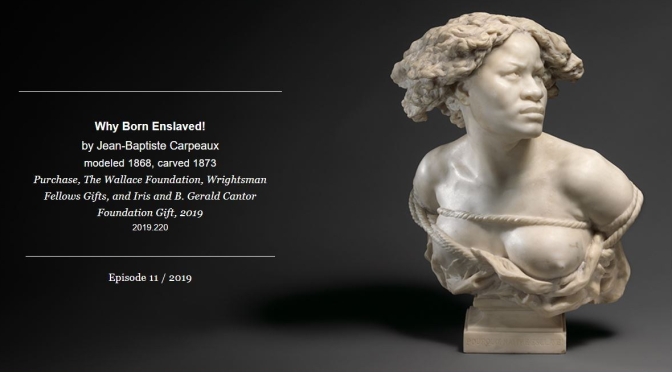
Why Born Enslaved! was first conceived in 1868 by Jean-Baptiste Carpeaux, one of the greatest French sculptors of the nineteenth century. The bust portrays a woman straining against a rope pulled taut around her arms, back, and breast. Her shoulders project forward and the right tendon of her neck protrudes as she twists her body in one direction and turns her head sharply in the other.

A poet's response to Carpeaux's Why Born Enslaved! MetCollects Video

In The Gallery by Wendy S. Walters

The figure’s defiant, uplifted gaze extends her spiraling movement and conveys her perseverance through pain as the work’s rhetorical title, inscribed on the sculpture’s base, proclaims, “Pourquoi Naitre Esclave!”

To read more: https://www.metmuseum.org/art/online-features/metcollects/why-born-enslaved

Culture: “Anger” In Society Explored By Artists And Writers (MoMA Video)


Anger. A word that often does the rounds in the 21st century. On a global scale, citizens are increasingly dissatisfied with their governments — from discord within the current American administration to rising hostility within France, Germany, Greece, Iraq, and Lebanon. Anger due to the persistence of racial violence, threats against the rights of women and workers, discrimination against the LGBTQ community, repression, as well as fear and instability surrounding health care systems, income inequality, the environmental crisis, and the effects of mass migration.

MoMA Research & Development

Join a nuanced conversation in this MoMA R&D Salon hosted by Paola Antonelli, Senior Curator of Architecture & Design and Director of Research & Development at MoMA, with speakers (in alphabetical order):

Shaun Leonardo: a multidisciplinary artist whose work discusses societal expectations of manhood––namely definitions surrounding black and brown masculinities––along with its notions of achievement, collective identity, and experience of failure.

Lydia Lunch: a writer, singer, poet, actress, and speaker whose career was spawned by the New York City “No Wave” scene. Widely considered one of the most influential performers originating from New York City, Lydia has worked with a range of bands and artists.

Andrew Marantz: a staff writer at The New Yorker, where he has worked since 2011. His work has also appeared in Harper’s, New York, and Mother Jones. He recently published his first book, Antisocial: Online Extremists, Techno-Utopians, and the Hijacking of the American Conversation.

Marilyn Minter: a contemporary artist whose works are in the collections of MoMA, the Solomon R. Guggenheim Museum in New York, the San Francisco Museum of Modern Art, and the Museum of Contemporary Art in Los Angeles, among others.

Pamela Sneed: a poet, writer, visual artist, and performer. She is the author of the books Imagine Being More Afraid of Freedom than Slavery (1998) and Kong and Other Works (2009), as well as the chapbooks Lincoln (2014), Gift (2015), and Sweet Dreams (2018).

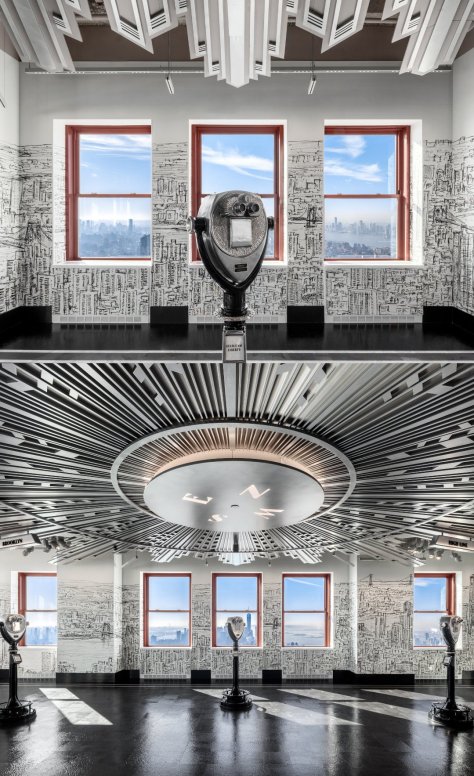
Top Travel Destinations: Photos From The New Empire State Building 80th Floor Observatory

From Empire State Building Twitter:

Our 80th Floor is officially re-opened – the final stage of our visitor experience redesign! The floor includes a special @nycgo  exhibit that will create a custom itinerary for the rest of your trip, based on questions you answer about your interests! esbo.nyc/bc1

Empire State Building 80th Floor Observatory

Metropolitan Museum: “Mechanical Marvels – Automation” From 17th & 18th Century (Videos)

The mahout (elephant keeper), the turbaned Ottoman warriors, and the crowning crescent all allude to the Eastern origins of the elephant. Within the Kunstkammer the elephant represented rulership. This automaton clock, which strikes at both the quarter hour and the hour, is driven by a movement connected to a wheel mounted on the walkway of the howdah (saddle). On the hour, the four Muslim warriors revolve around the brickwork tower. The mahout thumps his arm up and down, as though he were leading the animal, and his counterweighted eyes move back and forth as the machine travels.

Presented to Empress Maria Theresa in Vienna in 1760, this automaton was made at the height of the “century of writing.” Written communication connected scientists, dignitaries, scholars, and artists across long distances, and the act of writing was celebrated in every form. This piece is the last in a series of increasingly complicated ones that Friedrich von Knaus produced during his tenure as Austrian court machinist; he presented other examples to dignitaries such as the French king Louis XV and Duke Charles Alexander of Lorraine.

The machine writes through the hand of the small statuette seated at its top, one of the first mechanical writing figures in human form. This video shows the mechanisms inside the sphere that produce its precise movements. Up to 107 words can be preprogrammed by the arrangement of pegs on a barrel. The figure can also be set via a hand-worked control to appear to write from dictation; this technology that presaged the first typewriter.

Duke Charles Alexander of Lorraine, who bought this automaton clock in 1777, collected luxury objects made in his realm that demonstrated local technical advances. The self-moving components of this timepiece represent the height of Flemish invention in a fashionable Neoclassical style. Mechanically complex and visually impressive, this sparkling clock was a worthy addition to the duke’s collection of timepieces and scientific instruments.

This video shows the movement of the dials for hours, minutes, and seconds; days of the month; and phases of the moon, as well as that of the seven dynamic design elements. The cross-of-Lorraine pendulum swings steadily over the main dial, underneath a dancing letter M. Above the calendar dial turns a Catherine wheel, while the four dragons supporting the obelisk flap their wings and spit pearls. Another Catherine wheel spins above the moon-phase dial, and the entire obelisk is topped by a rotating planetarium. The fourth dial shows the maker’s signature.

Website: https://www.metmuseum.org/exhibitions/listings/2019/making-marvels-science-splendor