

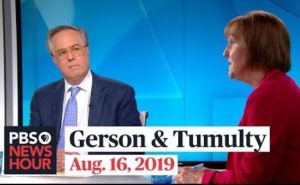
 The Washington Post’s Michael Gerson and Karen Tumulty join Amna Nawaz to discuss the latest in politics, including our analysis of upcoming 2020 Senate races and potential candidates, the controversy over Israel’s barring a visit from Reps. Omar and Tlaib, how trade tensions between the U.S. and China are affecting the economy and President Trump’s apparent interest in purchasing Greenland.
Tag Archives: News
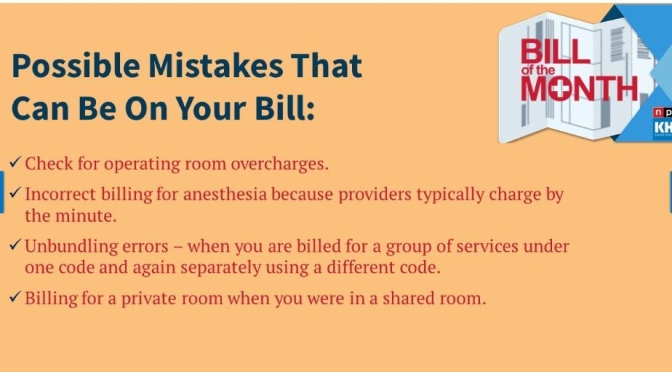
Boomers Health Tips: Kaiser Health News And NPR Team Up To Explain Confusing Medical Bills
From a Kaiser Health News article:
In 2018 Kaiser Health News and NPR teamed up to create “Bill of the Month,” a crowdsourced investigative series in which we dissect and explain medical bills you send us. We have received nearly 2,000 submissions of outrageous and confusing medical bills from across the country.

https://khn.org/news/your-go-to-guide-to-decode-medical-bills/
Each month we select one bill to thoroughly investigate, often resulting in the bill being resolved soon after the story is published. But what about the large number of Americans who receive surprise medical bills that reporters can’t examine?


Politics: Biden, Harris And Warren Lead Rivals Ahead Of 2nd Debates July 30-31
From FiveThirtyEight.com com article by Nate Silver:
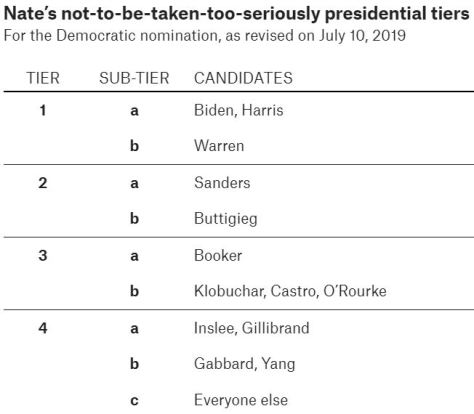
Biden, Harris and Warren represent three relatively distinct, but fairly traditional, archetypes for party nominees:
- Biden, as a former vice president, is a “next-in-line” candidate who is rather explicitly promising to perpetuate the legacy of President Obama and uphold the party’s current agenda. It might not be exciting, but these candidates have pretty good track records.
- Harris is a coalition-builder who would hope to unite the different factions of the party — black, white, left, liberal, moderate, etc. — as a consensus choice.
- Warren is offering more red meat (or should it be blue meat?) and would represent more of a leftward transformation from the status quo. But she’s simpatico enough with party elites and has broad enough appeal that she isn’t necessarily a factional candidate in the way that Sanders is. Instead, a better analogy for Warren might be Ronald Reagan; they are not comparable in terms of their backgrounds or their political styles, but they are both candidates who straddle the boundary between the ideological wings of their party and the party establishment.
Read more by clicking below:

“Live Below Your Means”: VW Beetle Ceases Production 70 Years After Coming To America
From NPR.org article by Laurel Wamsley
 An emblem of the hippie era in America, the car was marketed in the U.S. as adorably uncool. Volkswagen promoted the Beetle with cheeky advertising campaigns using slogans like “Live below your means” and “It’s ugly, but it gets you there.” In 1969, one of the vehicles cost $1,799.
It’s the end of an era — an era that has stretched on for a very long time, albeit with slightly different silhouettes.
The last Volkswagen Beetle, a third-generation Denim Blue coupe, will be produced in Puebla, Mexico, on Wednesday.
“It’s impossible to imagine where Volkswagen would be without the Beetle,” said Scott Keogh, president and CEO of Volkswagen Group of America. “While its time has come, the role it has played in the evolution of our brand will be forever cherished.”
Read more by clicking link below:

“The Mueller Report”: An Adaptation By Mark Bowden, Illustrated By Chad Hurd On Insider.com
From Insider.com (via Business Insider):
 It feels as if nobody read the Mueller report. That’s a shame, because it’s an important document, depicting possible crimes by a sitting US president.
But not reading it makes sense. As a narrative, the document is a disaster. And at 448 pages, it’s too long to grind through. For long stretches, it reads less like a story and more like a terms-of-service agreement. The instinct to click “next” is strong.
And yet, buried within the Mueller report, there is a narrative that reads in parts like a thriller, like a comedy, like a tragedy — and, most important — like an indictment. The facts are compelling, all the more so because they come not from President Donald Trump’s critics or “fake news” reports, but from Trump’s own handpicked colleagues and associates. The story just needed to be rearranged in a better form.
So we hired Mark Bowden, a journalist and author known for his brilliant works of narrative nonfiction like “Black Hawk Down,” “Killing Pablo,” and “Hue 1968.”
Read the full adaptation by clicking link below:
 Boomers Daily