

From NPR.org article by Laurel Wamsley
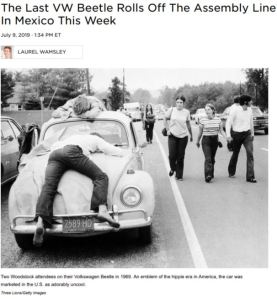 An emblem of the hippie era in America, the car was marketed in the U.S. as adorably uncool. Volkswagen promoted the Beetle with cheeky advertising campaigns using slogans like “Live below your means” and “It’s ugly, but it gets you there.” In 1969, one of the vehicles cost $1,799.
It’s the end of an era — an era that has stretched on for a very long time, albeit with slightly different silhouettes.
The last Volkswagen Beetle, a third-generation Denim Blue coupe, will be produced in Puebla, Mexico, on Wednesday.
“It’s impossible to imagine where Volkswagen would be without the Beetle,” said Scott Keogh, president and CEO of Volkswagen Group of America. “While its time has come, the role it has played in the evolution of our brand will be forever cherished.”
Read more by clicking link below:

 It feels as if nobody read the Mueller report. That’s a shame, because it’s an important document, depicting possible crimes by a sitting US president.
 Boomers Daily