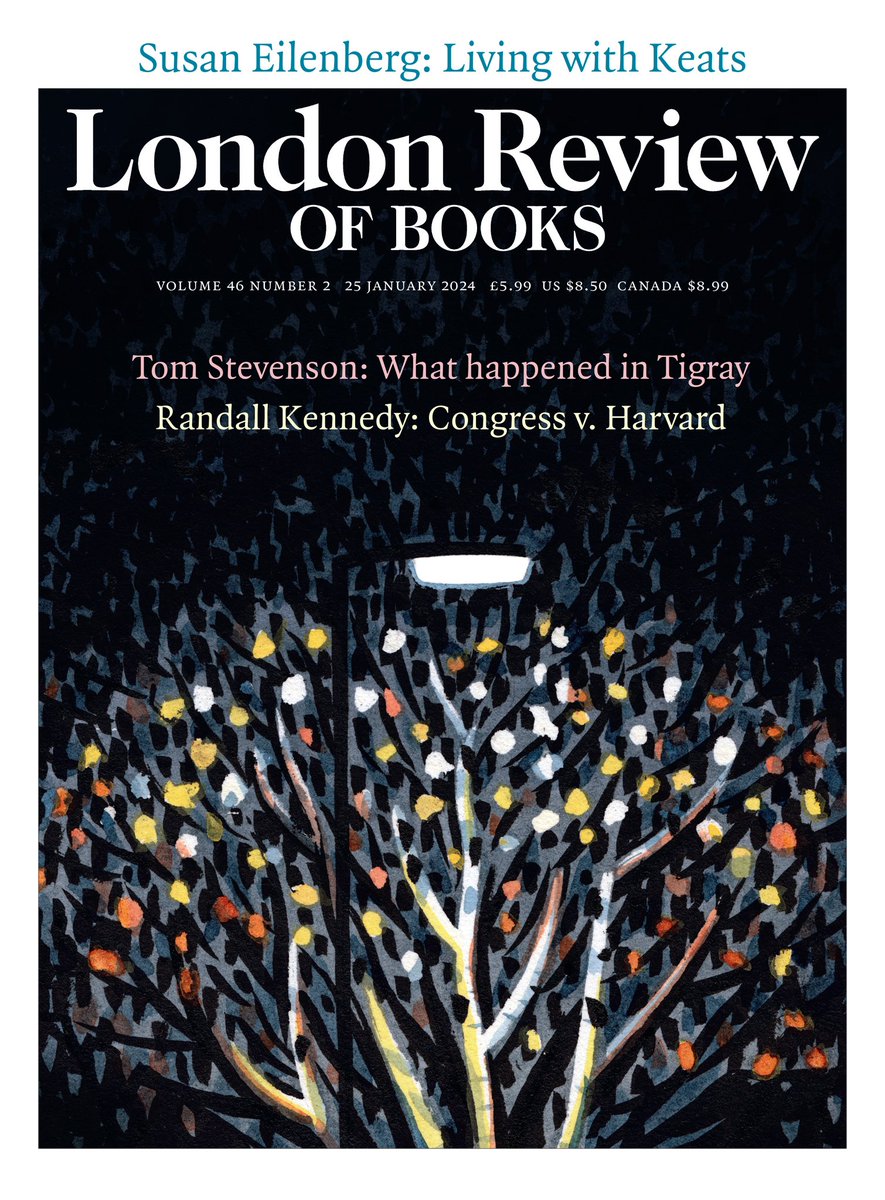
London Review of Books (LRB) – January 17, 2024: The latest issue features ‘Living With Keats’ – A Brief Life in Nine Poems and One Epitaph; Congress vs Harvard; The West’s Fight to Reverse the Russian Revolution, and more…
Looking back to September 1820, when things had gone badly wrong but not yet so grotesquely as to be visibly beyond repair, we can see how few and how poor Keats’s options were. Surely it was better that (in the absence of other volunteers) the young artist Joseph Severn agreed to travel with the dying poet to Rome that autumn than that he had refused.
Nature Magazine – January 17, 2024: The latest issue cover features the giant ape Gigantopithecus blacki, thought to be the largest primate that ever lived, which lived in China between 2 million and 300,000 years ago.
Financial Times (January 17, 2024) – In a year in which more than half the world goes to the polls, acclaimed novelist Margaret Atwood asks whether democracy is fragile and easily destroyed or flexible and resilient.
This animated monologue is the first of four films examining the state of government, representation, rights and freedom.
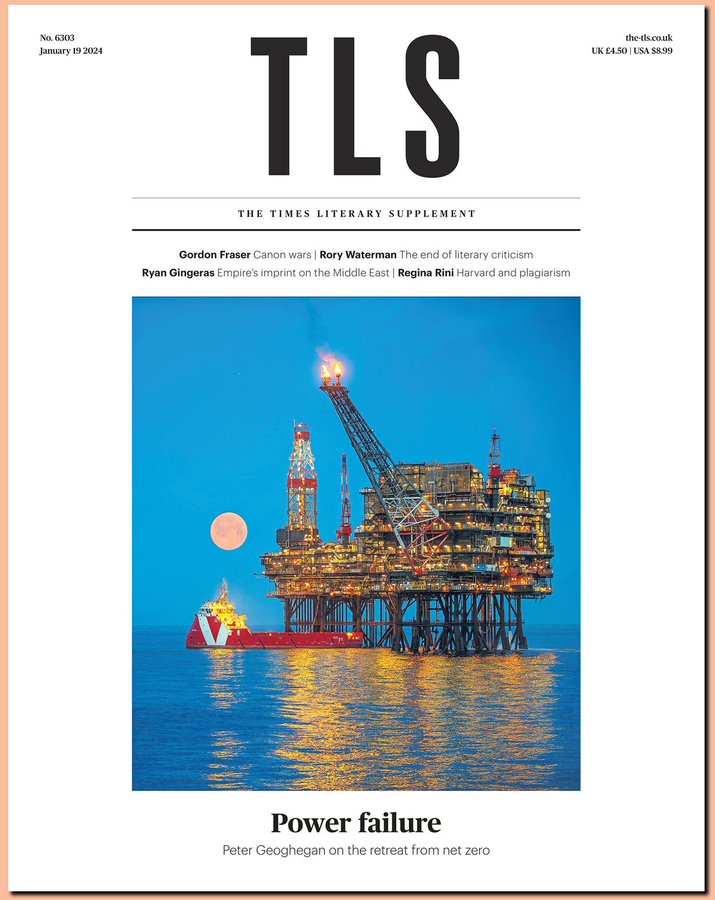
Times Literary Supplement (January 17, 2024): The latest issue features ‘Power Failure’ – The retreat from net zero; Canon wars; The end of literary criticism; Empires imprint on the Middle East; Harvard and plagarism….
Country Life Magazine – January 17, 2024: The latest issue features ‘Floral Fireworks’ – The National Collection of Dahlias; The Bridges of Britain; and the Arts-and-Crafts masterpieces of Madresfield Court, Worcestershire…
Floral fireworks
Kirsty Fergusson visits the new home of the 1,700-strong National Collection of Dahlias and reveals which blooms to order now for late-summer colour
The Bridges of Britain
Our greatest bridges span the ages and have the power to inspire both awe and admiration, as Jack Watkins discovers
Cold cures
The beautiful and practical cast-iron Victorian cloche is making a comeback. Tiffany Daneff investigates the revival of the miniature glass house
Twist and shout
Tiffany Daneff visits Morton Hall Gardens in Worcestershire to discover the secret of its owner’s intriguing new clematis-training technique
Why, why, why weigela?
New forms of this easy-to-grow garden shrub have repeating flowers in wonderful colours — no wonder they are hot sellers, suggests Charles Quest-Ritson
The American strikes destroyed four missiles that posed a threat to ships in the Red Sea, the Pentagon said. They came on the third day in a row the Houthis have defiantly fired at passing ships.
Phillips (January 16, 2024) – Curators Tony Abeyta and James Trotta-Bono explore highlights from New Terrains: Contemporary Native American Art, which they curated alongside Bruce Hartman.
The exhibition provides context for the evolution of contemporary Native art, including the influence of modernism, post-war, and pop art.
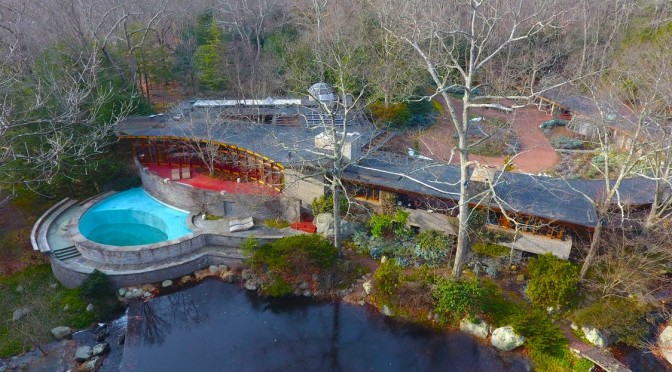
Architectural Digest (January 16, 2024) – Today AD travels to Connecticut to tour Tirranna, one of legendary architect Frank Lloyd Wright’s final designs. The Rayward–Shepherd House, also known as Tirranna and as the John L. Rayward House, is a home in New Canaan, Connecticut originally built in 1955 to an design of renowned architect Frank Lloyd Wright.
Considered one of the greatest architects of all time, Frank Lloyd Wright produced over 1000 designs in a career spanning 70 years, revolutionizing architecture in the United States.
A pioneer of organic architecture, Wright believed any building should exist in harmony with its inhabitants and surroundings–a concept that runs through the veins of Tirranna. Join Stuart Graff, president and CEO of the Frank Lloyd Wright Foundation, as he walks you through one of the final designs of Wright’s career.
The Local Project (January 16, 2024) – The Local Project’s latest house tour takes viewers inside an architect’s own cabin at Sea Ranch, a planned Californian community founded in the 1960s by architect and developer Alan Boeke.
Video timeline:00:00 – Introduction to the Architect’s Own Cabin 01:50 – The History of The Sea Ranch Community 02:19 – Unique and Special Aspects 02:35 – A Walkthrough of the Cabin 03:37 – Aligning with The Original Footprint 05:40 – The Sea Ranch Design Rules 06:50 – A Natural Material Palette 07:50 – Proud Moments
Originally designed in the 1970s by William Turnbull Jr. – one of Sea Ranch’s pioneering architects – the cabin now belongs to Berkeley-based architect Joanne Koch, who has renovated the cabin with humility and respect. Pleasingly, it still exhibits many of Sea Ranch’s defining tenets surrounding quiet and environmentally sustainable architecture, reimagined through a contemporary lens. Joanne considers herself to be a “steward and caretaker” of this historic house at Sea Ranch. Stepping inside an architect’s own cabin, it is easy to see how she has respected the original design intent by gently reimagining the architecture and interior design.
The house tour highlights various spaces inside an architect’s own cabin, such as the kitchen, bedrooms, garden, courtyard and balconies, illustrating a blend of contemporary and heritage ideals through the interior design, furniture and décor. The materials echo the cabin’s 1970s sensibility with a subtle contemporary edge, and a palette of moss green, blue and grey not only reflects the hues of the surrounding forest but complements the amber tones of the sugar pine throughout the home. The kitchen features new cabinetry and refined yet elemental fixtures to reflect the rudimentary nature of the cabin. The presence of the surrounding landscape inside an architect’s own cabin is significant. “You just have this feeling that you need to look up into the trees,” Joanne says.
Sea Ranch Forest Retreat illustrates the importance of taking an informed and intuitive approach to architecture of heritage significance. With thanks to Joanne’s sensitive response, this cabin will prevail as an important piece of modernist American architecture.
News, Views and Reviews For The Intellectually Curious








 Financial Times










 Arch
Arch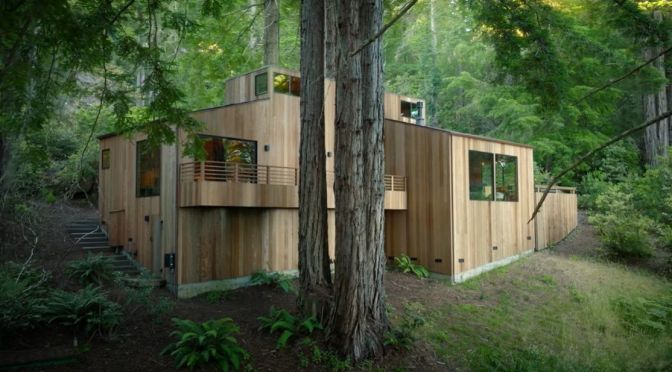

 Boomers Daily