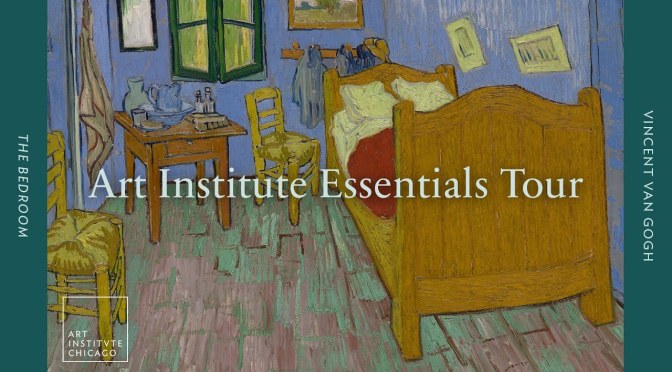
On this episode of Art Institute Essentials Tour, take a closer look at The Bedroom, painted by Vincent van Gogh in 1889. Vincent van Gogh painted three versions, including this one, of his bedroom in the “Yellow House” in Arles, France. To van Gogh, this picture symbolized relaxation and peace. However, to our eyes the canvas seems to teem with nervous energy, instability, and turmoil—an effect heightened by the sharply receding perspective.
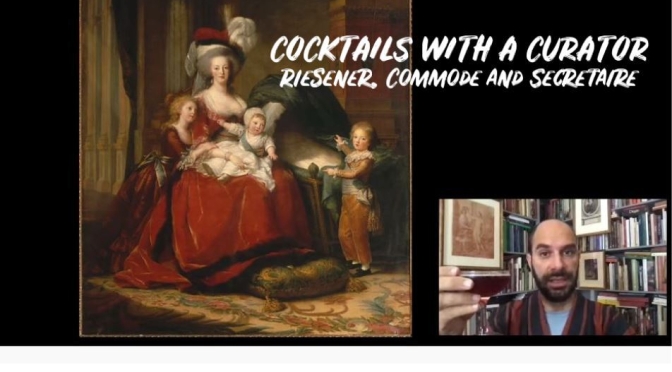
In this week’s episode of “Cocktails with a Curator,” join Deputy Director and Peter Jay Sharp Chief Curator Xavier F. Salomon as he explores the royal provenance of two pieces of furniture at the Frick made by Jean-Henri Riesener. Sometimes overlooked by visitors, Xavier encourages us to take a closer look at this exquisite commode and secrétaire set. In celebration of these works of art and the upcoming Bastille Day, this week’s complementary cocktail is the Kir Royale.
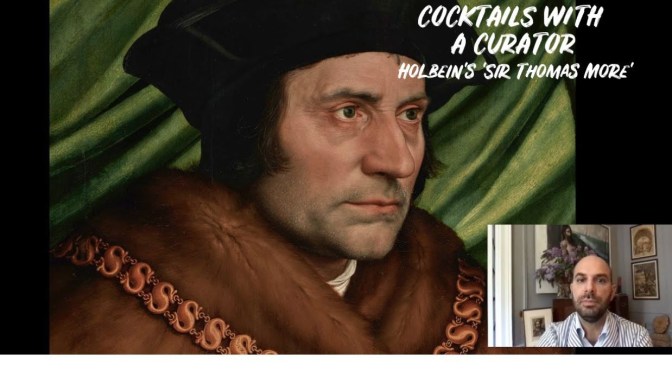
In this week’s episode of “Cocktails with a Curator,” Xavier F. Salomon, Deputy Director and Peter Jay Sharp Chief Curator, examines one of the Frick’s most beloved paintings, Hans Holbein’s “Sir Thomas More.” Xavier considers More’s relationship to humanist circles and the role of “friendship portraits” in making the absent present. In the words of More’s devoted friend, Desiderius Erasmus, “life without a friend is no life.” As a nod to the turbulent times of Tudor England, Xavier pairs this episode with a Bloody Mary cocktail.
On August 10, 1628, the Swedish warship Vasa, billed as the most advanced warship in the world, set sail on its maiden voyage from Stockholm Harbor. Within a mile, it had sunk to the bottom of the ocean. From the Series: Combat Ships: Doomed Vessels
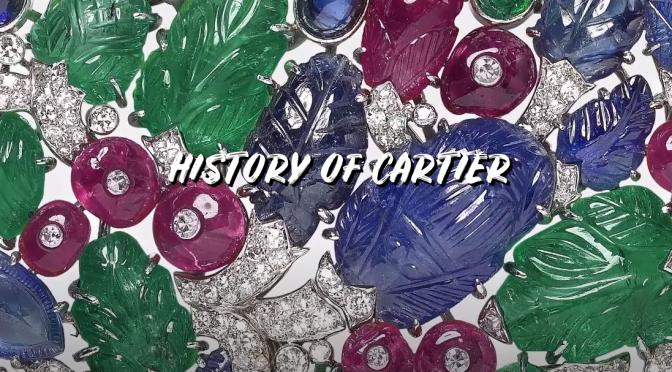
Meet Pascale Lepeu, Curator of the Cartier Collection, and see the incredible trove of historic Cartier jewellery that is held within. From elegant diamond tiaras of the Belle Époque to remarkable Art Deco tutti frutti bracelets and more, discover the enormous influence that Cartier has had on the world of high jewellery. An extract from the Christie’s Education online course, History of Jewellery Design: 1880–Now.
Valerie Hansen explores these early economic and cultural exchanges and their long-term impact in her new book “The Year 1000: When Explorers Connected the World―and Globalization Began”, which originated as a college course co-taught with Mary Miller, director of the Getty Research Institute. In this episode, Hansen and Miller discuss the state of the world around the year 1000.
From celebrated Yale professor Valerie Hansen, a groundbreaking work of history showing that bold explorations and daring trade missions connected all of the world’s great societies for the first time at the end of the first millennium.
People often believe that the years immediately prior to AD 1000 were, with just a few exceptions, lacking in any major cultural developments or geopolitical encounters, that the Europeans hadn’t yet reached North America, and that the farthest feat of sea travel was the Vikings’ invasion of Britain. But how, then, to explain the presence of blonde-haired people in Maya temple murals at Chichén Itzá, Mexico? Could it be possible that the Vikings had found their way to the Americas during the height of the Maya empire?
Valerie Hansen, an award-winning historian, argues that the year 1000 was the world’s first point of major cultural exchange and exploration. Drawing on nearly thirty years of research, she presents a compelling account of first encounters between disparate societies, which sparked conflict and collaboration eerily reminiscent of our contemporary moment.
For readers of Jared Diamond’s Guns, Germs, and Steel and Yuval Noah Harari’s Sapiens, The Year 1000 is an intellectually daring, provocative account that will make you rethink everything you thought you knew about how the modern world came to be. It will also hold up a mirror to the hopes and fears we experience today.
In this week’s episode of “Travels with a Curator,” travel with Xavier F. Salomon, Peter Jay Sharp Chief Curator, to Valenciennes, the birthplace of the Rococo painter Jean-Antoine Watteau. Delve into the historical events surrounding Watteau’s “Portal at Valenciennes” (ca. 1710–11), a scene of soldiers at rest near the ramparts of the town. Known for his depictions of garden frolics, Watteau seldom portrayed military life—“The Portal” is one of only three such paintings that survive today.
Valenciennes is a commune in the Nord department in northern France. It lies on the Scheldt river. Although the city and region experienced a steady population decline between 1975 and 1990, it has since rebounded.
A bird-monster devouring sinners, naked bodies in tantric contortions, a pair of ears brandishing a sharpened blade: with just 20 paintings and nine drawings to his name, Netherlandish visionary Hieronymus Bosch (c. 1450–1516) secured his place as a pillar of art history. To this day, the painter par excellence of hell and its demons continues to puzzle and enthrall scholars, artists, designers, and musicians alike.
.
Based on the best-selling XXL edition, which saw TASCHEN commission new and exclusive photography of details and recently restored works, this large-scale monograph presents Bosch’s complete oeuvre. Texts from art historian and Bosch expert Stefan Fischer dissect the many compelling elements that populate each scene, from hybrid creatures of man and beast to Bosch’s pictorial use of proverbs and idioms. By tying together the elusive threads of his oeuvre into one exhaustive overview, this book reveals just what it was about Bosch and his painting that proved so immensely influential.
Features:
Impeccable full-page reproductions celebrating the artist’s staggering compositional scope
Enlarged details unveiling the most intricate and bizarre scenes as much as the unsuspected technical minutiae, from subtle brush-strokes to the grain of the canvas
A fold-out spread drawn from the legendary Last Judgement
A special chapter focusing on Bosch’s most famous work, the mesmerizing and terrifying triptych The Garden of Earthly Delights
The author
Stefan Fischerstudied art history, history, and classical archaeology in Münster, Amsterdam, and Bonn. In 2009 he completed his doctoral thesis “Hieronymus Bosch: Malerei als Vision, Lehrbild und Kunstwerk.” His specialist fields are Netherlandish painting of the 15th to the 17th centuries and museology.
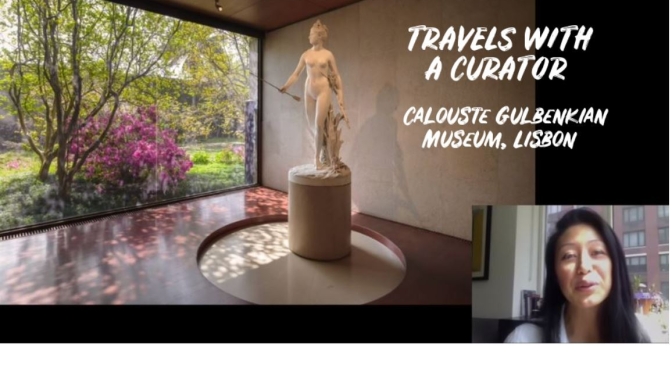
In this episode of “Travels with a Curator,” Curator Aimee Ng takes viewers on a journey to Lisbon’s Calouste Gulbenkian Museum, the home of an extraordinary private collection that, like the Frick, was made available for the enjoyment of the public after the collector’s death. This is a museum about discovery and movement, a place of marvelous encounters between the Old Masters and modernist architecture. Peek inside this spectacular museum—you may recognize a certain marble sculpture whose terracotta sister resides at the Frick.
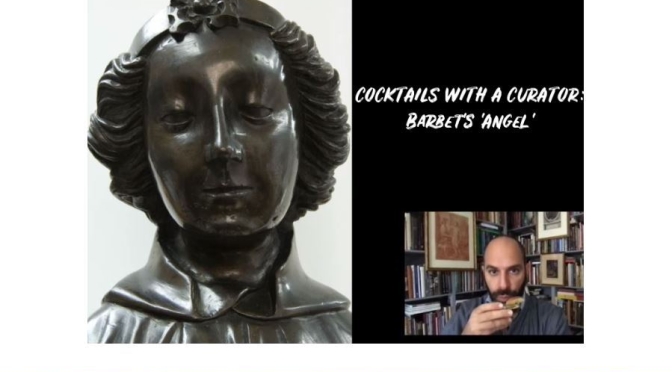
In this week’s episode of “Cocktails with a Curator,” discover the fascinating history of Jean Barbet’s Angel, an incredibly rare bronze from fifteenth-century France whose origins are shrouded in mystery. Xavier F. Salomon, Peter Jay Sharp Chief Curator, discusses the royal cannon-maker who cast the sculpture and the possibility that it once resided in Paris’s Sainte-Chapelle. This week’s complementary cocktail is the Angel Face, customarily garnished with an apple slice.


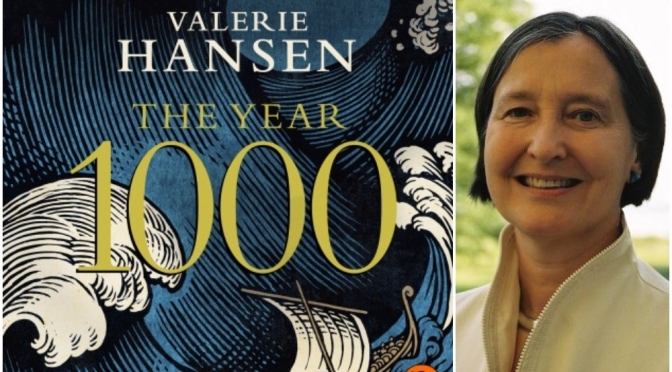
 Valerie Hansen explores these early economic and cultural exchanges and their long-term impact in her new book “The Year 1000: When Explorers Connected the World―and Globalization Began”, which originated as a college course co-taught with Mary Miller, director of the Getty Research Institute. In this episode, Hansen and Miller discuss the state of the world around the year 1000.
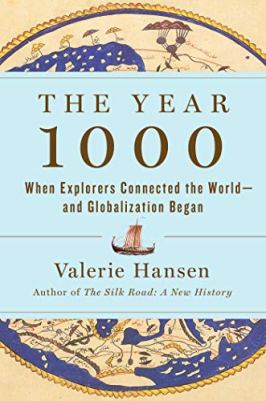 From celebrated Yale professor Valerie Hansen, a groundbreaking work of history showing that bold explorations and daring trade missions connected all of the world’s great societies for the first time at the end of the first millennium.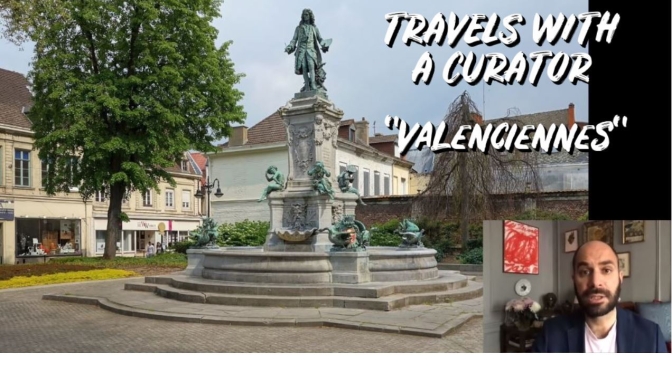
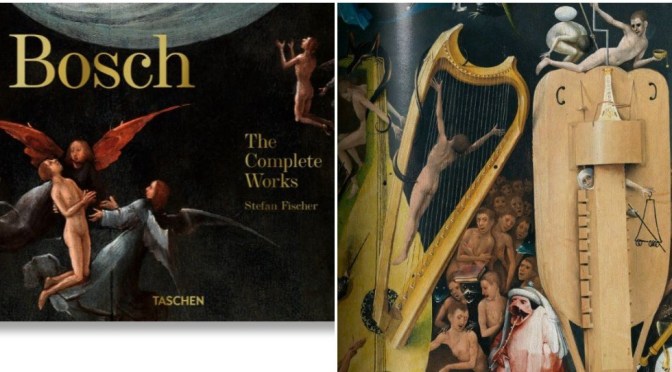
 A bird-monster devouring sinners, naked bodies in tantric contortions, a pair of ears brandishing a sharpened blade: with just 20 paintings and nine drawings to his name, Netherlandish visionary
 Boomers Daily