

The Globalist Podcast (October 27, 2023) – Can Europe’s leaders find common ground on the Israel-Gaza conflict? We discuss the European Union’s fractured approach to the Israel-Gaza conflict. Will the bloc’s leaders come to an agreement on their stance?
Plus: Chinese foreign minister Wang Yi’s visit to Washington and highlights from the Japan Mobility Show in Tokyo.
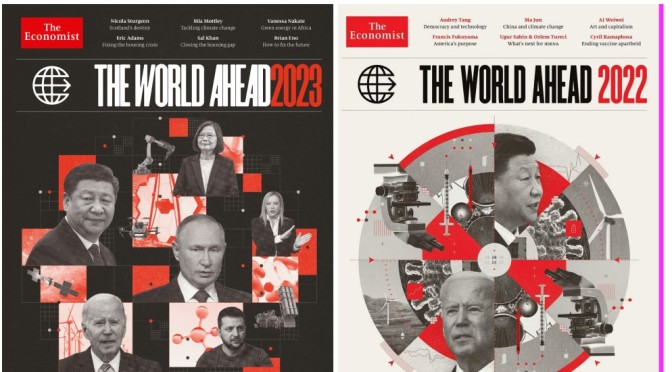
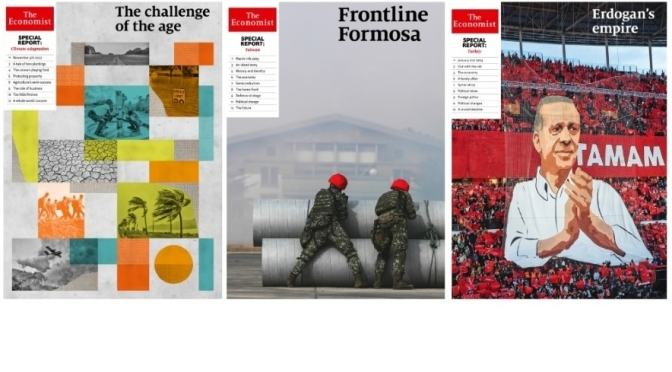
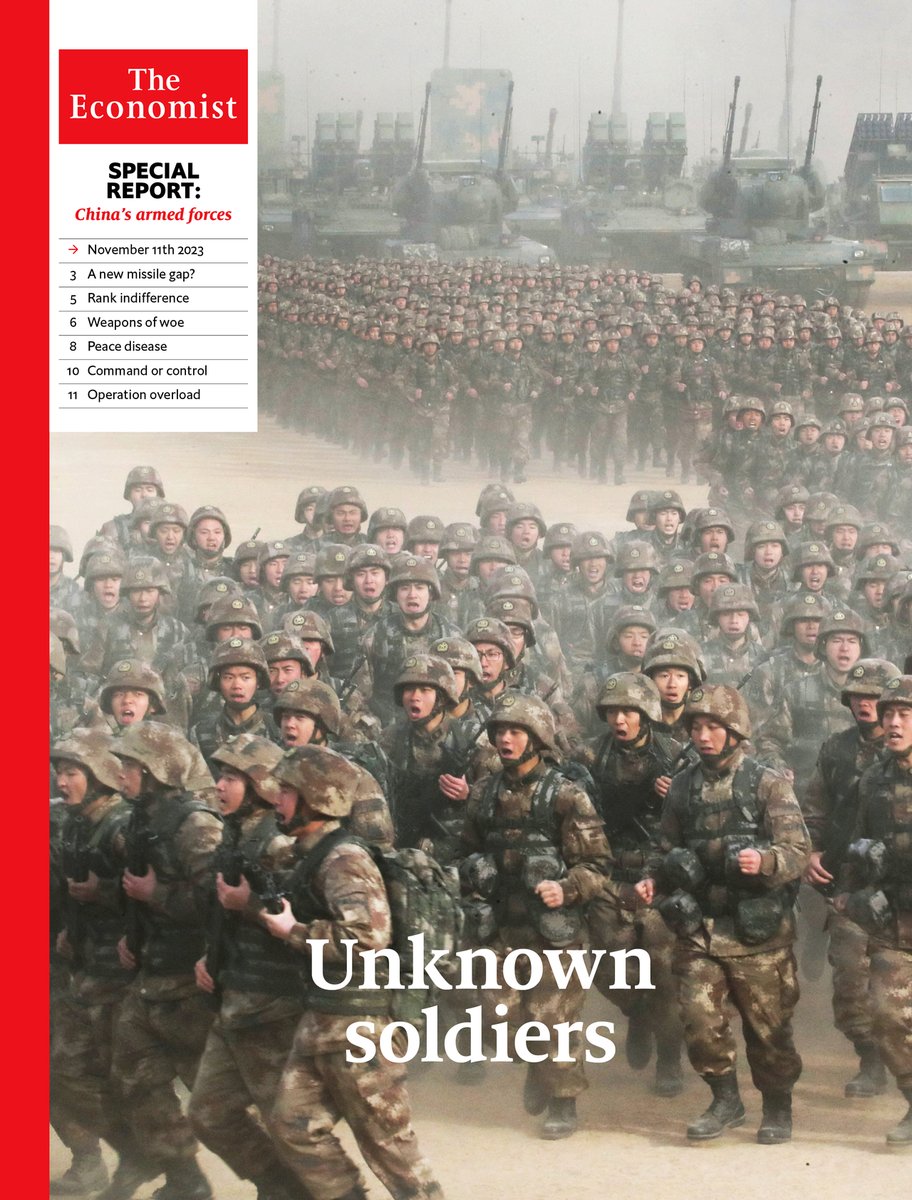
The Economist Magazine (October 28, 2023):The latest issue features America’s Test – How will it manage the Israel-Hamas war?; Argentina’s troubling election result; Should governments be ‘policing’ AI? and the ‘Art Rivalry’ between Paris and London….
Nothing in world politics is inevitable. The underlying elements of national power, such as demography, geography, and natural resources, matter, but history shows that these are not enough to determine which countries will shape the future. It is the strategic decisions countries make that matter most—how they organize themselves internally, what they invest in, whom they choose to align with and who wants to align with them, which wars they fight, which they deter, and which they avoid.
The United States now confronts graver threats to its security than it has in decades, perhaps ever. Never before has it faced four allied antagonists at the same time—Russia, China, North Korea, and Iran—whose collective nuclear arsenal could within a few years be nearly double the size of its own. Not since the Korean War has the United States had to contend with powerful military rivals in both Europe and Asia. And no one alive can remember a time when an adversary had as much economic, scientific, technological, and military power as China does today.
The New Yorker – October 30, 2023 issue: The new issue‘s cover features Mark Ulriksen’s “Spooky Spiral” – The artist discusses monsters, Halloween mishaps, and the frenzy surrounding the holiday.
Few citizens believe that China will reach the heights they once expected. “The word I use is ‘grieving,’ ” one entrepreneur said.Illustration by Xinmei Liu
Party officials are vanishing, young workers are “lying flat,” and entrepreneurs are fleeing the country. What does China’s inner turmoil mean for the world?
Twenty-five years ago, China’s writer of the moment was a man named Wang Xiaobo. Wang had endured the Cultural Revolution, but unlike most of his peers, who turned the experience into earnest tales of trauma, he was an ironist, in the vein of Kurt Vonnegut, with a piercing eye for the intrusion of politics into private life. In his novella “Golden Age,” two young lovers confess to the bourgeois crime of extramarital sex—“We committed epic friendship in the mountain, breathing wet steamy breath.” They are summoned to account for their failure of revolutionary propriety, but the local apparatchiks prove to be less interested in Marx than in the prurient details of their “epic friendship.”
The town of Spruce Pine, North Carolina, doesn’t have a lot to say for itself. Its Web site, which features a photo of a flowering tree next to a rusty bridge, notes that the town is “conveniently located between Asheville and Boone.” According to the latest census data, it has 2,332 residents and a population density of 498.1 per square mile. A recent story in the local newspaper concerned the closing of the Hardee’s on Highway 19E; this followed an incident, back in May, when a fourteen-year-old boy who’d eaten a biscuit at the restaurant began to hallucinate and had to be taken to the hospital. Without Spruce Pine, though, the global economy might well unravel.
The Economist Magazine (October 21, 2023):The latest issue features ‘Where will this end?’ – Only America can pull the Middle East back from the brink; Are American CEO’s overpaid?; The holes in export controls; Argentina’s radical option, and more….
Financial Times (October 18, 2023) – The rush back to the Moon has begun. The US and China are planning permanently crewed bases on the lunar surface. Billions of dollars in contracts are up for grabs as companies are launching ambitious new support projects, from growing food in space to a new lunar internet.
The FT’s Peggy Hollinger asks if the next great leap forward in space is a lunar economy?
The Guardian Weekly (October 13, 2023)– The new issue features Hamas militants’ devastating incursion into Israel from Gaza resulting in thousands of deaths, provoking a declaration of war and upending the fragile diplomacy of the Middle East.
The swirling composite of images on the magazine’s cover this week tries to encapsulate the human chaos and grief of civilians, both in Israel and Gaza, caught in the chaos of war. The central image shows a vast explosion filling the sky above Gaza City, an ominous portent of many violent acts still to come.
As the region faces its worst conflict for 50 years, Bethan McKernan reports from a kibbutz ransacked by militants and finds shocked residents still struggling to process events. Guardian correspondents Harriet Sherwood, Patrick Wintour and Peter Beaumont provide context and analysis, while international affairs commentator Simon Tisdall argues that the ultimate blame lies with Benjamin Netanyahu, Israel’s controversial prime minister.
Ahead of this weekend’s elections in Poland that could give the ruling nationalist Law and Justice (PiS) party an unprecedented third term in office, Shaun Walker goes on the campaign trail with Donald Tusk whose centre-right Civic Coalition is hoping to reverse the country’s slide away from democratic norms. And Brussels correspondent Lisa O’Carroll reports on the EU’s Granada summit where Hungary’s Viktor Orbán accused fellow leaders of attempting to impose a “diktat” with a proposal on a bloc-wide agreement on migration.
With global temperatures for September described as “gobsmackingly bananas” by leading climatologist Zeke Hausfather,our interview with the president of Cop28 could not be more timely. Sultan Al Jaber explains to environment editor Fiona Harvey how he believes he can square his job as the chief of the United Arab Emirates’ national oil company with leading a global conference focused on net zero carbon emissions.
4,000-year-old cuneiform tablets illuminate the personal lives of Mesopotamian businesswomen
By DURRIE BOUSCAREN
Excavations at the ancient Anatolian city of Kanesh in Turkey have revealed a district where merchants from the distant Mesopotamian city of Assur in Iraq lived and worked. Some 23,000 cuneiform tablets, mostly dating from about 1900 to 1840 B.C., have been found in the merchants’ personal archives in Kanesh.
The parents of an Assyrian woman named Zizizi were furious. Like many of their neighbors’ children, their daughter had dutifully wed an Assyrian merchant. Sometime around the year 1860 B.C., she had traveled with him to the faraway Anatolian city of Kanesh in modern-day Turkey, where he traded textiles. But her husband passed away and, instead of returning to her family, Zizizi chose to marry a local.
The New Yorker – October 16, 2023 issue: The new issue‘s cover features Yonatan Popper’s “Service Changes” – the delightful and dreadful parts of riding the subway.
On a Monday afternoon in August, when President Joe Biden was on vacation and the West Wing felt like a ghost town, his national-security adviser, Jake Sullivan, sat down to discuss America’s involvement in the war in Ukraine. Sullivan had agreed to an interview “with trepidation,” as he had told me, but now, in the White House’s Roosevelt Room, steps from the Oval Office, he seemed surprisingly relaxed for a congenital worrier. (“It’s my job to worry,” he once told an interviewer. “So I worry about literally everything.”)
China has invested heavily in an armada of far-flung fishing vessels, in part to extend its global influence. This maritime expansion has come at grave human cost.
In the past few decades, partly in an effort to project its influence abroad, China has dramatically expanded its distant-water fishing fleet. Chinese firms now own or operate terminals in ninety-five foreign ports. China estimates that it has twenty-seven hundred distant-water fishing ships, though this figure does not include vessels in contested waters; public records and satellite imaging suggest that the fleet may be closer to sixty-five hundred ships.
News, Views and Reviews For The Intellectually Curious