Tag Archives: Arts & Literature

Podcasts: Poet Jane Hirshfield & Other Writers Discuss “Memory And Forgetting” (UCSF)

Memory sits at the core of both literature and lives. Yet forgetting is also a part of our brains’ daily working, bringing its own human truths and a necessary path for moving forward. Lewis Hyde’s new _A Primer for Forgetting: Getting Past the Past_, provides inspiration for a deep-dive discussion of memory’s other side, with this august panel of writers and neuroscientists: poets Jane Hirshfield and Margaret Gibson, author Lewis Hyde, and UCSF neuroscientists Aimee Kao, Bruce Miller, and Virginia Sturm.

Co-hosted by Litquake, San Francisco’s Literary Festival

Jane Hirshfield’s ninth poetry collection, Ledger (Knopf), appears in 2020. Chancellor emerita of the Academy of American Poets and recently elected into the American Academy of Arts & Sciences, she works frequently at the intersection of poetry and science. Her work appears in The New Yorker, Atlantic, Poetry, et al.

Listen to Poet and Professor Margaret Gibson below:

Margaret Gibson, current Connecticut Poet Laureate, is the author of 12 books of poetry, including Not Hearing the Wood Thrush (2018) and Broken Cup (2014), centered on memory loss from Alzheimer’s disease and the gifts of sustaining presence through lament, acceptance, and love. She is Professor Emerita at the University of Connecticut.

Listen to author Lewis Hyde below:

Lewis Hyde’s recent book, A Primer for Forgetting (FSG, 2019), explores the many situations in which forgetfulness is more useful than memory—in myth, personal psychology, politics, art and spiritual life. A MacArthur Fellow, Hyde taught for many years at Kenyon College.

History: “Aztec Art And The Fragility Of Empire” (Art Institute Chicago)

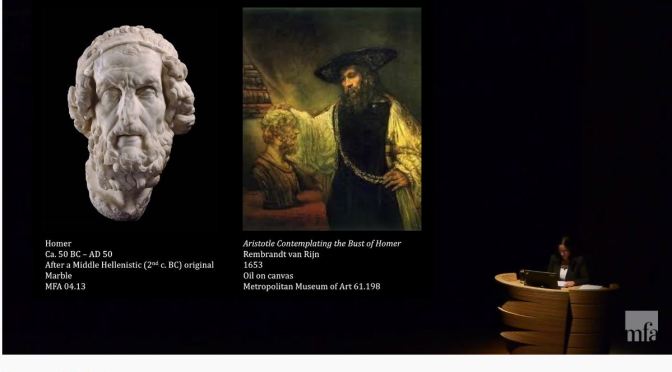
Aztec art drew on the Mesoamerican past, citing works from the ancient cities of Teotihuacan and Tula to lend authority and legitimacy to the new empire. But this engagement with the past also provoked reflection on the inevitable end of empire and the cyclicality of time, themes that resonate as the five hundredth anniversary of the Spanish invasion of Mexico unfolds this year. In this illustrated lecture, Claudia Brittenham, University of Chicago, discusses how Aztec art reflects this engagement with this historical past. This lecture delivered on October 31, 2019, was generously sponsored by the Boshell Foundation Lecture Fund.

Top Graphic Designers: 88-Year Old Seymour Chwast “The First Postmodernist”

Excerpts from The Revolutionary Seymour, By Steven Heller:

Seymour The Obsessive Images of Seymour ChwastSeymour’s art was postmodern long before the term was coined. Yet it was resolutely modern in its rejection of the nostalgic and romantic representation, as in the acolytes of Norman Rockwell, that had been popular in mainstream advertising magazines at the time. Instead of prosaic or melodramatic tableau, Seymour emphasized clever concept. What makes the very best of his art so arresting, and so identifiable, is the tenacity of his ideas—simple, complex, rational, and even absurd ideas.

Illustrator Seymour Chwast Archives

The illustrations for magazines, posters, advertisements, book jackets, record covers, product packages, and children’s books that he created after founding Push Pin Studios with Milton Glaser and Edward Sorel in 1954 directly influenced two generations (statistical fact) and indirectly inspired another two (educated conjecture) of international illustrators and designers to explore an eclectic range of stylistic an conceptual methods.

To read more: http://seymourchwastarchive.com/about/seymour/

New Museum Openings: “Fotografiska New York” Showcasess The World’s Greatest Photographers

From a The Art Newspaper online release:

Fotografiska New York Museum Opened Dec 14 2019 Sally Mann quote“People want to see photography and right now there are not a lot of places to do that,” he says. Showing “the best photography in the world” remains Fotografiska’s core mission, Broman says.

The global expansion of Fotografiska is finally taking shape. The Stockholm-based photography hub, founded in 2010 by brothers Jan and Per Broman, will open its New York outpost on 14 December, almost two months later than previously announced.

fotografiska-new-york-museum-opening-dec-14-2019-exhibitions.jpg

https://www.fotografiska.com/nyc/

This follows a venue launched in June in Tallinn, Estonia, and anticipates the arrival in late 2020 of Fotografiska London, billed as the world’s largest photography gallery by the British Journal of Photography.

To read more: https://www.theartnewspaper.com/news/first-fotografiska-takes-manhattan

Film Actor Profiles: “An Essay On (64-Year Old) Willem Dafoe’s Face…” (Gentleman’s Journal)

From a Gentleman’s Journal online article:

Willem Dafoe Gentleman's Journal photo Dec 2019Thankfully, Willem Dafoe and Willem Dafoe’s face have used this innate recognisability to their joint advantage. To date, the actor has appeared in well over 100 films, and his prolific career can be charted through the cracks and comments — some nice, some not so nice — that those in the industry have made about his looks.

In fact, in the intervening decades, Hollywood has called many, many times — as have independent filmmakers, foreign studios, animation houses, video game developers and scores of theatres. On the big screen, Dafoe has taken roles in PlatoonMississippi BurningBorn on the Fourth of JulyThe English PatientAmerican Psycho and Shadow of the Vampire. He flew into The Aviator for a cameo, swung into the Spider-Man trilogy as the villainous Green Goblin and dipped his toe in voiceover work with Finding Nemo. He’s taken on John CarterJohn Wick and narrated films from Vox Lux to The Great Wall. He’s been Oscar-nominated several times, for playing characters as wild and disparate as hammy vampires, Floridian motel managers and Vincent van Gogh. The man is a chameleon — and has managed to become one despite having Willem Dafoe’s face.

To read entire article: https://www.thegentlemansjournal.com/article/willem-dafoe-interview-face-hollywood-cover/

Art History: “Bullets And Steel” In Elizabethan Armor (Art Institute Of Chicago Video)

Jeffrey D. Wasson, the armorer who crafted the accurate replica of the Art Institute’s Greenwich armor, and Jonathan Tavares, the Art Institute’s associate curator of arms, armor and European decorative arts before 1700, discuss how utilizing experimental archaeology allowed them to uncover the methods used by Renaissance armorers in crafting the bulletproof protection.

To read more: https://www.artic.edu/events/4684/conversation-bullets-and-steelthe-making-of-elizabethan-armor-2

New Museums: “Academy Museum Of Motion Pictures” By Architect Renzo Piano (Opens 2020)

From the Renzo Piano Building Workshop website:

Academy Museum Renzo Piano Architect“The Academy Museum gives us the opportunity to honor the past while creating a building for the future—in fact, for the possibility of many futures. The historic Saban Building is a wonderful example of Streamline Moderne style, which preserves the way people envisioned the future in 1939. The new structure, the Sphere Building, is a form that seems to lift off the ground into the perpetual, imaginary voyage through space and time that is moviegoing. By connecting these two experiences we create something that is itself like a movie. You go from sequence to sequence, from the exhibition galleries to the film theater and the terrace, with everything blending into one experience.”

Renzo Piano, Architect

When it opens in the heart of Los Angeles, at the intersection of Wilshire Boulevard and Fairfax Avenue, the Academy Museum of Motion Pictures will be the world’s premier movie museum.

Academy Museum Renzo Piano Architect

Academy Museum Renzo Piano ArchitectSituated on the famed “Miracle Mile,” the museum will preserve and breathe new life into the former 1939 May Company department store, now re-named the Saban Building. Celebrating its history and imagining new possibilities, the additions to the building that date from 1946 have been removed and replaced with a spherical building that features the 1,000-seat David Geffen Theater and the Dolby Family Terrace with views towards Hollywood. The revitalized campus will feature more than 50,000 square feet of gallery space, two theaters, cutting-edge project spaces, an outdoor piazza, the rooftop terrace, an active education studio, a restaurant, and store.

https://www.academymuseum.org/en/

To read and see more: http://www.rpbw.com/project/academy-museum-of-motion-pictures