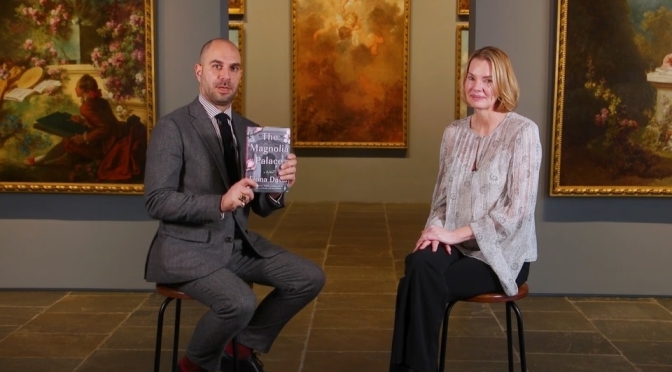
What was Jasper Johns’s reaction to seeing Paul Cézanne’s The Large Bathers? Curator Carlos Basualdo recalls standing in front of the painting and Johns’s fascination with the finished and unfinished aspects of the artwork.
Even if you don’t know the name, chances are you’ve seen a reproduction of one of his prints. What is it about his work that has made it last? Through paintings, drawings, prints, and letters, our exhibition ‘Dürer’s Journeys: Travels of a Renaissance Artist’ brings to life this art history megastar and the people and places he visited.
“I think it just shows very well how Rubens worked, how he got the inspiration from antiquity, but he transforms it into something completely new and very alive.”
The Flemish Baroque painter Peter Paul Rubens is most famous for his dynamic, colorful renderings of religious scenes and mythological stories. Yet Rubens’s work was also deeply inspired by the art of the past. He was a keen student of classical antiquity, engaging with ancient sculptures, coins, gems, and cameos both at home and in his travels through Italy. His friendships with antiquarians, patrons, and scholars provided a network for vibrant intellectual exchanges that informed the artist’s work.
In this episode, Getty curators Anne T. Woollett, Davide Gasparotto, and Jeffrey Spier discuss their exhibition Rubens: Picturing Antiquity, which explores how Rubens was affected by and, in turn, transformed the classical past in his paintings, drawings, and designs. The exhibition, which received major support from Jo Carole and Ronald S. Lauder and generous support from the Leonetti/O’Connell Family Foundation, is on view at the Getty Villa through January 24, 2022.
An interview with Howardena Pindell + Gainsborough’s Blue Boy and friends +The Humboldt Forum finally opens + Medieval Christian art in Georgia + Plus: Kazakh gold in Cambridge, Dürer’s wanderlust, rocks that look good enough to eat – and are New Towns old hat?
Building on the Morgan’s tradition of presenting to the American public distinguished works from outstanding institutions abroad, Van Eyck to Mondrian: 300 Years of Collecting in Dresden focuses on the exceptional drawing collection of the Kupferstich-Kabinett, Dresden.
Established by Augustus II the Strong, Elector of Saxony, in 1720, the museum is one of the oldest and finest depositories of works on paper in the world. The exhibition celebrates pivotal moments and key traditions in the history of European draftsmanship. Most remarkably, it will feature Jan van Eyck’s Portrait of an Elderly Man (ca. 1435–40)—an exceptionally rare drawing by the great Netherlandish Renaissance painter, which has never before traveled to the United States.
The Kupferstich-Kabinett’s strength in Northern Renaissance and Baroque drawings will be further showcased through works by Lucas Cranach the Elder, Hans Holbein the Younger, Rembrandt, and Rubens, while the museum’s rich holdings of Southern European works will be represented by Correggio, Bronzino, Sofonisba Anguissola, and others.
Among works produced in the nineteenth and twentieth centuries, highlights include studies by Caspar David Friedrich, Goya, Käthe Kollwitz, Gustav Klimt, Otto Dix, and Piet Mondrian.
Our Conservation Fellow, Kendall Francis takes a closer look at indigo, a blue dye and pigment extracted from the leaves of plants, and how it is used and represented in paintings in our collection.
Kendall’s research reveals histories that are not explicitly portrayed in the paintings and highlights the important contributions from a wider range of people, including the enslaved people who cultivated the crops and extracted the indigo against their will. Supported using public funding by Arts Council England.
🐳 🖼 On today’s podcast @philipwhale joins Adam Biles to discuss Albert & the Whale, his extraordinary exploration of the work of Albrecht Dürer. Search “Shakespeare and Company” in your podcast app or click here: https://t.co/PwrovM8BnF 🖼 🐳 pic.twitter.com/oNRo9Q5cAg
“The Cloisters, also known as the Met Cloisters, is a museum in Fort Tryon Park in Washington Heights, Manhattan, New York City, specializing in European medieval art and architecture, with a focus on the Romanesque and Gothic periods. Governed by the Metropolitan Museum of Art, it contains a large collection of medieval artworks shown in the architectural settings of French monasteries and abbeys…..”
'An unmissable testament to creativity' ★★★★★ The Guardian #LifeBetweenIslands is open now at Tate Britain! 📢 This landmark show celebrates 70 years of Caribbean-British art through over 40 artists. Book your tickets today: https://t.co/bZZxLWkfkhpic.twitter.com/rs2ndnhD5R