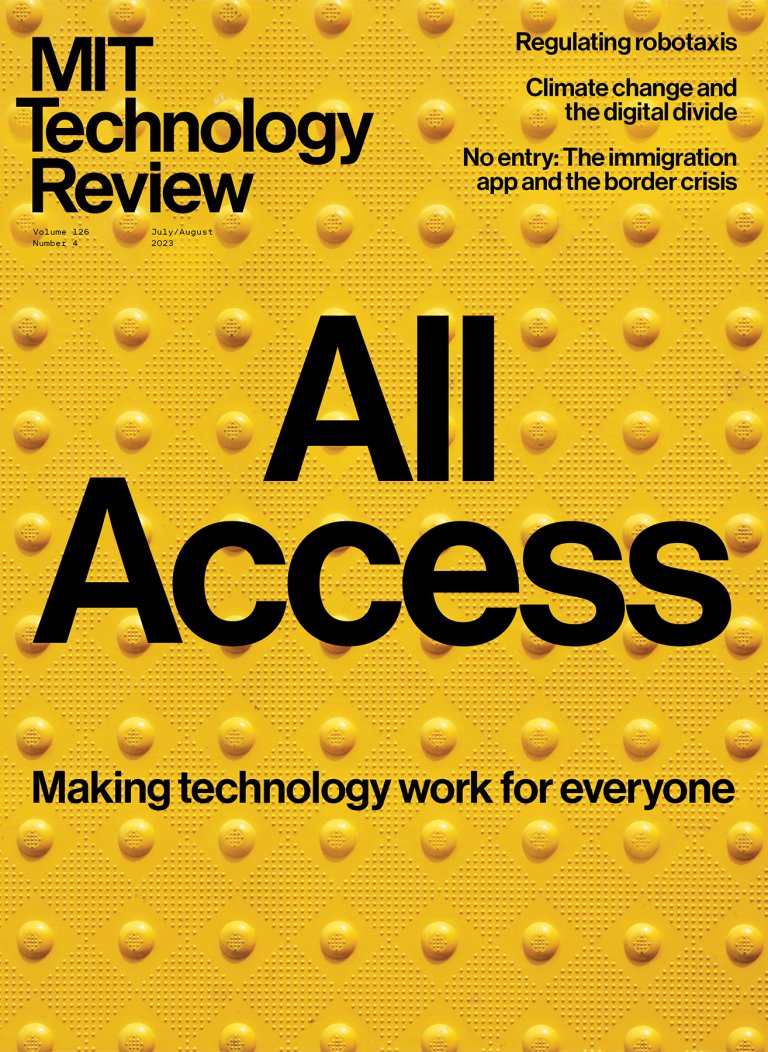
MIT Technology Review – July/August 2023: ‘The Accessibility issue’ features Connecting climate change and the digital divide. A blind educator working to make images accessible to everyone. How the app meant to streamline immigration at the border may be making things worse. Plus regulating robotaxis, Metaverse attorneys, and the forgotten history of highway photologs.
We need to take steps toward a more inclusive future—one that we all can inhabit.
“Technology,” wrote the late historian of technology Melvin Kranzberg Jr., “is neither good nor bad, nor is it neutral.” It’s an observation that often doesn’t stick with people as they think about technologies related to accessibility.
For people who can’t speak, there has been depressingly little innovation in technology that helps them communicate.
A piece of hardware, however impressively designed and engineered, is only as valuable as what a person can do with it. After the iPad’s release, the flood of new, easy-to-use AAC apps that LoStracco, Shevchenko, and their clients wanted never came.
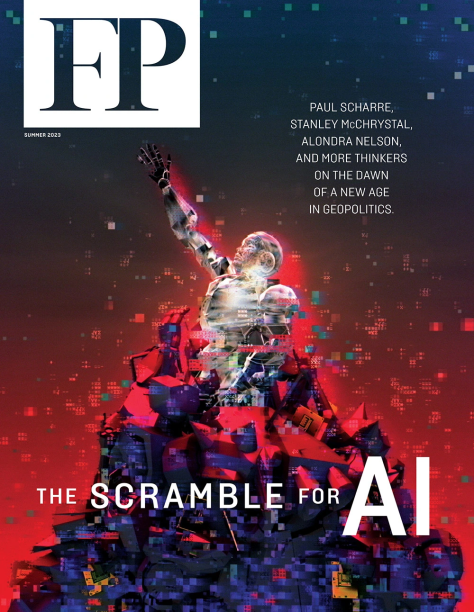
Foreign Policy Magazine – Summer 2023: Artificial intelligence is suddenly everywhere. It seems as though no conversation about jobs, education, health care, technology, or politics happens without an inevitable question about how AI could disrupt it all.
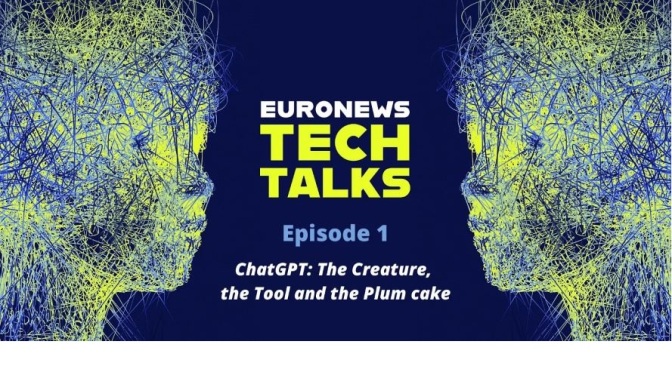
euronews (June 15, 2023) – What does it mean to be human? An age-old philosophical question, thrown into the spotlight by the rise of #AI, which has managed to pass the sentience test created by Alan Turing.
In this first episode of Euronews Tech Talks, an Italian programmer delegates code-writing, a French artist reinvents her practice, a Cypriot student brainstorms, and a German teacher ignites minds.
Released a mere six months ago in November, ChatGPT has already become the fastest-growing consumer application. With this rapid growth, how is AI affecting life across Europe?
The education system is scrambling to catch up with #AI, but it’s not all doom and gloom for teachers. Dr. @sabinehauert and Dr. Matthew Glanville tell us about the benefits of this technology in the classroom, and how it can help diverse learners achieve their goals
Harvard Business Review (June 12, 2023) – Gen AI and the New Age of Human Creativity: How revolutionary technology can enhance, rather than replace, our powers of imagination.
There is tremendous apprehension about the potential of generative AI—technologies that can create new content such as audio, text, images, and video—to replace people in many jobs. But one of the biggest opportunities generative AI offers to businesses and governments is to augment human creativity and overcome the challenges of democratizing innovation.
Having studied TV signals in East Germany from the 1960s to 1989 and rates of entrepreneurship there after German reunification, the researchers found that people in households with access to West German broadcasts were more likely than other East Germans to launch companies later in life.
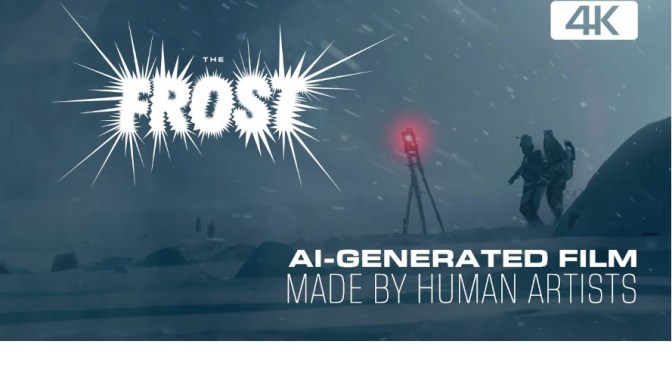
The Frost is a 12-minute movie in which every shot is generated by an image-making AI. It’s one of the most impressive—and bizarre—examples yet of this strange new genre. You can watch the film below in an exclusive reveal from MIT Technology Review.
MIT Technology Review (June 2023) – The Frost nails its uncanny, disconcerting vibe in its first few shots. Vast icy mountains, a makeshift camp of military-style tents, a group of people huddled around a fire, barking dogs. It’s familiar stuff, yet weird enough to plant a growing seed of dread. There’s something wrong here.
“Pass me the tail,” someone says. Cut to a close-up of a man by the fire gnawing on a pink piece of jerky. It’s grotesque. The way his lips are moving isn’t quite right. For a beat it looks as if he’s chewing on his own frozen tongue.
Welcome to the unsettling world of AI moviemaking. “We kind of hit a point where we just stopped fighting the desire for photographic accuracy and started leaning into the weirdness that is DALL-E,” says Stephen Parker at Waymark, the Detroit-based video creation company behind The Frost.
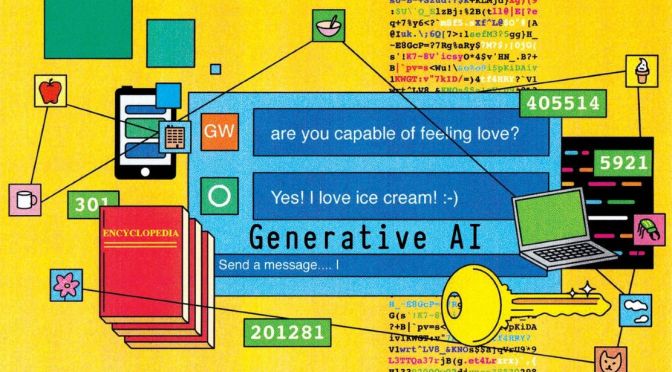
The Economist (May 18, 2023) – Generative AI is the technology behind the wave of new online tools used by millions around the world. As the technology is ever more widely deployed, what are its current strengths and its weaknesses?
Video timeline:00:00 – What is generative AI? 00:46 – Breakthroughs and take-up of the technology 02:03 – Strengths 03:32 – Weaknesses
World Economic Forum (May 27, 2023) – This week’s top stories of the week include:
0:15Why we need to consider AI development – Berkeley professor Stuart Russell is one of the world’s leading experts on AI, and one of more than 1,000 experts who recently signed an open letter calling for a 6-month pause in the development of AI systems for safety reasons. “I think there’s a lot of misunderstanding about the letter. Some people say it bans AI research and so on but what it really is saying is: we have developed this technology that’s pretty powerful, but we haven’t developed the regulation to go along with it. At the moment, the technology is moving very fast. Governments tend to move very slowly. So we need a pause on the development and release of still more powerful models so that, in a sense, regulation can catch up.”
5:43Germany’s first 3D printed house – It took just 100 hours to print the walls thanks to a nozzle that moves at 1 metre per second. The fireplace, kitchen island and bathtub were all printed too. The house contains 160m2 of living space over 2 floors. It was designed by architects Mense Korte. Its walls are comprised of an inner and outer shell with insulation filling the gap between them.
7:11Ocean search for 100,000 species begins – They’re launching dozens of explorations deep into the ocean to build a huge catalogue of as-yet-unknown marine life. An estimated 2.2 million species live in the ocean but just 10% of them have been discovered and named by scientists. It’s a race against time to document endangered marine animals before overfishing and climate change drive them to extinction.
8:56How kids learn through play – These 3 to 5-year-olds are taking part in a programme called Play Labs. They spend their day on puzzles. Games outside playing with others and learning about the world. The programme boosts kids’ physical, social, cognitive and language development and helps them close the education gap with their peers.
_____________________________________________
The World Economic Forum is the International Organization for Public-Private Cooperation. The Forum engages the foremost political, business, cultural and other leaders of society to shape global, regional and industry agendas. We believe that progress happens by bringing together people from all walks of life who have the drive and the influence to make positive change.
The Art Newspaper May 11, 2023: This week: the Sudan crisis. How are artists responding to another war in the East African country?
The photographer Ala Kheir joins us from Khartoum to tell us about the conflict in Sudan and how it is affecting him and other artists. We talk to Alyce Mahon, the co-curator of Sade: Freedom or Evil, a new exhibition at the Centre Cultura Contemporània de Barcelona (CCCB) in Barcelona about the 18th-century writer and libertine the Marquis de Sade and his artistic and literary influence, particularly in the 20th and 21st centuries.
And this episode’s Work of the Week is Gwen John’s La Chambre sur la Cour (1907-08), a painting of John herself in a Parisian interior. The picture is one of the highlights of an exhibition dedicated to John at the Pallant House Gallery in Chichester, UK.Ala Kheir on Instagram @ala.kheir.Sade: Freedom or Evil, Centre Cultura Contemporània de Barcelona, until 15 October.
Alyce Mahon, The Marquis de Sade and the Avant-Garde, Princeton University Press, $47/£40.Gwen John: Art and Life in London and Paris, Pallant House Gallery, Chichester, 13 May-8 October. Alicia Foster, Gwen John: Art and Life in London and Paris, Thames and Hudson, $39.95/£30. Out now in UK, published in the US on 18 July.
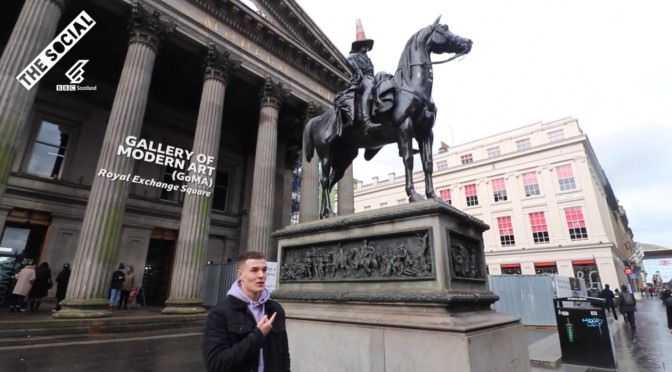
BBC Scotland (May 6, 2023) – Which source provides the most trustworthy tips on Glasgow’s attractions – artificial intelligence or the humans who live there? Craig Ferguson puts both options to the test.
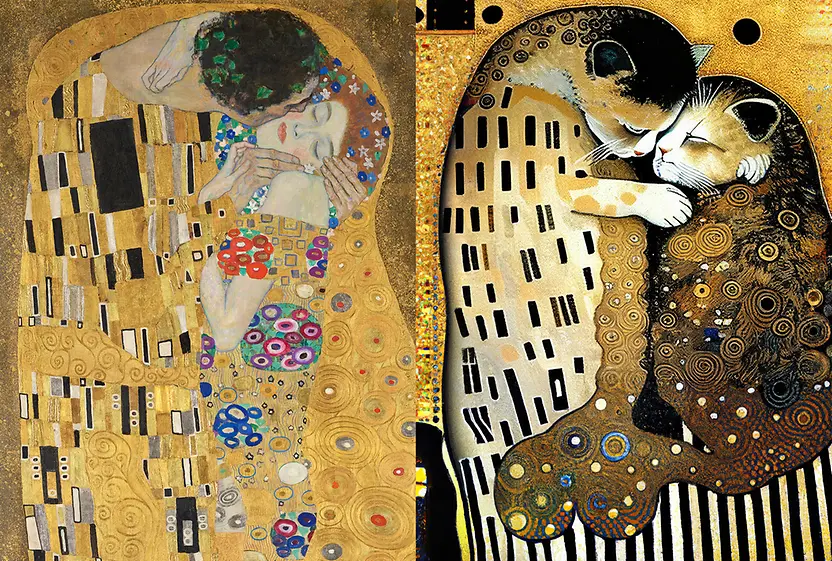
Vienna Channel (May 5, 2023) – Art expert Markus Hübl takes you to the Upper Belvedere, the Kunsthistorisches Museum and the Leopold Museum. He analyzes some of the world’s most famous artworks as well as AI pictures with cats that clearly were inspired by those masterpieces.
Video timeline:00:16 Upper Belvedere: The Kiss (Lovers) by Gustav Klimt, 1907–1908 01:33 Kunsthistorisches Museum Vienna: Tower of Babel by Pieter Bruegel, 1563 02:33 Leopold Museum: Self-Portrait with Chinese Lantern Plant by Egon Schiele, 1912



 euronews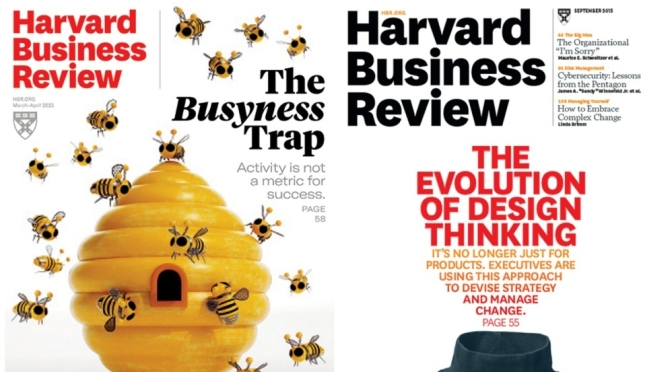

 Harvard Business Review

 The Economist



 Boomers Daily