Category Archives: Urban Planning

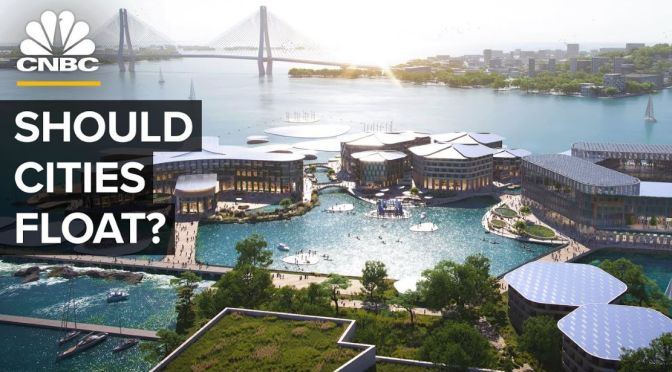
Urban Planning: Will The Cities Of The Future Float?

A new industry of floating infrastructure is emerging to help adapt to rising sea levels. There are two distinct approaches that are being put forth as possible solutions: retrofitting homes to be amphibious and building floating cities.

Amphibious homes can preserve the accessibility of the house and maintain the congenial front porch culture in places like Louisiana, said Elizabeth English, founder and director of The Buoyant Foundation Project. English’s design places a steel frame beneath a house, and then below that, in the crawl space, buoyancy elements. Her team then recommends adding elements to prevent lateral movement so the home will not float away while on the surface of floodwaters.

She estimated that a contractor could do such a retrofit for about $20 to $30 per square foot, but cautioned the Federal Emergency Management Agency currently discourages this type of building practice. Modern floating cities are the brainchild of architect Bjarke Ingels. He told CNBC he hopes his Oceanix City, which is currently slated to be built in the harbor near Busan,

South Korea, will be “a city that is the most resilient city you can imagine, but at the same time, the most enjoyable city that you can imagine.” “We really hope that it will be a successful project and we would like to replicate it in other parts of the world,” Maimunah Mohd Sharif, executive director of the United Nations Human Settlements Programme, told CNBC of the Oceanix development.

She said the world must look more into adaptation and hopes that the project can help mitigate or even solve the problem of sea-level rise. Would you live in a floating city or retrofit your home so it floats during floods? Watch the video above to learn more about what life could be like in these innovative climate change adaptations.

Reviews: The Top 12 Biking Cities In The U.S. & Canada

Cities in Europe, particularly the Netherlands, are known for their amazing bicycle infrastructure. Can a city in the top one percent of all bike cities in the United States compete with the best in Europe? And how much better are these top US bike cities when compared to the worst in the US?

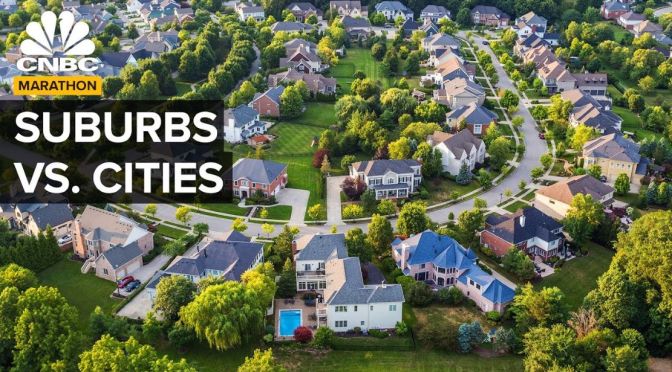
Economic Analysis: Are Cities Or Suburbs Better?

CNBC Marathon reviews why a cost-of-living crisis is unfolding across America’s housing infrastructure. CNBC explores what that means for apartments in the cities and houses in the suburbs. Inflation data shows that costs for items such as rent and groceries are increasing quickly across the Sun Belt and coastal cities.

Chapters: 00:00 Introduction 00:39 How to make the suburbs more affordable (Published April. 2022) 13:22 How suburban sprawl shapes the U.S. economy (Published Feb. 2022) 26:34 Are major cities still worth it? (Published May 2022)

Now years removed from the darkest days of the pandemic, people are asking: Is a return to the city worth it? Metropolitan regions have sprawled in recent years, raising budget concerns and quality-of-life issues for the people who remain downtown. Meanwhile the absence of commuters is slowing the recovery in leisure and hospitality. About 46% of renters in the U.S. are struggling to make ends meet, according to Harvard University researchers.

Builders say conditions for renters will get worse before they get better. A snarled supply chain, a labor shortage, and rising interest rates are worsening what some call a “throwaway” development pattern. Several real estate industry experts have ideas about how to make housing more attainable. Some of the most popular ideas include mixed-use districts and master-planned communities.

America’s suburbs are sprawling again. Over the 20th century, real estate developers built large tracts of single-family homes outside of major cities. The builders were following mortgage underwriting standards first introduced by the Federal Housing Administration in the 1930s. Over the century, those guidelines created housing market conditions that explicitly shut out many minorities. Experts say it is possible to update these old building codes to create equity while fixing some, but not all of the problems of American suburbia. CNBC Marathon brings together the best of CNBC’s coverage on the U.S. housing crisis and how life in the suburbs impacts city living.

Cover: The Architectural Review – September 2022

xindex-magazines-1494-1600x1066.jpg

AR September 2022

As students all over the world head back to school this month, this issue maps the different sites for learning – both inside and outside academic institutions. From rainforests to classrooms to disused water basins, spaces for education come in all different forms, but face similar challenges and are subjected to the same damaging forces: of marketisation, racism and colonialism, and asymmetries of power. Architecture schools are no exception, as this issue lays bare.

Wolff Architects | Alison Brooks Architects | Feilden Fowles| Níall McLaughlin Architects | Wright & Wright | Henley Halebrown | Comunal | Raumlabor | Joar Nango | bell hooks

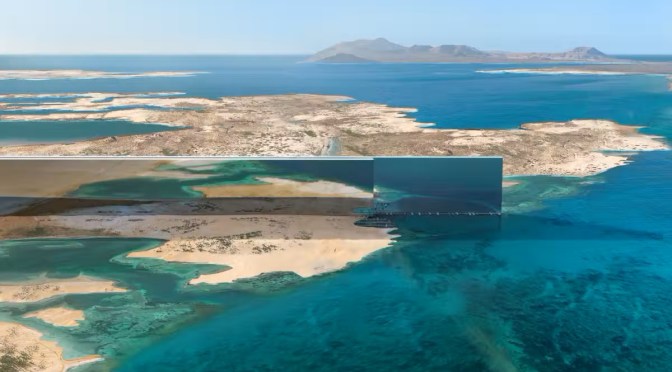
Design: ‘The Line’ – A 100% Renewable Energy & Low Carbon Saudi Arabia City

No roads, cars or emissions, it will run on 100% renewable energy and 95% of land will be preserved for nature. People’s health and wellbeing will be prioritized over transportation and infrastructure, unlike traditional cities. Only 200 meters wide, but 170 kilometers long and 500 meters above sea level.

THE LINE will eventually accommodate 9 million people and will be built on a footprint of just 34 square kilometers. This will mean a reduced infrastructure footprint, creating never-before-seen efficiencies in city functions. The ideal climate all-year-round will ensure that residents can enjoy the surrounding nature. Residents will also have access to all facilities within a five-minute walk, in addition to high-speed rail – with an end-to-end transit of 20 minutes.

Preview: Architectural Review – July/August 2022

AR July/August 2022

For two and a half years, risks of contagion have justified restrictions on public life around the world, at times tipping towards punitive control and attacks on civil liberty. The essays in this issue examine some of the forces that encroach upon public spaces, whether they be the economic imperatives that govern late capitalist cities or anti‑democratic political regimes that grab common land. The affordances of public spaces are never singular and neither are their publics. The voices in this issue question assumptions about who – or what – the monolithic ‘public’ is, advocating spaces that make room for difference. Also featured are the commended projects of the inaugural AR Public awards, which take us from Paris, Dhaka, and Guiyuan Village in China, to Singapore, London and Bangkok. Public spaces are complex and often imperfect – a ‘versatile, if unevenly distributed, resourcescape’, to use Álvaro Sevilla-Buitrago’s phrase – but as the pandemic continues, it is crucial that designers and publics continue to negotiate them.

For two and a half years, risks of contagion have justified restrictions on public life around the world, at times tipping towards punitive control and attacks on civil liberty. The essays in this issue examine some of the forces that encroach upon public spaces, whether they be the economic imperatives that govern late capitalist cities or anti‑democratic political regimes that grab common land. The affordances of public spaces are never singular and neither are their publics. The voices in this issue question assumptions about who – or what – the monolithic ‘public’ is, advocating spaces that make room for difference. Also featured are the commended projects of the inaugural AR Public awards, which take us from Paris, Dhaka, and Guiyuan Village in China, to Singapore, London and Bangkok. Public spaces are complex and often imperfect – a ‘versatile, if unevenly distributed, resourcescape’, to use Álvaro Sevilla-Buitrago’s phrase – but as the pandemic continues, it is crucial that designers and publics continue to negotiate them.

Public

Keynote: Publicity, Álvaro Sevilla-Buitrago
Reputations: Michael Sorkin, Kate Wagner
Unceded land, unpublic use, Timmah Ball
Reclaiming Asunción, Laurence Blair
Pockets of promise in Gugulethu, Kathryn Ewing
Outrage: Legacies of Covid-19 in Shanghai, Flora Ng

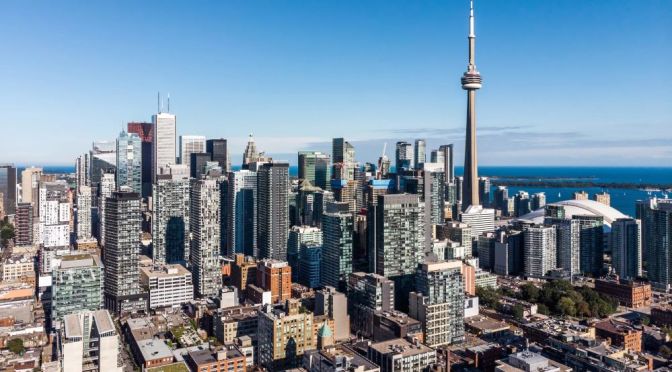
Cities: The Skyscraper Boom In Toronto, Canada

Canada’s biggest city is experiencing a skyscraper boom. Toronto, the capital of the province of Ontario, is a major Canadian city along Lake Ontario’s northwestern shore. It’s a dynamic metropolis with a core of soaring skyscrapers, all dwarfed by the iconic, free-standing CN Tower. Toronto also has many green spaces, from the orderly oval of Queen’s Park to 400-acre High Park and its trails, sports facilities and zoo.

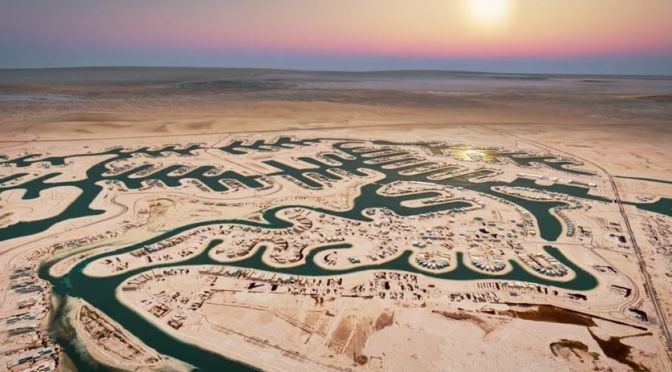
Engineering: Sabah Al Ahmad Sea City, Kuwait

In this city almost every resident has their own beach access on a lagoon that leads directly into the sea. But constructing such a city meant overcoming tremendous engineering problems.

Sabah Al Ahmad Sea City is a city in Khiran Kuwait built with canals forming 200 kilometres (120 mi) of artificial shoreline. The city houses up to 250,000 residents.[1][2] The city was inaugurated in mid 2016.[3][4] The artificial islands that make up the area are unusual because they were built excavating large channels in desert land rather than using reclaimed land. The city is considered a pioneering project in the region due to its environmentally sustainable construction techniques.[5][6]

The first phase of the project was opened to the sea in 2004.[5] The multi-billion dollar development is within a 25 year construction period with ten phases.[1] Sabah Al Ahmad Sea City is the first urban area in Kuwait built entirely by the private sector.

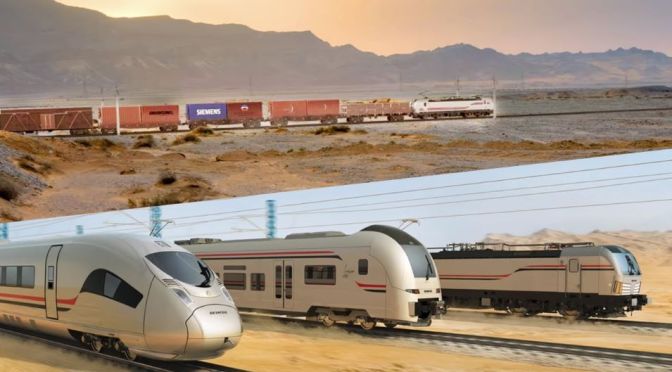
Public Transit: Seattle’s $54 Billion Railway (Video)

This could be the most ambitious public transit project in America.

SEATTLE has become one of the most attractive cities in the United States.

The tech boom has helped bring in some 1,000 new residents every week. Of course, all those new Seattleites need a way to get around, and things are getting crowded.

In response, the city has been expanding its rail system, and fast. The latest project, Sound Transit 3, will invest $54BN over the next 25 years to expand the network five-fold.

With the passage of the $1.2 trillion Bipartisan Infrastructure Bill, American cities are getting a chance to rethink their public transit systems with fresh infrastructure funding.

And Seattle’s expansion might be the country’s most ambitious project yet.