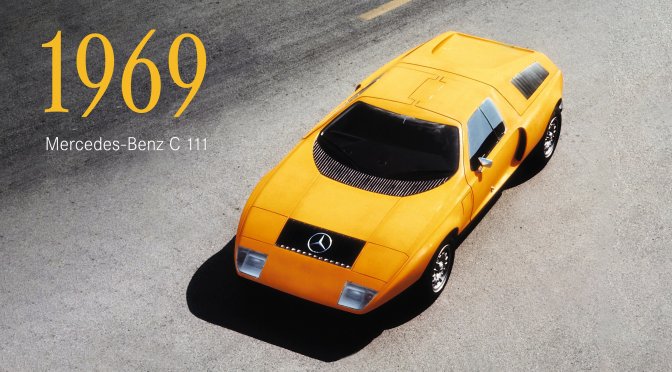
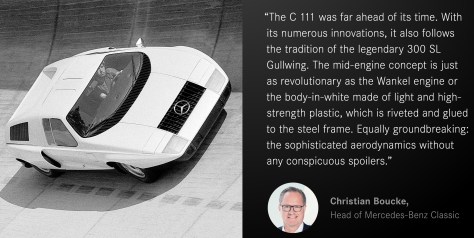

To read more: https://www.mercedes-benz.com/en/classic/history/c-111/?shortener=true

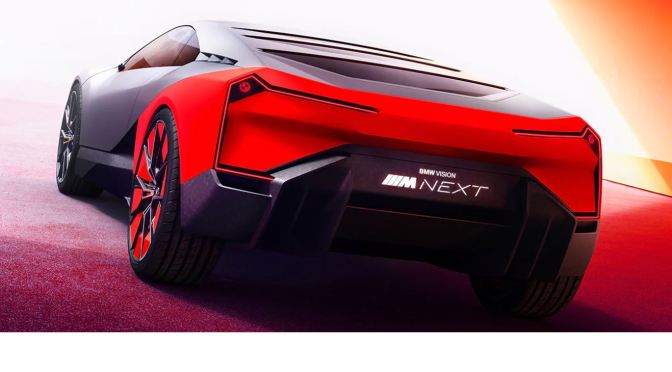
 ‘we believe in the power of choice,’ begins domagoj dukec. as cars embrace new technologies such as autonomous systems, BMW and their designers are ensuring customers are still offered their own ultimate driving experience. in fact, they are actually integrating technology into the background of their designs, from the powertrains to the adaptable furniture and interior fabrics, creating mobility spaces that adapt to your needs. the innovations are there to help and enhance the experience but are free to the user to choose when, where and how it affects their journey. this power of choice is exemplified by BMW‘s two driving modes and vision cars: EASE and BOOST, and the Vision iNEXT and Vision M NEXT.

From a Classic Driver online listing:
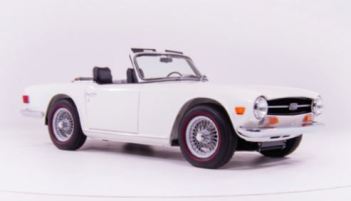
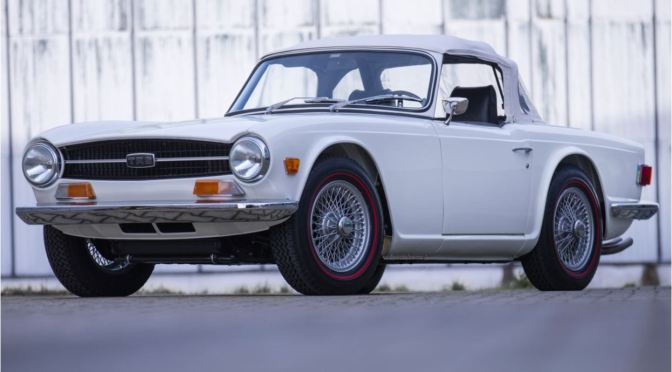
Offered as an affordable, six-cylinder sports car, the first Triumph TR6 rolled off the production line in 1968 as a 1969 model. It’s intended target was to rival similar sports cars at the time, and although most were designed with sleek, curved lines, the TR6 was squared off at both ends, making it stand out from it’s competitors. With just a seven year production span, the TR6 grew to become a true British classic.
The Triumph TR6 was offered as a convertible only, with a factory steel hard top available optionally.
Triumph produced a range of TR models, from the TR1 right up to a limited run of the TR8, but it was the sixth car in the range that really stood out from a sales point of view. The TR5 enjoyed a very brief thirteen-month period of manufacture between 1967 and 1968. Less than 3,000 units were produced before the TR6 came in to improve on many of the specifications. Unlike its predecessors, the Triumph TR6 was more reliable mechanically, which means that there are many original models still on our roads.
Website: https://www.classicdriver.com/en/car/triumph/tr6/1968/723270
Description from a Wikipedia listing:
 Along with the Vespa, Lambretta was an iconic vehicle of the 1950s and 1960s when they became the adopted vehicle of choice for the UK youth-culture known as Mods. The character Jimmy from the influential scooter movie Quadrophenia rode a Lambretta Li 150 Series 3. Of the 1960s models, the TV (Turismo Veloce), the Special (125 and 150), the SX (Special X) and the GP (Grand Prix) are generally considered the most desirable due to their increased performance and refined look; the “matte black” fittings on the GP model are said to have influenced European car designs throughout the 1970s. These three models came with a front disc brake made by Campagnolo. The TV was the world’s first production two-wheeled vehicle with a front disc brake.
Pictures from Classic Driver: https://www.classicdriver.com/en/bike/lambretta/125-e/1968/478697
To read more: https://en.wikipedia.org/wiki/Lambretta
From a Classic Driver online article:
 The Type E Series III had the privilege of launching the new Jaguar V12 engine in 1971. This superb 5.3L engine with two overhead cams, derived from a prototype for the 24 Hours of Le Mans, was powered by four carburettors. and developed 272CV DIN upon its release, it will give up to 700CV in competition versions.
The car shown is in Cotswolds blue with a light gray leather and a marine mohair top. It’s a rare combination of colors that gives it exclusivity and distinction. It was delivered new to Vancouver in Canada and was imported to France by its second owner in 1990. Its third and last owner, a well-known collector and driver emeritus has kept it nearly twenty years.
From the Gestalten website:
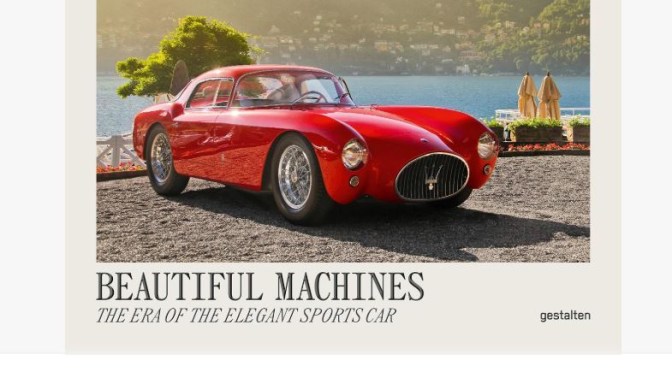
 Start your engines for a grand tour of the most stylish grand motoring automobiles ever created. Evoking an era when elegance, romance, and outright performance defined the automobile and the fascinating stories that made them icons of the road. From the shark-inspired Maserati Ghibli to the fiery Lamborghini Miura, from European elegance with American firepower such as the Iso Grifo and Facel Vega to the groundbreaking designs of the Alfa Romeo Tipo 33 Stradale and Renault Alpine and the advanced technology behind the Jensen FF or Porsche 918 Spyder.

These cars are less transportation and more testaments to beauty, freedom, ambition, innovation, and speed. Beautiful Machines was conceived and edited by gestalten. The stories are written by automobile expert Blake Z. Rong with a preface by Classic Driver’s Jan Baedeker and gestalten’s Robert Klanten.
 In an engaging, deeply reported book, the authors travel to mobility hotspots, from Helsinki to Shanghai, to scout out this future. And they visit the companies putting it together. One, Divergent3d, is devising a system to manufacture cars with robots and 3D printers. PonyAI, a Chinese-Silicon Valley startup, builds autonomous software that perceives potholes, oncoming trucks, and wayward pedestrians, and guides the vehicle around them. Voom, an Airbus subsidiary, is racing with dozens of others to operate fleets of air taxis that fly by themselves.
Urban expert John Rossant and business journalist Stephen Baker look beyond the false promises of the past to examine the real future of transportation and the repercussions for the world’s cities, the global economy, the environment, and our individual lives.
Human mobility, dominated for a century by cars and trucks, is facing a dramatic transformation. Over the next decade, new networked devices, from electric bikes to fleets of autonomous cars, will change the way we move. They will also disrupt major industries, from energy to cars, give birth to new mobility giants, and lead to a redesign of our cities. For Rossant and Baker, this represents the advance of the Information Revolution into the physical world.
To read more: https://www.amazon.com/Hop-Skip-Go-Revolution-Transforming/dp/0062883062
From the Tesla website:


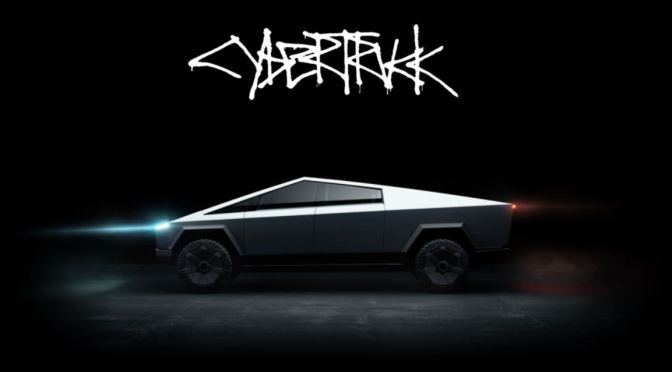
It’ll do 0-60 mph (0-98 km/h) in 2.9 seconds, and a quarter mile in a ridiculous 10.8 seconds in its highest performance variant. In top spec, it’ll go as far as 500 miles (800 km) on a charge, making it a genuine option for multi-day off-road adventures, and its 250-plus kilowatt charging capability means fast top-ups are on the cards, too. Towing capacity is over 7,500 lb (3,400 kg), which Musk happily demonstrated in an uphill tug of war against a hapless F150.
Website: https://www.tesla.com/cybertruck
From a AutoCar online article:
 The van is new from the ground up, sitting on a new modular platform and featuring a 60kWh lithium ion powertrain said to endow it with a “power-to-weight efficiency that fully maximises the range of the vehicle”. It can fast charge to 80% in 30 minutes.
Morris Commercial ranks it alongside the Mini, Morris Minor and Land Rover Defender as a “truly iconic post-war British automotive design”.
Revived thanks to unnamed UK and European financial backing, Morris Commercial’s first production model since the 1960s has a 200-mile range, a 1000kg payload and a 2.5-tonne gross weight.
Company website: https://www.morris-commercial.com/
It’ll be priced from £60,000 and set to be built in the UK at an undisclosed location, with the design an engineering taking place in a facility in Worcestershire.

From a New York Times online article:
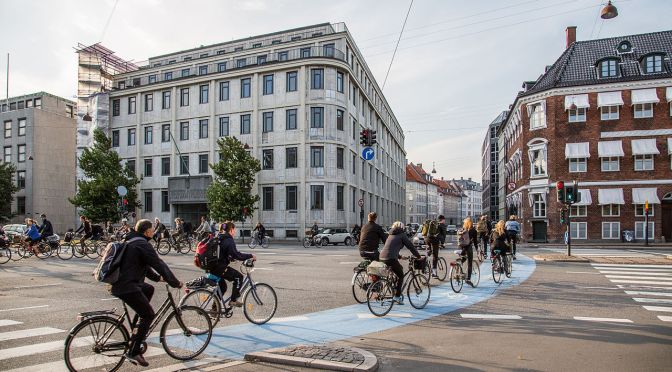
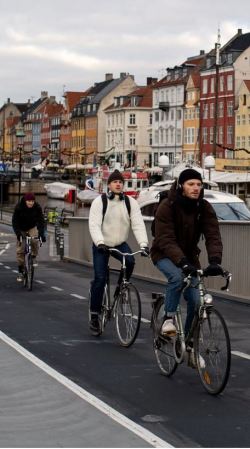 Copenhagen’s legendary bicycle setup has been propelled by all of these aspirations, but the critical element is the simplest: People here eagerly use their bicycles — in any weather, carrying the young, the infirm, the elderly and the dead — because it is typically the easiest way to get around.
Copenhagen’s status as a global exemplar of bicycle culture owes to the accommodating flatness of the terrain and the lack of a Danish auto industry, which might have hijacked the policy levers. Trouble also played a role.
The global oil shock of the 1970s lifted the price of gasoline, making driving exorbitantly costly. A dismal economy in the 1980s brought the city to the brink of bankruptcy, depriving it of finance to build roads, and making bicycle lanes an appealingly thrifty alternative.
To read more: https://www.nytimes.com/2019/11/09/world/europe/biking-copenhagen.html




 Boomers Daily