Category Archives: Transportation

AI Technology: Are Tesla Robotaxis Ready To Roll?

CNBC (October 2, 2024): For a decade, Elon Musk has championed the idea that one day Tesla cars will drive themselves as robotaxis. On October 10, the company plans to reveal a “dedicated robotaxi” design at an invitation-only event in Los Angeles.

Chapters: 3:18 Ch 1 – Tesla’s vision for autonomy 6:33 Ch 2 – Full self-driving 10:13 Ch 3 – Realizing the robotaxi 15:34 Ch 4 – Sizing up the robotaxi competition

Despite years of bold predictions and missed deadlines, fans of the company are holding out hope that Musk will finally deliver. Regardless of what the company showcases at its robotaxi day, experts are skeptical of the company’s strategy, citing its Auotpilot and Full Self-Driving technology as a barometer for Tesla’s progress, or lack thereof.

While Tesla has been developing its autonomous vehicles, competitors like Google-owned Waymo and Chinese companies like Pony.ai and Baidu have already launched commercial robotaxi services. With U.S. EV sales growth slowing, there’s a lot riding on Tesla’s potential pivot to autonomy. CNBC explores whether the company is ready for robotaxis and if Musk’s vision for driverless Teslas will become a reality anytime soon.
Reviews: The Race To Build America’s First High-Speed Railway – L.A. To Las Vegas

The B1M Films (December 27, 2023) – This new plan for a US bullet train might actually work.

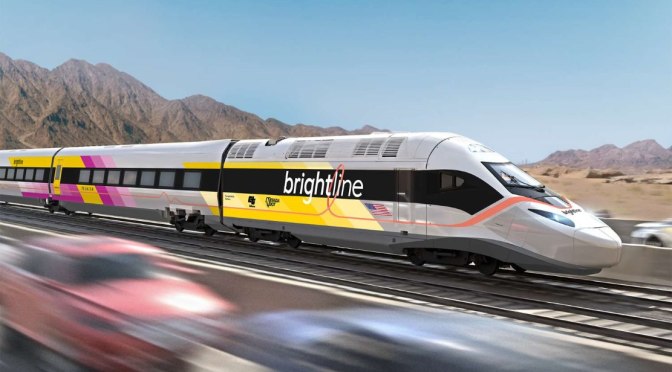
The Los Angeles Times (December 2023) – A high-speed rail project between the Inland Empire and Las Vegas landed a $3-billion federal grant that sets it on track to be open by 2028, in time for the Olympic Games in Los Angeles, officials said Tuesday.

Brightline, a private company that completed the final phase of the intercity rail line connecting Miami and Orlando, Fla., this year, secured the U.S. Department of Transportation grant as part of the historic infrastructure package, Nevada’s U.S. senators said. The rest of the funds for the $12-billion project are expected to be raised through private capital and bonds.

The trip on the 218-mile electrified line from Rancho Cucamonga to Las Vegas will take just over two hours, with stops in Hesperia or Apple Valley, according to Brightline. The trains can reach speeds of 200 miles per hour. The company already has the federal permits, the labor agreements and the land — a swath in the wide median of Interstate 15 — to build the line. Construction is expected to begin early next year.

Reviews: Autonomous Driving Reshapes The Car

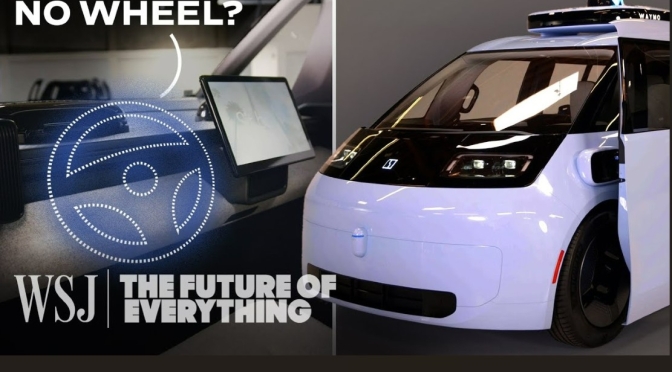
The Wall Street Journal (December 14, 2023) – As autonomous driving technology becomes more mainstream, automakers like Waymo and Geely are beginning to make crucial decisions about what their next generation of vehicles will look like.

Video timeline: 0:00 The future of the car 0:51 Car seats and safety 3:51 Wheel and trust 5:11 Screens and sickness 7:15 Trusting autonomous cars

So could future driverless cars have no steering wheels? And what could the touchscreen dashboards look like? WSJ’s George Downs explores how the car could evolve when you don’t need to be behind the wheel. #Autonomous #Cars #WSJ

Roads: How Colorado I-70 From Denver To Grand Junction Was Engineered

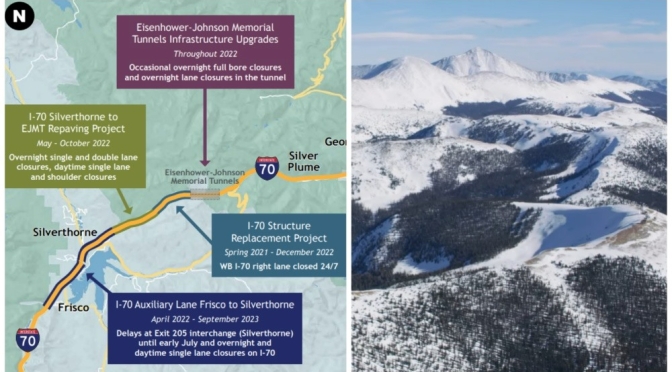
Wendover Productions (August 11, 2023) – The history, planning, budgeting, environmental studying, engineering and construction of the I-70 from Denver to Grand Junction in Colorado, which totals 243 miles.

Reviews: Can California Finish Its High-Speed Rail?

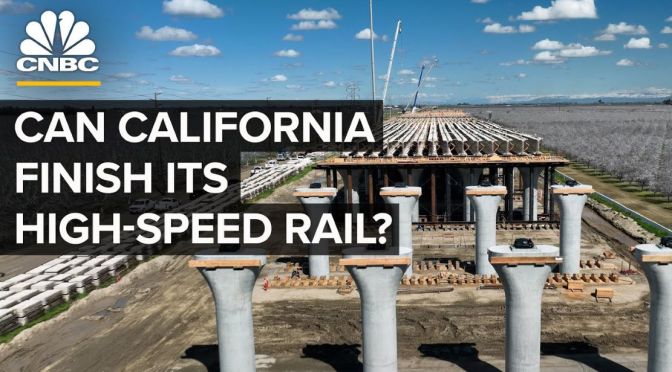
CNBC (May 16, 2023) – In 2008, California voted yes on a $9 billion bond authorization to build the nation’s first high-speed railway. The plan is to build an electric train that will connect Los Angeles with the Central Valley and then San Francisco in two hours and forty minutes.

Chapters: 1:35 Intro 1:41 The Vision 4:48 Progress 8:17 Setbacks and challenges

At the time, it was estimated the project would be complete by 2020 and cost $33 billion. But 15 years later, there is not a single mile of track laid, and there isn’t enough money to finish the project. The latest estimates show it will cost $88 billion to $128 billion to complete the entire system from LA to San Francisco. Inflation and higher construction costs have contributed to the high price tag. Despite the funding challenges, progress has been made on the project.

119 miles are under construction in California’s Central Valley. The project recently celebrated its 10,000th worker on the job. The infrastructure design work is complete, and 422 out of 500 miles have been environmentally cleared. CNBC visited California’s Central Valley, where construction is underway, to find out what it will take to complete what would be the nation’s largest infrastructure project.

Public Transit: NYC’s $16 Billion Subway Line Costs

CNBC (May 13, 2023) – Public transit can be extremely valuable for a city’s economy – in New York City 85% of the people who travel into the business district below 61st Street take some form of public transportation.

Chapters: 00:00 — Introduction 01:39 — Second Avenue Subway 06:45 — A national problem 08:37 — Subway costs 15:31 — Solutions

In several major cities – New York, Boston, Washington, D.C., and San Francisco – the subway and other rapid rail systems are key contributors to the prosperity of the city. In NYC for example, more than $37 billion of the Metropolitan Transportation Authority’s $54 billion budget goes to subways. But building subways in the U.S. is very expensive.

In fact, it’s the sixth most expensive country to build rail transit in the world. And even that is likely an understatement. High labor costs, overbuilt tracks and stations, and onerous regulations all jack up costs. NYC’s sheer population density makes it rather worth it – so many people ride the subway that the cost per rider is comparable to many European cities where total expenditures are substantially lower.

However, the high costs hurt the case for public transit in less dense areas of the country. Lowering those costs could go a long way toward building affordable and accessible public transit for smaller cities around the country and reducing traffic congestion, pollution and traffic accidents.

Travel Safety: How Trains Derail, Explained (WSJ)

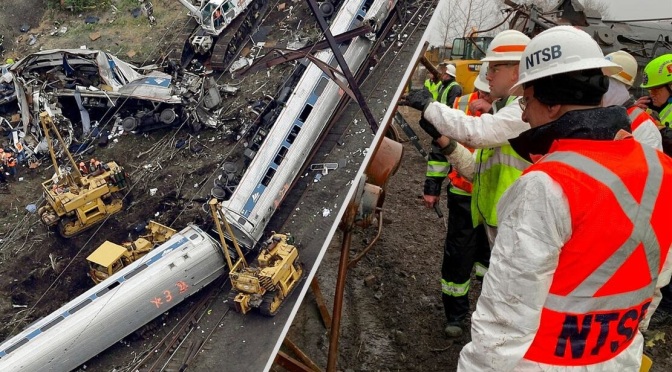
Wall Street Journal (March 28, 2023) – The train derailment in East Palestine, Ohio, was just one of over 1,000 that happen every year. NTSB’s Michael Hiller explains the most common reasons trains come off the tracks and what can be done to prevent derailments.

Video timeline: 0:00 Why do trains derail and how can they be prevented? 0:37 One of the biggest causes of derailments are track issues 3:04 Other derailments stem from human errors or equipment failures 5:01 Why most derailments are not severe and could be prevented

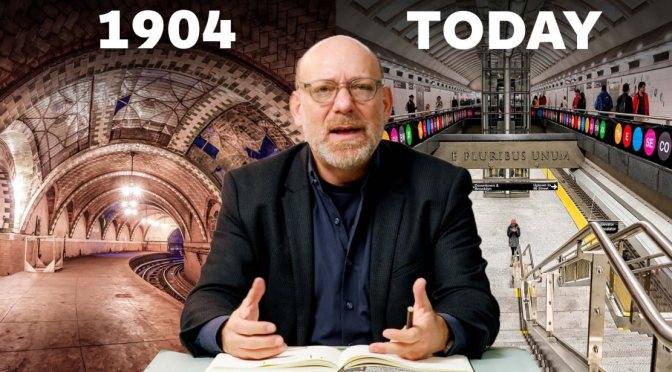
Architectural History: New York City Subways From 1904 To 2017 (AD)

Architectural Digest – Today Michael Wyetzner of Michielli + Wyetzner Architects returns to Architectural Digest to explore the history of New York City’s storied subway system, breaking down the architectural and design details found in some of its oldest and newest stations.

Automobile Technology: BMW Unveils ‘iVision Dee’

CNET (January 5, 2023) – BMW i Vision Dee is the futuristic mid-size sedan with a new and pared-down design language. The name “Dee” stands for Digital Emotional Experience – and that is precisely its aim: to create an even stronger bond between people and their cars going forward. Future digital functions will go far beyond the level of voice control and driver assistance systems we are familiar with today.

The BMW Head-Up-Display extends across the full width of the windscreen, providing a glimpse of the next vehicle generation. From 2025 onwards, this innovation will be available in the models of the NEUE KLASSE. The BMW Group has also refined its use of colour-change technology. Having unveiled the BMW iX Flow Featuring E Ink, with the ability to change from black to white, at the last CES, BMW i Vision Dee can now curate its exterior in up to 32 colours. 

Rail Transport: Chicago’s Vulnerability To Strikes

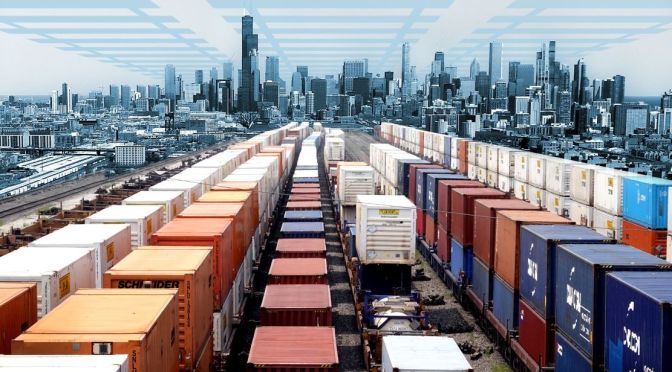
Wall Street Journal (December 19, 2022) – In recent years, the city’s railyards have seen severe bottlenecks as the supply chain choked up nationally. With $3 trillion in goods traveling through Chicago every year, the city is the busiest rail hub in the U.S. WSJ breaks down how important rail is to the region, and how vulnerable the system is to a work stoppage like a strike.

Illustration: Adele Morgan