

The Paris Club, comprising 22 wealthy countries, provides a platform for governments facing financial difficulties to reduce and renegotiate their debt repayments. Formed in 1956, it has signed more than 400 agreements to date, worth more than half a trillion dollars to about 100 countries. As public debt soars in the wake of the pandemic, CNBC’s Timothyna Duncan breaks down how this exclusive club functions and the challenges it faces to stay relevant.
Category Archives: Reviews

Books: Preventing the Next Pandemic: Vaccine Diplomacy in a Time of Anti-Science (Peter Hotez)


The Arts: ‘Technology & The Future of Theatre’
Art and technology are often seen as distinct disciplines. But combining them results in magic. Sarah Ellis, the Director of Digital Development at the Royal Shakespeare Company, teaches us how technology is reimagining the experience of theatre, taking it beyond the stage and into our living rooms. As an award-winning producer, Sarah Ellis currently works as Director of Digital Development for the Royal Shakespeare Company to explore new artistic initiatives and partnerships.

Nuclear Power: ‘Why Is It So Unpopular?’ (Video)
The meltdown at a nuclear power station in Fukushima, Japan, ten years ago stoked anxieties about nuclear energy. But nuclear is one of the safest, most reliable and sustainable forms of energy, and decarbonising will be much more difficult without it.

Alzheimer’s Disease: ‘How It Starts & Progresses’
The first event in our Lab Notes online series features two researchers from our South Coast Network Centre talking about early brain changes in Alzheimer’s. Dr Karen Marshall shares her work studying how waste disposal and recycling systems in nerve cells cause damage in Alzheimer’s disease, and whether there could be ways to rescue cells from this. Dr Mariana Vargas-Caballero speaks about her research into brain cell connections and how they are affected in Alzheimer’s. The event is chaired by Dr Katy Stubbs from Alzheimer’s Research UK, and also features a Q&A session.
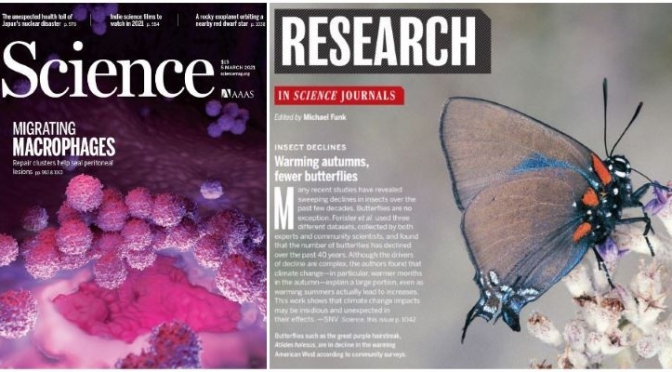
TOP JOURNALS: RESEARCH HIGHLIGHTS FROM SCIENCE MAGAZINE (Mar 5, 2021)



Science Podcast: 2000-Year-Old Pet Cemetary, Eyeless Worms See Color
Science’s Online News Editor David Grimm joins host Sarah Crespi to talk about a 2000-year-old pet cemetery found in the Egyptian city of Berenice and what it can tell us about the history of human-animal relationships.
Also this week, Dipon Ghosh, a postdoctoral fellow at the Massachusetts Institute of Technology, talks about how scientists missed that the tiny eyeless roundworm Caenorhabditis elegans, which has been intensively studied from top to bottom for decades, somehow has the ability to detect colors.

Infographic: ‘Vaccines Without Needles’ (WSJ)
Technologies in development for delivering vaccines include Enesi’s dissolving implants, microneedle patches, electrical-pulse systems, nasal sprays and even pills.

Some firms are developing their own vaccines against Covid-19, while others are aiming to reformulate some of the dozens already in development or being rolled out world-wide. Some are sitting this pandemic out in the hope of being ready for the next one.
All are in the early to mid-stages of development and clinical testing, suggesting it might be months if not years before they come to market. Big pharmaceutical companies have so far shown limited interest.

Home Design: Top Space-Saving Accessories (Video)
Space saving furniture and accessories.

Green Energy: Harnessing Ocean Wave Power (Video)
Searching for ways to reduce our reliance on fossil fuels, engineers and entrepreneurs are looking to a largely untapped potential source of renewable energy: wave power.
 Boomers Daily