

 Kiplinger’s vice president of content Sarah Stevens joins our podcast hosts Sandy Block and Ryan Ermey to talk about the advantages, risks, obstacles and other things to consider when having your DNA tested.
Category Archives: Reviews

Future Of Avation: “Safe Return” Emergency Autolanding In A Cirrus G2 Vision Jet (Video)
From a New Atlas online review:
An important step towards autonomous aviation was taken today, as Cirrus Aviation announced “Safe Return” functionality for its G2 Vision jet, which will find the nearest airstrip, alert authorities and land itself in an emergency.
The Vision is a small private jet capable of seating seven people, cruising at over 300 knots at 31,000 feet. Small, quick and user-friendly, it’s good for those that wish to fly themselves, as well as being flown. It’s been a successful product for Cirrus, but its new functionality could represent something bigger. CEO Zean Nielsen calls it “a product that we believe is going to change personal aviation forever.”
Safe Return Autonomous Autoland, developed in conjunction with Garmin, manifests as a button on the roof of the Vision jet that is accessible to passengers. If something happens to the pilot, a passenger can hit the button and request an autoland.
To read more: https://newatlas.com/aircraft/cirrus-vision-g2-automatic-emergency-landing/

Road Trip Adventures: The “Khar Us Nuur National Park” In Mongolia
From a Wall Street Journal online article:
A will to avoid traveling absurd distances had informed our itinerary, but in Mongolia, it seems, you can’t get anywhere without one hell of a journey. The arena for this particular expedition was the Khar Us Nuur National Park. Accessible by road from the dusty town of Khovd, itself a two-hour flight from the capital, Ulaanbaatar, the park spans a transitional zone between the Altai highlands and the Gobi Desert. In the company of our driver, Gala, my friend Marcus and I had set out to experience three of Mongolia’s predominant habitats—steppe, mountains and desert—in the space of one drivable circuit.
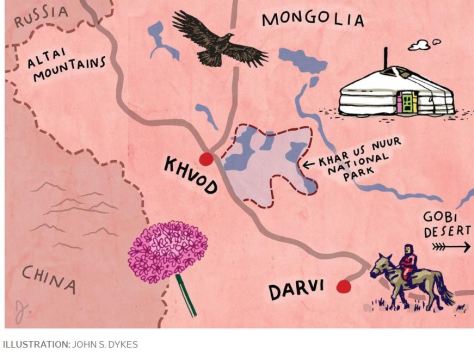
WE HAD already been driving for three hours when the lake appeared in the heat-shimmer and the pink smear behind it resolved into sand dunes. I guessed it would be around 10 minutes until we reached the shore. Fifteen tops. We arrived at the water’s edge two hours later. On the empty plains of Western Mongolia, perspective is illusory, patience a necessity.
To read more: https://www.wsj.com/articles/a-road-trip-in-mongolia-bizarre-in-the-best-way-11572520659

Destination Restaurants: Newly Opened “Le Tre Rane” Inspired By Da Vinci Just Outside Of Florence
From a The Florentine magazine online review:
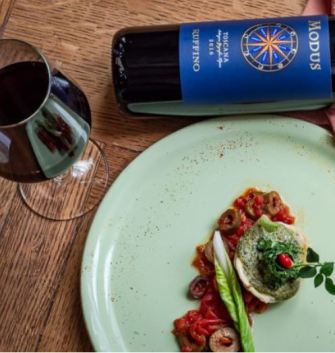 Legend has it that Le Tre Rane was the name of an inn that a young Leonardo da Vinci opened on Florence’s Ponte Vecchio, with a vision of a pioneering cooking style that would embody fine dining and healthy eating, while heightening the taste of being together.
Stefano Frassineti has taken the helm in the kitchen at Le Tre Rane. Born in Chianti and a career cook for almost 30 years, Stefano believes in dishes based on tradition that evolve into an unmistakable identity. He takes an orchestra of seasonal ingredients from personally sourced Tuscan suppliers and conducts them with endless curiosity and creativity. Eight seasonal menus will rotate year round—the current one is centred around freshly pressed extra-virgin olive oil—in addition to an à la carte menu featuring Tuscan meat (and the occasional fish) courses. Start with a delicate ricotta and chard pie, continue with hunter’s chicken tortelli and opt for a beef tagliata or bistecca alla Fiorentina.

To read more: https://www.theflorentine.net/food-wine/2019/10/tre-rane-restaurant-ruffino/?mc_cid=e3c3fdbb7f&mc_eid=69f70995d1
Interviews: “We The Corporations” Author Adam Winkler (PBS NewsHour Podcast)
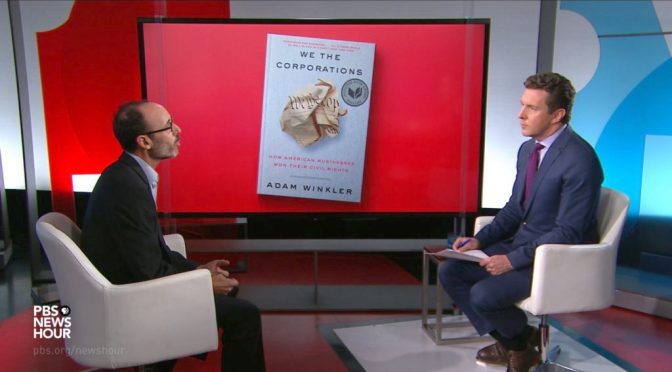
 Adam Winkler, author of our October pick for the NewsHour-New York Times book club, Now Read This, joins William Brangham to discuss “We the Corporations,” and William announces the November book selection.
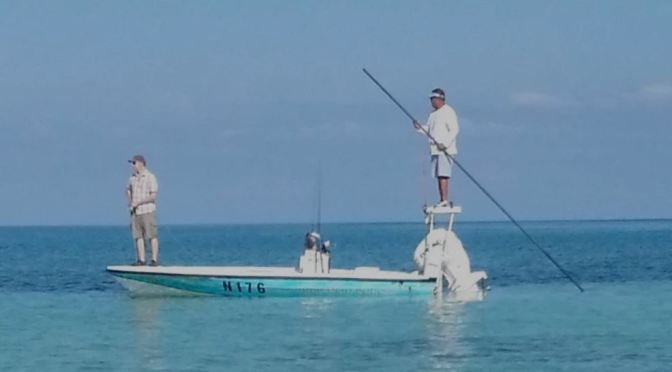
Travel Destinations: Bonefishing In Bermuda Combines Luxury Leisure With Island Adventure
From a Wall Street Journal online review:
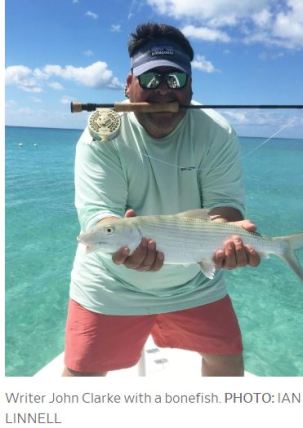 We headed west and hugged the shallow shoreline, casting at shadows of fish as the sun mixed with clouds making it more difficult to sight fish. We curled around a point of land I instantly recognized as Cambridge Beaches, where I stayed with my parents on my first visit to the island and where my sister celebrated her honeymoon.
Mr. Linnell used a push pole to move the skiff quietly along shore as he chatted up guests snorkeling nearby, expertly keeping them away from our bonefish spots by urging the snorkelers to take in sights a safe distance away.
I HAD NEVER considered fly fishing for bonefish in Bermuda. Chasing the elusive, silver-green creatures, prized for their fight, was something you did at remote outposts and rustic camps, where showering was optional and accommodations primitive. Such a trip could be fun for a few days, but you’d never dare drag your wife or kids along.
To read more: https://www.wsj.com/articles/for-a-luxe-fly-fishing-trip-try-bermuda-11572455090
Dementia Studies: Healthy Sleep, Diet And Exercise Changes Boost Cognition
From a Wall Street Journal online article:
 Mr. Chambers, a 48-year-old physical therapist in Jersey City, N.J., modified his sleep, diet and exercise routines. Eighteen months later, his performance on a battery of cognitive tests improved, particularly in areas like processing speed and executive function, such as decision-making and planning.
Most surprising, says Dr. Isaacson, is that the MCI patients who followed at least 60% of their recommendations showed cognitive improvement. However, MCI patients who followed less than 60% of the recommendations experienced cognitive declines similar to the control groups, he notes.
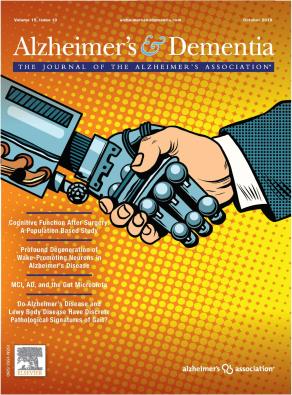
Mr. Chambers is among 154 patients in a study, published Wednesday in Alzheimer’s & Dementia: The Journal of the Alzheimer’s Association, that doctors say shows encouraging results. Among healthy patients, people who made changes in nutrition and exercise showed cognitive improvements on average. People who were already experiencing some memory problems also showed cognitive improvement—if they followed at least 60% of the recommended changes.
To read actual study: https://els-jbs-prod-cdn.literatumonline.com/pb/assets/raw/Health%20Advance/journals/jalz/JALZ_2985-1572445934507.pdf?mod=article_inline
To read more: https://www.wsj.com/articles/the -link-between-diet-exercise-and-alzheimers-11572427802
Science Podcasts: Quest To Detect Gravitational Waves, First Hypothesised By Einstein (Nature)
 In 2015, the Laser Interferometer Gravitational Wave Observatory (LIGO) facilities in the US directly detected ripples in space-time known as gravitational waves. These waves were produced by the final spiral of two oribiting black holes that smashed into each other, sending ripples across the universe.
In this Podcast Extra, Benjamin Thompson speaks to Cole Miller from the University of Maryland about the quest to detect gravitational waves, which were first hypothesised by Albert Einstein back in 1916.
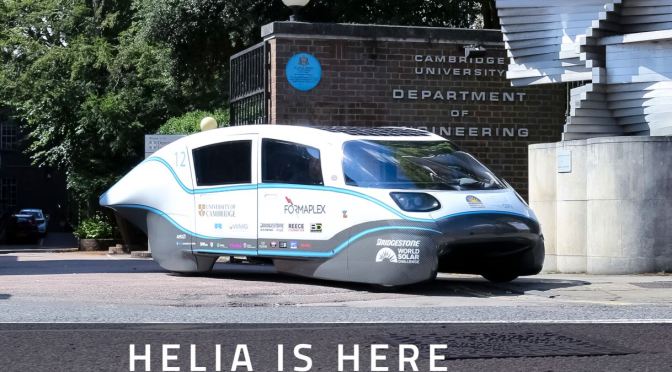
Transportation: Cambridge University Builds Ultra-Efficient, 560-Mile Range Electric Car
From a Dezeen.com online review:
On a single charge, Helia can cover a range of 900 kilometres – the distance from London to Edinburgh. Again, compared to the Tesla 3, the Cambridge University team’s car has double the range on a battery a quarter of the size.
 The ability to cover this distance is aided by Helia’s chassis and body panels made from carbon fibre, which grant it a kerb weight of 550 kilograms.
Students from Cambridge University have built an ultra-efficient electric car that drives using only as much power as it takes to boil a kettle.
The Cambridge University Eco Racing (CUER) student society built the four-seater car, named Helia, with efficiency as the main goal.
Their achievement has been to produce a car that can travel 80 kilometres-per-hour using only 2500 watts, or as much power as it takes to boil a single kettle, which is equivalent to 31 watt-hours-per-kilometre.

Ethics Of Lying About A Terminal Cancer Diagnosis Explored In Movie “The Farewell”
From a New Scientist online review:
The prevailing narrative of “battling cancer” in Western society has its own issues, with its discourse of personal triumph that values individual responsibility and determination. But the alternative – to lie outright – might seem inconceivable, particularly to those accustomed to the norms of Western culture. It is, however, a common practice in China, rooted in the belief that telling a person about their diagnosis can make their condition deteriorate quicker.
 The plot line of The Farewell is familiar to me. Like Billi’s Nai Nai, my aunt was diagnosed with metatastic lung cancer. Nobody in the family told her – nor did the doctors when she later underwent surgery to remove a tumour. The last time I saw her was in north-eastern China a few years ago. Her once-plump figure had shrunk to a wiry frame. She was in her early 70s, in good spirits, but a far cry from the feisty matriarch who used to dominate conversations.
The Farewell is a heartfelt film, punctuated by moments of unexpected – and unexpectedly uplifting – humour. In a darkly comical scene in a printing shop, Nai Nai’s younger sister demands that the results of a medical report be doctored to edit out references to cancerous nodules and replaced with the nebulous term “benign shadows”.
 Boomers Daily