Category Archives: Profiles

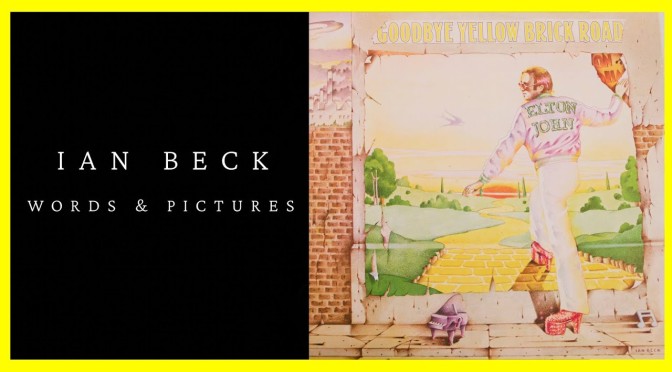
Art Documentary: “Words And Pictures – Ian Beck”

Directed, Filmed and Edited by: Edmund Beck

Music composed by: Simon Whiteside
Interview and Graphics by: Laurence Beck
Sound mix by: David Mead
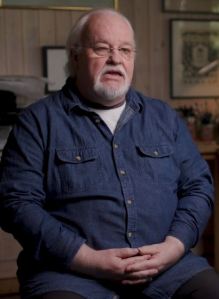
Ian Beck - IllustratorShort documentary film about Author, illustrator Ian Beck. A brief look at his life and where he works. Included are, his inspirations from childhood reading, the making of the artwork for Elton John’s 1973 album ‘Goodbye Yellow Brick Road’ and his current project in collaboration with Philip Pullman (His Dark Materials) creating a Myriorama.


Ian Archibald Beck is an English children’s illustrator and author. In addition to his numerous children’s books, he is also known for his cover illustration on Elton John’s Goodbye Yellow Brick Road album. More than a million copies of his books have been sold worldwide.
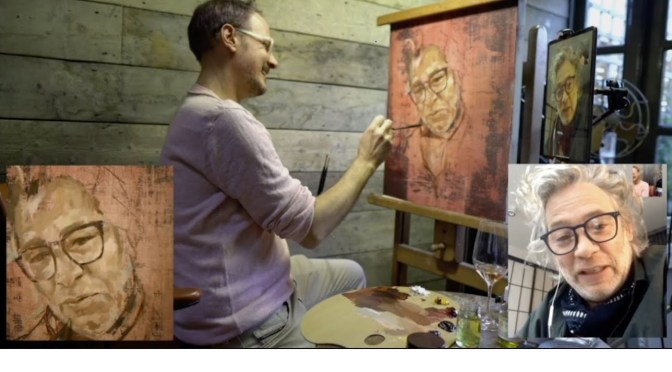

Video Profiles: British Artist Jonathan Yeo – “FaceTime Portraits”

Since lockdown started in the UK, British artist Jonathan Yeo began a ‘FaceTime Portraits’ series where sittings have been filmed by his household, offering viewers a live glimpse into his portrait painting process.

Here he tells us about the pros and cons of painting faces by digital means and how he sees the future of portraiture as technologies continue to evolve.

Jonathan Yeo is a British artist who rose to international prominence in his early 20s as a contemporary portraitist, having painted Kevin Spacey, Dennis Hopper, Cara Delevingne, Damien Hirst, Prince Philip, Erin O’Connor, Tony Blair, and David Cameron among others.

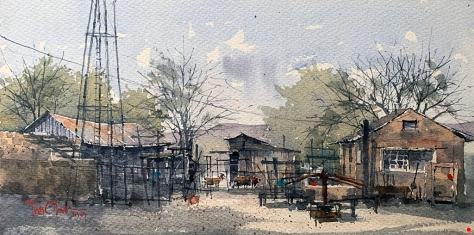
Top American Painters: Watercolorist Tim Oliver – “Sketchy Landscapes”

As with all artists, my style is constantly evolving but presently I describe my style as “sloppy representationalism”.  I paint in a representational style with a “sketchy” quality to it. It seems to fit me.  I’m passionate about interpreting and communicating the character and the emotion of places in my work. 

Bowen Ranch Goat Pens - Tim Oliver

Tim Oliver Watercolors Paintings

Tim Oliver - ArtistWatercolor, in a practiced hand, is the perfect medium for capturing the powerful emotion of a place.  While I paint a variety of subjects, I’m most attracted to landscapes that stir passion within me in the moment.  I’m always drawn to things western, rural, gritty and seemingly mundane or ordinary. Anything evocative of a ‘time long passed by’ will always capture my attention.
Website

Literary Profiles: The “Sparkling, Perfect” Prose Of P.G. Wodehouse (BBC)

From BBC Culture (June 2, 2020):

P.G._Wodehouse_-_My_Man_Jeeves_-_1st_American_edition_(1920_printing)_-_CropWith every sparkling joke, every well-meaning and innocent character, every farcical tussle with angry swans and pet Pekingese, every utopian description of a stroll around the grounds of a pal’s stately home or a flutter on the choir boys’ hundred yards handicap at a summer village fete, he wanted to whisk us far away from our worries.
If we’re talking about culture that makes people happy, we have to start with the works of PG Wodehouse. There are two reasons why. One reason is that making people happy was Wodehouse’s overriding ambition. The other reason is that he was better at it than any other writer in history.

Read more

P. G. Wodehouse: A Brief History

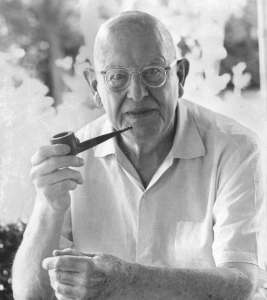
P.G. WodehouseThe author of almost a hundred books and the creator of Jeeves, Blandings Castle, Psmith, Ukridge, Uncle Fred and Mr Mulliner, P. G. Wodehouse was born in 1881 and educated at Dulwich College. After two years with the Hong Kong and Shanghai Bank he became a full-time writer, contributing to a variety of periodicals including Punch and the Globe. He married in 1914.

As well as his novels and short stories, he wrote lyrics for musical comedies with Guy Bolton and Jerome Kern, and at one time had five musicals running simultaneously on Broadway. His time in Hollywood also provided much source material for fiction.

At the age of ninty-three, in the New Year’s Honours List of 1975, he received a long-overdue knighthood, only to die on St Valentine’s Day some forty-five days later.

Official Website

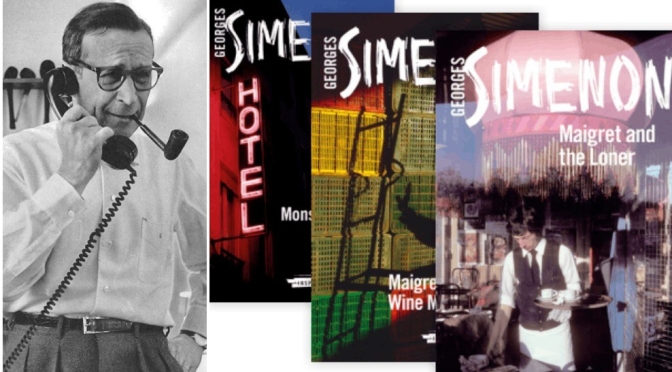
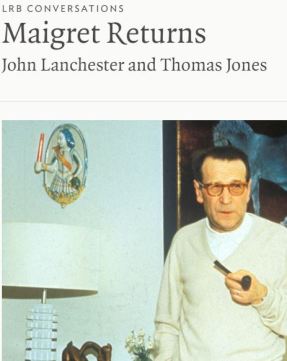
Podcast Profiles: Author Georges Simenon, Creator Of Inspector Maigret (LRB)

London Review of Books’ John Lanchester talks to Thomas Jones about Georges Simenon, whose output was so prodigious that even he didn’t know how many books he wrote.

Georges Simenon - Maigret ReturnsTRANSCRIPT

Thomas Jones: Hello, and welcome to the London Review of Books podcast. My name is Thomas Jones, and today I’m talking to John Lanchester, who’s written a piece in the current issue of the LRB about Georges Simenon and his 75 Maigret novels, which Penguin have just finished reissuing in new translations. Hello, John.

John Lanchester: Hi Tom. Thanks for having me.

TJ: Thank you for joining me. And I thought we could begin where you begin your piece with Simenon’s ‘colossal output’, as you put it, and that nobody knows how many books he actually wrote, though it was probably more than four hundred, which is fewer than Barbara Cartland, but still puts the rest of us to shame.

JL: He didn’t half crack on, that’s true. Yes, he started as a young man in Liège, his home town in Belgium. And he got a job as a reporter on the local paper. I think he was not quite 16, which is properly strange. It’s like something out of a high concept kid’s TV show, you know, Georges Simenon – Boy Reporter, and very early on latched onto the idea of making money through writing.He began writing when he was 18, his first book came out when he was 19. He started writing every sort of potboiler, thrillers, romances, sort of semi-porn westerns, things like that, at an absolutely astounding rate of productivity. And his target was eighty pages a day, typewritten, and even on the assumption that the pages … I mean, a short page would be 150 words and it could well have been more, but it was 10,000 words a day, and he did that every single day. And then he’d write eighty pages, and then he’d go and be sick. Just from the physical and mental exertion and the strain. That was in the morning. And then he’d recover and do a bit of light reading and pottering about. And then the next day he did the same again, over and over and over for about seven years. And in that period, as you’ve mentioned, we don’t know exactly how many, because he forgot, and he had multiple pseudonyms. The main one being Georges Sim, which was how he was known when he began writing the Simenon novels. People thought that Simenon was a pseudonym because George Sim was so well known, but he seems to have written about 150 or more books in this seven-year burst. It  makes you feel peculiar even to think about what that must have been like.

Read full transcript

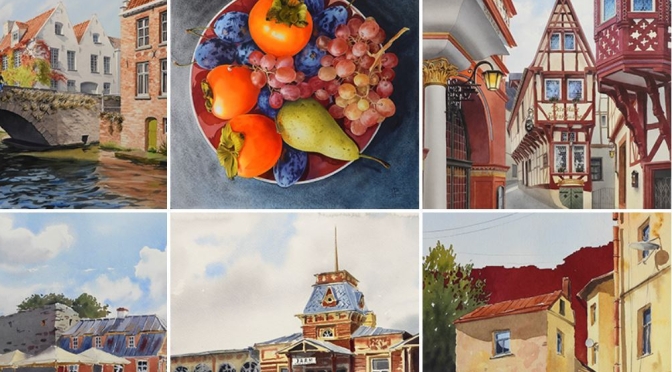
Artist Profiles: Russian Watercolor Painter Eleanor Mill – “Exacting”

From MyModernMet (May 25, 2020):

Eleanor Mill Watercolor Artist“Buildings and constructions once created by people but now fallen into oblivion have an inspirational value for me,” Mill tells My Modern Met. “They are silent witnesses of history. These giants towering over densely populated cities preserve the memories from the moment of their creation until the last stone drops off their walls.”
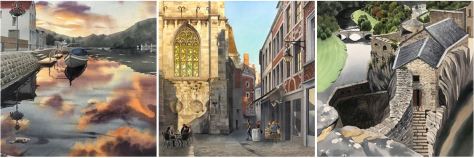
Eleanor Mill Watercolor ArtistRussian graphic designer and watercolor painter Eleanor Mill has a knack for capturing the spirit of place. Through her architectural watercolor sketches, she documents buildings with exacting detail. At the same time, Mill imbues her work with the color and light that gives each environment character. This allows viewers to come along with her as she places the memories of her travels down on paper.
Read more

Art: “The Lives Of Rubens” Through 17-Century Biographies (The Getty)

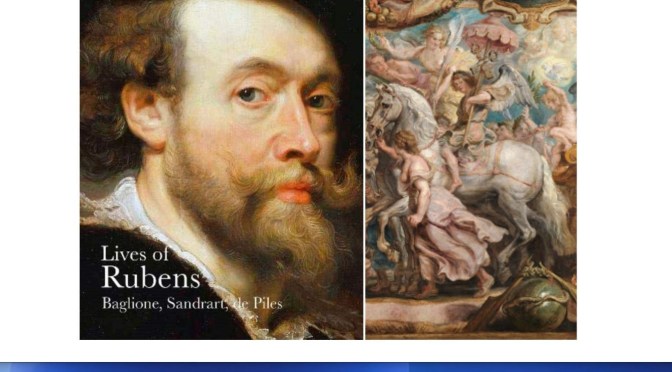
Art + Ideas - Getty PodcastsPeter Paul Rubens was among the most influential artists in 17th-century Europe. Despite a childhood marred by a scandal that landed his father in prison, Rubens rose to become not only a prominent court painter in the Spanish Netherlands but also a lauded diplomat who worked across Western Europe.



With countless biographies written about the artist and exhibitions of his work continuing into the present day, the legacy of this Flemish Baroque artist is hard to overstate.

In this episode, Getty curator Anne Woollett discusses the life of Rubens through 17th-century biographies by three authors: Giovanni Baglione, Joachim von Sandrart, and Roger de Piles.

For images, transcripts, and more, visit getty.edu/podcasts.

Sir Peter Paul Rubens was a Flemish artist and diplomat. He is considered the most influential artist of Flemish Baroque tradition. Rubens’s highly charged compositions reference erudite aspects of classical and Christian history.

Top Designers: “Imagined Architectural Spaces” By Alexis Christodoulou

Alexis Christodoulou - Imagined Architectural Spaces

Alexis Christodoulou logo

Alexis Christodoulou, a self-taught 3D artist living in Cape Town, South Africa has spent the last 6 years building a collection of works focusing on imaginary architecture. While working professionally as a copywriter for the last decade, Alexis taught himself 3D rendering as a hobby.

From a lifelong fascination of digital worlds and 3D graphics from playing video games a boy, Alexis became frustrated with the lack of modern aesthetics represented therein. The images he creates are a simple extension of this desire to see fantastic spaces come to life that echo a more modern and clean aesthetic.

Website

Video Profiles: 78-Year Old British-American Singer Graham Nash (CBS Sunday)

Singer-songwriter Graham Nash had recently embarked on a sold-out tour, until it was cancelled due to coronavirus. Anthony Mason sits down with Nash in New York City to talk with the former member of The Hollies and Crosby, Stills & Nash about how he has maintained his productivity while remaining under lockdown.