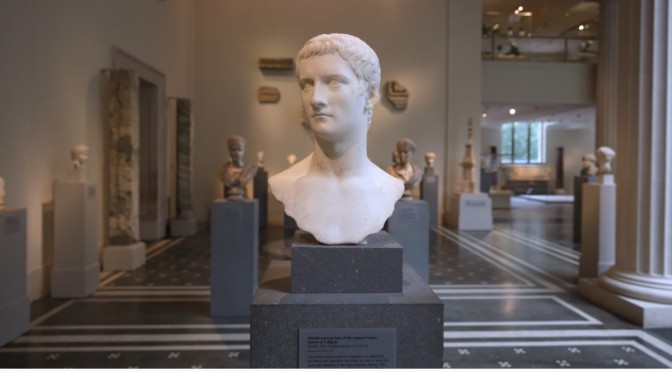
Archaeologists Vinzenz and Ulrike Koch Brinkmann have spent the last 40 years dedicated to the study of polychromy—or “many colors” in Greek—in ancient sculpture. Once a fringe area of study, their research combats the misconception of white purity in ancient Greece and Rome. They reflect on the marble bust of Caligula and how the reconstruction of its former color can help us better understand history.
Attirement of the Bride is an example of Max Ernst’s veristic or illusionistic Surrealism, in which a traditional technique is applied to an incongruous or unsettling subject. The theatrical, evocative scene has roots in late nineteenth-century Symbolist painting, especially that of Gustave Moreau. It also echoes the settings and motifs of sixteenth-century German art. The willowy, swollen-bellied figure types recall those of Lucas Cranach the Elder in particular. The architectural backdrop with its strong contrast of light and shadow and its inconsistent perspective shows the additional influence of Giorgio de Chirico, whose work had overwhelmed Ernst when he first saw it in 1919.
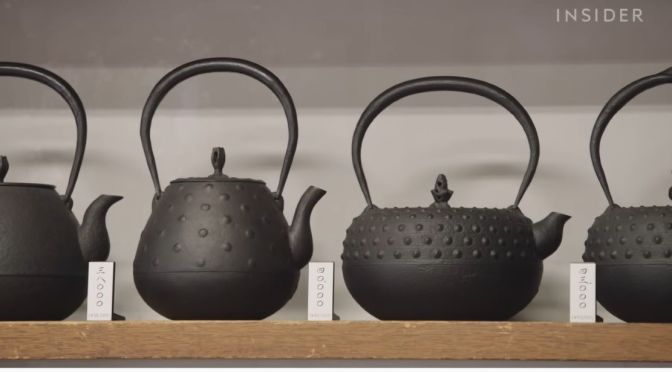
A handmade Japanese iron kettle can cost over $300. For centuries, artisans have made kettles by pouring molten iron into molds and hammering them out once they’ve cooled. These kettles often have beautiful designs but they’re only used for boiling water. You can buy a mass produced stovetop kettle for $20, so what makes these kettles unique? And why are they so expensive?
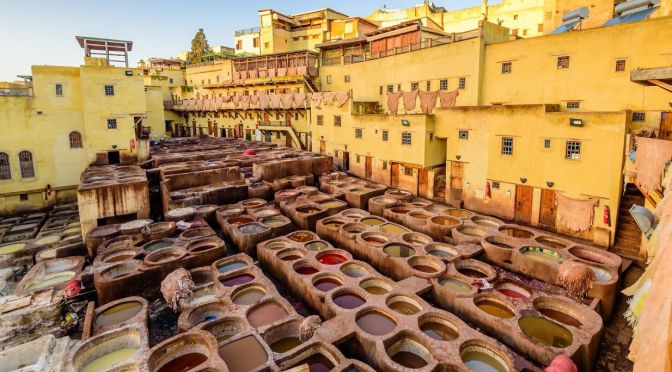
Tanners at the Chouara Tannery have been transforming animal hides into leather since the 11th century. The tanning process has gone unchanged since then, but it relies on heavy chemicals that threaten the health of workers. Some say they are not willing to take that risk. We traveled to the world’s oldest leather tannery in Fez, Morocco, to find out how this ancient craft is still standing.
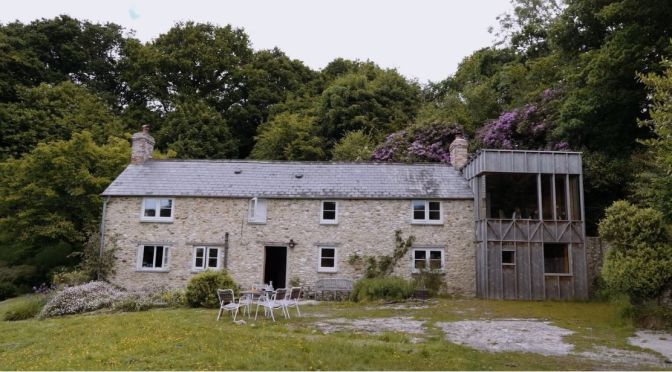
Natalie Silk and Tom Baker have worked on many projects together, the best known of which is Field Day festival, which they co-founded in 2007. As individuals, Natalie now produces regenerative food and craft events that celebrates links between the city and countryside as part of Village Mentality; Tom runs Eat Your Own Ears, which has been a part of London’s music scene since 2001.
But the couple’s latest project is an altogether quieter and slower-going one: the sensitive renovation and extension of an old cottage in the bucolic hills of East Devon, which you can explore in our latest film.
The American sports car racing scene of the 1950s was a time like no other, when fiercely independent, deep-pocketed men could acquire ex-factory racecars and campaign them with some of history’s most legendary drivers. Admirably pure in its essence, this was a golden era of racing that fielded some of the decade’s most beautifully sculpted and ferociously specified competition machines.
One of the most significant purpose-built Ferrari “big block” sports-racing prototypes from the 1950s, this 1955 Ferrari 410 Sport Spider by Scaglietti is one of just two factory-campaigned 410 Sports equipped with a 24-spark plug 4.9-liter V-12 and is one of a select few Ferrari models with coachwork both designed and built by Sergio Scaglietti.
0598 CM was the Scuderia Ferrari team car driven by Juan Manuel Fangio at the 1956 1000 KM Buenos Aires and later piloted by Carroll Shelby during his landmark 1956 and 1957 seasons when driving for the renowned Southern California-based team principal John Edgar. Shelby won more races as a driver in 0598 CM than any other car in his racing career, with eight wins and ten podium finishes.
There seemed to be no race it could not win as Shelby told a Los Angeles Times reporter, “Nothing can touch this Ferrari if it runs” and decades later he added, “It was the best Ferrari I ever drove.” Also raced in-period by legendary drivers Phil Hill, Eugenio Castellotti, Masten Gregory, Richie Ginther, Joakim Bonnier, Bruce Kessler, Jim Rathmann, and Chuck Daigh, 0598 CM is, without exaggeration, one of the most important and colorful Ferraris to compete in racing during the 1950s. It is among the most successful of all even-numbered sports-racing Ferraris, entering nearly 40 races in-period with 11 victories and 19 total podium finishes from 1956-1958.
As it remains a highly original example retaining the matching-numbers engine, chassis, and body, and fitted with the original fuel tank inscribed by Shelby, “Mr. Ferrari told me that this was the best Ferrari he ever built,” this example offers an unparalleled opportunity to acquire a purpose-built, even chassis-numbered racing sports car of unequaled provenance. Faithfully presented in its period livery and desirably maintained, including the recent engine rebuild by a team of Ferrari experts, this 410 Sport can expect an enthusiastic welcome at the most exclusive vintage racing and exhibition events worldwide and will go to its new owners with the first (1956) and last (1958) trophies won by Shelby driving 0598 CM, along with the original 1957 Nassau racing license plate.
Like the famed men who rode it to such success in-period, the illustrious John Edgar and the inimitable Carroll Shelby, this Scaglietti-built spider is a powerful and nuanced character that cannot be repeated—and will never be forgotten.
Heads of state are meeting for the G7 World Economic Summit at the luxury Schloss Elmau hotel in Bavaria. And they won’t just be talking about global problems there, they’ll also be staying at the hotel, protected from the outside world.
We take a look behind the scenes at the five-star superior hotel close to Garmisch-Partenkirchen in the south of Germany. What does German Chancellor Olaf Scholz’s hotel room look like? And US President Joe Biden’s bathtub? How’s the view from the balcony over the Alps? What’s the food like at the hotel’s two-star Michelin restaurant? How much does it all cost? And why is the hotel manager such a fan of elephants?
Schloss Elmau, built by the philosopher and theologian Johannes Müller and architect Carl Sattler between 1914 and 1916, is a four-story national monument with hipped roof, tower and porch, situated between Garmisch-Partenkirchen and Mittenwald in a sanctuary of the Bavarian Alps, Germany.
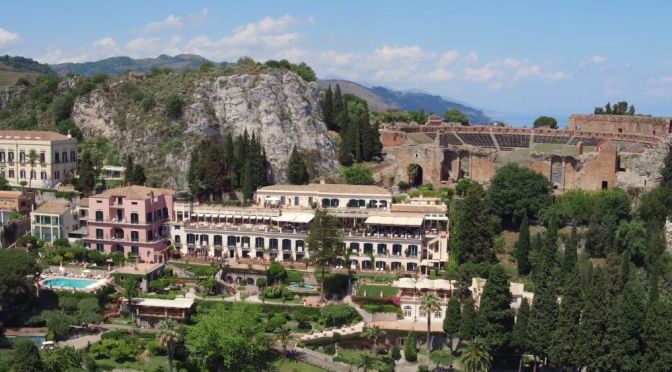
For the 2022 season, Belmond has launched a partnership with internationally acclaimed art gallery – Galleria Continua – entitled MITICO, which celebrates the talents of four prominent artists, as they take the spotlight in some of Belmond’s captivating landmark gardens across Italy.
Evoking a feeling of inclusivity and community, MITICO embodies a new art philosophy: it is the reinterpretation of universal customs shared amongst different societies, such as cooking, painting, observing, and appreciating, and how these are consumed in their environments.
MITICO is a moment in time and history where cultures interact – ultimately it is a celebration of art de vivre. Deepening its long-standing connection to the arts, through MITICO, Galleria Continua and Belmond invite guests to see cultures through a different lens, tapping into each individual destination’s essence and beauty.










 Boomers Daily