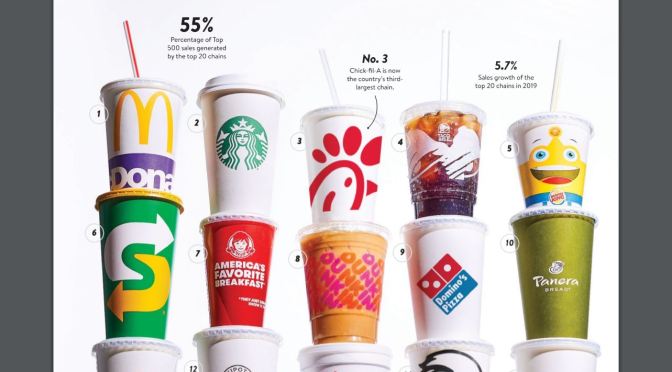
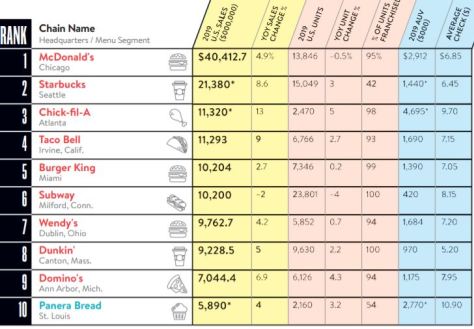
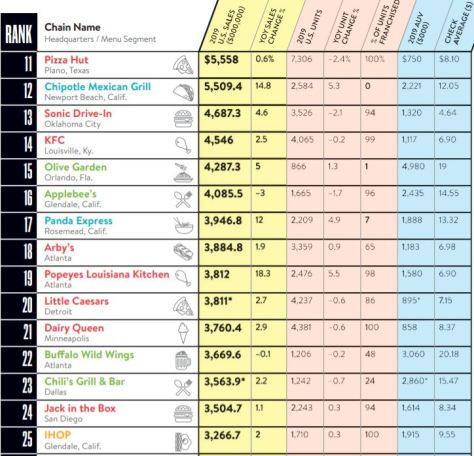
From Restaurant Business May – June 2020:

 This week, a new way to study elusive subatomic particles – pions, and the story of Galileo remains relevant in a time of modern science denialism.
In this episode:
00:46 Probing pions
Pions are incredibly unstable and difficult-to-study subatomic particles. Now researchers have come up with a clever way to examine them – by sticking them into helium atoms. Research Article: Hori et al.
08:28 Research Highlights
A colourful way to cool buildings, and the rapid expansion of cities. Research Highlight: A rainbow of layered paints could help buildings to keep their cool; Research Highlight: Urban sprawl overspreads Earth at an unprecedented speed
10:46 The life of Galileo
A new biography of Galileo Galilei examines some of the myths about his life and draws parallels with problems facing scientists today. Books and Arts: Galileo’s story is always relevant
16:42 Pick of the Briefing
We pick our highlights from the Nature Briefing, including botanical graffiti, and rock-eating bacteria. The Guardian: ‘Not just weeds’: how rebel botanists are using graffiti to name forgotten flora; Scientific American: Scientists Waited Two and a Half Years to See whether Bacteria Can Eat Rock
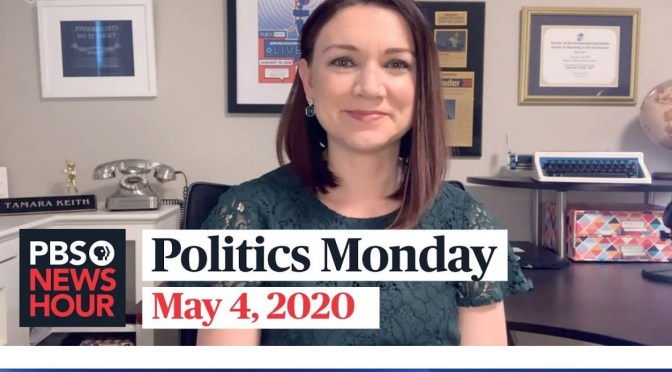
NPR’s Tamara Keith and Amy Walter of the Cook Political Report join Judy Woodruff to discuss the latest political news, including President Trump’s prediction of an economic resurgence after the pandemic, the difference in campaign strategies between Trump and former Vice President Joe Biden and how public perceptions of the COVID-19 threat vary according to political identity.
 A selection of three essential articles read aloud from the latest issue of The Economist. This week, a 90% economy—life after lockdowns will be hard in ways that are difficult to imagine today. Also, a bust-up in Brasilia (10:10), and solitude is both a blessing and a curse (17:25).
Syndicated columnist Mark Shields and New York Times columnist David Brooks join Judy Woodruff to discuss the week’s news, including former Vice President Joe Biden’s new public denial of a sexual assault allegation against him, congressional action in response to the COVID-19 pandemic and where the country stands on lifting business restrictions and stay-at-home orders.
From Oxford University Press – OUP (May 1, 2020):
…ultra-processed foods are generally the foods available to nurses working nightshifts, firefighters returning to their department after a call, police officers 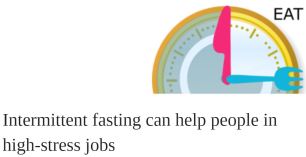 patrolling neighborhoods, or military soldiers during field-exercises. Thus, time-restricted eating removes the added stress of what to eat, and serves as a practical intervention conducive to the schedules of many people.
Time-restricted eating has been shown to lower circulating insulin, blood pressure, body fat and overall body weight, inflammation, and oxidative stress.
Time-restricted eating is a nutrition intervention which alternates between a period of fasting (12 – 16 hours) followed by a period of eating (8 – 12 hours). Unlike other diets, which focus on the caloric content of a meal or which foods you should eat, time-restricted eating focuses exclusively on when you eat by compressing and standardizing the feeding window each day. In turn, people following this type of eating pattern naturally enter a state of caloric deficit.
 Staff Writer Jocelyn Kaiser joins Sarah to talk about a recent Science paper describing the results of a large study on a blood test for multiple types of cancer. The trial’s results suggest such a blood test combined with follow-up scans may help detect cancers early, but there is a danger of too many false positives.
 And postdoctoral researcher Timo Reinhold of the Max Planck Institute for Solar System Research joins Sarah to talk about his paper on how the Sun is a lot less variable in its magnetic activity compared with similar stars—what does it mean that our Sun is a little bit boring?
 As states grapple with the question of when it will be safe to reopen businesses and relax social distancing, there’s increasing urgency to better understand who’s immune to Covid-19. Does having the virus and recovering mean you can’t get it again, or at least that you can’t be reinfected for some time?
No one yet has good answers to these questions. Kristen V. Brown looked into what we do, and don’t, know about the science of coronavirus immunity.


 Boomers Daily