The consensus among economists is that the U.S. recovery will most likely be something in between a V and a W — a sharp drop, a relatively small bounce back, and then a long period of slow growth.
Time to pay attention again: The coronavirus surge is real, and it’s everywhere in the United States.
And Axios co-founder Mike Allen tells us what to expect at the virtual Democratic National Convention in Milwaukee.
Guests: Axios’ Felix Salmon, Sam Baker, and Mike Allen.
On this week’s podcast, life lessons from poker, keeping things civil during peer review, a sweaty synthetic skin that can exude useful compounds, and Mars’s green atmosphere.
In this episode:
00:44 Deciding to play poker
When writer Maria Konnikova wanted to better understand the human decision making process, she took a rather unusual step: becoming a professional poker player. We delve into her journey and find out how poker could help people make better decisions. Books and Arts: What the world needs now: lessons from a poker player
The peer-review process is an integral part of scientific discourse, however, sometimes interactions between authors and reviews can be less than civil. How do we tread the fine line between critique and rudeness? Editorial: Peer review should be an honest, but collegial, conversation
The world now faces the threat of a second wave of coronavirus outbreaks. Zanny Minton Beddoes, The Economist’s editor-in-chief, and Slavea Chankova, our health-care correspondent, answer your questions.
In fact, research on actual cases, as well as models of the pandemic, indicate that between 10 and 20 percent of infected people are responsible for 80 percent of the coronavirus’s spread.
Researchers have identified several factors that make it easier for superspreading to happen. Some of them are environmental.
Poorly ventilated indoor areas seem especially conducive to the virus’s spread – A preliminary analysis of 110 COVID-19 cases in Japan found that the odds of transmitting the pathogen in a closed environment was more than 18 times greater than in an open-air space.
Places where large numbers of people congregate – As a group’s size increases, so does the risk of transmitting the virus to a wider cluster. A large group size also increases the chance that someone present will be infectious.
The longer a group stays in contact, the greater the likelihood that the virus will spread among them – The benchmark used for risk assessment in her contact-tracing work is 10 minutes of contact with an infectious person, though the CDC uses 15 minutes as a guideline.
Some activities seem to make it easier to spread respiratory gunk – Speech emits more particles than normal breathing. And emissions also increase as people speak louder. Singing emits even more particles, which may partially explain the superspreader event at the Washington State choir practice. Breathing hard during exercise might also help the spread of COVID-19.
In the past few weeks, best seller lists and streaming platforms have been full of books, shows, and songs about racism in America. Demand for this type of content is growing, streaming companies are featuring more prominently and it could have a lasting impact.
NPR’s Tamara Keith and Amy Walter of the Cook Political Report join Judy Woodruff to discuss the latest political news, including whether younger voters will turn out this fall to support presumptive Democratic presidential nominee Joe Biden, President Trump’s unfounded claims of fraud with mail-in voting and what to watch in a key primary race in Kentucky this week.
A selection of three essential articles read aloud from the latest issue of The Economist. This week, Amazon is essential, but vulnerable; (10:35) pandemic politics in Britain; (18:15) and the United Nations after 75 years.
Syndicated columnist Mark Shields and New York Times columnist David Brooks join Judy Woodruff to discuss the latest political news, including major Supreme Court decisions on LGBTQ employment protections and DACA, the claims from John Bolton’s new book about President Trump’s interactions with foreign leaders and whether Joe Biden will pick a woman of color as his running mate.
Senior Correspondent Jeffrey Mervis joins host Sarah Crespi to talk about how universities are dealing with the financial crunch brought on by the coronavirus. Jeff discusses how big research universities are balancing their budgets as federal grants continue to flow, but endowments are down and so is the promise of state funding.
Mosquito-borne infections like Zika, dengue, malaria, and chikungunya cause millions of deaths each year. Nicole Culbert and colleges write this week in Science Robotics about a new way to deal with deadly mosquitoes—using drones. The drones are designed to drop hundreds of thousands of sterile male mosquitoes in areas with high risk of mosquito-borne illness. The idea is that sterile male mosquitoes will mate with females and the females then lay infertile eggs, which causes the population to decline. They found this drone-based approach is cheaper and more efficient than other methods of releasing sterile mosquitoes and does not have the problems associated with pesticide-based eradication efforts such as resistance and off-target effects.
News, Views and Reviews For The Intellectually Curious


 The consensus among economists is that the U.S. recovery will most likely be something in between a V and a W — a sharp drop, a relatively small bounce back, and then a long period of slow growth.
 On this week’s podcast, life lessons from poker, keeping things civil during peer review, a sweaty synthetic skin that can exude useful compounds, and Mars’s green atmosphere.

 In fact,
  In the past few weeks, best seller lists and streaming platforms have been full of books, shows, and songs about racism in America. Demand for this type of content is growing, streaming companies are featuring more prominently and it could have a lasting impact.
 A selection of three essential articles read aloud from the latest issue of The Economist. This week,
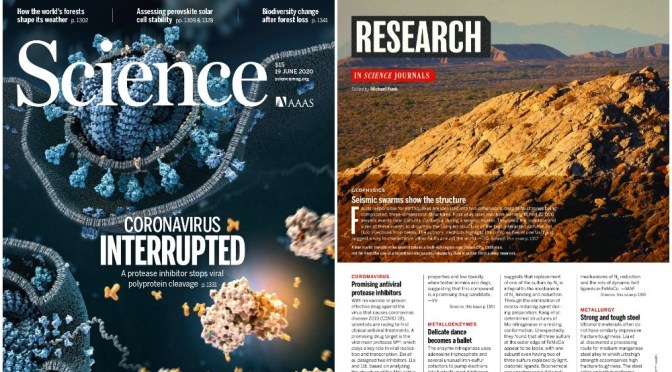



 Senior Correspondent Jeffrey Mervis joins host Sarah Crespi to talk about how universities are dealing with the financial crunch brought on by the coronavirus. Jeff discusses how big research universities are balancing their budgets as federal grants continue to flow, but endowments are down and so is the promise of state funding.
 Boomers Daily